

Khet Ka Hisab: Farm Record Keeping That Actually Changes What You Earn
Ask most farmers what last season cost them per acre and you get an estimate, not a number. The money was real; the record was not. Here are the six categories that capture almost all of it, the costs farmers routinely leave out, and the one hidden interest charge that never appears as interest.
Quick answer
Log every rupee on the day you spend it, into six categories: seed, nutrients, plant protection, labour, machinery and fuel, water and power. Then add the four costs farmers omit — your own labour, your own machinery's time, land, and post-harvest loss — and divide by measured acres.
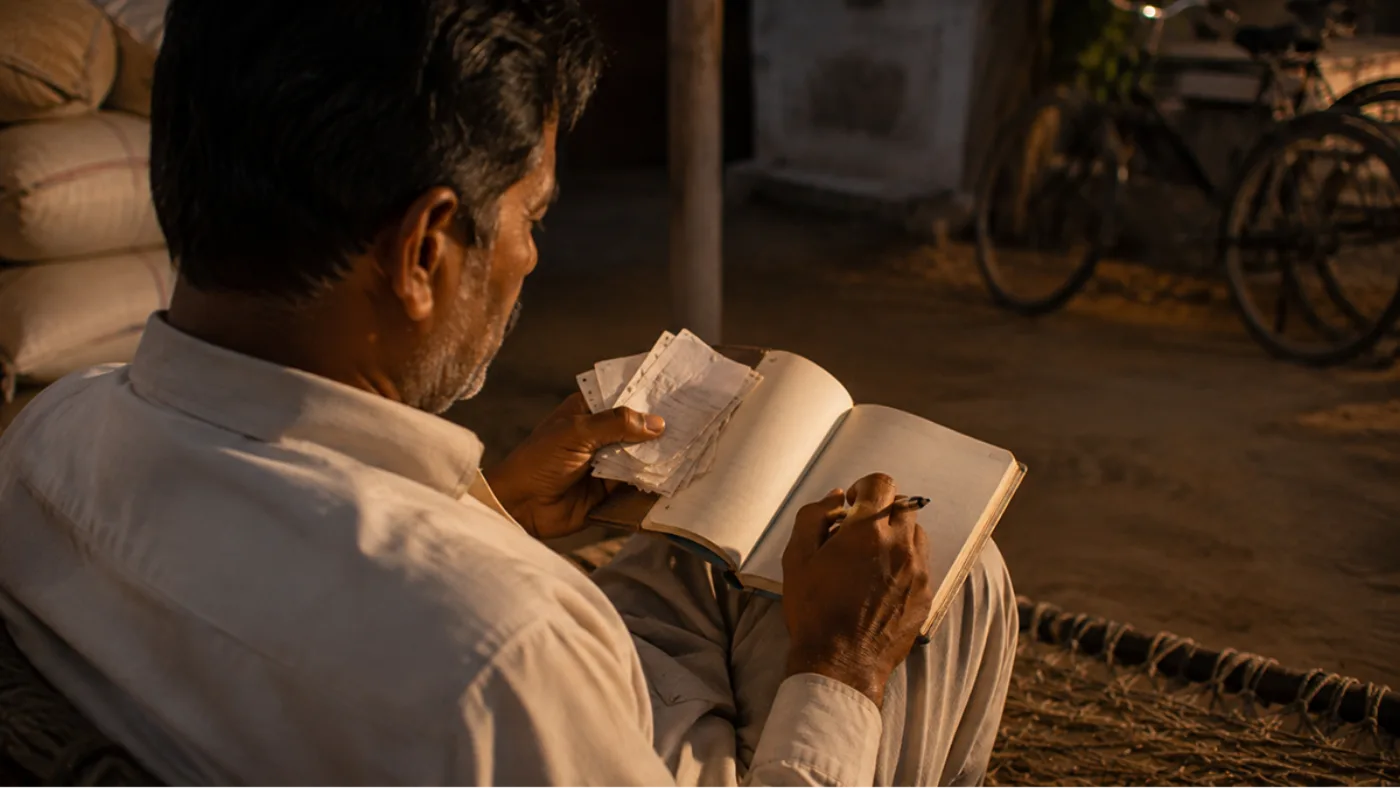
Almost every farmer knows roughly what they spent. Very few can say what they spent per acre, on what, in which order of size — and that gap is expensive, because you cannot cut a cost you cannot see. This is not about bookkeeping for its own sake. It is about being able to answer three questions at the end of a season: what did this cost me per acre, where did the money actually go, and what price did I need to break even.
Why the money becomes invisible
Farm spending hides for structural reasons, not carelessness. It arrives in different forms — cash at the shop, a running credit account with the input dealer, diesel bought a can at a time, labour paid daily, family labour never paid at all, and your own tractor's time which feels free because you already own it. None of those leave a single tidy trail, so at season end there is nothing to add up.
The result is a farmer who is certain fertiliser is his biggest cost when it was actually seed, or who blames a bad price for a poor year when the real damage was done on the input side months earlier. Both mistakes lead to the wrong decision next season, which is the actual cost of not keeping records.
Six categories capture almost everything
You do not need an accountant's chart of accounts. Six categories capture the overwhelming majority of what a season costs, and the discipline is simply putting every rupee into one of them as it is spent.
- Seed and planting material — including your own saved seed, valued at what you could have sold it for.
- Nutrients — fertiliser, manure, micronutrients, biofertilisers, and the cost of applying them.
- Plant protection — pesticides, fungicides, weedicides, plus spraying labour or drone hire.
- Labour — hired daily wage, contract work, and your own and your family's time.
- Machinery and fuel — diesel, hired tractor or harvester, your own machine's running cost, repairs.
- Water and power — electricity or diesel for pumping, canal dues, irrigation maintenance.
The costs farmers leave out — and they are large
Four omissions distort almost every farmer's numbers, and all four make the season look more profitable than it was.
The first is your own and your family's labour. If you count it at zero, you are not measuring profit, you are measuring whether the farm covered its cash costs while your labour was free. Value it at the local daily wage — you would have to pay someone that if you were not doing it. The second is your own machinery's time. Your tractor burns diesel and wears out whether you charge yourself or not, so price your own hours at least at the diesel and a wear allowance.
The third is land. If you own it, there is still an opportunity cost — the rent you could have taken. If you rent it, that is straightforward but often forgotten in a per-acre calculation. The fourth is post-harvest loss: produce that rotted, was eaten, or was rejected on grading is a real cost even though no money left your hand.
The interest charge that never looks like interest
This is the single most under-counted cost in Indian farming, and it deserves its own section. When you take inputs on credit from the trader who will also buy your crop, you are borrowing — but the interest never appears as interest. It arrives as a lower price at the gate. You are not free to sell to the highest bidder, because you owe him, so you accept what you are offered.
Put a number on it. If accepting ₹100 less per quintal is the price of that credit and you sell a hundred quintals, that arrangement cost you ₹10,000 — as surely as if it had been billed as interest. Once written down as a line in your records, this cost usually turns out to be one of the largest on the farm, and it is invisible to every farmer who does not write it down.
The comparison worth making is a Kisan Credit Card at a subsidised rate, which is almost always cheaper than credit repaid through a suppressed price. Our Kisan Credit Card guide covers how it works. Freeing yourself to sell to any buyer is often worth more than the interest saving itself, because it lets you use today's mandi bhav to choose where and when to sell instead of being locked to one trader.
Always per acre, and record it the same day
Total spending tells you almost nothing, because plot sizes and seasons differ. Cost per acre is what lets you compare this kharif with last kharif, one plot with another, or your numbers with a neighbour's. Divide by real measured area rather than an inherited figure — if you have never actually measured your plots, how to measure your field with a phone explains why an area that is fifteen per cent wrong makes every per-acre figure fifteen per cent wrong.
Record on the day it happens. Not weekly, not at season end. A season-end reconstruction is a guess dressed as a record, and it consistently misses the small repeated spends — the can of diesel, the two extra labourers, the top-up bag of urea — which in aggregate are usually where the surprise lives. Photograph the bill or note the amount immediately; ten seconds each time is the whole discipline.
- Log the amount, category, date and plot — four fields, nothing more.
- Always divide by measured area, not the figure on an old document.
- Record on the day. Season-end recall systematically under-counts small repeat spends.
- Keep the same categories every season, or you cannot compare years.
- Note yield and the price you actually got, not the price you hoped for.
Reading where the money went
Once a season is logged, the useful exercise is ranking the categories by size and looking at the top two. In practice one or two categories dominate almost every farm's spending, and farmers are frequently wrong about which. A season in which you bought certified seed can see seed take the overwhelming majority of the input spend; another season fertiliser dominates completely. You cannot attack the biggest cost until you know which it is.
Then ask whether the biggest line is actually buying you anything. Overspending on phosphatic fertiliser is a classic example, because phosphorus accumulates in soil and many farmers keep applying it while testing high — how to read a soil health card explains how to check, and it is the most common way a soil test pays for itself many times over. Excess plant protection spend often traces back to calendar spraying rather than scouting, which integrated pest management addresses directly.
Finally, convert the total into a break-even price per quintal and hold that number in your head at the mandi. That is the whole point of the exercise: a farmer who knows his break-even negotiates from fact, and a farmer who does not accepts what he is offered. The farming cost and profit calculator does this arithmetic for you, and how to calculate farming cost and profit walks through the full method step by step.
Frequently asked
How do I calculate khet ka hisab — my real cost per acre?+
Add every rupee spent in six categories — seed, nutrients, plant protection, labour, machinery and fuel, water and power — then include your own and family labour at the local wage, your own machinery's running cost, land rent or its opportunity cost, and any post-harvest loss. Divide the total by your measured area, not an inherited figure.
What costs do farmers usually forget?+
Four: their own and their family's labour, their own tractor or bullock time, land rent or the rent they could have received on owned land, and post-harvest losses from spoilage or grading rejection. All four make a season look more profitable than it was, which leads to the wrong decision next year.
Is buying inputs on credit from a trader expensive?+
Usually far more expensive than it appears, because the interest arrives as a lower price at the gate rather than as an interest charge. If you accept ₹100 less per quintal on a hundred quintals, that credit cost you ₹10,000. A Kisan Credit Card at a subsidised rate is almost always cheaper, and it frees you to sell to whichever buyer pays best.
How often should I record farm expenses?+
On the day they happen. Reconstructing a season at the end is a guess dressed as a record, and it systematically misses small repeated spends — a can of diesel, two extra labourers, a top-up bag of urea — which is usually exactly where the unpleasant surprise is hiding.
Why record cost per acre instead of total cost?+
Because total spending cannot be compared across plots or seasons of different sizes. Cost per acre lets you compare this season with the last, one plot with another, and your figures with a neighbour's. It is also the unit every recommendation and price quote uses.
Where to go next
- Farming cost & profit calculatorWork out cost per acre, break-even yield and expected profit before you sow.
- Today's mandi bhavOfficial AGMARKNET rates for your crop, nearby mandis compared, and the net price after travel.
- Agri Bazar marketplaceBuy and sell animals, crops, equipment and dairy near you — and see what buyers want today.
Want this as daily tasks for your farm?
Khetiyaar turns guides like this into a day-by-day plan — in your language, free to start.

Related guides
How to Calculate Farming Cost and Profit
Many farmers know their yield but not their profit — a costly blind spot. Track costs, find your break-even price, and farming becomes a business.
Build an Herb Spiral: A Perpetual Spice Bank Right Outside Your Kitchen
A stone spiral packs sun-loving and shade-loving, wet and dry herbs into one small footprint by stacking microclimates vertically — so you stop buying dried spice jars and start harvesting fresh, year after year.
Do AI Farming Apps Actually Work? An Honest Assessment
Five different capabilities are sold under the word AI, and they have wildly different reliability. Photo disease diagnosis scores above 95% in the lab and commonly 70-80% on real field photos. Judge each feature separately.