

Kisan Credit Card (KCC): How to Apply and How the Interest Subsidy Works
A Kisan Credit Card gives you a ready line of credit for the season instead of scrambling for cash at sowing time. Here's who qualifies, what documents you actually need, and how the interest subsidy for on-time repayment works.
Quick answer
A Kisan Credit Card is built around how farming cash flow actually works — draw what you need for the season, repay after harvest, and get rewarded with a lower effective interest rate for repaying on time. Eligibility reaches beyond landowners to tenant farmers, oral lessees and SHG/JLG members, so don't assume you don't qualify without asking your bank directly. Because the exact interest rate, subvention percentage and prompt-repayment incentive are set by policy and do change, always confirm the current effective rate with your bank rather than relying on a number from an old conversation or article.
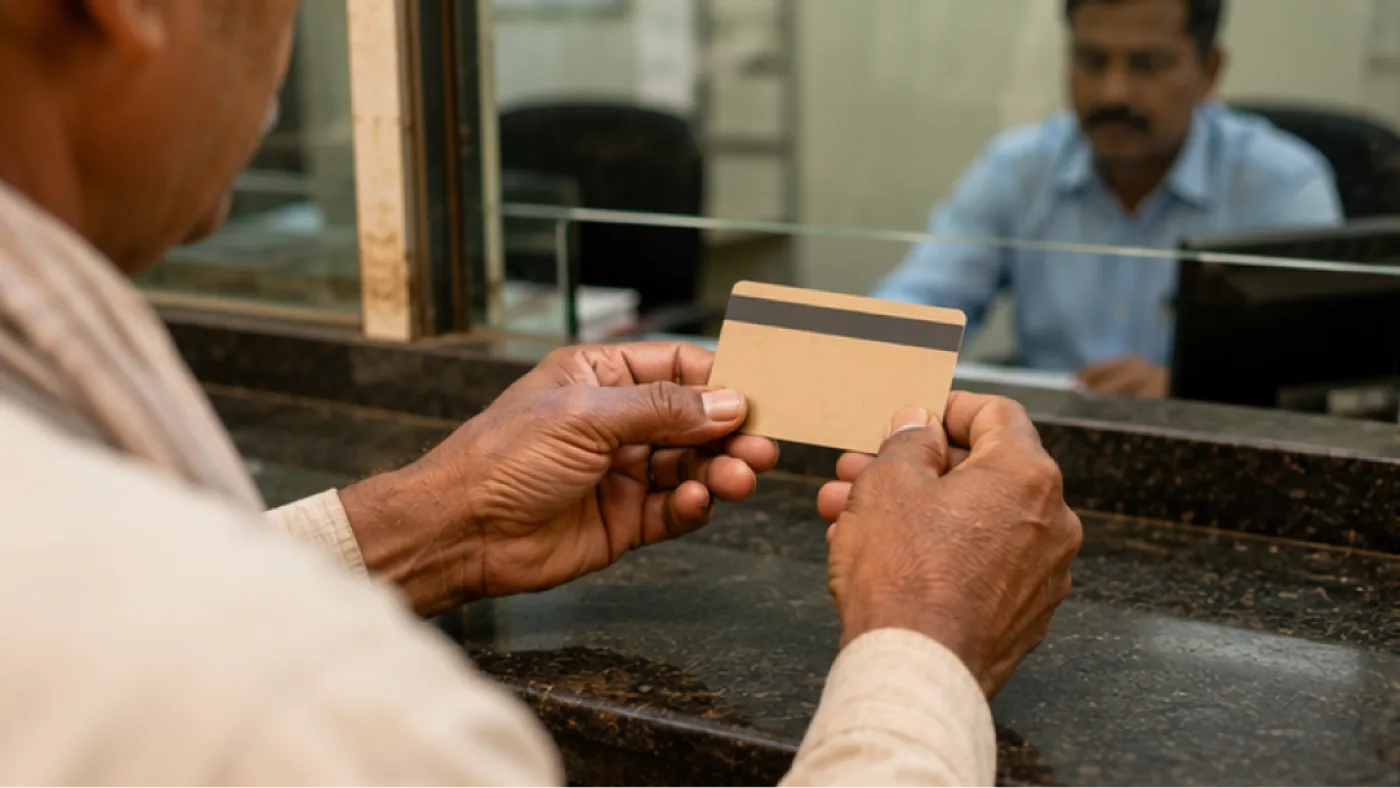
The single biggest reason farming income feels unpredictable isn't the crop — it's the cash flow gap between paying for seed, fertiliser and labour now and getting paid for the harvest months later. The Kisan Credit Card exists to close exactly that gap: a revolving line of credit designed around the farming calendar rather than a fixed-instalment loan, with a genuine interest-rate reward built in for farmers who repay on time. Understanding how it actually works — not just that it exists — is what lets you use it well instead of just having a card in a drawer.
What KCC actually gives you
A Kisan Credit Card is a revolving credit limit, not a one-time loan disbursed in full — you draw down what you need for crop production expenses (seed, fertiliser, pesticide, labour, and similar working-capital needs) as the season demands, and repay after harvest, rather than servicing a fixed EMI schedule that doesn't match when farm income actually arrives.
Depending on the bank and the scheme's current scope, the same card can also extend to allied activities like animal husbandry and fisheries, and to a modest component for household or consumption needs alongside crop production — check with your bank on exactly what your card covers, since scope can vary.
Who is eligible
Eligibility is broader than just landowning farmers. It typically includes owner-cultivators, tenant farmers, oral lessees and sharecroppers (farmers who cultivate land they don't formally own, common in many parts of India), and Self-Help Group (SHG) or Joint Liability Group (JLG) members who farm collectively.
Since documentation requirements differ for a landowner versus a tenant farmer or a group member, it's worth asking your bank directly which category you fall into and what proof of cultivation (rather than proof of ownership) it will accept, especially if you don't hold formal land title.
The interest subvention: what it actually means
Interest subvention is the scheme's core financial benefit: the government subsidizes part of the interest cost on short-term crop loans up to a defined limit, so the bank can lend at a lower rate than it otherwise would. On top of that base subvention, an additional incentive is typically available specifically for farmers who repay their loan promptly (within the due period) — meaning the effective interest rate for a farmer who repays on time can end up meaningfully lower than the headline lending rate.
The exact base interest rate, the subvention percentage, and the additional prompt-repayment incentive are set by policy and have been revised over the scheme's history — always confirm the current effective rate with your bank rather than assuming a figure you heard elsewhere, since this is precisely the kind of number that changes.
Documents you'll typically need
Most banks ask for identity proof (such as Aadhaar), address proof, and documentation establishing your relationship to the land you cultivate — ownership records for owner-cultivators, or the appropriate tenancy/cultivation certificate where your state and bank recognize tenant or oral-lease farming for this purpose. A passport-size photograph and a simple KCC application form (available at the bank or, in many cases, online) round out the basic requirements.
If you're already a PM-KISAN beneficiary, ask your bank about any simplified or fast-track KCC application process for existing PM-KISAN registrants — some banks have used this to reduce paperwork, though availability varies by bank and has changed over time.
How to apply
You can apply at any branch of a nationalized bank, a cooperative bank, or a Regional Rural Bank (RRB) that issues KCCs — most public sector banks participate in the scheme. Bring your documents, fill in the application form, and the bank will assess your land/cultivation records to set your credit limit based on your cropping pattern and scale of farming.
Processing time varies by bank and branch workload; if your application seems to be taking unusually long, it's reasonable to follow up directly with the branch rather than assuming it's a normal wait — a missing document is a common, easily fixed cause of delay.
Renewal and staying in good standing
A KCC is typically valid for a period of a few years, with the credit limit reviewed and often revised annually based on your cropping scale and repayment history, rather than requiring a fresh full application each season. Renewal is usually simpler than the original application — mainly updating your land/cultivation records and confirming your repayment status — but exact renewal periods and requirements vary by bank, so ask your branch what your specific renewal cycle looks like.
The single most valuable habit with a KCC is repaying within the due period every time you can, since that is what unlocks the additional prompt-repayment interest benefit and also builds the track record that supports a higher credit limit at renewal.
Terms explained in this guide
Frequently asked
Who is eligible for a Kisan Credit Card?+
Owner-cultivators, tenant farmers, oral lessees, sharecroppers, and members of Self-Help Groups or Joint Liability Groups engaged in farming are all typically eligible, though documentation requirements differ by category — ask your bank which applies to you.
What is the interest subvention on a KCC loan?+
The government subsidizes part of the interest on short-term crop loans up to a defined limit, and an additional incentive is typically available for farmers who repay promptly, lowering the effective rate further. The exact current rate and percentages are set by policy and can change — confirm with your bank.
What documents do I need to apply for a KCC?+
Typically identity proof, address proof, documentation of your relationship to the cultivated land (ownership or the appropriate tenancy/cultivation proof), a photograph, and a completed application form. Ask your bank about any simplified process if you're already a PM-KISAN beneficiary.
Can a tenant farmer or sharecropper get a KCC?+
Yes — eligibility is not limited to landowners. Tenant farmers, oral lessees and sharecroppers are typically eligible, though the proof of cultivation required differs from a landowner's documentation; check the specifics with your bank.
Does a KCC need to be renewed every year?+
It's typically valid for a few years with the credit limit reviewed and often revised annually rather than requiring a full fresh application each season, though exact renewal cycles vary by bank — ask your branch about your specific renewal requirements.
Where to go next
- Farming cost & profit calculatorWork out cost per acre, break-even yield and expected profit before you sow.
- Today's mandi bhavOfficial AGMARKNET rates for your crop, nearby mandis compared, and the net price after travel.
- Agri Bazar marketplaceBuy and sell animals, crops, equipment and dairy near you — and see what buyers want today.
Want this as daily tasks for your farm?
Khetiyaar turns guides like this into a day-by-day plan — in your language, free to start.

Related guides
Women Farmers in India: The Paperwork That Decides What You Can Access
Most of what blocks a woman farmer is not farming — it is a record. Schemes, credit and insurance are issued against land in your name, and that is the gap worth closing. Here is exactly how.

Government Schemes Every Indian Farmer Should Know
Income support, cheap credit, crop insurance, free soil testing and irrigation subsidies — real value that often goes unused simply for lack of awareness.
PM-KISAN in 2026: Instalment Dates, e-KYC, Beneficiary Status and Why Payments Get Stuck
PM-KISAN has been extended to 2030-31 with a ₹3.15 lakh crore outlay. But every cycle, lakhs of farmers find the money has not arrived. Almost always it is one of four fixable problems. Here is how to check your status and fix each one.