Do AI Farming Apps Actually Work? An Honest Assessment
Five different capabilities are sold under the word AI, and they have wildly different reliability. Photo disease diagnosis scores above 95% in the lab and commonly 70-80% on real field photos. Judge each feature separately.
Quick answer
Partly, and the honest answer differs by feature. Short-range weather at 1 to 5 days is genuinely useful and the strongest thing in any farming app. Photo disease diagnosis is a good first opinion: research models score above 95% on the standard laboratory dataset but commonly fall to 70-80% on real field photographs, with individual studies measuring far lower. Mandi prices are only as good as the market feed behind them. Yield prediction and seasonal rainfall prediction are weak at farm scale and should not drive decisions.
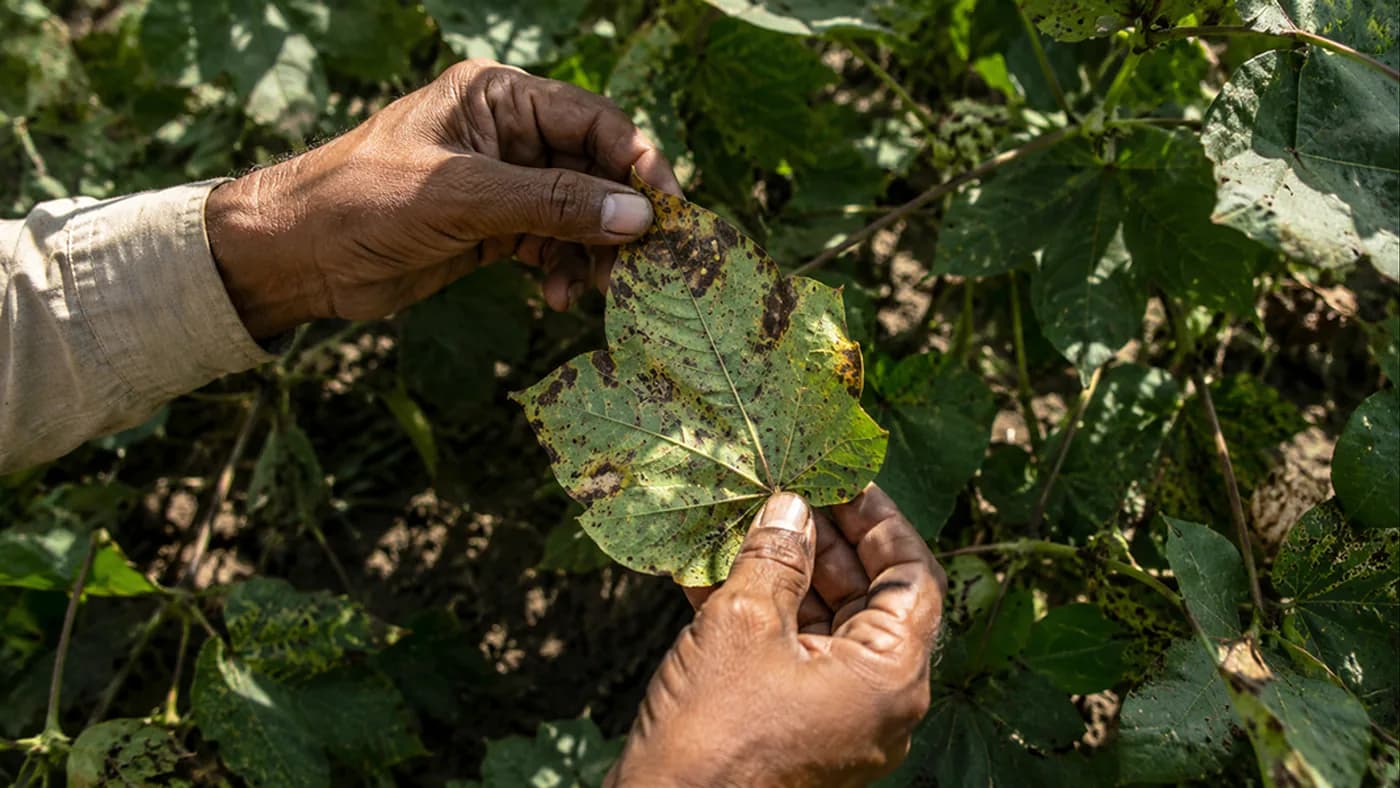
Every farming app in India now says AI on the front page, and the word covers at least five different things that work to very different standards. Treating it as one capability is how farmers end up either dismissing the whole category or trusting a diagnosis they should have checked. This article goes feature by feature, says plainly what the technology does and does not do, and ends with a way to test any app — including ours — over a single season at no cost.
Five different things are sold as AI
When an app says AI, it usually means one or more of the following: a model that classifies a photograph of a diseased leaf; a weather forecast repackaged from a public source; a mandi price feed; a yield or income projection; and a chatbot that answers typed or spoken questions.
These have almost nothing in common technically, and their reliability ranges from genuinely good to close to useless. A single app can be excellent at one and poor at another, which is why a blanket judgement about whether farming apps work is the wrong question. The right question is which feature you are about to rely on, and for what decision.
There is also a fair amount of software described as AI that is a rules engine — if the crop is at this stage and the date is in this range, show this advice. That is not a criticism; well-built rules are often more reliable than a model. But it means the word on the front page tells you very little.
| Sold as | How well it actually works | How to use it |
|---|---|---|
| Photo disease diagnosis | Good on common, visually distinct diseases in a clear, close photo. Above 95% on laboratory datasets but commonly 70-80% on real field images, and worse on early symptoms or in poor light | Treat it as a strong first opinion that narrows the possibilities. Confirm before spending on chemicals |
| Short-range weather (1-5 days) | Genuinely useful. The most reliable thing in any farming app, and it comes from public meteorological data | Use it for spray timing, irrigation and harvest decisions. This alone justifies having an app |
| Mandi prices | As good as the APMC reporting behind it, no better. Dated by nature, and thin arrivals distort a day's rate | Use for direction and for deciding which market to check. Never as the price you will be offered |
| Seasonal or monsoon prediction | Weak at farm scale. Useful as a broad national signal, close to meaningless for your specific field | Do not plan sowing on it. Plan for variability instead |
| Chatbot advisory | Fluent and often right on general agronomy. Confidently wrong on local specifics — variety names, doses, local pest pressure | Good for understanding a concept. Never for a chemical dose without checking the label |
Photo diagnosis: the gap between the lab and your field
This is the feature most people mean by AI farming, and it is worth understanding properly because the published numbers are misleading if you do not know how they were produced.
Nearly all crop disease models are trained and tested on standard research image collections, where each photograph shows a single detached leaf against a plain background in even light. On that kind of data, modern models score above 95% and often above 98%. Those are the numbers that end up in marketing.
Field photographs are a different problem. Peer-reviewed reviews of these models report that accuracy commonly falls to somewhere in the range of 70-80% when the same architectures meet real field images, a degradation of roughly 15 to 25 points. Individual studies have measured worse: one model scoring 85% on lab-style images managed 61% on field images, and an evaluation of a laboratory-trained model in an actual field setting recorded 33%. Reported reductions of 30 to 40 points in overall accuracy are not unusual.
The reasons are mundane and they will apply to your photograph too: cluttered backgrounds with soil and other leaves, changing sunlight and shadow, leaves partly hidden behind other leaves, symptoms caught early before they look typical, and more than one problem present on the same plant at the same time.
None of this means the feature is worthless. A tool that narrows fifty possibilities to three, in seconds, in your own language, is genuinely valuable — and far better than guessing or than acting on what worked in a neighbour's field. It means you should treat the answer as a first opinion rather than a verdict, particularly before spending money on a chemical. Using a crop disease detection app properly covers how to take a photograph that gives the model its best chance.
Where the technology genuinely earns its keep
The strongest feature in any farming app is the least glamorous: a short-range weather forecast tied to your location. At one to five days, forecasting is genuinely skilful, and it converts directly into decisions worth real money — whether to spray this afternoon, whether to irrigate tomorrow, whether to cut and leave the crop lying.
Note what is actually happening here. The app is not generating the forecast; it is presenting public meteorological data in a usable form, ideally alongside your own plot. That is a modest technical claim and a large practical benefit, and any app that hides how ordinary it is underneath is overselling.
The second genuinely useful thing is record keeping, which nobody markets because it does not sound like AI. Sowing dates, input costs and observations recorded per plot, over several seasons, beat every general recommendation aimed at your district — because they describe your land rather than an average. This is unglamorous and it compounds.
How to actually read a weather forecast covers what the probabilities mean and which decisions a forecast can carry, which is the difference between having the feature and using it.
Where it does not, and where nobody should pretend
Seasonal and monsoon prediction is the clearest example. A national seasonal outlook has genuine value at policy scale, but it cannot tell you what your block will receive in August, and an app that presents a seasonal signal as farm-level guidance is misleading you. The monsoon arrives in active spells separated by breaks, and the timing of those breaks — which is what actually decides your crop — is not predictable months ahead. Why the monsoon comes in bursts explains the mechanism.
Yield prediction is the weakest feature commonly sold. Yield depends on too many things nobody has measured on your specific field — soil variation within the plot, the exact timing of stress against growth stage, pest pressure, how well each operation was actually carried out. A number produced without that information is a guess with a decimal point on it. Be especially wary where a projected yield is being used to justify the cost of a subscription or an input.
Mandi prices deserve a plain statement because this is where farmers are most often disappointed. Any app is passing on what was reported from a market on a particular day. That figure is dated the moment it is published, a day with thin arrivals can distort it, and your grade and moisture will move the number you are actually offered. Treat it as direction and as a reason to check a second market, not as a promise.
Chatbots: fluent is not the same as correct
Language models have made farming chatbots genuinely useful for explanation. Ask why a soil test recommends less urea than you expected, or what the difference is between two categories of pesticide, and a good chatbot will explain it clearly in Gujarati or Hindi, which is a real advance over a page of English.
The failure mode is specific and worth knowing: these systems are most confident exactly where they should hesitate. Local variety names, recommended doses, the pest pressure in your taluka this month, the current price of an input — these are the details a model is most likely to state fluently and get wrong, because fluency and accuracy are produced by different things.
The practical rule is simple. Use a chatbot to understand something. Do not use it as the final authority on a quantity you are about to apply to a field. For a dose, read the product label, and if the label and any app disagree, the label wins.
How to test any farming app in one season, for free
- Check its rain call against reality for two weeks. Note what it says for tomorrow, then note what actually fell. This is the cheapest and most revealing test there is, and it tells you whether to trust the feature you will use most.
- Photograph a problem you already know the answer to — something your KVK or an experienced neighbour has already identified. If the app agrees, that is real evidence. If it confidently disagrees, you have learned something important.
- Compare its mandi price to the price you actually received. Track the gap over a few sales. A consistent gap is useful information; you can adjust for it.
- See whether it ever says it is not sure. An app that returns a confident answer to every photograph, including a blurry one of the wrong crop, is not measuring its own uncertainty — and that is a warning sign.
- Check whether it points you to free public resources. Any honest farming app should tell you about the Kisan Call Centre, your KVK and the free government apps — the genuinely free farming apps in India lists them. An app that pretends those do not exist is optimising for you paying, not for you farming well.
- Give it one season, not one afternoon. Almost every app looks impressive for a day and reveals itself over a crop cycle.
What Khetiyaar claims, and what it does not
Applying the above to our own app, because a page like this is worthless if it exempts the publisher.
Disease diagnosis in Khetiyaar is a first opinion, subject to exactly the lab-to-field gap described above. It is useful for narrowing possibilities quickly in Gujarati or Hindi, and it is not a substitute for a KVK scientist looking at the plant. Weather is short-range and comes from public meteorological data presented against your plot. Mandi prices are dated, distances to market are approximate, and what you see is an estimate rather than a promise.
We do not offer yield prediction, and we would rather explain why than ship a number that looks authoritative. We do not claim to be the best farming app in India, because no single app is best for every farmer and the claim would be unverifiable. What we do claim is narrower and checkable: it is the most complete single app for a farmer working in Gujarati or Hindi, covering the season from plan to sale in one place, with your own plot records underneath. It is free to start with no subscription, and Android only for now, with iOS coming.
If you want the comparison against the alternatives, including where they beat us, the honest comparison of AI farming apps in India names which app leads on which axis.
Frequently asked
Do AI crop disease apps actually work?+
They work well enough to be useful and not well enough to be trusted blindly. On a clear close photograph of a common, visually distinct disease they are often right, and they narrow the possibilities in seconds. On early symptoms, poor light, cluttered backgrounds or a plant with two problems at once, accuracy drops sharply. Use the answer as a first opinion and confirm before spending money on a chemical.
How accurate is AI plant disease detection?+
It depends entirely on the photograph. On standard research image collections — a single detached leaf, plain background, even light — modern models score above 95% and often above 98%. Peer-reviewed reviews report that accuracy commonly falls to about 70-80% on real field images, and individual studies have measured 61% and even 33% when a laboratory-trained model was evaluated in an actual field. The gap is caused by background clutter, light, overlapping leaves and early or mixed symptoms.
Can a farming app predict my yield?+
Not reliably. Yield depends on soil variation within your own plot, the exact timing of stress against growth stage, pest pressure and how well each operation was carried out — none of which an app has measured. Treat any yield figure as a rough illustration, and be particularly careful when one is being used to justify the cost of a subscription or an input.
Should I trust a farming chatbot for a pesticide dose?+
No. Chatbots are genuinely good at explaining concepts in your own language, but they are most confident precisely where they are least reliable — local variety names, quantities and current prices. Read the product label for any dose, and if the label and an app disagree, follow the label.
Are AI farming apps worth it for a small farm?+
The weather feature alone usually is, and it is available free from the government apps. Start there, add record keeping for your plots, and only pay for anything once you have tested it against the free options for a full season. The honest measure is whether the app changed a decision and whether that decision paid.
Where to go next
- Kheti app for Indian farmersCrop plans, disease diagnosis, weather and mandi rates in one app.
- AI farming chatbotAsk any farming question in Gujarati, Hindi or English and get an answer in seconds.
- Today's mandi bhavOfficial AGMARKNET rates for your crop, nearby mandis compared, and the net price after travel.
Want this as daily tasks for your farm?
Khetiyaar turns guides like this into a day-by-day plan — in your language, free to start.

Related guides
Best Free Farming Apps in India: What Is Actually Free
The word free is doing four different jobs in this market. Government apps are permanently free and almost nobody recommends them, because there is no commission on a free app.
Indian Farming in 2027: Four Changes Already Underway
Not predictions — four shifts that have already started and will decide how you farm in 2027: digital farm records, the fight over your data, a fertiliser policy turn, and sensing cheap enough for two acres.
Who Owns Your Farm Data? A Plain Guide for Indian Farmers
Your cropping history is worth money to somebody. Here is what farming apps actually collect, what you should refuse outright, and what India's data protection law lets you demand.