

Millet Farming in India: Bajra, Jowar and Ragi Compared
Millets survive where other cereals fail, and that is the whole argument for growing them. Which of the three suits your rainfall, your soil and your market — and where the money actually comes from.
Quick answer
Bajra (pearl millet) suits the driest, sandiest land and the shortest season. Jowar (sorghum) handles heavier soils and gives both grain and fodder, which is often where its money is. Ragi (finger millet) needs more reliable moisture but stores for years without pest damage. All three need far less water than wheat or paddy and tolerate poor soil, which is why they are returning.
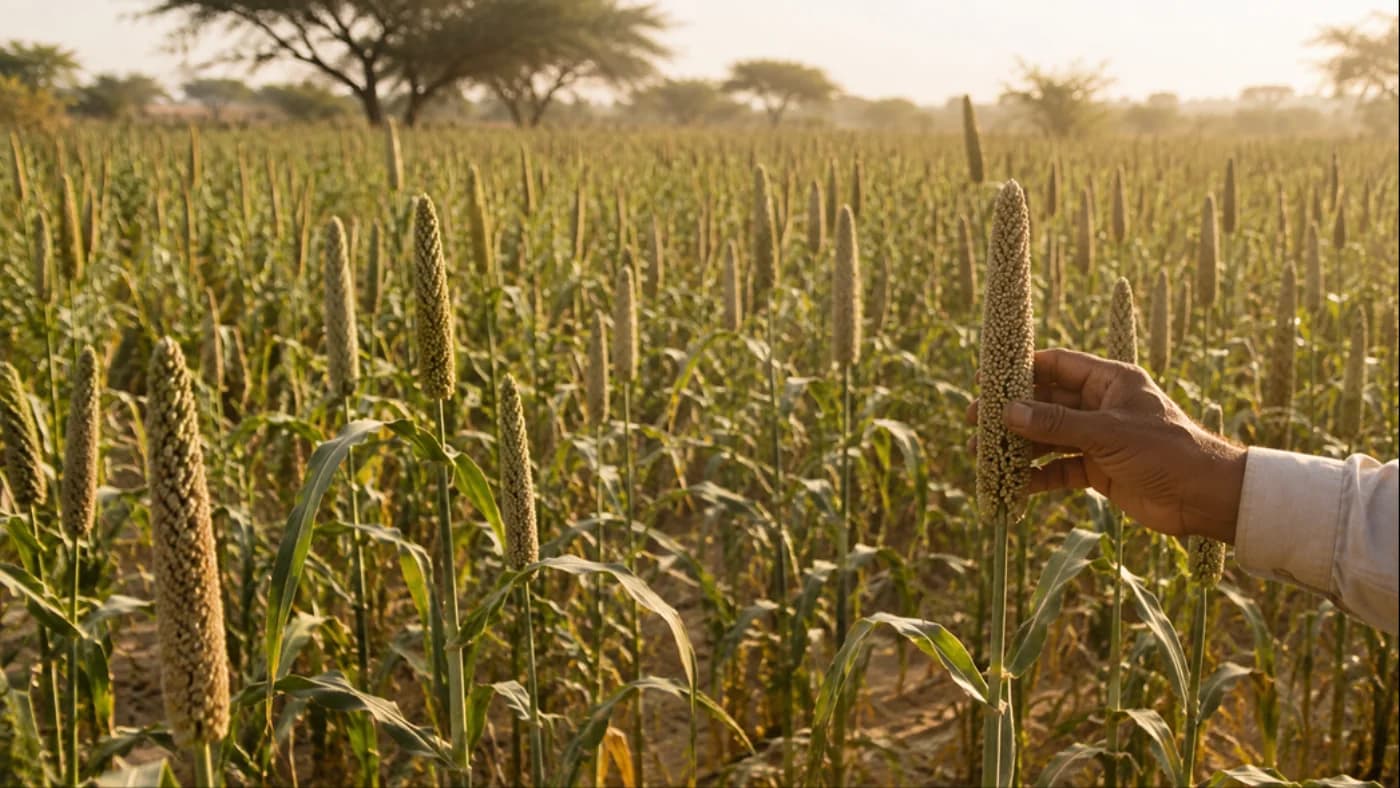
Millets were the everyday grain of dry India long before wheat and paddy took over, and they are coming back for an unsentimental reason: they still yield when the rain does not arrive. If you farm light soil, uncertain rainfall or land that has been squeezed by years of water-hungry crops, one of the three below probably belongs in your rotation. This guide is about choosing between them honestly, and about where the money actually is — because it is not always in the grain.
Why millets are worth a second look
A millet crop asks for a fraction of the water a paddy crop does, tolerates soil that would embarrass a wheat grower, and finishes fast enough to fit where a longer crop cannot. On marginal land this is not a modest advantage — it is the difference between a harvest and a failure in a year the monsoon breaks early.
The reasons are agronomic, not patriotic. Millets root deep and quickly, they handle heat during grain filling far better than wheat, and they need no standing water at any stage. Add the fodder value and the storage life, and on light or unirrigated land the economics often beat what the same field would return under a thirstier crop.
Choosing between the three
Start from your land and your rainfall, not from the price you heard someone got. The commonest expensive mistake is picking the millet with the best story rather than the one your field can actually carry.
| Bajra (pearl millet) | Jowar (sorghum) | Ragi (finger millet) | |
|---|---|---|---|
| Suits | Light, sandy, low-rainfall land — the driest of the three | Medium to heavy soils, moderate rainfall | Red and loamy soils with more reliable moisture |
| Main season | Kharif, and summer where irrigation exists | Both kharif and rabi, depending on the region | Mainly kharif; irrigated summer crop in the south |
| Duration | Shortest — fits a narrow window | Medium | Medium to long |
| Where the money is | Grain, plus good dry fodder | Often the fodder as much as the grain | Grain — commands a premium as a health food |
| Storage | Good | Good | Excellent — stores for years with little pest damage |
| Watch out for | Downy mildew, birds near harvest | Shoot fly early, stem borer later | Blast disease, and it needs more moisture than the other two |
Sowing: the decisions that matter most
- Sow on the monsoon, not on the calendar. All three establish best in moist soil; sowing dry and waiting for rain is how you lose a stand.
- Treat the seed. Millet seedlings are small and vulnerable, and seed treatment against soil-borne disease is one of the cheapest interventions on the farm.
- Do not sow too deep. These are small seeds — a shallow sowing into moisture beats a deep one into dry soil every time.
- Thin early if the stand is thick. Millets compensate well for gaps, but a crowded stand competes with itself and thin grain is the result.
- Take spacing and seed rate from your state package of practices or your KVK, not from an article. They vary by variety, season and region, and the right number for Saurashtra is not the right number for Karnataka.
Managing the crop without overspending
Millets respond to fertiliser, but they are also the crop most often over-fertilised out of habit carried over from wheat. Nitrogen beyond what the soil and variety can use produces lodging and leaf, not grain. Base the dose on a soil test rather than on the bag your neighbour bought — reading a Soil Health Card covers how.
Weeds do the real damage in the first three to four weeks, while the crop is small and slow. One timely weeding in that window is worth more than three later ones. After canopy closure the crop largely looks after itself, which is a good part of why millets are cheap to grow.
Watch for shoot fly in jowar early and stem borer later, downy mildew in bajra, and blast in ragi. Integrated pest management is the right frame here: on a low-input crop, a heavy spray programme can quietly cost more than the yield it protects.
The market, honestly
This is where millet enthusiasm most often meets reality. Several millets carry a Minimum Support Price, but MSP only helps where procurement actually operates — and for millets that varies enormously by state. Before you sow on the strength of an MSP figure, find out whether anyone near you procures at it, because an announced price with no buyer is not a price.
The premium markets are real but they are not automatic. Health-food demand for ragi and organic millets pays well and reaches the farmer mainly through FPOs, direct sales or processors — not usually through the ordinary mandi chain. If you are growing for that market, arrange the buyer before the sowing, not after the harvest. Selling produce for a better price and what an FPO actually does both bear on this.
And do not forget the fodder. For many jowar growers the fodder is not a by-product, it is a substantial part of the return — particularly if you keep animals, in which case the crop pays you twice.
Where Khetiyaar helps, and where it does not
We can help with the arithmetic and the timing. The cost and profit calculator will tell you what a millet acre actually costs you against what a competing crop would, which is the comparison that should drive the decision — and it needs no account. In the app, a crop plan turns a sowing date into a task schedule, and mandi prices let you see what nearby markets have actually been paying rather than what you have been told they pay.
What we cannot do is tell you your seed rate or your dose. Those depend on your variety, your soil and your season, and the authority is your state package of practices or your local KVK. We also cannot tell you whether procurement operates near you — that is a phone call to your APMC, and it is worth making before you sow rather than after.
Frequently asked
Which millet is easiest to grow in India?+
Bajra, on light or sandy soil with unreliable rainfall. It has the shortest duration of the three and the lowest water requirement, so it fits where almost nothing else will. On heavier soil with more moisture, jowar is usually the easier crop.
Is millet farming profitable?+
It can be, and the economics depend far more on the market than on the yield. Millets cost little to grow and tolerate poor land, so the cost side is favourable. The risk is on the selling side: MSP exists for several millets but procurement varies greatly by state, and premium health-food prices usually reach the farmer through an FPO, a processor or direct sale rather than the ordinary mandi.
How much water does millet need compared to rice?+
Far less. Millets need no standing water at any stage and root deeply and quickly, which is why they survive a broken monsoon that would destroy paddy. On unirrigated or light land that difference is usually the whole reason to grow them.
What is Shree Anna?+
It is the name adopted in India for millets as a group, used in government programmes promoting their cultivation and consumption. It refers to the same crops discussed here — bajra, jowar, ragi and the smaller millets — rather than to any single new variety.
Where to go next
Want this as daily tasks for your farm?
Khetiyaar turns guides like this into a day-by-day plan — in your language, free to start.

Related guides
Cumin Farming: Growing Jeera When the Weather Decides Everything
Cumin is among the highest-value crops a Gujarat farmer can grow and among the easiest to lose. Two cloudy weeks at flowering can take the whole field. Here is how to give it the best odds.
Isabgol Farming: Growing Psyllium for the Husk, Not the Seed
North Gujarat supplies much of the world's psyllium husk from light land and almost no water. The crop is easy until harvest — and at harvest one shower can take the value out of it.
Castor Farming in Gujarat: Erandi from Sowing to the Last Picking
Gujarat grows most of India's castor, and India supplies most of the world's. A deep-rooted crop for light land that pays across several pickings — and one you must never treat as food or fodder.