

How to Form a Farmer Producer Organisation (FPO): A Practical Guide
One small farmer negotiating alone rarely gets a good price. A group of farmers registered as an FPO can buy inputs in bulk, share machinery, and sell with real bargaining power. Here's what an FPO actually is and how one gets formed.
Quick answer
An FPO turns the basic economics of smallholder farming around — instead of many individual farmers each negotiating alone from a position of weakness, a registered collective negotiates once, at scale, for everyone's benefit. Getting one formed properly usually means working with a facilitating agency (a CBBO under NABARD, SFAC or a similar body) rather than attempting registration alone, and succeeding afterward means investing real effort in governance training, building member trust through consistent results, and actively pursuing the credit guarantee and equity grant support that exists precisely to solve the early working-capital problem. The member-count minimum is a stable legal requirement, but grant amounts and support programmes are set by policy and do change, so confirm those specifics directly with NABARD, SFAC or your state agriculture department.
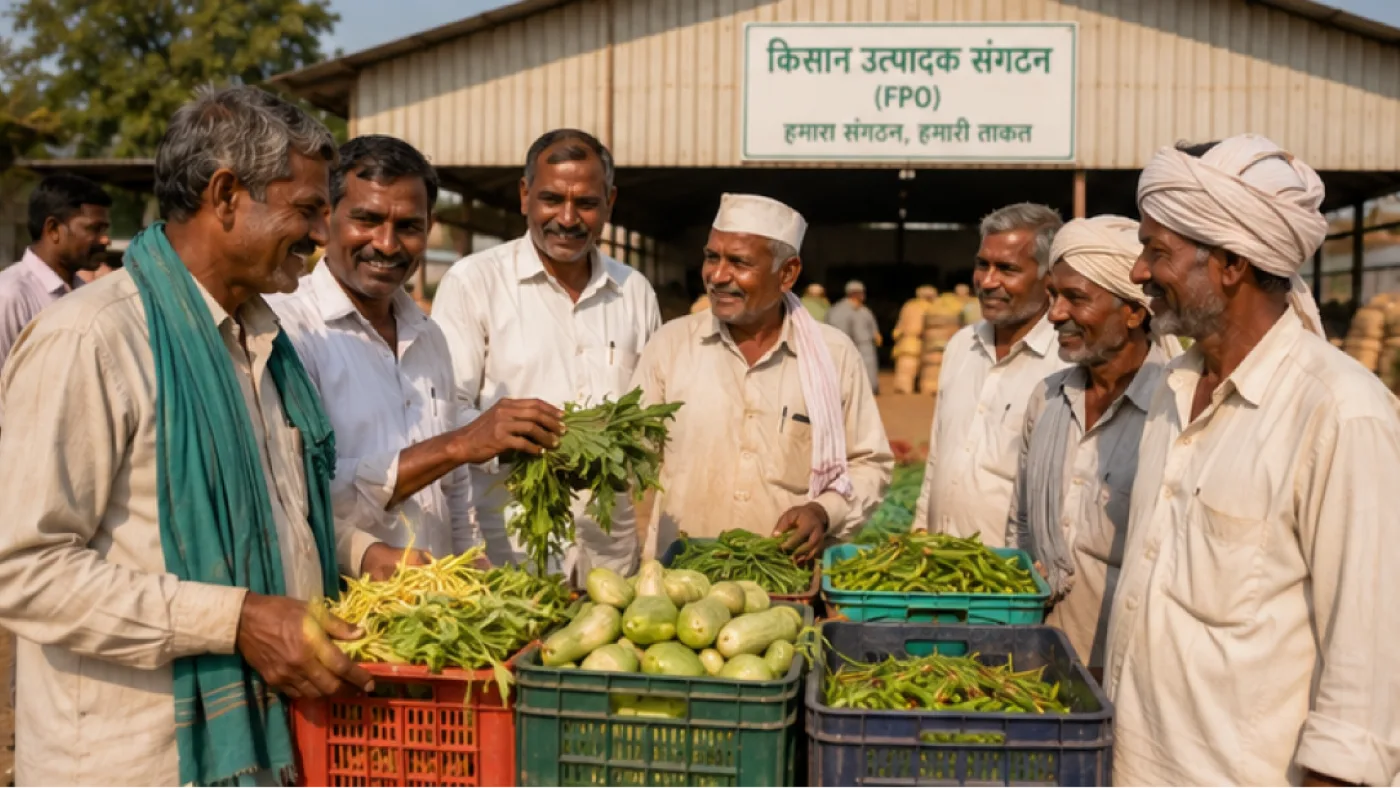
A single smallholder farmer, selling alone and buying inputs alone, is almost always a price-taker — accepting whatever the trader offers that day, paying whatever the input dealer charges. A Farmer Producer Organisation changes that arithmetic by turning many small farmers into one collective voice with real bargaining power, in both directions: buying inputs together at lower cost, and selling produce together at a better price. It is not a cooperative in the old, sometimes politically entangled sense — it is typically a formally registered producer company or cooperative, run by farmer-directors, with real legal structure and, increasingly, real government support to get started.
What an FPO actually is, and why it helps
An FPO is a formal collective of farmer-producers, most commonly registered as a Producer Company under the relevant provisions of the Companies Act, though registration as a cooperative society is also used in some states and contexts. Either way, it is a genuine legal entity, owned and directed by its farmer-members, distinct from an informal village group or an unregistered self-help arrangement.
The practical benefits flow directly from scale: collective bargaining power when negotiating sale prices with larger buyers or processors, bulk purchase of seed, fertiliser and other inputs at wholesale rather than retail cost, shared access to machinery, storage and processing facilities that no single smallholder could justify buying alone, and, for produce sold collectively under the FPO's own aggregation, often a materially better price than any individual member could get selling small quantities alone.
Minimum requirements to form one
For the most common route — registering as a Producer Company under the Companies Act — the statutory minimum is 10 or more individual farmer-producers, or 2 or more producer institutions, or a combination of the two, together with a minimum of 5 directors on the board (a cooperative-society registration instead follows the relevant state cooperative societies act, which sets its own separate minimums). This is a structural legal requirement rather than a scheme figure that shifts year to year, but it's still worth confirming with the Registrar of Companies or your facilitating CBBO that nothing has changed before you finalise your member list.
In practice, most FPOs today are formed with support from a facilitating agency — often a Cluster Based Business Organisation (CBBO) working under national programmes coordinated through bodies like NABARD, SFAC, or NCDC — which provides hands-on help identifying enough interested farmer-members, structuring the organisation correctly, and completing registration paperwork, rather than farmers navigating the entire process alone from scratch.
The registration process, at a high level
For a Producer Company structure, registration follows the Companies Act's provisions for producer companies — involving formal incorporation documents, a defined set of promoter-members, and appointment of farmer-directors who will govern the organisation. For a cooperative structure, registration follows the relevant state cooperative societies act instead, with its own set of formation documents and approval process through the state's cooperative registrar.
Because the exact paperwork, fees and approval timeline differ by structure and by state, and because a facilitating agency (CBBO or similar) can significantly reduce the burden of navigating this correctly, it is genuinely worth reaching out to your state agriculture department, NABARD's regional office, or SFAC to ask what registration support is currently available in your district before attempting the process unassisted.
Government support available for FPO formation
Central government programmes have supported FPO formation with measures such as matching equity grants (additional capital contributed to match what members themselves invest, up to a defined cap) and credit guarantee support that makes it easier for a new FPO to access institutional credit without extensive collateral, since a newly formed organisation typically has little credit history of its own.
The exact grant amounts, caps and eligibility conditions are set by the specific scheme in force and can change, so treat any specific figure you hear as indicative rather than guaranteed, and confirm current support directly with NABARD, SFAC, or your state agriculture department, all of which are commonly involved in administering this kind of support.
Common early-stage challenges, honestly
Governance is the most common early struggle — farmer-directors are usually skilled cultivators but not necessarily experienced at running a formal company, so building basic financial literacy, record-keeping discipline and decision-making processes among the leadership takes real time and often needs outside training support, which facilitating agencies typically provide.
Building genuine member trust and active participation is the second major challenge — an FPO only delivers its bargaining-power benefit if members actually route a meaningful share of their buying and selling through it rather than continuing to deal individually with traders out of habit or short-term convenience, and building that habit takes a track record of the FPO actually delivering better terms consistently.
Working capital in the first few seasons is the third real constraint — an FPO needs cash to buy inputs in bulk or to aggregate and hold produce before sale, and until it has built a credit history and a revenue track record, financing that working capital can be genuinely difficult, which is exactly why credit guarantee support schemes exist and are worth pursuing actively rather than assuming self-funding alone will be enough.
Terms explained in this guide
Frequently asked
What exactly is a Farmer Producer Organisation?+
It's a formal collective of farmer-producers, most commonly registered as a Producer Company under the Companies Act (or as a cooperative in some states), owned and run by farmer-members, enabling collective input purchase, shared infrastructure, and collective selling with real bargaining power.
How many members do I need to form an FPO?+
For a Producer Company under the Companies Act, the statutory minimum is 10 or more individual farmer-producers, or 2 or more producer institutions, or a combination of both, plus at least 5 directors. A cooperative-society registration instead follows your state's cooperative societies act, which sets its own minimum. It's a stable legal requirement, but confirm with the Registrar of Companies or your facilitating CBBO before finalising your member list.
Do I have to register an FPO on my own?+
Most FPOs today are formed with support from a facilitating agency, often a Cluster Based Business Organisation working under NABARD, SFAC or NCDC programmes, which helps with member identification, structuring and registration paperwork — reaching out to one of these is usually far easier than navigating the process alone.
What government support is available for forming an FPO?+
Support has typically included matching equity grants and credit guarantee facilities to help a new FPO access institutional credit without extensive collateral. Exact amounts and conditions are set by the current scheme and change, so confirm specifics with NABARD, SFAC or your state agriculture department.
What are the biggest challenges after forming an FPO?+
Governance capacity among farmer-directors, building genuine member trust and participation so members actually route business through the FPO, and working capital in the early seasons before a credit history and revenue track record are established.
Where to go next
- Farming cost & profit calculatorWork out cost per acre, break-even yield and expected profit before you sow.
- Today's mandi bhavOfficial AGMARKNET rates for your crop, nearby mandis compared, and the net price after travel.
- Agri Bazar marketplaceBuy and sell animals, crops, equipment and dairy near you — and see what buyers want today.
Want this as daily tasks for your farm?
Khetiyaar turns guides like this into a day-by-day plan — in your language, free to start.

Related guides
Women Farmers in India: The Paperwork That Decides What You Can Access
Most of what blocks a woman farmer is not farming — it is a record. Schemes, credit and insurance are issued against land in your name, and that is the gap worth closing. Here is exactly how.

How to Sell Your Farm Produce and Get a Better Price
The difference between a good year and a poor one is often not how much you grow, but the price you get. Selling smarter adds more than any input.
PM-KISAN in 2026: Instalment Dates, e-KYC, Beneficiary Status and Why Payments Get Stuck
PM-KISAN has been extended to 2030-31 with a ₹3.15 lakh crore outlay. But every cycle, lakhs of farmers find the money has not arrived. Almost always it is one of four fixable problems. Here is how to check your status and fix each one.