

How to Actually Read a Weather Forecast for Your Farm
A seasonal forecast and a three-hour warning are different products with different reliability. Knowing which to trust for which decision is most of the skill — and it is rarely explained.
Quick answer
Forecast reliability falls sharply with how far ahead it looks. A one to five day forecast is genuinely useful for spraying and irrigation. A two-week outlook shows trends only. A seasonal forecast is about totals and probabilities, never timing. Nowcasts, issued a few hours ahead, are the most reliable of all and the ones worth acting on immediately.
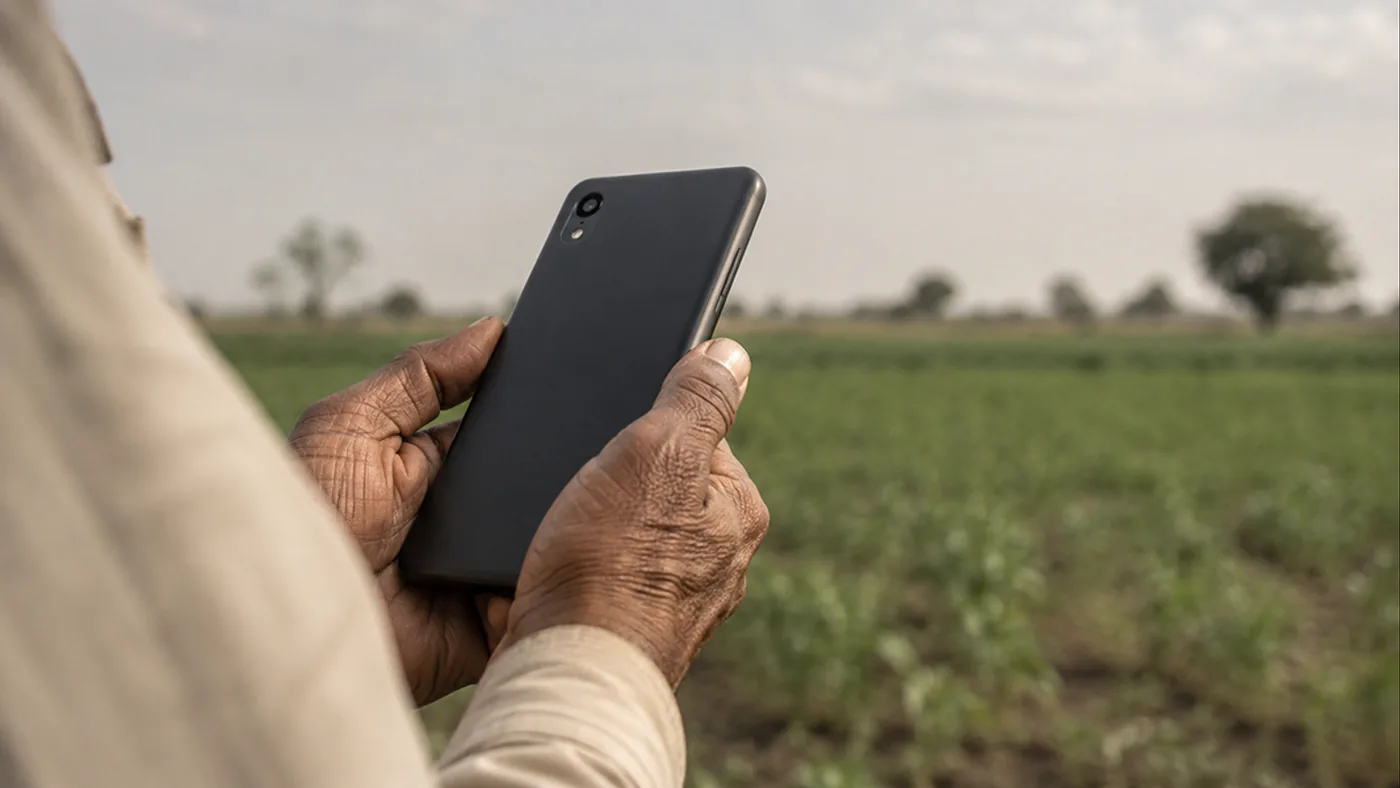
Most complaints that the forecast was wrong are really complaints about the wrong product being used for the wrong decision. The seasonal outlook issued in April was never trying to tell you whether it would rain on your field in the second week of August, and treating it as though it were guarantees disappointment. There are several different forecasts, they answer different questions, and their reliability differs enormously. Sorting that out is a short lesson with a large payoff.
Reliability falls with distance
This is the single most important thing to internalise. Weather forecasting is genuinely skilful over a few days and genuinely limited beyond a couple of weeks, and no amount of computing power has changed that fundamental — the atmosphere is chaotic, and small errors grow.
So the products are not versions of the same thing at different lengths. They are different in kind. A nowcast is close to an observation: a system has formed, it is moving, here is where it will be in two hours. A seasonal forecast is a statement about odds across three months over a large area. Between those two the character of the information changes completely.
The practical rule follows directly. Use the short range to decide what to do this week. Use the seasonal outlook to decide how much risk to take on for the season — how much area, which crop, how much borrowed money. Never use one for the other's job.
| Product | Range | Use it to decide | How much to trust it |
|---|---|---|---|
| Nowcast | Next few hours | Whether to be in the field at all; shelter from lightning | High — act on it immediately |
| Short range | 1 to 5 days | Spraying, irrigation, cutting, harvest timing | Good, and the workhorse for farm operations |
| Extended range | Around two weeks | Whether a wet or dry spell is likely to continue | Trends only — direction, not detail |
| Monthly and seasonal outlook | A month to the whole season | Area to plant, crop choice, how much risk to carry | Totals and odds only. It cannot tell you timing |
What a percentage chance actually means
A forty per cent chance of rain does not mean it will rain on forty per cent of your field, and it does not mean the forecaster is forty per cent confident. It means that in the situation being forecast, rain occurs at a given point in the area about four times out of ten.
That reframes what a wrong forecast is. If it does not rain on a day given a forty per cent chance, the forecast was not wrong — the more likely outcome happened. A forecast is only wrong if, across many such days, the frequency does not match. Individual days cannot falsify a probability, and this is where most frustration with forecasts comes from.
The practical consequence is that you should treat probabilities as a way of sizing bets rather than as predictions. A twenty per cent chance of rain is worth spraying through; a seventy per cent chance is not. Both may be followed by a dry afternoon, and neither was a lie.
How monsoon onset is actually declared
Worth knowing, because the announcement is widely misread as a starting gun for sowing. The India Meteorological Department does not declare onset over Kerala because it rained somewhere. Three conditions have to hold together.
First, after 10 May, at least sixty per cent of fourteen designated stations across the far south — from Minicoy and Amini through Thiruvananthapuram, Kochi and Kozhikode up to Mangalore — must record 2.5 mm of rain or more on two consecutive days. Second, the westerly winds must be established to a depth reaching 600 hPa in a defined box over the ocean south-west of India. Third, outgoing longwave radiation over that ocean area must fall below 200 watts per square metre, which is a measure of how much cloud has built up.
Two things follow for a farmer. The declaration is a rigorous, physically-defined event rather than a guess — which is a reason to take it seriously. But it describes conditions over Kerala and the surrounding ocean, not over your district. Onset over Kerala is the beginning of a journey north that takes weeks, and the date the monsoon reaches your area is a separate matter.
The products built for farmers specifically
- District agromet advisories are the most underused resource in Indian farming. Agromet units attached to state agricultural universities and KVKs issue bulletins twice a week that combine the weather outlook with what to do about it for local crops — spray, delay, irrigate, hold off. Ask your KVK how to receive them.
- Lightning nowcasts save lives. India loses a very large number of people to lightning every year, most of them outdoors and many of them farming. A warning app that gives a few minutes' notice is worth having on the phone of everyone who works in an open field.
- Agromet advisory apps carry the same district bulletins in a readable form, which is easier than chasing them through an office.
- Your own soil readings beat any bulletin for irrigation timing, because a district advisory cannot know how much water is left in your root zone.
- Keep a record of forecast versus outcome for your own location. Over a season you will learn whether your area tends to get more or less than the district figure, and that correction is worth more than any single forecast.
Where Khetiyaar fits, and the honest limits
The app gives hyperlocal weather including soil temperature and moisture, which is a closer instrument than a district bulletin for the decisions that happen at field scale — when to spray, when to irrigate, whether the ground is fit to work. That is the gap it is genuinely filling.
It is not a replacement for the official system, and two things in particular should come from there rather than from us: the agromet advisory for your district, which pairs the weather with crop-specific action from people working locally, and lightning warnings, which are a safety matter.
And the limit that applies to everyone: a forecast shifts your odds, it does not remove your risk. Nobody can tell you when the next monsoon break will start — why the monsoon comes in bursts explains why that is a genuine limit of the science rather than a gap in any product. Plan as though a break will happen, and use the forecast to handle the weeks you can actually see.
Frequently asked
What does a 40% chance of rain mean?+
That in the situation being forecast, rain occurs at a given point in the area about four times out of ten. It does not mean rain over forty per cent of your field, and a dry day does not make it wrong — the more likely outcome simply happened. Use probabilities to size decisions rather than as predictions.
How does IMD declare the monsoon onset over Kerala?+
Three conditions must hold together after 10 May. At least 60% of fourteen designated southern stations must record 2.5 mm of rain or more on two consecutive days; westerly winds must be established to a depth of 600 hPa in a defined box over the ocean south-west of India; and outgoing longwave radiation over that area must fall below 200 watts per square metre.
Why do seasonal monsoon forecasts feel wrong?+
Usually because they are read as timing when they are about totals. A seasonal outlook estimates how much rain the season will bring across a large area and with what probability. It does not and cannot say when the rain will fall relative to your crop's stages, which is what actually decides your harvest.
How do I get a weather advisory for my own district?+
Ask your Krishi Vigyan Kendra about the agromet advisory bulletin. Agromet units attached to KVKs and state agricultural universities issue these twice a week, combining the local weather outlook with specific crop advice — whether to spray, irrigate or wait. They are free and consistently underused.
Where to go next
Want this as daily tasks for your farm?
Khetiyaar turns guides like this into a day-by-day plan — in your language, free to start.

Related guides
Reading the Weather the Old Way: Which Signs Actually Hold Up
Farmers read the sky, the wind, the birds and the trees long before there were forecasts. Some of those signs have a real physical mechanism behind them. Some do not. Here is the honest separation.
Bhadli Vakya: Gujarat's Monsoon Sayings, Examined Honestly
A thousand-year-old body of weather couplets that Gujarati farmers still use. Some of it is careful observation with a real mechanism. Some of it is not. Both deserve to be said out loud.
Why the Monsoon Comes in Bursts: Active Spells and Breaks
The monsoon is not four months of rain. It is a sequence of heavy spells and dry breaks, and the pattern matters more to your crop than the total. Here is what causes it.