

PM-KISAN in 2026: Instalment Dates, e-KYC, Beneficiary Status and Why Payments Get Stuck
PM-KISAN has been extended to 2030-31 with a ₹3.15 lakh crore outlay. But every cycle, lakhs of farmers find the money has not arrived. Almost always it is one of four fixable problems. Here is how to check your status and fix each one.
Quick answer
PM-KISAN pays ₹6,000 a year in three ₹2,000 instalments, and has been extended through 2030-31. If money has not arrived, it is almost always one of four things: e-KYC not completed, land records not seeded, a bank account not Aadhaar-seeded for DBT, or an exclusion category. Check your status on pmkisan.gov.in.
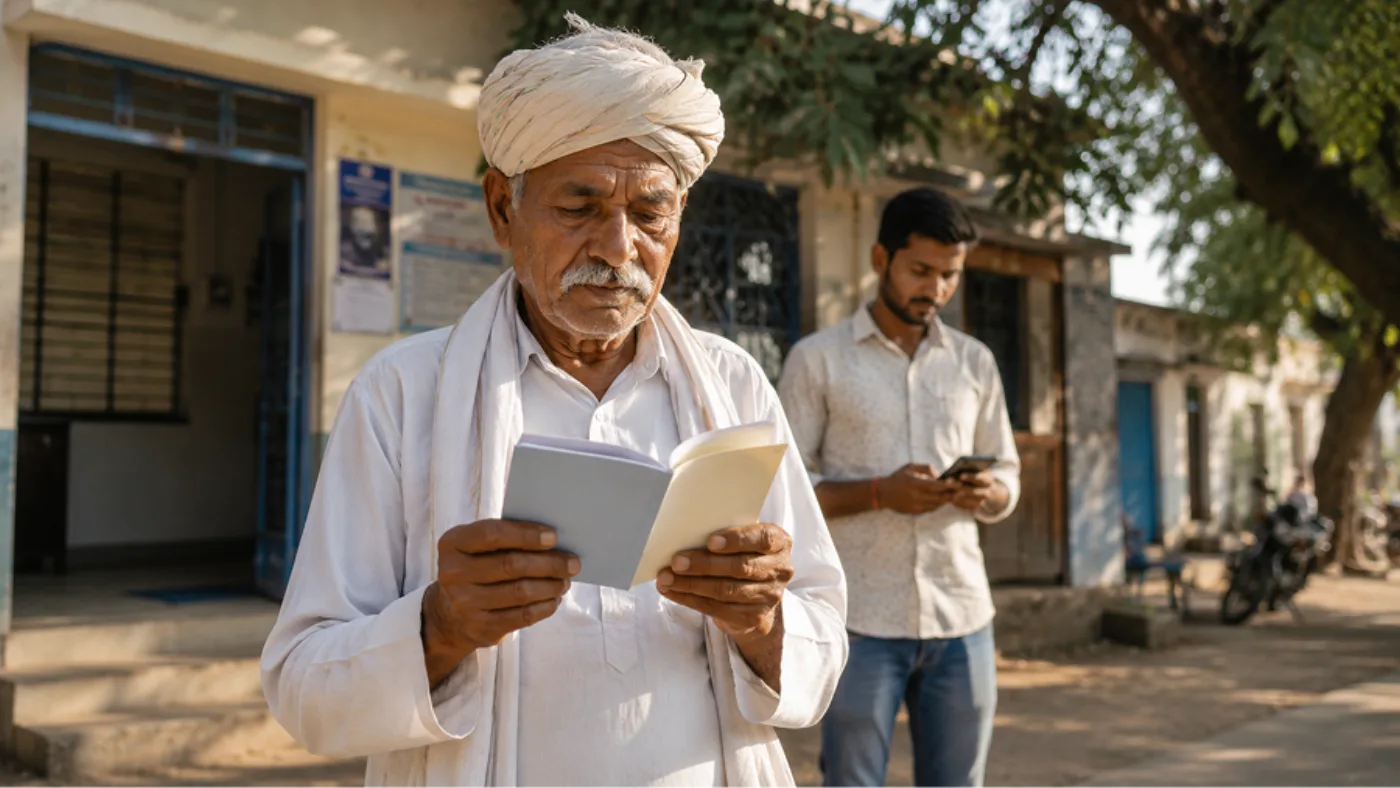
PM-KISAN is the simplest large scheme in Indian agriculture — ₹6,000 a year, paid directly, no forms per instalment. If you are new to it, PM-KISAN explained covers eligibility and registration from scratch; this guide is about what changed for 2026 and how to unstick a payment that has not arrived. That simplicity is exactly why farmers get confused when the money does not arrive: there is nothing obvious to fix. In practice the money stops for one of four reasons, all of which you can check yourself in about ten minutes.
What PM-KISAN pays, and what changed for 2026
Pradhan Mantri Kisan Samman Nidhi pays eligible landholding farmer families ₹6,000 per year, transferred directly to a bank account in three equal instalments of ₹2,000 roughly every four months. There is no application per instalment — once you are a verified beneficiary, payments arrive automatically as long as your records stay clean.
The important 2026 news is continuity. The Cabinet approved continuation of PM-KISAN from 2026-27 through 2030-31 with a financial outlay of about ₹3.15 lakh crore, and the Union Budget for 2026-27 allocated ₹60,000 crore to the scheme. The 22nd instalment was released on 13 March 2026, with over ₹18,640 crore reaching more than 9.32 crore farmers. Independent evaluations reported that a large majority of beneficiaries put the money into agricultural activity rather than general consumption, which is the case the government makes for extending it.
Subsequent instalments follow the same roughly four-monthly rhythm, but exact release dates are announced rather than fixed in advance. Do not rely on a date you read on a news site or a YouTube thumbnail — confirm on pmkisan.gov.in, which is the only authoritative source.
Check your beneficiary status first
Before assuming something is wrong, check what the system actually thinks. On pmkisan.gov.in there is a beneficiary status section where you enter your registered mobile number or Aadhaar number and an OTP. It will show your instalment history and, crucially, flags against your record if something is incomplete.
Read the flags carefully rather than skimming. The portal usually states the problem plainly — e-KYC pending, land seeding not done, Aadhaar not linked to bank account. Each of those has a different fix, and applying the wrong fix wastes a cycle.
Problem 1 — e-KYC not completed
e-KYC is mandatory for PM-KISAN beneficiaries and is the single most common reason payments halt. There are generally three routes: OTP-based e-KYC on the PM-KISAN portal or mobile app using your Aadhaar-linked mobile number; biometric e-KYC at a Common Service Centre (CSC); and face-authentication e-KYC through the official PM-KISAN mobile app, which helps farmers whose fingerprints scan poorly.
The OTP route fails for a large number of farmers for one specific reason: the mobile number linked to Aadhaar is old, belongs to a family member, or has been discontinued. If you do not receive the OTP, do not keep retrying — update your mobile number at an Aadhaar centre first, or use the biometric or face-authentication route instead. This is worth doing well before an instalment is due, not in the week it is expected.
Problem 2 — land records not seeded
PM-KISAN is a landholding-based scheme, so your land records must be verified and linked to your beneficiary record. Land seeding fails when the record is in a deceased parent's name and mutation has not been completed, when the survey number recorded in the application does not match the revenue record, or when a holding has been partitioned but the update has not flowed through.
This one cannot be fixed from your phone. It requires the revenue side — your talati, patwari or village accountant, and the taluka or tehsil office — to correct or complete the mutation. It is also the fix that takes longest, so start it the moment the portal flags it rather than waiting for the next instalment to fail too.
Problem 3 — Aadhaar and bank account not properly linked
Payments move by Direct Benefit Transfer, which needs your Aadhaar seeded into the bank account itself, not merely written on a form. A great many farmers have an account that receives ordinary credits perfectly well but is not Aadhaar-seeded for DBT, and they are surprised when a transfer bounces.
Ask your bank branch specifically to confirm two things: that the account is Aadhaar-seeded and active in the NPCI mapper, and that the account is not dormant. Bank mergers are a frequent culprit — an IFSC code that changed after a merger will silently break transfers. If your bank has merged in the last few years, verify the current IFSC and update it.
Problem 4 — you may fall under an exclusion category
PM-KISAN excludes several categories, and some farmers are excluded without realising it. Institutional landholders are excluded. So are families where a member is or was a constitutional post holder, a serving or retired government employee above certain ranks, an income-tax payer in the last assessment year, or a professional such as a doctor, engineer, lawyer, chartered accountant or architect practising their profession. Pensioners drawing above a specified monthly pension are also excluded.
If a family member falls into one of these categories, the family is not eligible even if the land is farmed genuinely. It is far better to establish this early than to receive instalments and later face recovery, which does happen. If you are unsure, ask at the taluka agriculture office rather than guessing.
Related schemes most PM-KISAN farmers also qualify for
PM-KISAN registration often makes other schemes easier to access, and many farmers leave money unclaimed simply because nobody mentioned it. Pradhan Mantri Kisan Maan-Dhan Yojana provides a monthly pension of ₹3,000 after the age of 60 for eligible small and marginal farmers, with around 24.95 lakh farmers enrolled by February 2026. PMFBY covers crop insurance, and the Kisan Credit Card provides working capital at a subsidised rate — usually far cheaper than borrowing from a trader against the standing crop.
Our guide to government schemes for Indian farmers covers the main central schemes together. In Gujarat, state subsidies for machinery, irrigation and infrastructure run separately through the iKhedut portal, and you can hold both at once.
A ten-minute check worth doing this week
Income support is only one part of farm income, and the larger levers are still cost and price. Once your PM-KISAN record is clean, put the same ten minutes into knowing your break-even: the farming cost and profit calculator will tell you what price your crop actually needs, and the MSP and mandi bhav guide for 2026-27 explains how announced rates translate into what you are offered at the gate. If you would rather have scheme reminders and your season plan in one place in your own language, Khetiyaar's kheti app does that free to start.
- Open pmkisan.gov.in and check beneficiary status using your Aadhaar or registered mobile.
- If e-KYC is pending, complete it by OTP, or at a CSC, or by face authentication in the official app.
- If land seeding is flagged, visit your talati or taluka office now — this fix is slow.
- Ask your bank to confirm the account is Aadhaar-seeded, active, and on the correct IFSC after any merger.
- Confirm no family member falls under an exclusion category.
- Save a screenshot of your beneficiary record with the date, so you can show exactly what was pending and when.
Frequently asked
How much does PM-KISAN pay and how often?+
₹6,000 per year per eligible landholding farmer family, paid in three equal instalments of ₹2,000 roughly every four months, transferred directly to the bank account. You do not apply separately for each instalment.
How do I complete PM-KISAN e-KYC?+
Three routes: OTP-based e-KYC on pmkisan.gov.in or the official app using your Aadhaar-linked mobile number; biometric e-KYC at a Common Service Centre; or face-authentication e-KYC in the official PM-KISAN mobile app. If the OTP never arrives, your Aadhaar-linked mobile number is probably outdated — update it at an Aadhaar centre or use the biometric or face route.
How do I check my PM-KISAN beneficiary status?+
Go to pmkisan.gov.in, open the beneficiary status section, and enter your registered mobile number or Aadhaar number with an OTP. It shows your instalment history and flags anything incomplete, such as pending e-KYC or unseeded land records.
Why has my PM-KISAN instalment not been credited?+
Almost always one of four things: e-KYC is not complete, your land records are not seeded or the mutation is pending, your bank account is not Aadhaar-seeded for DBT or has an outdated IFSC after a merger, or a family member falls under an exclusion category. The portal usually names the specific problem against your record.
Will PM-KISAN continue after 2026?+
Yes. The Cabinet approved continuation of PM-KISAN from 2026-27 through 2030-31 with an outlay of about ₹3.15 lakh crore, and ₹60,000 crore was allocated in the 2026-27 Union Budget. The 22nd instalment was released on 13 March 2026, reaching more than 9.32 crore farmers.
Who is not eligible for PM-KISAN?+
Institutional landholders; families with a member who is or was a constitutional post holder, a serving or retired government employee above certain ranks, an income-tax payer in the last assessment year, or a practising professional such as a doctor, engineer, lawyer, chartered accountant or architect; and pensioners drawing above a specified monthly pension. Exclusion applies at family level, not just to the individual.
Where to go next
- Farming cost & profit calculatorWork out cost per acre, break-even yield and expected profit before you sow.
- Today's mandi bhavOfficial AGMARKNET rates for your crop, nearby mandis compared, and the net price after travel.
- Agri Bazar marketplaceBuy and sell animals, crops, equipment and dairy near you — and see what buyers want today.
Want this as daily tasks for your farm?
Khetiyaar turns guides like this into a day-by-day plan — in your language, free to start.

Related guides
PM-KISAN Explained: Eligibility, Installments and How to Check Your Status
PM-KISAN puts direct income support into the bank accounts of landholding farmer families across India, three installments a year. Here's exactly who qualifies, how the money reaches you, and what to check if a payment doesn't arrive.
PMFBY Crop Insurance: What It Covers and How to File a Claim
A hailstorm, a failed monsoon, or a pest outbreak can wipe out a season's income overnight. PMFBY exists to cushion exactly that risk — here's what it actually covers, how enrollment works, and the exact steps to file a claim after damage.
Kisan Credit Card (KCC): How to Apply and How the Interest Subsidy Works
A Kisan Credit Card gives you a ready line of credit for the season instead of scrambling for cash at sowing time. Here's who qualifies, what documents you actually need, and how the interest subsidy for on-time repayment works.