

PMFBY Crop Insurance: What It Covers and How to File a Claim
A hailstorm, a failed monsoon, or a pest outbreak can wipe out a season's income overnight. PMFBY exists to cushion exactly that risk — here's what it actually covers, how enrollment works, and the exact steps to file a claim after damage.
Quick answer
PMFBY covers two genuinely different situations, and it helps to know which one applies to you: an area-wide yield shortfall, assessed collectively through Crop Cutting Experiments with no individual claim needed from you, and localized damage like hailstorm or flooding, which you must report yourself, quickly, through your state's official channel to trigger an individual assessment. The premium you pay is a small, capped share of the true cost, with the rest subsidized by government — but always confirm the current percentage, cutoff dates and helpline details for your state and crop with your bank, insurer, or the official PMFBY portal, since these are set by policy and do change.
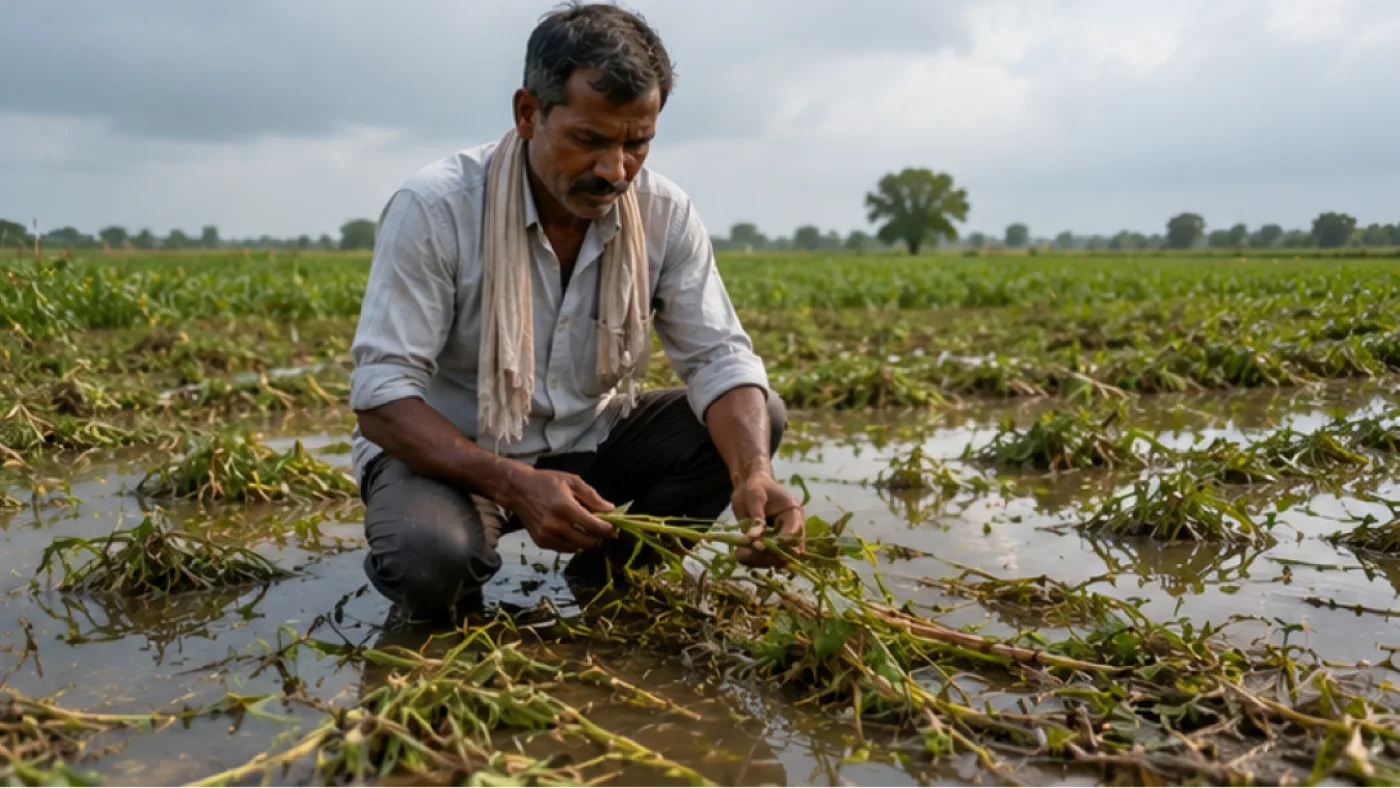
Farming income depends on things no farmer controls — rainfall, hailstorms, pest outbreaks, temperature swings at exactly the wrong moment. The Pradhan Mantri Fasal Bima Yojana (PMFBY) is the government's flagship answer to that risk: a crop insurance scheme designed to be affordable enough that ordinary farmers actually use it, covering a wide range of perils from sowing right through to a defined window after harvest. Knowing what it covers, how enrollment actually works, and exactly what to do the moment your crop is damaged is what turns this scheme from a line in a pamphlet into money in your account when you need it most.
What PMFBY actually insures against
PMFBY is built around yield loss — if your actual yield for the season falls meaningfully short of a benchmark yield for your area and crop, due to insured perils, you become eligible for a payout, even without a single visible disaster on your own field, since the assessment is done at the notified area level (more on that below).
Beyond overall yield shortfall, the scheme also covers localized calamities that damage an individual field even when the wider area is fine — events like hailstorm, landslide, inundation and cloudburst are typically covered as localized risks assessed on an individual-farm basis rather than waiting for an area-wide yield assessment. It also extends limited cover to specific post-harvest losses, for crops that are cut and left to dry in the field for a defined period, against risks like unseasonal rain and cyclone during that drying window.
What the premium actually costs you
The scheme's core design idea is that the farmer pays a small, capped share of the premium, while the central and state governments jointly subsidize the rest — often the large majority of the true premium cost. The farmer's share is typically set at a low flat percentage for food and oilseed crops in the kharif season, a slightly lower flat percentage for the rabi season, and a somewhat higher capped percentage for annual commercial and horticultural crops.
The exact percentages, and the government's subsidy share, are fixed by policy and can be revised — always confirm the current premium rate for your specific crop and season with your bank, the insurance company operating in your district, or the official PMFBY portal, rather than relying on a number you heard from another farmer or an old source.
How and when to enroll
For farmers who have taken a crop loan, enrollment has historically been linked automatically to the loan at many banks unless the farmer actively opts out within a defined window — check with your bank on the current rule, since this has changed over the scheme's history and the choice may now be entirely voluntary depending on current policy. For farmers without a crop loan, enrollment is voluntary and done directly through a bank, an authorized insurance company, a Common Service Centre, or the official PMFBY portal.
Enrollment must happen before a cutoff date set separately for each crop and season — miss that date and you cannot enroll for that season regardless of circumstances, so it is worth checking the notified cutoff for your district and crop well before sowing rather than close to the deadline.
How yield-loss claims are actually assessed
For the main yield-shortfall cover, the mechanism is the Crop Cutting Experiment (CCE) — agriculture department officials conduct sample harvests across a notified area (typically a cluster of villages or a defined insurance unit) to measure the actual average yield for that crop in that area for the season. If that measured average yield comes in meaningfully below the area's benchmark (threshold) yield, every insured farmer in that unit becomes eligible for a payout proportional to the shortfall — you do not need to prove individual damage on your own field for this category of claim, since it is assessed collectively.
This is precisely why the scheme is described as area-based for the main yield cover: your payout depends on the area's overall result, not solely on what happened in your own field, which is both the scheme's main strength (it removes the burden of proving individual crop loss) and something worth understanding so your expectations match how the assessment actually works.
How to report localized damage and file a claim
For localized risks (hailstorm, landslide, inundation, cloudburst) and for the specific post-harvest window cover, the process is different and time-sensitive: the farmer must report the damage directly, within a defined intimation window after the event, through the channel available in that season — this can include a toll-free helpline number, the insurance company directly, the bank through which the policy was taken, the state government's crop-loss reporting app or portal where available, or the local agriculture office.
After a report is filed, an insurance company or government surveyor typically inspects the affected field to assess the loss individually, since this category of claim (unlike the area-based yield-shortfall cover) is assessed farm-by-farm rather than by an area-wide Crop Cutting Experiment. Reporting quickly matters a great deal here — the intimation window is often measured in a small number of days from the damage event, and a late report can mean a claim is not accepted at all, so keep the toll-free number and your policy/enrollment details somewhere you can find them quickly during the season, not only when you need them.
Practical steps to protect your own claim
Keep your policy/enrollment confirmation, your crop loan or bank details, and the toll-free/reporting number for your state readily accessible throughout the season — during an actual hailstorm or flood is not the time to be searching for a policy number.
If a localized event damages your field, report it as soon as possible through whichever official channel is available, and note the date and details of the damage yourself in case you need to follow up. For the area-based yield cover, there is generally nothing for an individual farmer to report — the payout process is triggered by the official Crop Cutting Experiment result for your notified area — but it is still worth confirming with your bank or the insurance company that your enrollment for the season was correctly recorded.
Terms explained in this guide
Frequently asked
What does PMFBY actually cover?+
It covers area-wide yield shortfall due to natural calamities, localized damage to an individual field such as hailstorm, landslide or inundation, and specific post-harvest losses for crops drying in the field against risks like unseasonal rain, within a defined window after harvest.
How much premium do I have to pay?+
The farmer's share is a small, capped percentage that differs by crop type and season, with government subsidizing most of the true cost. The exact current percentages are set by policy and can change, so confirm them with your bank, insurer, or the official PMFBY portal.
How do I file a claim after a hailstorm or flood damages my field?+
Report the damage yourself, as soon as possible, through the toll-free helpline, the insurance company, your bank, or your state's crop-loss reporting app/portal where available — this category of claim is time-sensitive and assessed field-by-field, unlike the area-wide yield cover.
Do I need to report anything for a general yield-shortfall claim?+
Generally no individual report is required — this is assessed collectively for your notified area through official Crop Cutting Experiments, and eligible farmers in that area receive a payout automatically if the measured yield falls meaningfully below the benchmark.
Is enrollment in PMFBY compulsory if I have a crop loan?+
This has varied over the scheme's history and current policy may differ by bank and season — check directly with your bank on whether enrollment is automatic with an opt-out option, or fully voluntary, for your current loan.
Where to go next
- Farming cost & profit calculatorWork out cost per acre, break-even yield and expected profit before you sow.
- Today's mandi bhavOfficial AGMARKNET rates for your crop, nearby mandis compared, and the net price after travel.
- Agri Bazar marketplaceBuy and sell animals, crops, equipment and dairy near you — and see what buyers want today.
Want this as daily tasks for your farm?
Khetiyaar turns guides like this into a day-by-day plan — in your language, free to start.

Related guides

Government Schemes Every Indian Farmer Should Know
Income support, cheap credit, crop insurance, free soil testing and irrigation subsidies — real value that often goes unused simply for lack of awareness.
PM-KISAN in 2026: Instalment Dates, e-KYC, Beneficiary Status and Why Payments Get Stuck
PM-KISAN has been extended to 2030-31 with a ₹3.15 lakh crore outlay. But every cycle, lakhs of farmers find the money has not arrived. Almost always it is one of four fixable problems. Here is how to check your status and fix each one.
PM-KISAN Explained: Eligibility, Installments and How to Check Your Status
PM-KISAN puts direct income support into the bank accounts of landholding farmer families across India, three installments a year. Here's exactly who qualifies, how the money reaches you, and what to check if a payment doesn't arrive.