

Women Farmers in India: The Paperwork That Decides What You Can Access
Most of what blocks a woman farmer is not farming — it is a record. Schemes, credit and insurance are issued against land in your name, and that is the gap worth closing. Here is exactly how.
Quick answer
Most schemes, crop loans and insurance are issued against land recorded in your name, not against the work you do. That is why a woman doing most of the farming may still be unable to claim PM-Kisan, a Kisan Credit Card or a crop insurance payout. The fixes are getting your name onto the land record through mutation or joint ownership, and — where land is not possible — using a Joint Liability Group, an SHG or FPO membership instead.
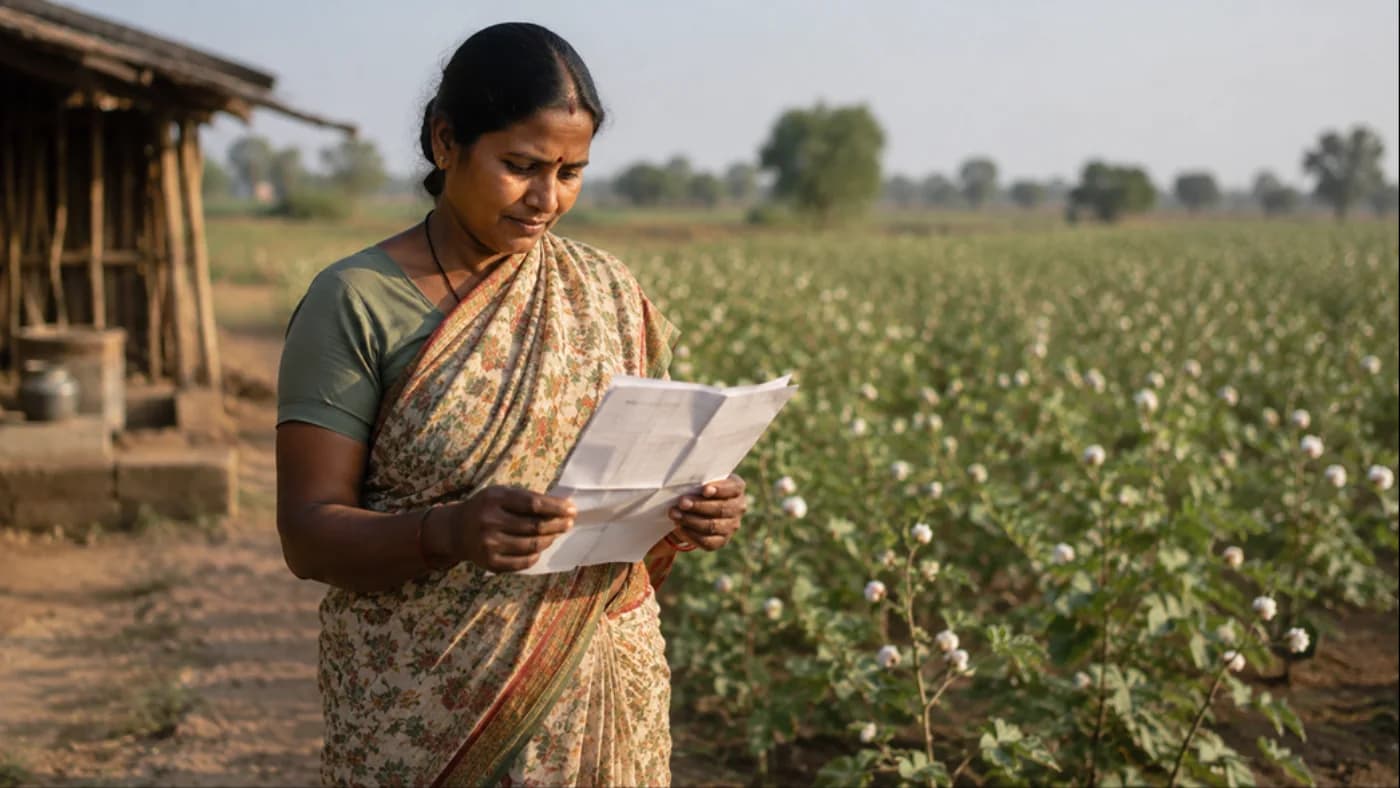
Across much of India a woman may sow, weed, transplant, harvest and decide what goes in next season, and still not appear anywhere in the paperwork of that farm. The consequence is not symbolic. Schemes, crop loans, insurance settlements and now the Farmer ID are all issued against the land record, so the person doing the work and the person the system recognises can be two different people. 2026 is the United Nations International Year of the Woman Farmer, which is a good moment to say something more useful than a slogan: here is exactly which door the record closes, and how to open it.
Why the record matters more than the work
Almost every benefit an Indian farmer can claim is verified the same way — against land records. PM-Kisan is paid to landholding farmer families. A Kisan Credit Card is sanctioned against land or a documented tenancy. A crop insurance claim is settled for the person insured on a recorded holding. And the Farmer ID being issued under AgriStack is generated by linking your identity to those same records.
So when land sits in a husband's, father-in-law's or late husband's name, a woman farming it full time is invisible to all of it. She cannot claim the instalment, cannot get the loan in her own name, and has no standing when a claim is assessed. The land may be family land in every practical sense — the system does not read practical sense, it reads the record.
This is worth stating plainly because it changes what to do about it. The barrier is administrative, not agricultural, which means it is fixable with paperwork rather than with argument.
What the law already gives you
The Hindu Succession (Amendment) Act, 2005 gave daughters the same coparcenary rights in ancestral property as sons. This applies by birth, and it applies whether or not the family has acted on it. A great many families have simply never updated the record to match the law, and the entitlement quietly goes unclaimed.
Inheritance after a death is where the gap opens most often. When a husband or father dies, the land does not transfer itself — someone has to apply for mutation, the updating of the revenue record to show the new holder. Where nobody applies, the record keeps naming a person who has died, and the widow or daughter farming that land cannot claim anything against it. Mutation is a routine application at the revenue office, and it is the single highest-value piece of paperwork discussed on this page.
Several states also offer a reduced stamp duty when property is registered in a woman's name. The concession varies by state, so check the current rate with your sub-registrar rather than relying on a figure you read anywhere — including here.
What you can access, with and without land in your name
The table below is the practical map. The right-hand column matters most, because it shows that being left off the record does not close everything — it closes some things and reroutes others.
| With land in your name | Without land in your name | |
|---|---|---|
| PM-Kisan | Can be claimed as a landholding farmer | Not available — it is tied to the landholding |
| Kisan Credit Card | Sanctioned against your own holding | Possible through a Joint Liability Group, or against a documented tenancy |
| Crop insurance (PMFBY) | You are the insured party and receive the claim | Generally settles to the recorded holder, not the cultivator |
| Farmer ID / AgriStack | Generated against your holding | Enrolment is possible, but benefits still follow the land record |
| SHG credit (DAY-NRLM) | Available | Available — this is the main route for landless women |
| FPO membership | Available | Usually available — most FPOs admit producers, not only landowners |
| Input subsidies | Claimable in your name | Usually requires the recorded holder to claim |
The four steps that actually change something
- Find out whose name the land is currently in. Ask at the revenue office or check your state's land record portal. A surprising number of families are unsure, and everything else depends on the answer.
- If a holder has died, apply for mutation. Until the record is updated, nobody farming that land can claim against it. This is ordinary revenue-office work, not litigation.
- Consider joint ownership on family land. It does not take anything away from anyone else, and it makes the woman farming the land eligible in her own right.
- If land is not going to happen, join an SHG or a Joint Liability Group. This is the established route to credit for women without a holding, it works, and it does not require anybody's permission on the land record.
- Whatever the record says, keep your own dated evidence of what you sowed, spent and harvested. It is what supports a claim, a tenancy argument or an FPO application — and it belongs to you regardless of whose name is on the khata.
Where a woman farmer's position is strongest
Two routes do not depend on the land record at all, and they are worth knowing precisely because of that. Self-Help Groups under the national rural livelihoods programme are built around women's collectives and give access to credit on the group's standing rather than on a title deed. Joint Liability Groups do something similar for cultivators without documented land, which includes a very large number of tenant and oral-lease farmers of both sexes.
FPO membership is the second. Most Farmer Producer Organisations admit producers rather than landowners, which means a woman cultivating family land can usually join, vote and sell through the FPO in her own name. That matters for price, because collective selling is where smallholders get leverage — what an FPO actually does covers the mechanics.
Neither is a substitute for being on the land record. Both are real, immediate, and available without waiting for a family decision.
Where Khetiyaar fits
The app is in Gujarati, Hindi and English and does not ask whose name the land is in. Crop plans, disease diagnosis, weather and mandi prices work for whoever is doing the farming, which is not a policy position — it is just how the product works.
The most useful thing we can offer here is the record. Sowing dates, inputs, costs and yields per plot, kept as you go, are exactly the evidence that supports a tenancy claim, an FPO application or a dispute about who actually cultivated a field. Keeping a farm record covers the habit, and it is worth building whoever's name is on the khata.
What we cannot do is any of the paperwork. We do not register anyone for schemes, we do not hold Aadhaar or land documents, and we have no role in AgriStack or mutation — those go through the revenue office and your state government. AgriStack and the Farmer ID explains why checking your entry early matters, and that applies with particular force here: a record that has never named you is easier to correct now than during a claim.
Frequently asked
Can a woman get a Kisan Credit Card without land in her name?+
Often yes, through a Joint Liability Group, which is designed for cultivators without documented land. A KCC can also be sanctioned against a documented tenancy in some states. The most direct route remains having land or a share of it recorded in your name, but the absence of that is not a dead end.
Is PM-Kisan available to women farmers?+
Yes, where the land is recorded in her name — the scheme is paid to landholding farmer families and verified against the land record. A woman cultivating land recorded in someone else's name cannot claim it separately, which is why getting mutation done after a death, or adding a name to family land, matters so much.
What is mutation and why does it matter for women?+
Mutation is updating the revenue record to show the current holder, usually needed after a death or a transfer. Until it is done, the record keeps naming the previous holder, and nobody farming that land can claim schemes, credit or insurance against it. It is a routine application at the revenue office, and it is the single most valuable step for many widows and daughters.
Do daughters have a legal right to agricultural land?+
Under the Hindu Succession (Amendment) Act, 2005, daughters have the same coparcenary rights in ancestral property as sons, by birth. The right exists whether or not the family has acted on it — but the land record will not change by itself, so the entitlement has to be claimed and the record updated.
What is the International Year of the Woman Farmer?+
The United Nations General Assembly declared 2026 the International Year of the Woman Farmer, with the FAO coordinating it. It is intended to raise awareness of women's role in agrifood systems and the barriers they face — land tenure, credit, and access to services and training being the ones most often named.
Where to go next
- Farming cost & profit calculatorWork out cost per acre, break-even yield and expected profit before you sow.
- Land unit converterConvert bigha, vigha, acre, guntha and hectare instantly — free, no login.
- Today's mandi bhavOfficial AGMARKNET rates for your crop, nearby mandis compared, and the net price after travel.
Want this as daily tasks for your farm?
Khetiyaar turns guides like this into a day-by-day plan — in your language, free to start.

Related guides
Best Free Farming Apps in India: What Is Actually Free
The word free is doing four different jobs in this market. Government apps are permanently free and almost nobody recommends them, because there is no commission on a free app.
AgriStack and the Farmer ID: What It Is and How to Check Yours
The Farmer ID links your identity to your land and to whatever crop the survey says you sowed. That record — not what you tell an official — is what schemes will be assessed against. Here is how to register, and how to check it is right.
Government Schemes Every Indian Farmer Should Know
Income support, cheap credit, crop insurance, free soil testing and irrigation subsidies — real value that often goes unused simply for lack of awareness.