

Vertical Gardening With Cattle Panels: Get Vines Off the Ground and Double Your Space
Sprawling cucumber and gourd vines eat up your walking paths, trap humidity, and rot fruit against wet soil. A simple welded-mesh panel arch fixes all three problems and can nearly double the usable growing space in a small plot.
Quick answer
A welded-mesh panel arch costs more upfront than string or plastic netting, but for a fraction of a small garden's footprint it gives climbing crops better airflow, cleaner fruit, easier harvesting, and a walking path you get back to use. Once it's built and wired down properly, it needs almost no maintenance for years — plan the layout around the sun, train your vines early, and let the structure do the rest.
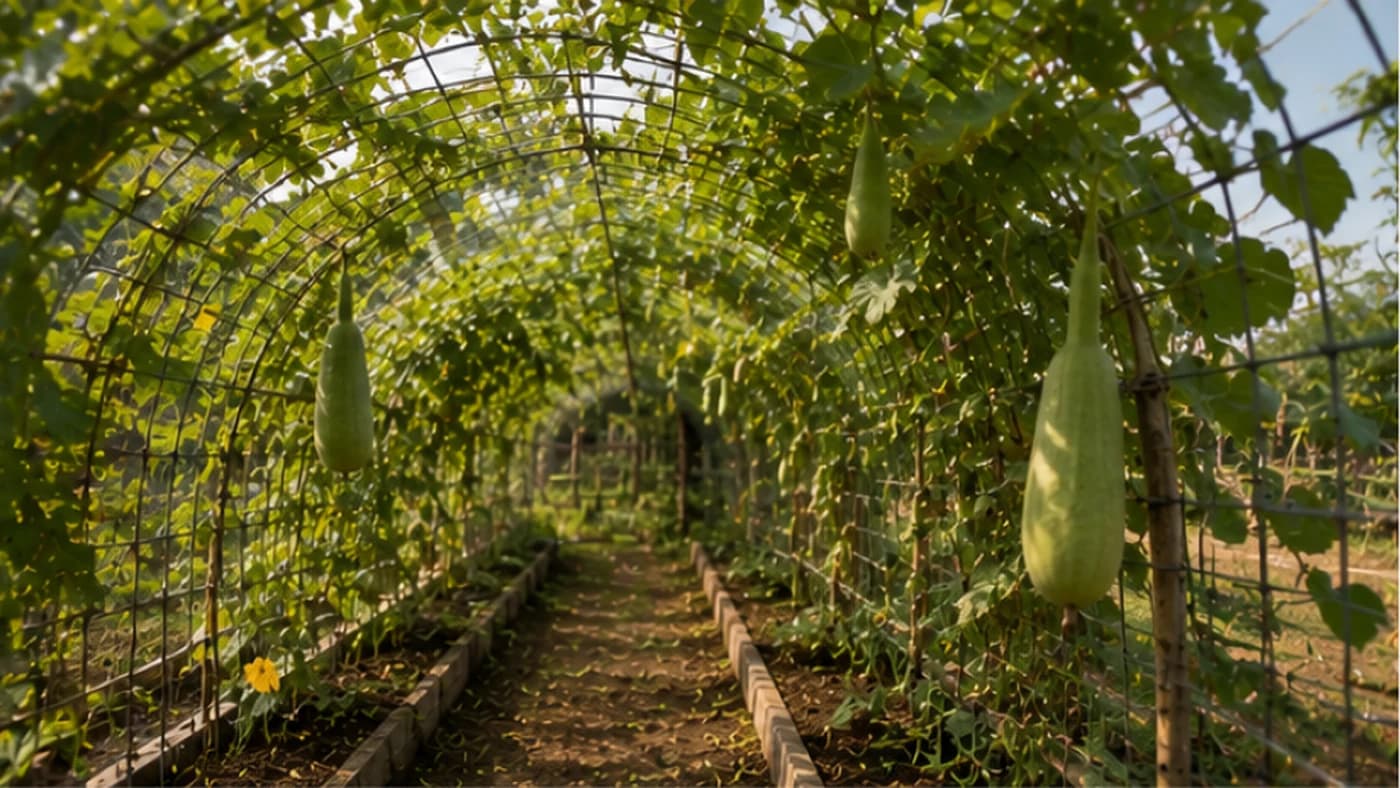
A small kitchen garden runs out of room fast, and the usual result is a tangle of cucumber, bottle gourd or ridge gourd vines swallowing every path until walking through the garden means stepping over foliage. That thick mat on the ground also traps humidity, which is exactly what powdery mildew and fruit rot need to take hold. The fix that serious growers use is simple: stop thinking about the ground and start using the air above it. A heavy-gauge welded wire mesh panel — sold in India for livestock fencing and often called a cattle panel, weld mesh panel or jaali — bent into an arch gives climbing crops a rigid, permanent trellis strong enough to carry hundreds of kilograms of fruit for decades, turning a chaotic patch of vines into an organised, high-yield tunnel.
What a cattle-panel trellis actually is
A typical panel is a rigid sheet of galvanised, 4-gauge (pencil-thick) welded wire, roughly 4.8 m long and about 1.25 m tall, with openings of 10–20 cm — wide enough to slide a hand through at harvest time, but small enough to give a cucumber's tendrils a thousand tiny rungs to climb. Bent into a U-shape and anchored at both ends, it becomes a walk-through arch; left flat, it works as a vertical wall or A-frame. Either way, the goal is the same: lift the fruit off the ground and into moving air and sunlight, the way wild gourds and beans naturally climb through hedges and trees.
How to build one, step by step
You need four sturdy posts (metal T-posts or strong bamboo, at least 1.8 m long), one panel, a post driver or sledgehammer, and heavy-duty UV-resistant zip ties or galvanised wire. Pick a spot that gets at least eight hours of full sun, and orient the arch north–south rather than east–west, so both sides get roughly equal light through the day instead of one side sitting in shade.
Mark a rectangle 1.5–1.8 m wide — a comfortable width for a walk-through arch over a path — and drive a post into each corner, 30–45 cm into the ground, with any studs facing inward. Bending the panel is a two-person job: brace one end against one pair of posts while the second person walks the other end toward the opposite posts, bowing the steel upward into an arch. Once both ends are tucked against their posts the tension holds it in place temporarily; then wire or zip-tie it to each post at the bottom, middle and top. Done this way, the structure can carry serious weight for many seasons with no rot and almost no maintenance.
Why going vertical works so well
Airflow is the biggest win: vines bunched on the ground trap moisture between leaves, which is exactly what powdery mildew and blight need, while a lifted canopy dries out quickly after rain or dew and stays healthier without extra spraying. Harvesting also gets far easier — instead of bending and digging through prickly ground vines, you simply walk under the arch with fruit at chest height, which makes it much easier to spot pests early and pick vegetables without straining your back.
You also get the space back: training vines upward frees the walking path underneath, so a wheelbarrow or cart can move through without crushing plants, effectively doubling the usable growing area of a small plot by using the air above it, not just the ground. And fruit quality improves — cucumbers and gourds grown on a panel don't develop the pale, soft patch that comes from lying on wet soil, and being off the ground also keeps them away from slugs, sowbugs and other soil-dwelling pests.
Common mistakes and pitfalls
Moving a long panel is the first practical hurdle — it won't fit flat in most vehicles, so bow it into a wide U-shape to transport it, and never fold it sharply, since a kink ruins its strength permanently. Heavy fruit like bottle gourd or pumpkin can pull itself off the vine before it ripens, so serious growers support it with a sling made of old netting or cloth tied to the panel, letting the panel carry the weight instead of the vine.
Weak anchoring is another common failure: in loose or sandy soil, short posts may not hold a heavy, wind-loaded arch, so use longer posts or reinforce the base with heavy stones in windy spots, and never rely on thin wooden stakes — the tension in bent wire mesh will snap or pull them out within weeks. Finally, don't neglect early training: cucumbers and beans usually find the mesh on their own, but heavier vines like tomato or squash need to be guided onto it every few days in early growth, or they will sprawl across the path and defeat the purpose.
Where this method has limits
Once a panel is wired to its posts it isn't easily moved, which makes crop rotation harder — avoid growing the same crop (say, a gourd) on the same arch two years running, to reduce soil-borne disease. A tall, densely leafed arch also casts real shade, so think about the sun's path before you place one; putting it on the south side of a bed of sun-loving chillies or brinjal, for instance, will shade them out for much of the day. The upfront cost of steel mesh and posts is also higher than a simple string or plastic net trellis — but unlike plastic netting, which needs replacing within a season or two, a well-built mesh panel can last two decades or more, so the higher first cost is repaid many times over.
Comparing trellis materials
Welded wire panel: lasts 20+ years, very high load capacity, virtually no maintenance, immune to rot, needs two people to install. Wooden trellis: lasts 3–5 years, medium load capacity, needs staining and repair, poor rot resistance in humid climates, easier to build with basic carpentry. Plastic or nylon netting: lasts one or two seasons, very low load capacity, needs regular replacement, high rot resistance itself but flimsy support, easiest and cheapest to install. For a permanent structure that a homestead relies on year after year, the mesh panel wins clearly on total cost over time, even though it costs more on day one.
Practical tips and maintenance
Start training vines when they are about 30 cm long, gently weaving the growing tip through the mesh — tendrilled crops like cucumber and gourds will grip on their own after that, while tomatoes and other non-tendrilled plants need to be tied to the mesh every 15 cm or so with soft twine or cloth strips. You don't need to dismantle the arch after harvest — leaving it up over the off-season is fine — but do clear away dead vines each year, since old, brittle foliage left on the wire can harbour pests and disease spores.
Keep the base mulched with straw or dry leaves to retain moisture and suppress weeds, since a small footprint is supporting a large volume of growth and the soil works hard. Once a season, walk your arches and give them a firm shake — if a zip tie has gone brittle in the sun, replace it with a fresh UV-rated one or galvanised wire.
Getting more from the same structure
Intercrop underneath the arch: while the top is covered in heat-loving gourds, the ground below stays in cool, dappled shade — a good spot for a second-season crop of spinach, coriander or lettuce that would otherwise bolt in full sun. Feed the base deliberately, since a long vine has to move nutrients a long way to reach fruit hanging near the top — concentrate compost and manure at the base where the main stem enters the ground, and use a diluted liquid feed as a foliar spray to reach the upper leaves. Pollination often improves too, since flowers held up in the open air are easier for bees to find than flowers buried in ground-level foliage — planting a few marigolds at the base of the posts helps draw pollinators in.
A real space-saving example
In a standard 3 x 3 m garden bed, three sprawling cucumber or gourd plants grown on the ground can take up nearly 9 square metres, leaving little room for anything else and turning the centre of the bed into a no-go zone you can't step into without crushing a vine. Move those same three plants onto a single panel arch across the centre path, and their footprint at ground level shrinks to under 1 square metre — the vines now grow up and over the path instead of across it — freeing most of that space for rows of beans, chillies or a dozen brinjal plants, roughly doubling the usable yield per square metre. Growers who make this switch commonly report far less fruit lost to rot, since every fruit hanging on the arch is visible, easy to reach at the right size, and never sitting in contact with wet soil.
Frequently asked
What is a cattle-panel trellis?+
A rigid arch or wall made from heavy-gauge galvanised welded wire mesh (sold for livestock fencing), used to support climbing crops like cucumber, gourds and beans off the ground.
Which direction should the arch face?+
North to south, so both sides get roughly equal sunlight through the day. An east–west orientation leaves one side shaded for much of the day.
How long does a mesh panel trellis last compared to wood or plastic netting?+
A galvanised mesh panel can last 20 years or more with almost no maintenance, versus 3–5 years for wood and just one or two seasons for plastic netting.
How do I stop heavy fruit like gourds from falling off the vine?+
Support the fruit in a sling made of old netting or cloth tied to the panel, so the structure carries the weight instead of the vine stem.
Can I still rotate crops if the arch is permanently fixed?+
Yes, but plan ahead — avoid growing the same crop on the same arch two years in a row to reduce the buildup of soil-borne disease.
Where to go next
Want this as daily tasks for your farm?
Khetiyaar turns guides like this into a day-by-day plan — in your language, free to start.

Related guides
Perennial Grains Explained: The Future of Low-Till Grain Growing
Imagine a grain crop you plant once and harvest for years, with roots deep enough to shrug off drought. Perennial grains are still an emerging frontier — but the soil-building principles behind them are usable on any Indian farm today.
Electroculture Gardening: What It Is, and What the Evidence Actually Says
Copper antenna gardening promises faster growth and lower water use for almost no cost. It's a genuinely old folk technique — but the claims run well ahead of the science. Here's what it involves and how to think about it honestly.

Moon Phase Gardening: The Ancestral Planting Calendar, Honestly Explained
Long before soil-test kits, farmers across the world timed sowing to the moon. We explain the four lunar quarters, what farmers claim it does, and what the actual evidence says — so you can try it without confusing tradition for proven science.