

Electroculture Gardening: What It Is, and What the Evidence Actually Says
Copper antenna gardening promises faster growth and lower water use for almost no cost. It's a genuinely old folk technique — but the claims run well ahead of the science. Here's what it involves and how to think about it honestly.
Quick answer
Electroculture is a low-cost, low-risk curiosity worth understanding honestly rather than dismissing outright or believing uncritically. The copper-antenna technique itself won't harm your garden, but the dramatic claims attached to it (300% yield increases, precise irrigation savings) are not backed by solid, controlled agricultural research. If you're curious, run it as a genuine side-by-side experiment against a normal bed rather than replacing proven practices — good soil, water, sunlight, and nutrition — with it.
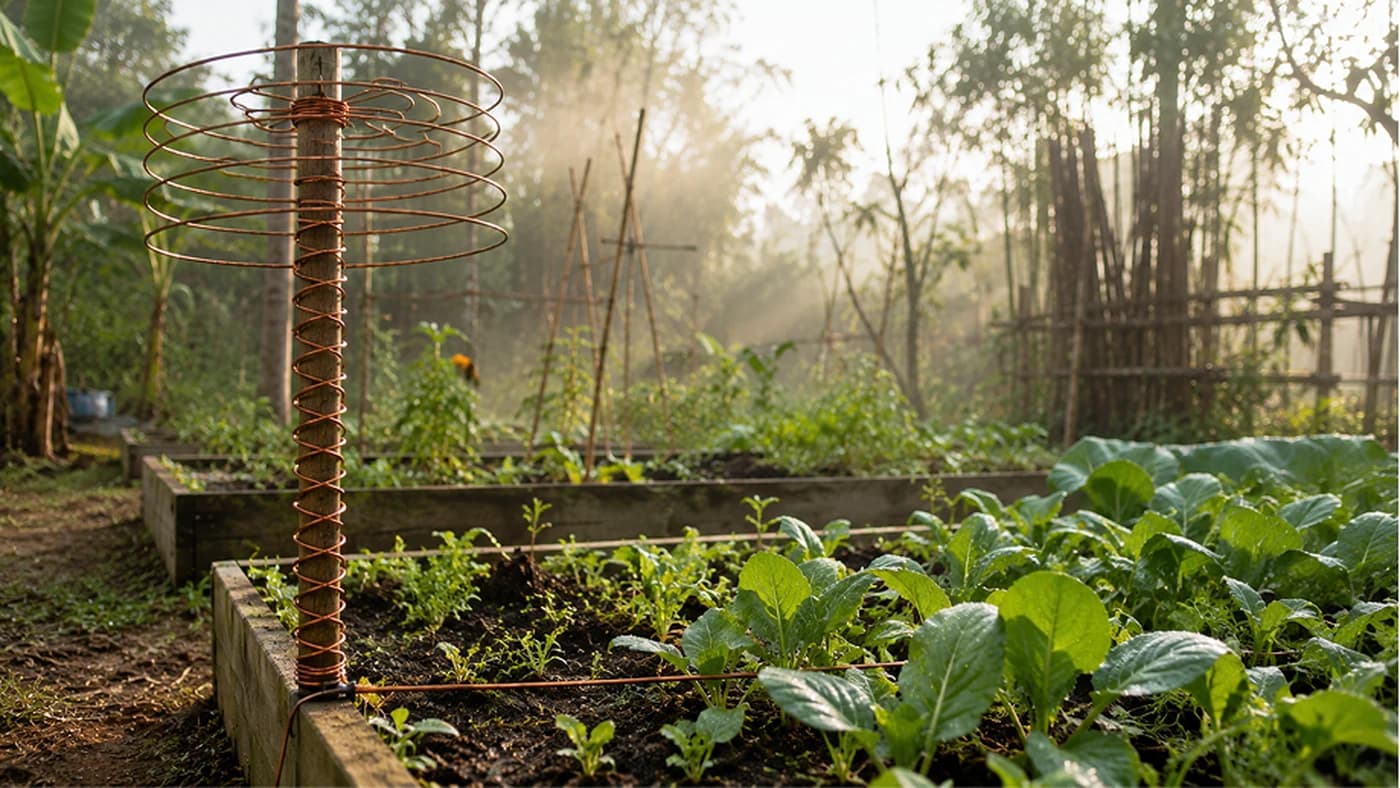
Electroculture is an old idea, revived online: that atmospheric electricity and the earth's magnetic field, channelled through a copper coil stuck in the garden, can boost plant growth without any chemical input. It costs very little to try — a wooden stake and some copper wire — which is exactly why it has spread widely on social media with dramatic claims attached. It's worth understanding clearly: what the practice actually is, what its supporters claim, and how much of that is backed by real agricultural science versus folklore and anecdote.
What electroculture claims and how it's built
The basic setup is an 'atmospheric antenna': a wooden stake, usually 1.8 to 3 metres tall, wrapped from bottom to top in a spiral of bare (uninsulated) copper wire — typically 14 or 16 gauge, wound with coils spaced 5 to 7 cm apart, with about 30 cm of wire left bare at the bottom to bury in the soil and a coil, cross, or small pyramid shape left exposed at the top. It's installed by digging a hole 30 to 45 cm deep near the centre of a bed, burying the bare end of the wire in contact with moist soil, and backfilling. Some practitioners orient stakes or buried wire north-south to align with magnetic north, use copper rings placed around the base of stressed plants ('Lakhovsky rings'), or bury galvanized wire in a grid beneath a bed.
What proponents say it does
Supporters report faster germination, visibly taller and sturdier plants, higher fruit weight (commonly cited figures range from a modest 20-50% increase up to extraordinary claims of 300%), reduced irrigation needs (some report cutting water use by 30% or more), and better pest resistance, attributed to healthier plants being less attractive to insects. The proposed mechanism — that copper 'collects' atmospheric or ionospheric charge and channels it into the root zone, stimulating nutrient uptake — is not something mainstream soil science or plant physiology currently supports with controlled evidence; it remains a theory offered by practitioners, not an established finding.
What to make of the evidence honestly
Be clear-eyed about this: rigorous, peer-reviewed field trials proving these effects are largely absent, and the reported results are almost entirely anecdotal — from individual gardeners, not controlled experiments that rule out other explanations (better soil, more attention and watering from an engaged gardener, confirmation bias, or simply normal variation between plants). This doesn't automatically mean it does nothing; some historical experiments with atmospheric and electrical effects on plant growth do exist in agricultural literature from the early 20th century, but they are far from conclusive and modern controlled replication is scarce. Treat any claim of '300% larger harvests' as marketing, not measured fact.
If you want to experiment anyway
The materials are cheap and the technique is harmless to plants and safe to try, which is part of its appeal. Use pure copper (99%) — recycled copper pipe or thick copper wire works; never use insulated or enamelled wire, since the coating (real or theorised) blocks the effect proponents describe. Bury at least 20 to 30 cm of bare wire in consistently moist soil for a proper ground contact. If you want to test it seriously rather than just try it, treat it like any home experiment: keep an identical control bed without an antenna, use the same seed batch, same watering and same care in both, and compare results over a full season rather than judging from a few weeks.
Its real limitations
Electroculture is not a substitute for water, sunlight, good soil, or nutrients — even its strongest proponents describe it as a supplement, not a replacement for basic agronomy. Near high-voltage power lines or mobile towers, any subtle atmospheric effect (real or claimed) may be swamped by stronger electromagnetic interference. Very sandy soils with poor conductivity may need more antennas, while heavy clay may dissipate charge quickly. And results, if any, build slowly over weeks to months — this is not a quick fix like a chemical fertiliser that greens up a crop within days.
Frequently asked
Does electroculture actually work?+
There is no strong, peer-reviewed evidence proving the claimed mechanism. Reported results are mostly anecdotal. It's low-cost and harmless to try, but should not replace proven practices like soil health, irrigation and nutrition.
What materials are used to build an electroculture antenna?+
A wooden stake 1.8 to 3 metres tall wrapped in bare (uninsulated) copper wire, usually 14-16 gauge, buried 30 to 45 cm deep at the base with about 30 cm of bare wire in contact with moist soil.
Why must the copper wire be uninsulated?+
Practitioners believe the plastic coating on insulated wire blocks the atmospheric charge the antenna is meant to collect, so bare copper is used throughout.
Is electroculture dangerous to plants or soil?+
No — the technique itself is harmless. The concern is not safety but that the dramatic yield and water-saving claims attached to it are not scientifically proven.
Should I replace fertiliser or irrigation with electroculture?+
No. Even its supporters describe it as a supplement at most, not a replacement for water, sunlight, healthy soil, and proper nutrition.
Where to go next
Want this as daily tasks for your farm?
Khetiyaar turns guides like this into a day-by-day plan — in your language, free to start.

Related guides
Perennial Grains Explained: The Future of Low-Till Grain Growing
Imagine a grain crop you plant once and harvest for years, with roots deep enough to shrug off drought. Perennial grains are still an emerging frontier — but the soil-building principles behind them are usable on any Indian farm today.
Hexagonal Spacing: Fit 15% More Plants in the Same Bed and Stop Weeding
Plant in a staggered triangle pattern instead of straight rows and the leaves close into a canopy that shades out weeds on its own — 10-15% more plants per bed, far less watering, and far less hoeing.
Deep-Rooted Weeds and Cover Crops That Fix Compacted Soil for Free
A weed with a long taproot pushing through hardpan isn't a sign your land has failed — it's the soil trying to repair itself. Here's how deep-rooted plants act as free biological drills, and which ones actually make sense on Indian farms.