

Natural Barn Sanitation and Odour Control With Effective Microorganisms
A barn that smells like bleach has killed the good bacteria that actually keep disease away. Effective Microorganisms (EM) digest ammonia at the source instead of masking it — here's how to use them safely.
Quick answer
You can never sterilise a barn, coop or shed — you can only decide which microbes get to dominate it. Effective Microorganisms let beneficial bacteria, yeast and phototrophic bacteria outcompete the pathogens that cause ammonia smell, disease and fly problems, cutting odour fast and speeding up composting, without the corrosive risks of bleach. Get the basics right — no chlorine, correct dilution, proper mucking first — and a healthier barn follows.
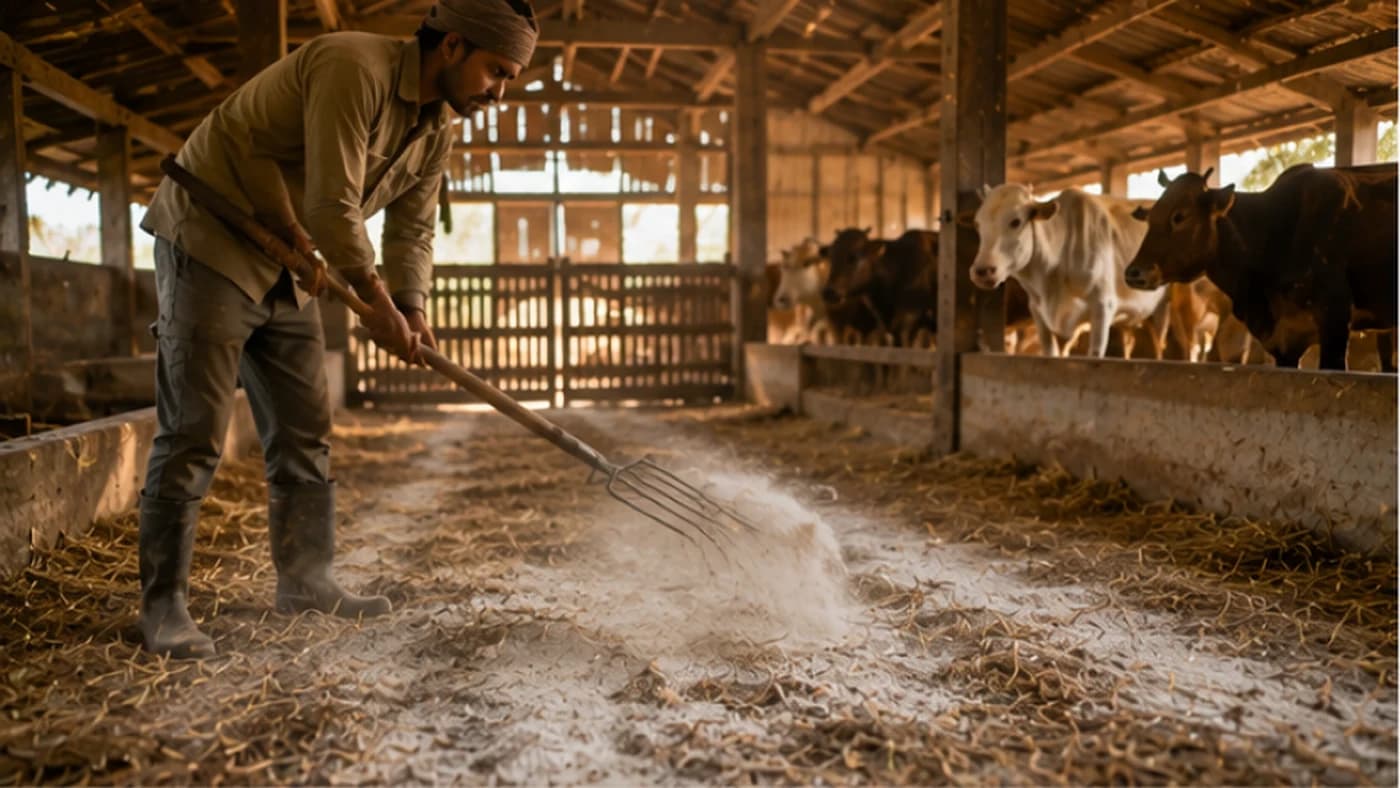
A sharp, stinging ammonia smell in a barn or coop means proteins are rotting and pathogens are winning; a sweet, earthy smell means beneficial microbes are in charge. Harsh chemical cleaners create a biological vacuum that the toughest, most resistant pathogens fill first, while a probiotic approach using Effective Microorganisms (EM) crowds out the bad bacteria before they can establish. This isn't a new-age idea — it's simply choosing which life gets to dominate your animals' living space, since a barn can never truly be sterile.
What EM actually is
EM-1 is a liquid culture of three microbe groups working together: lactic acid bacteria, which lower the pH so pathogens like Salmonella and E. coli struggle to survive, and also break down straw and wood-shaving fibre; yeasts, which ferment waste into vitamins and amino acids instead of foul-smelling putrefaction byproducts; and phototrophic bacteria, which use sunlight and heat to clean up gases like hydrogen sulphide. Sprayed onto bedding, this mix outnumbers pathogens by billions to one and consumes the nitrogen in urine before it can turn into ammonia gas — which is why the smell disappears so fast.
What it actually delivers
EM can cut ammonia levels by up to 80% within 8-12 hours of application; ammonia above roughly 25 ppm damages the respiratory lining of animals and can lead to chronic coughing or pneumonia in horses and heaves-like symptoms in other livestock. Skin and hoof conditions caused by wet, putrid bedding — like scratches on a horse's pastern — improve when probiotics dominate instead. Flies, which are drawn to the smell of rotting manure to lay eggs, become far less interested once fermentation replaces putrefaction. And manure treated with EM in the barn is already partly broken down, so it composts in roughly a third of the usual time.
How to apply it
For a standard stall or coop of about 3.6 x 3.6 metres, a 1:100 dilution (1 part EM to 100 parts water) misted with a pump sprayer is enough for daily maintenance, with extra attention to wet spots after mucking out. Spray the walls, doors and rafters once a month too — dust carries pathogens and mould spores, and coating it in EM makes it far less biologically active if inhaled.
Common mistakes that undo it
Mixing chemical and biological approaches is the most common error — the chlorine in bleach or ordinary tap water kills EM instantly, so if you must use tap water, let it stand in an open container for 24 hours first to let the chlorine off-gas. EM works best between 20-40°C; below freezing the microbes go dormant rather than dying, and resume once it warms up. EM also isn't a substitute for basic mucking — remove the bulk of manure and soaked bedding first; it manages residual moisture and biology, not a pile of waste. And store concentrate in a cool, dark place, never the fridge (cold shocks it) and never in direct sun (it overheats the phototrophic bacteria) — keep the cap tight, since the culture is anaerobic.
Where this method has limits
No amount of good bacteria can keep up with severe overcrowding — a space built for two animals holding ten will always produce more waste than any biological system can manage. In very dry climates, sprayed EM can evaporate before it establishes in the bedding; spraying more often, or switching to a Bokashi (fermented bran) that holds moisture better, helps. And EM cannot fix a genuinely low-lying, poorly drained floor — that needs a structural fix, not a microbial one.
Sterile chemicals vs. a probiotic shield
A chemical approach aims to kill essentially all life, masks odour rather than removing its source, can irritate skin and lungs, risks resistant 'superbugs' recolonising afterward, and slows composting. A probiotic approach establishes dominant good life, digests ammonia at its source, is non-toxic to touch, forms a stable self-regulating ecosystem, and speeds up composting.
Making your own EM at home
One litre of EM-1 concentrate can be activated into 20 litres of ready-to-use solution: mix 5% EM-1 concentrate, 5% unsulfured blackstrap-style molasses (avoid sulfured molasses — the sulfur is a preservative that kills the very microbes you want) and 90% clean, chlorine-free water in a sealed plastic container with minimal air space, since the culture is anaerobic. Store at around 30°C for 7-10 days, burping the container occasionally to release gas, until the pH drops below 3.8. It's ready when it smells sweet-and-sour, like apple cider vinegar or a good sourdough starter — if it smells rotten, the batch has failed and should not be used.
Two worked examples
In a 3 x 3 metre backyard coop with a heavy ammonia smell, stripping the old litter, spraying a 1:10 dilution onto the bare floor and lower walls, adding 15 cm of fresh bedding, then misting the top with a 1:100 dilution cleared the smell within three days; a weekly misting afterward let the deep litter ferment into rich compost right on the coop floor. In a boarding stable, spraying stall mats with a 1:50 dilution every morning after mucking, plus misting a horse's lower legs with a 1:100 dilution twice daily, resolved chronic pastern scratches within two weeks and kept the stall smelling like fresh earth through summer heat.
Frequently asked
How fast does EM reduce ammonia smell in a coop or stall?+
Often by up to 80% within 8-12 hours of a proper application, since the beneficial microbes consume the nitrogen in urine before it converts to ammonia gas.
Can I mix EM with bleach or chemical cleaners?+
No — chlorine, including that in ordinary tap water, kills EM instantly. Let tap water sit uncovered for 24 hours before use, and avoid chemical disinfectants once you switch to a probiotic approach.
Does EM replace mucking out the barn?+
No — you still need to remove the bulk of manure and soaked bedding. EM manages residual moisture and unseen biology, not a full load of waste.
Can I make my own EM instead of buying it?+
Yes — activate 5% EM-1 concentrate with 5% unsulfured molasses and 90% chlorine-free water in a sealed container for 7-10 days at around 30°C until it smells sweet-and-sour, not rotten.
What dilution should I use for daily spraying?+
A 1:100 dilution (1 part EM to 100 parts water) is typical for daily maintenance misting of bedding in a standard-sized stall or coop.
Where to go next
- AI farming chatbotAsk any farming question in Gujarati, Hindi or English and get an answer in seconds.
- Kheti app for Indian farmersCrop plans, disease diagnosis, weather and mandi rates in one app.
- Agri Bazar marketplaceBuy and sell animals, crops, equipment and dairy near you — and see what buyers want today.
Want this as daily tasks for your farm?
Khetiyaar turns guides like this into a day-by-day plan — in your language, free to start.

Related guides

How to Attract Barn Owls to Your Farm for Free Rodent Control
One pair of barn owls can hunt over a thousand rodents in a single season — but only if you give them a properly designed, dark, predator-proof box. Barn owls (Tyto alba) already live across most of India; here's how to bring them onto your farm.
Natural Fly Control for Animal Shelters: Building a Living Barrier Instead of Spraying Chemicals
Flies can cut cattle weight gain by 10-25% and spread over 65 diseases. Instead of a fresh can of spray every week, a planted barrier of repellent trees and shrubs can keep them out permanently — here's how, using plants that actually grow in India.

Training a Farm Dog for Rat Control (Without Poison)
Rat poison doesn't just kill rats — it kills the owls, hawks and cats that eat them too, and leaves a toxic carcass to rot in a wall. A trained working dog, even a sharp local pariah dog, is a chemical-free alternative that's been used on farms for centuries.