

How to Attract Barn Owls to Your Farm for Free Rodent Control
One pair of barn owls can hunt over a thousand rodents in a single season — but only if you give them a properly designed, dark, predator-proof box. Barn owls (Tyto alba) already live across most of India; here's how to bring them onto your farm.
Quick answer
Barn owls are already part of India's countryside — what most farms are missing isn't the bird, it's the dark, predator-proof nesting space and the poison-free environment they need to actually stay and breed. Build the box to the right dimensions, mount it high with a clear flight path, stop using rodenticides nearby, and give it a season or two — the reward is a family of owls doing your rodent control for free, every single night.
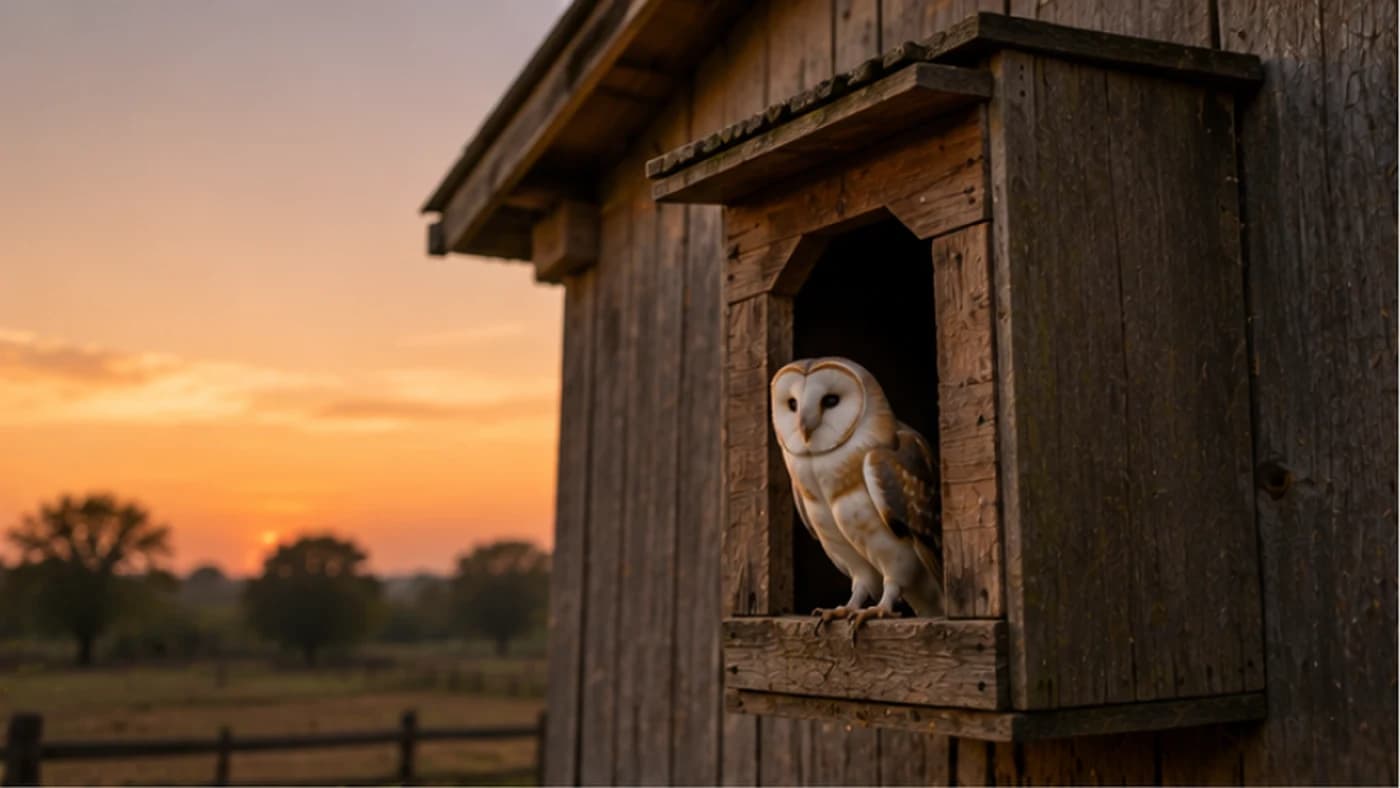
Stop setting traps and start building homes. Barn owls are among the most efficient rodent hunters found anywhere, and the barn owl (Tyto alba) already lives across most of India — around farmland, granaries, old buildings and open fields — wherever there's open hunting ground and a dark place to nest. They don't build stick nests like hawks; they're cavity nesters, searching for deep, dark hollows in old trees or forgotten corners of a loft or barn. When old structures get demolished and hollow trees get cleared, that nesting habitat disappears — so a properly built box fills a real gap, provided you also stop using the poisons that make an owl's job of hunting a slow, dying rat both easy and fatal to the owl itself.
What makes a farm attractive to barn owls
Barn owls need open hunting ground — at least 2 to 4 hectares of pasture, farmland or open field where their main prey (field rats, mice, and other rodents) is abundant. Unlike territorial owls, barn owls tolerate each other reasonably well and can nest in loose groups if food is plentiful, which makes them well suited to farms, orchards and mixed cropland. The single most important condition, though, is this: you must stop using anticoagulant rodenticides. A poisoned rat moves slowly and is an easy catch for an owl, but the poison then travels up the food chain and can kill the very predator you're trying to attract — undoing the whole point of the exercise.
Designing a box that actually gets used
The single biggest design mistake is a simple open box — it leaves owlets vulnerable to predators, wind and rain. A proper nest box needs an internal baffle: a partition that separates the entrance hole from the nesting area, creating an L-shaped path that blocks light and keeps larger predators like snakes, cats or mongooses from reaching in.
For dimensions, aim for a floor roughly 75 x 60 cm, an entrance hole shaped as an ellipse about 11 x 14 cm, placed at least 40 cm above the floor so owlets can't tumble out before they can fly, and a minimum internal volume of around 0.22 cubic metres so the chicks have room to stretch their wings without overheating. Build with exterior-grade plywood (avoid pressure-treated or chemically treated wood, which can harm the birds), assemble with corrosion-resistant screws, and finish the outside only with a water-based, low-VOC stain — a well-built box can last a decade or more.
How barn owls actually hunt
A barn owl's hearing is among the most sensitive of any animal tested — its ears are placed asymmetrically on its head, letting it pinpoint the exact location of a rodent moving under grass or leaf litter purely by sound. A single pair and their chicks can consume well over a thousand rodents in one nesting season, with the male making repeated hunting trips each night once chicks hatch. Their feathers have fringed edges that break up airflow over the wing, making their flight almost silent, so prey gets no warning before the strike. Instead of bringing in nesting material, barn owls regurgitate pellets — compact bundles of undigested bone and fur — which they shred over time into a soft, insulating floor layer for their eggs.
What owl-based rodent control gives you
The most direct benefit is fewer rodents around stored grain, seed and feed, achieved without any chemical footprint — no neurotoxins leaching into soil or risking exposure to farm animals, pets or children, just a scatter of pellets that break down into a nitrogen-rich soil amendment. It's also far less labour: traps need setting, checking and clearing, a grim and repetitive chore, while an established owl box works every night without any effort from you, and tends to get more effective over years as the same pair returns season after season. In vineyard and orchard studies abroad, owl-based control has worked out to a small fraction of the ongoing cost of routine trapping and baiting — the real return in the Indian context is fewer bought-in rodenticides and less grain lost to pests.
Common mistakes
A box that's too small causes overheating and fighting between chicks — always build to the minimum internal volume above, even if a smaller box is cheaper or easier to hang. Placement matters just as much as size: mounting a box in a tree seems easy but is the weakest choice, since trees give climbing predators easy access and branches can block the owl's flight path — a pole-mounted box, or one fixed high on a barn gable, is far more likely to be used. Skipping the internal baffle is a critical error, since without that darkness owls feel exposed and are unlikely to stay. And neglecting yearly maintenance causes problems too — clean the box out once a year in the off-season, since built-up pellet debris can eventually push chicks too close to the entrance hole.
When owls aren't the right answer
Barn owls need edge habitat — the transition zone between shelter and open ground — so in heavily forested or fully built-up areas with no open hunting ground nearby, they'll struggle to find enough food, and other owl species are more likely to show up instead. They hunt low, often just a metre or so above the ground, so a farm right next to a busy road puts owls at real risk of being hit by traffic. Heavy security lighting or a lot of ambient light also discourages them, since they rely on darkness to hunt safely without becoming prey themselves. And patience is required either way — it can take one to three years for a scout owl to even discover a new box, so don't expect immediate results and keep other rodent controls in place in the meantime.
Open rafter vs a proper baffled box
An exposed barn rafter offers low protection from predators, inconsistent light and temperature, debris falling onto the barn floor, and only a moderate success rate since eggs can roll off. A properly baffled nest box, by contrast, offers strong predator protection, near-total darkness, better temperature control from the insulating wood, contained and easy annual cleaning, and a much higher success rate because eggs stay put in a defined space. A rafter might get used as a casual roost, but if you actually want a breeding pair raising young year after year, the box is worth the extra effort to build properly.
Placement and setup
Mount the box at least 3.5 to 6 metres above the ground on a sturdy pole set well into the ground (or concreted in), so it doesn't sway in wind. Face the entrance away from the prevailing wind — a north- or east-facing opening usually avoids the worst of the afternoon heat. Keep the flight path clear: avoid branches or wires within 3 to 4.5 metres of the entrance, though having a tall roosting tree somewhere within about 90 metres is a genuine bonus. For bedding, a 2–3 cm layer of wood shavings (not cedar) or hardwood mulch keeps eggs from rolling on a bare plywood floor — avoid straw or hay, which holds damp and can grow mould.
Extra features worth adding
In hot regions, a secondary roof or side panel with a small air gap acts as a heat shield, letting air circulate and keeping the interior noticeably cooler on the hottest days — genuinely useful across most of India's summer. A small landing ledge just below the entrance gives fledglings a safe spot to exercise their wings and gives parents an easy place to hand off food. If you want to monitor progress without disturbing the birds, a low-light camera inside the box can show you exactly when eggs hatch and how often prey is delivered. And for larger farms, a rough guide is one or two boxes per 8 hectares, which allows for natural population turnover and gives a backup home if one box gets taken over by bees or squirrels.
Terms explained in this guide
Frequently asked
Do barn owls live in India?+
Yes — the barn owl (Tyto alba) is found across most of the country, wherever there's open farmland or grassland near a dark, quiet nesting spot.
How many rodents can a barn owl family eat?+
A single breeding pair and their chicks can consume well over a thousand rodents in one nesting season, hunting nightly once the chicks hatch.
What size should a barn owl nest box be?+
A floor of roughly 75 x 60 cm, an entrance hole about 11 x 14 cm placed at least 40 cm above the floor, and a minimum internal volume of about 0.22 cubic metres, with an internal baffle separating the entrance from the nesting area.
Can I still use rat poison if I want owls on my farm?+
No — anticoagulant rodenticides poison the rodents owls eat, which then poisons the owls themselves. Using both together defeats the purpose; choose one approach.
How long does it take for owls to move into a new box?+
Often one to three years, since a scout owl needs to find the box first. Keep other rodent controls in place while you wait, and don't give up if the first season shows no activity.
Where to go next
- AI farming chatbotAsk any farming question in Gujarati, Hindi or English and get an answer in seconds.
- Kheti app for Indian farmersCrop plans, disease diagnosis, weather and mandi rates in one app.
- Agri Bazar marketplaceBuy and sell animals, crops, equipment and dairy near you — and see what buyers want today.
Want this as daily tasks for your farm?
Khetiyaar turns guides like this into a day-by-day plan — in your language, free to start.

Related guides
Natural Barn Sanitation and Odour Control With Effective Microorganisms
A barn that smells like bleach has killed the good bacteria that actually keep disease away. Effective Microorganisms (EM) digest ammonia at the source instead of masking it — here's how to use them safely.
Attract Barn Swallows to Your Farm for Free, Natural Fly Control
A single pair of swallows can eat close to a thousand flies and mosquitoes a day. A few rough wooden ledges under your shed roof can turn your barn into a self-running pest-control unit that never needs refilling.
Training a Farm Dog for Rat Control (Without Poison)
Rat poison doesn't just kill rats — it kills the owls, hawks and cats that eat them too, and leaves a toxic carcass to rot in a wall. A trained working dog, even a sharp local pariah dog, is a chemical-free alternative that's been used on farms for centuries.