

Natural Fly Control for Animal Shelters: Building a Living Barrier Instead of Spraying Chemicals
Flies can cut cattle weight gain by 10-25% and spread over 65 diseases. Instead of a fresh can of spray every week, a planted barrier of repellent trees and shrubs can keep them out permanently — here's how, using plants that actually grow in India.
Quick answer
Trading a weekly chemical spray for a planted barrier of neem, Vitex negundo, marigold or lemongrass — placed on the windward side of your shelter — plus protecting your dung beetles from chemical residue, builds a fly-control system that gets stronger every season instead of weaker. Start before fly season peaks, keep the floor dry, and give the plants a full season to mature; the payoff is cleaner air for your animals, lower recurring cost, and a shelter that fights flies on its own.
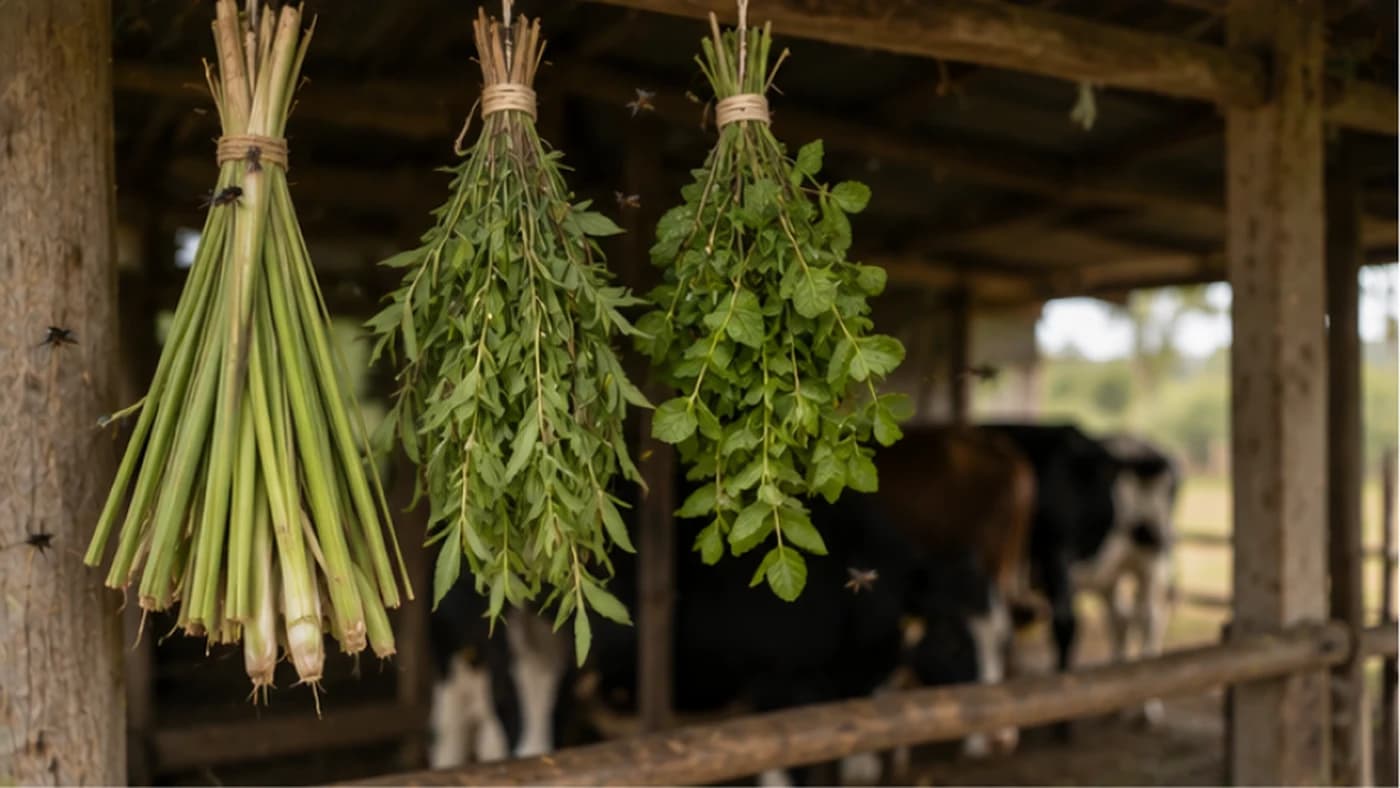
Fly control is usually treated as a weekly chemical battle — spray, wait, spray again as resistance builds and the smell fades. But it can be treated instead as a landscape design problem: a shelter surrounded by aromatic, repellent plants and protected natural predators becomes progressively harder for flies to colonise, while a shelter that depends on constant spraying stays fragile and never gets ahead of the problem. Flies are not a minor nuisance — in cattle, stable and horn flies can cut weight gain by 10-25% and are linked to over 65 diseases, so this is worth solving properly, not just masking for a week at a time.
Why a living barrier works better than a chemical cloud
Natural fly control targets the whole fly lifecycle, not just the adults buzzing around. It works by making the shelter smell unattractive to flies and by protecting the creatures that already hunt fly larvae for you — rather than relying on a spray that must be reapplied constantly and that flies gradually evolve resistance to.
House flies breed in moist manure, stable flies in rotting organic matter like wet hay — so an aromatic plant barrier masks the scent that draws them in, while protecting natural predators (birds, spiders, and above all dung beetles) removes their breeding grounds before they can multiply. Unlike a chemical spray, this system gets stronger every year as plants mature and predator populations recover.
Choosing repellent plants that actually work in India
The commonly cited Western plants for this — Tansy and Elderberry — are temperate-climate species not widely available in most of India, so don't go looking for them. The good news is that India already has strong, well-documented fly- and insect-repellent plants that farmers have used around cattle sheds and goshalas for generations: neem (Azadirachta indica), whose leaves and oil are one of the most effective natural insect repellents known; Vitex negundo (nirgundi/sambhalu), long used in traditional medicine and around animal housing for its insect-repellent properties; marigold (genda), whose strong scent deters many insects and is widely used as a companion planting border; and lemongrass or citronella grass, a well-known natural fly and mosquito repellent that grows easily across most of India.
The principle is the same regardless of species: plant a dense hedge or border of these at the shelter's main entry points and on the side the prevailing wind comes from, so the wind carries the repellent scent into the barn rather than away from it. A wall of neem and lemongrass on the windward side of a goshala does the same job as a Tansy hedge does in a European barn.
Protecting your natural fly predators
In many countries, farmers buy small parasitic wasps (Fly Predators) that lay their eggs inside fly pupae in manure, killing the next generation before it hatches — these are gnat-sized, do not sting people or animals, and are increasingly sold by some agricultural input suppliers, though availability in India is patchier than in the US or Europe.
What every Indian farmer can rely on regardless of supplier access is the dung beetle: a healthy dung beetle population can bury a fresh manure pat within 48 hours, removing the breeding ground for hundreds of flies before eggs even hatch. Chemical fly-control residues that pass through livestock and into the manure kill these beetles along with the flies, so avoiding broad-spectrum sprays is itself one of the most effective natural fly-control decisions you can make.
Why this pays off economically and for animal health
Chemical sprays used in barns — many pyrethroid and organophosphate products — can irritate the sensitive lungs of horses, goats and calves; a natural buffer of plants and predators allows cleaner air around the animals. It also protects other beneficial insects like ladybirds and lacewings that keep other pests in check, so the benefit extends beyond just fewer flies.
Economically, a can of spray needs repeat purchases every few weeks, while a hedge of neem, lemongrass or Vitex negundo is close to a one-time planting investment — over several years, the total cost of a planted barrier is typically far lower than a continuous chemical programme, even accounting for the initial setup.
Mistakes that undermine a natural fly barrier
The most common error is starting too late in the season — you cannot wait until the shed is swarming with flies before planting or protecting predators; establish the barrier before or right at the start of fly season, since once the fly population explodes, any natural control struggles to catch up.
Poor placement is the second common mistake: a hedge planted on the leeward (downwind) side of the shelter does nothing, since the repellent scent must be carried into the structure by the prevailing wind. If your shelter sits in a valley with little airflow, you may need to supplement plants with fans.
The third, and most overlooked, mistake is ignoring moisture. No amount of repellent planting will stop an infestation if there is standing water or a leaking trough nearby, since flies need moisture to breed — a single square foot of wet, manure-caked bedding can produce thousands of flies in a week. A dry floor and clean bedding are non-negotiable foundations underneath any planting strategy.
When plants alone won't be enough
In areas of extreme fly pressure — for example, downwind of a poorly managed feedlot or dairy — a plant barrier alone may be overwhelmed, and you may need to add fine-mesh screening on windows and doors as a physical backup. In very dry, water-scarce regions, elderberry-type shrubs that need consistent moisture struggle; drought-tolerant options like rosemary or lemongrass are more realistic, though their repellent range is smaller and may need denser planting.
One important safety note: while neem and marigold are safe around most livestock, some repellent plants can be toxic if eaten in quantity by certain animals — always check a plant's safety for your specific livestock before planting it where animals can graze on it, and fence off any borderline species.
Frequently asked
What Indian plants work like Tansy or Elderberry for fly control?+
Neem, Vitex negundo (nirgundi), marigold, and lemongrass/citronella grass are well-documented, widely available Indian alternatives with genuine insect-repellent properties.
Where should I plant a repellent barrier?+
On the side of the shelter the prevailing wind blows from, and around every door and window — the wind needs to carry the scent into the structure, not away from it.
Do I need to buy predatory wasps to control flies naturally?+
No — they help where available, but the single most reliable natural control every farmer can rely on is protecting dung beetles by avoiding chemical residues in manure; a healthy population buries a manure pat within about 48 hours.
Why is moisture management so important for fly control?+
Flies breed in moisture — a single square foot of wet, manure-caked bedding can produce thousands of flies in a week, so no planting strategy will work without a dry floor and clean bedding underneath it.
Are any repellent plants unsafe for livestock?+
Some can be, if eaten in quantity by certain species, so always confirm a plant is safe for your specific animals before planting it where they can graze, and fence off any that aren't.
Where to go next
- AI farming chatbotAsk any farming question in Gujarati, Hindi or English and get an answer in seconds.
- Kheti app for Indian farmersCrop plans, disease diagnosis, weather and mandi rates in one app.
- Agri Bazar marketplaceBuy and sell animals, crops, equipment and dairy near you — and see what buyers want today.
Want this as daily tasks for your farm?
Khetiyaar turns guides like this into a day-by-day plan — in your language, free to start.

Related guides
Natural Barn Sanitation and Odour Control With Effective Microorganisms
A barn that smells like bleach has killed the good bacteria that actually keep disease away. Effective Microorganisms (EM) digest ammonia at the source instead of masking it — here's how to use them safely.
Chemical-Free Parasite Control for Sheep and Goats
Common dewormers are now failing in the gut of the very worms they're meant to kill — on many farms efficacy has dropped to 21-34% for some species. Rotational grazing and tannin-rich fodder can do what the bottle no longer can.
Deep Litter Method: Turn Your Chicken Coop Into a Living Compost System
A scrubbed, bare coop floor is a wasted opportunity. Let a thick carbon bed and billions of microbes do the composting for you — less labour, healthier birds, and free fertiliser for the field.