

How to Save Tomato Seeds Using Fermentation (95%+ Germination)
Scrubbing tomato seeds by hand still leaves the germination-blocking gel behind. A simple 2-3 day ferment does what scrubbing can't — cleaner seeds, fewer diseases, and far higher germination.
Quick answer
A 2-3 day ferment does what scrubbing can't: it fully strips the germination-blocking gel, kills off seed-borne disease, and reliably delivers 95%+ germination versus 70-85% for hand-scrubbed seed. Ferment in a breathable-covered jar for 2-3 days, rinse until only heavy seeds and clear water remain, dry fast in good airflow, and label and store in a cool, dry place for next season.
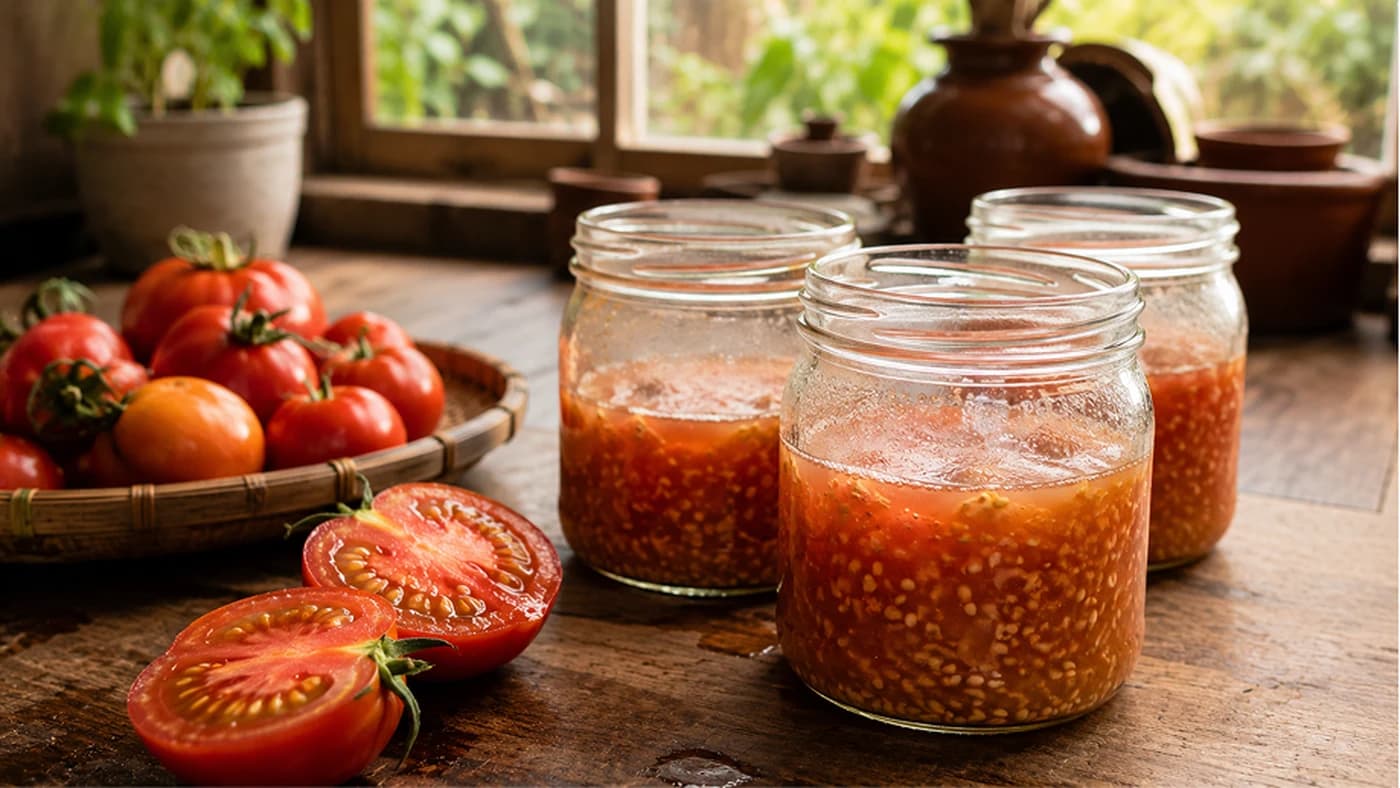
Every tomato seed sits inside a slippery gel sac that acts as a natural germination inhibitor, stopping seeds from sprouting while still inside a warm, wet fruit. Rinsing or hand-scrubbing rarely removes it fully. Fermentation mimics what happens when a tomato falls and rots on the ground — beneficial microbes break down the gel completely over 2 to 3 days, leaving clean seed with far higher germination and better resistance to seed-borne disease. It's the standard method used by serious seed savers and seed companies for good reason.
Choosing the right fruit
Pick your most robust, healthy, fully ripe tomatoes from open-pollinated or heirloom varieties — not F1 hybrids, since hybrid seed won't grow true to the parent plant and isn't worth saving through this process. Avoid under-ripe fruit (seeds may not be fully developed) and fruit that's rotting or mouldy (seeds may already be compromised).
The fermentation process, step by step
Slice the tomato around its equator rather than stem to base — this opens the seed cavities directly. Squeeze the seeds and surrounding juice into a clean glass jar, keeping out large chunks of flesh. If the mixture is too thick to stir, add about 120 ml of water. Cover the jar with a breathable cloth or paper towel secured with a rubber band — never an airtight lid, since fermentation produces gas and a sealed jar can turn anaerobic and smell far worse. Keep the jar somewhere warm, ideally 22 to 30°C — easy to achieve across most of India outside the coldest winter months. Stir once or twice a day. Within 48 to 72 hours a layer of white or grey mould on the surface signals it's working.
Cleaning and drying the seed
Fill the jar with water and stir well — viable, heavy seeds sink, while pulp, scum, and hollow non-viable seeds float. Pour off the floating layer, add fresh water, and repeat until only clean seed and clear water remain. Spread the clean seed on a plate, a fine-mesh sieve, or a coffee filter — never on cloth or paper towel, since seeds stick to it — and dry somewhere with good airflow. In humid conditions (above roughly 60% humidity), use a fan or a dedicated screen to fully dry the seed within 24 to 48 hours and prevent mould forming again during drying.
Why fermentation beats scrubbing
Hand-scrubbing in a sieve is faster but typically leaves seeds sticking together in clumps and gives germination rates of roughly 70 to 85%, with minimal disease control. Fermentation takes a few days of mostly waiting, but reliably delivers 95 to 99% germination and meaningfully reduces seed-borne pathogens, including bacterial canker (Clavibacter michiganensis), which can devastate a tomato crop the following season. The mould and mild acidity that develop during fermentation create conditions hostile to many of these pathogens while leaving the seed itself unharmed.
Mistakes that ruin a batch
Over-fermenting is the most common failure — beyond 4 to 5 days in warm weather, the breakdown of the gel signals the seeds to sprout inside the jar, ruining them for storage. Using an airtight lid is another frequent mistake; it traps gas, cuts off oxygen, and can turn the ferment anaerobic and foul-smelling. Fruit flies are a constant seasonal nuisance and will lay eggs in an uncovered or poorly covered jar — a snugly secured breathable cover prevents this.
When to skip fermentation
If you're racing an early frost or unexpected plant loss and only have one or two fruit to save, the 2-3 day wait may not be practical — a simple rinse-and-smear onto a plate, while giving a lower germination rate, is better than losing the seed entirely. Never bother fermenting seed from F1 hybrid tomatoes, since the resulting plants won't breed true to what you grew; save this method for open-pollinated and heirloom varieties you intend to keep growing year after year.
Terms explained in this guide
Frequently asked
How long should tomato seeds ferment?+
48 to 72 hours in a warm spot (22-30°C) is usually enough — a layer of mould on the surface signals it's ready. Don't go beyond 4-5 days, or the seeds may start sprouting in the jar.
Why do fermented tomato seeds germinate better than scrubbed seeds?+
Fermentation fully dissolves the natural germination-inhibiting gel and reduces seed-borne pathogens, typically reaching 95-99% germination versus 70-85% for simple scrubbing.
Can I ferment seeds from hybrid tomato varieties?+
It's not worth it — seeds from F1 hybrid tomatoes won't grow true to the parent plant. Save this method for open-pollinated and heirloom varieties.
Why should I use a breathable cover instead of a lid on the jar?+
Fermentation produces gas that needs to escape. A sealed, airtight lid traps it, cutting off oxygen and turning the mixture anaerobic and foul-smelling.
How do I know if my tomato seeds are still viable after fermenting?+
Fill the jar with water and stir — viable, dense seeds sink to the bottom, while pulp and hollow, non-viable seeds float and can be poured off.
Where to go next
Want this as daily tasks for your farm?
Khetiyaar turns guides like this into a day-by-day plan — in your language, free to start.

Related guides
Using Urine as Garden Fertiliser: The Free Nitrogen You're Flushing Away
Human urine is roughly 95% water and 5% urea, nitrogen, phosphorus and potassium — a fast-acting, completely free liquid fertiliser most people pour down the drain every day. Diluted and used correctly, it can match synthetic NPK feed at zero cost.
Tomato Farming: A Complete Guide for Indian Farmers
Tomato is high-value but demanding. Strong seedlings, steady water, staking and early disease action separate the farmers who earn well from those who lose the crop.
The Phawra (Azada Hoe): Why One Forged Tool Beats a Shed Full of Gadgets
Long before garden centres sold a different plastic tool for every task, farmers across Asia, Africa, and Southern Europe relied on one heavy, forged hoe to dig, weed, chop, and level. In India it's the phawra or kudal — and used correctly, it saves your back as much as it saves your money.