

The Chicken Moat: A Double Fence That Hunts Pests for You, 24/7
A normal fence just stands there while insects walk straight through. A chicken moat — a double-fenced ring around your garden — turns your birds into round-the-clock pest patrol, fertiliser spreaders and weed control, all at once.
Quick answer
A chicken moat costs more upfront than a single fence — roughly double the wire and posts — but it turns that investment into a system that hunts pests all day, spreads its own fertiliser, and keeps weeds from creeping into your beds. Build it wide enough for the birds to work comfortably, keep water and shade spread along the loop, and pick a breed with real foraging drive, and the moat will keep earning its keep for years.
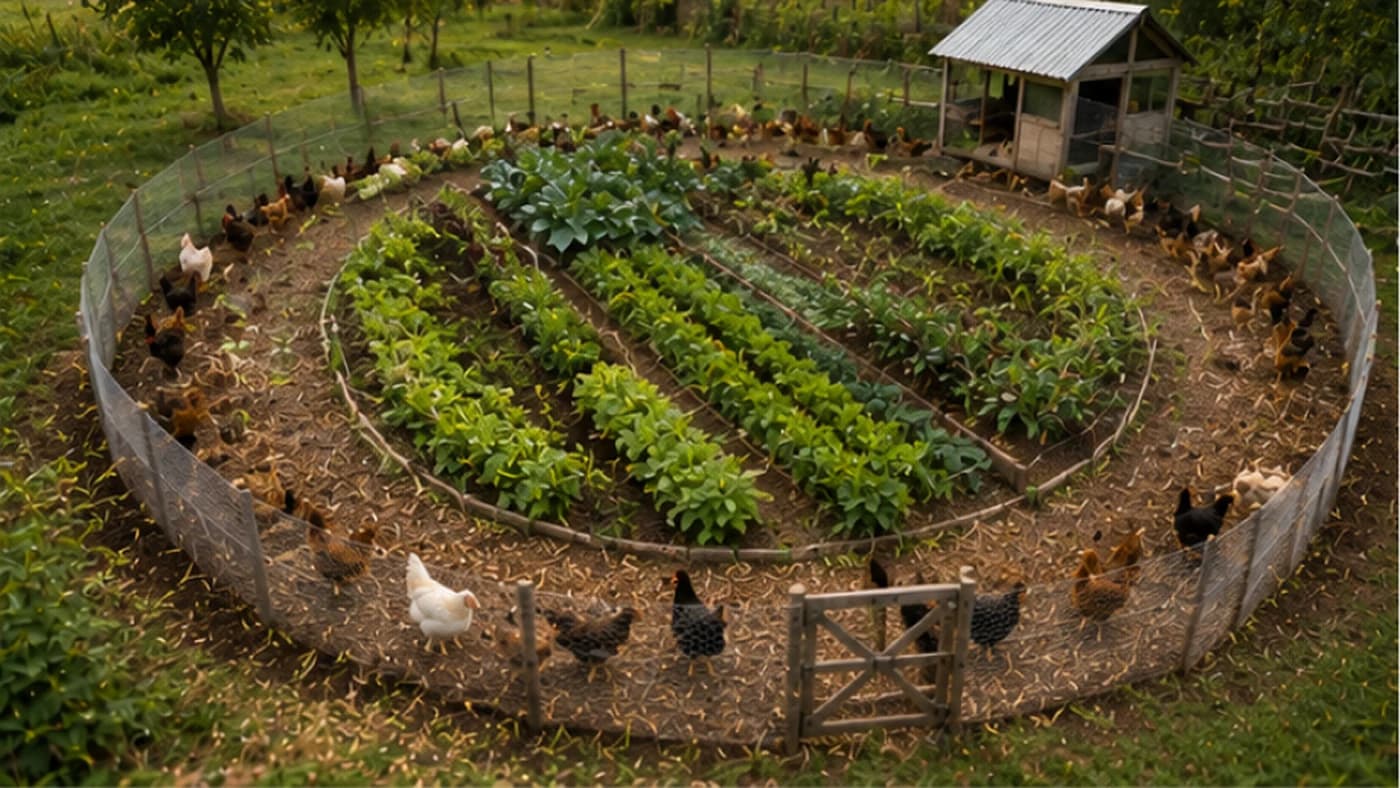
A fence's usual job is to keep something out, but it does nothing about the grasshoppers, beetles and slugs that simply crawl or fly straight through the mesh. A chicken moat flips that thinking: instead of one static wall, you build two fences that wrap all the way around your garden or orchard, with a narrow patrol lane in between where your birds spend their day. Anything trying to cross that lane on its way to your vegetables has to get past a team of hungry, highly motivated hunters first — a system rooted in old mixed-farming wisdom, where a single piece of ground does several jobs at once: fence, feeder, fertiliser spreader and pest control, all in one.
What a chicken moat is and how it works
A chicken moat is two parallel fences running around the entire perimeter of a garden or orchard, creating a corridor where chickens live during the day: the inner fence keeps the birds out of your crops, the outer fence keeps predators away from the birds, and the strip between them — the moat itself — is the working zone. Most homesteaders build the moat 1–1.8 m wide: narrow enough that a bird can spot an insect crossing from one side to the other, but wide enough to make ground-level pests think twice before crossing, and wide enough that larger animals like nilgai or wild boar, which have poor depth perception, are reluctant to jump a double barrier with that kind of gap.
In practice, as insects move toward your garden they must cross bare or short-grazed ground to get there, and to a chicken a crawling grasshopper or beetle is simply food — so by the time a bug clears the outer fence and crosses the moat, it is very likely to be spotted and eaten before it ever reaches your beds. The moat should connect directly to your coop wherever possible, so the birds can walk straight into patrol duty at sunrise; where the garden is some distance from the coop, a simple wire-enclosed tunnel can bridge the gap.
Why the moat outperforms a normal fence
A static fence is a passive obstacle: once a pest clears it, nothing stops it. A chicken moat is an active, living barrier — the birds keep the moat's grass scratched down to almost nothing, which removes the cover that slugs, snails and beetles rely on to hide, while their constant scratching also disturbs the soil enough to interrupt the life cycle of grubs and larvae before they ever emerge as adult pests.
There's a fertility bonus too: rain washes the nitrogen-rich droppings from the moat toward the root zone of whatever is growing just inside the inner fence, effectively creating a self-fertilising border that pays for itself through lower feed and fertiliser costs.
Step-by-step construction
Mark your perimeter with stakes and string first, so the lines stay straight and the width stays consistent all the way around. For the outer fence — your main defence against dogs, jackals and other predators — use heavy-gauge welded wire rather than flimsy chicken-wire mesh, at least 1.5–1.8 m high; bury the bottom 30 cm in a trench, or bend it outward in an L-shape and peg it down, to stop animals that dig.
The inner fence only needs to hold the chickens in, so it can be a little lighter, but should still be at least 1.2–1.5 m high to stop active breeds from flying over into your vegetables — and if you're growing tall crops like maize or climbing beans near this fence, make sure the birds can't reach through the mesh to peck at the leaves. Plan at least one wide gate for a cart or tiller, since gateways are the weakest point in the loop — a small tunnel or raised bridge over the gate keeps the moat continuous. Avoid sharp 90-degree inside corners, since panicked birds can get trapped in them; a slightly rounded or convex corner helps them find their way back to the coop.
Choosing the right patrol: best foraging breeds
Not every bird is a natural hunter — you want high-energy, alert foragers, not the heavy, docile breeds that wait by the feeder. Among Indian breeds, Kadaknath and Aseel are known for being hardy, alert and excellent foragers well suited to active patrol work, while Vanaraja and Giriraja combine good foraging instinct with strong dual-purpose (egg and meat) performance for a homestead flock. Among common commercial layer breeds available across India, Rhode Island Red is a tough, aggressive all-day forager, and White Leghorn is light, fast and highly motivated by insects, making it well suited to a long moat. Whichever breed you choose, avoid heavy ornamental birds that prefer to sit rather than hunt.
The practical benefits
Moat owners commonly report a 70–90% drop in grasshopper numbers within the first season, and because the birds are confined to the moat rather than free-ranging directly in the garden, they can't scratch up seedlings or peck holes in ripening fruit. A well-managed moat can also supply a meaningful share — often up to 40% — of a flock's nutritional needs through insects, weed seeds and greens, and that varied diet tends to produce eggs with deeper, richer yolks. On top of pest control, the moat acts as a weed barrier too: any weed that tries to establish along the perimeter gets scratched up and eaten before it can go to seed and spread into your beds, which helps hold back aggressive creeping grasses.
Common mistakes
The most frequent error is making the moat too narrow — under about 1 m and it quickly turns into a muddy, compacted trench where nothing can live, and a narrow moat also makes birds easier for a reaching predator to grab through the fence. Aim for at least 1 m for basic function, and 1.5 m or more for good deterrence against larger animals. Another common mistake is forgetting shade and water inside the moat itself — because it is a long, thin corridor, a single waterer at the coop may be too far away on a hot day, so place small water points and shaded rest spots at intervals along the loop. On heavy clay soils the moat can turn to mud after rain, so a deep-litter approach — adding wood chips, straw or dry leaves — helps manage moisture, controls smell, and gives the birds more grubs to hunt.
Limitations to plan around
A chicken moat is not a set-and-forget system: it needs roughly double the fencing materials of a standard garden fence, which is a real cost consideration on a tight budget. In very dry regions the moat may not produce enough natural forage to sustain the flock without extra feed, while in very wet climates the constant foot traffic in a narrow space can compact the soil and turn it sour if it isn't managed with plenty of carbon-rich bedding. And while the moat is excellent against ground-based pests and predators, the open lane offers little protection from hawks or other birds of prey — in areas with heavy raptor pressure, consider netting sections of the moat or training a fast-growing vine over part of it for cover.
Static fence vs. chicken moat, side by side
Static fence: purely passive pest control; lower upfront cost of a single fence; low maintenance; no soil-fertility benefit; limited protection against larger animals unless very tall. Chicken moat: active, round-the-clock pest control; higher cost of double fencing; moderate maintenance from daily bird care; strong soil-fertility benefit from manure runoff; better deterrence against larger animals through the depth of the double barrier.
Practical tips and advanced use
Leave a few scrap boards or pieces of ply in the moat and flip them each morning — slugs and snails gather underneath overnight, giving your birds a concentrated breakfast. Plant a trap crop of marigold or sunflower just outside the outer fence to draw aphids and beetles, which then have to run the gauntlet of the moat before reaching your main garden. In late autumn or after harvest, open the inner gate and let the birds spend a few weeks directly in the garden beds, clearing spent plants and weed seed and adding fertility ahead of the next season.
For more advanced use, dedicate one stretch of the moat as a compost drop zone — the birds will spend hours turning kitchen and garden scraps, speeding up decomposition and creating a hotspot for worms and grubs you can shovel over the inner fence every few months. If your garden sits on a gentle slope, position the moat on the uphill side so nutrient-rich rainwater drains toward your beds rather than away from them.
A real example: breaking a grasshopper siege
Picture a standard vegetable plot of about 12 x 15 m during a dry spell, when grasshoppers migrate in from surrounding fields by the thousand — even a tall fence won't stop them, since they simply fly over or crawl through the mesh, and within days a crop can be stripped to stubble. Now picture that same plot ringed with a 1.2 m wide chicken moat: as grasshoppers approach the green of the garden, they hit the bare, hunted ground of the moat with nowhere to hide, and a small flock on patrol spots the movement almost instantly. Because chickens have a high metabolic rate, a handful of hens can eat dozens of grasshoppers each per day — so the siege breaks not through chemicals but through the ordinary appetite of birds already doing their daily rounds.
Terms explained in this guide
Frequently asked
What is a chicken moat?+
A double fence built around the entire perimeter of a garden or orchard, with a corridor in between where chickens patrol — the inner fence keeps birds out of the crops, the outer fence keeps predators out.
How wide should a chicken moat be?+
At least 1 metre for basic function; 1.5 metres or more gives better protection against larger animals like nilgai or wild boar, which are reluctant to clear a double barrier with that much depth.
Which chicken breeds work best for pest patrol?+
Active, alert foragers — Kadaknath, Aseel, Vanaraja and Giriraja among Indian breeds, or Rhode Island Red and White Leghorn among common commercial layers. Avoid heavy, docile ornamental breeds.
Does a chicken moat protect against hawks or other birds of prey?+
Not on its own — the open lane offers little cover from the air. In areas with heavy raptor pressure, net sections of the moat or grow a fast vine over part of it.
What's the biggest mistake people make building a moat?+
Making it too narrow. Under about a metre wide, it quickly turns to mud and stops functioning as a barrier, and birds become easier for predators to reach through the fence.
Where to go next
Want this as daily tasks for your farm?
Khetiyaar turns guides like this into a day-by-day plan — in your language, free to start.

Related guides

Ancestral Smoke Methods for Pest Control: What's Real and What's Folklore
Long before chemical sprays, farmers used smoke from aromatic wood and herbs to drive pests off prize plants. The science behind it is genuine — the pest-control claims are more traditional practice than proven fact. Here's how to use it honestly and safely.

Training a Farm Dog for Rat Control (Without Poison)
Rat poison doesn't just kill rats — it kills the owls, hawks and cats that eat them too, and leaves a toxic carcass to rot in a wall. A trained working dog, even a sharp local pariah dog, is a chemical-free alternative that's been used on farms for centuries.
Chicken Fodder From Mulberry Trees: India's Sericulture Trick for Free Protein
Mulberry leaves are as protein-rich as alfalfa, but the real value shows up once silkworms process them — a trick Indian sericulture regions have used for generations, and one any backyard flock keeper can borrow.