

Fossil-Fuel-Free Food Production: Growing on Sunlight Instead of Oil
Industrial food takes roughly 10 units of fossil-fuel energy to produce a single unit of food energy — a debt tied directly to oil and gas prices. Here's how to grow food that runs on sunlight, compost and manual tools instead, and why it's really just natural farming with a sharper name.
Quick answer
Fossil-fuel-free food production isn't a single technique but a direction — soil health first, nitrogen from legumes instead of a gas plant, manual or animal-powered tools instead of diesel, and passive solar design instead of a heating bill. It costs more labour and more patience while the soil wakes up, but the payoff is a food supply that isn't hostage to fuel prices or supply chains. Start with one bed, one legume, and one honest look at what your climate actually supports — the rest builds from there.
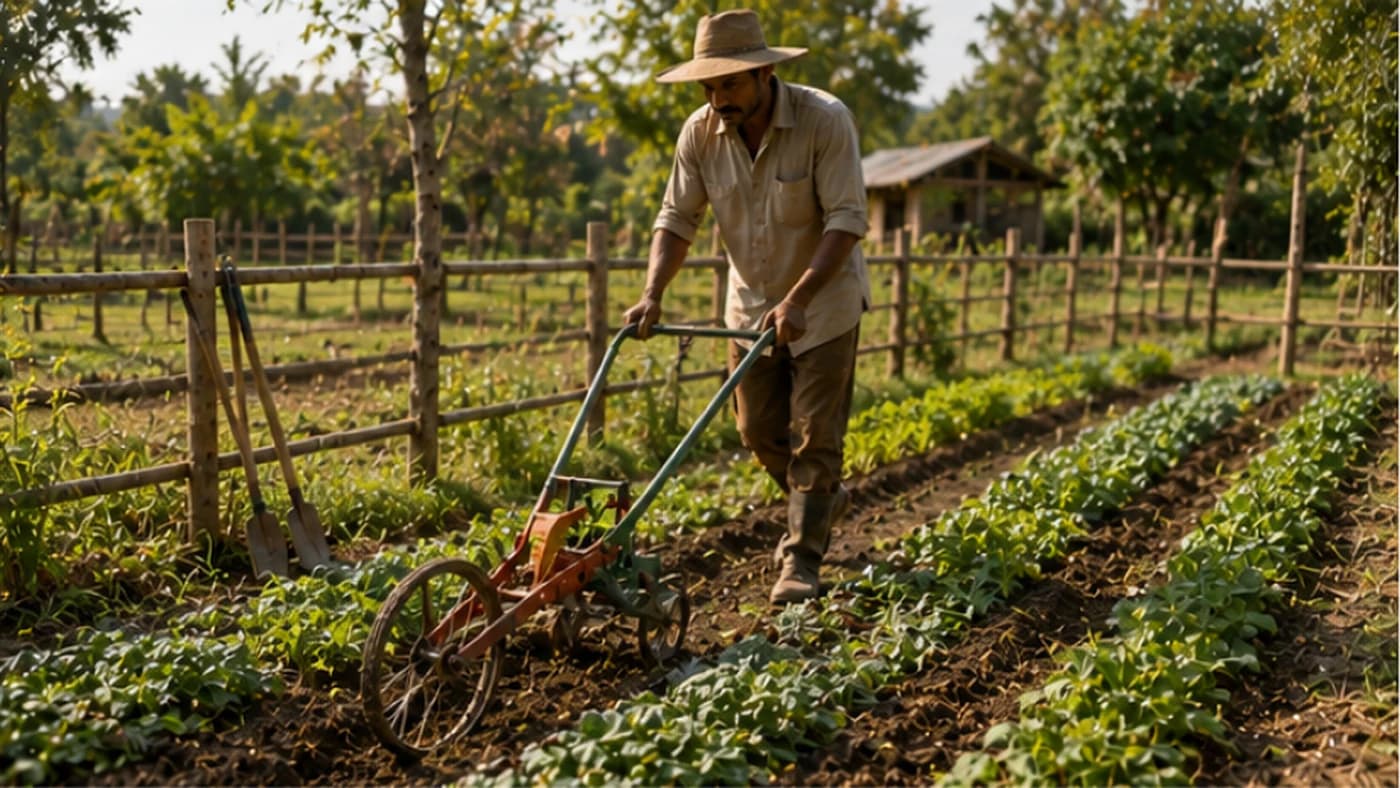
Most store-bought food carries a hidden fuel bill: it can take around 10 units of fossil-fuel energy — for synthetic nitrogen, diesel-run tractors, and refrigerated transport — to deliver just 1 unit of food energy to a plate. That ratio means your grocery bill rides on global oil and gas markets whether you notice it or not. Fossil-fuel-free food production flips the equation: instead of ancient, buried sunlight (oil and gas), it runs on the sunlight falling on your land today, converted through compost, legumes and manual tools rather than synthetic inputs and machinery. It isn't a new invention — it's close to what India's natural-farming movement (Zero Budget Natural Farming and its relatives) has been rebuilding for years, described here with a slightly different vocabulary.
The two pillars: living soil and nitrogen from the air
The first step is treating soil as a living organism rather than a dead substrate that just holds a plant upright while you feed it liquid chemicals. Building soil health means leaning hard on organic matter — aged farmyard manure, leaf mould, kitchen scraps — to feed a thriving microbial community, the same principle behind compost-and-cover-crop systems everywhere.
The second pillar is nitrogen. Instead of buying urea or ammonium nitrate — both products of the energy-intensive Haber-Bosch process — plant legumes like peas, beans, cowpea or clover. Their roots host rhizobia bacteria that pull nitrogen straight from the air and fix it in the soil for the next crop. The classic North American 'Three Sisters' planting (corn, beans and squash, where the beans feed the heavy-feeding corn) is one example of this principle in action — and it sits right alongside India's own long tradition of cereal-legume intercropping for exactly the same reason.
Decarbonising water
Many farms lean on diesel or electric pumps to draw water from deep aquifers. A solar-based approach instead uses gravity-fed systems, rooftop rainwater harvesting, and swales — level trenches dug along the land's contour — to catch water and let it soak into the ground, cutting the need for active pumping and keeping a garden resilient through dry spells without burning any fuel.
Tools that cut fuel out of the equation
A petrol-powered rototiller preps a bed fast, but it shreds the soil's fungal networks and creates a hardpan layer that blocks root growth. A broadfork aerates deeply without turning the soil over, keeping structure intact and carbon locked in the ground. Manual tools like the scythe and sickle are highly efficient for small-scale grain or fodder cutting — a sharp scythe can clear an acre of grass in a day with zero emissions. On larger holdings, draft animals such as bullocks offer a genuine middle ground between hand labour and heavy machinery: unlike a tractor, an animal runs on home-grown fodder, and its manure closes the nutrient loop instead of leaving the farm as exhaust.
A useful low-tech toolkit: a broadfork for deep aeration without destroying soil biology; a scythe for cutting grain or grass for mulch; a wheel hoe for efficient manual weeding and furrowing; a hand seed drill for precise, waste-free sowing; and a solar dehydrator that uses sun and airflow alone to preserve harvest for the lean season.
Extending the season without a fuel bill
Instead of a propane- or electric-heated greenhouse, a passive solar design uses a heavily insulated back wall and a sun-facing glass or polycarbonate slope, with thermal mass — black-painted water drums or a stone wall — absorbing heat by day and releasing it slowly at night. Done well, this keeps a growing space well above outside temperature through winter with no utility bill at all, letting you start seedlings early or keep leafy greens going through the coldest months.
What you actually gain
Financial independence is the most immediate benefit — once synthetic fertiliser, pesticide and fuel purchases drop away, your production cost falls toward zero, letting a small producer stay viable even when commodity prices swing. Crops grown in biologically active, mineral-rich soil are often more nutrient-dense, and because you're not selecting varieties purely for their ability to survive long-distance shipping, you can grow older, open-pollinated varieties prized for flavour and nutrition. And there's a resilience dividend: a household producing even a meaningful share of its own food is far less exposed when fuel prices spike or supply chains falter.
The real costs: labour and patience
The biggest trade-off is labour. A litre of diesel packs the rough energy equivalent of hundreds of hours of human effort, so removing it from the equation means working smarter, not simply harder — and the common beginner mistake is taking on too much land before the soil and tools can support it. Start small, and lean on high-calorie, low-effort crops like potato, sweet potato and squash while you build capacity.
Soil transition takes real time too. Land that has run on chemical fertiliser for years usually has a dormant or thin microbial community, and it can take two to three seasons of heavy composting and cover-cropping before that biology fully wakes up — yields may lag and pest pressure may run higher during this window, which calls for patience rather than reaching for a quick chemical fix.
Pest management shifts from eradication to balance: seeing aphids should prompt you to ask where your ladybirds are, not reach straight for a spray. Building habitat for beneficial insects — flowering borders, undisturbed hedgerows — matters more than any single product, and even organic sprays like neem oil are best used as a last resort, since they can disrupt the very predator-prey balance you're trying to build.
Where the limits genuinely are
This approach is highly effective for vegetables, fruit and small-scale grain, but it runs into real limits with certain commodities — food from a very different climate will always cost energy to transport or grow under cover, and producing meat at scale without any fossil input needs a lot of pasture and disciplined rotational grazing. Local climate ultimately decides what you can grow without importing fertility or climate control from outside — the honest response is to work with what your land supports rather than force it to be something it isn't.
Industrial versus solar-based systems, compared
Industrial (fossil-fuel) system: roughly 10 units of input energy per 1 unit of food output; fertility comes from natural-gas-based synthetic NPK; primary tools are internal-combustion engines; seed is typically patented hybrid or GM stock; water is pumped from deep wells at high energy cost. Regenerative (solar-based) system: roughly 1 unit of human effort per 10 units of solar gain; fertility comes from photosynthesis via compost and legumes; primary tools are manual, animal-drawn or small-scale solar-electric; seed is open-pollinated and often home-saved; water comes from rainwater, gravity or swales.
Practical steps you can start this week
Stop tilling: every pass through the soil oxidises organic matter and kills the fungal networks that help roots absorb nutrients. A no-dig approach — cardboard and thick mulch laid over existing weeds — smothers unwanted growth while feeding earthworms, who do the tilling for you for free over a few months. Plant a living, nitrogen-fixing hedge of shrubs you can prune regularly, dropping the clippings straight onto beds as green manure — a 'chop and drop' system that cycles nutrients from deep roots to the surface with almost no labour. And save your own seed: seeds from your strongest, most pest-resistant plants gradually breed a landrace adapted to your exact microclimate, removing one more dependency on the commercial supply chain.
Simple homemade pest-control recipes: garlic and chilli spray (blend two garlic bulbs and two hot chillies into a litre of water, steep 24 hours, strain, and spray to repel aphids and beetles); a milk spray for mildew (mix 1 part raw milk to 9 parts water and spray on squash or cucumber leaves to suppress powdery mildew); and nettle or similar leaf-tea fertiliser (soak stinging nettle or a comparable leafy weed in a bucket of water for two weeks, then dilute 1:10 for a high-nitrogen liquid feed).
Going further: livestock and agrivoltaics
Integrating livestock takes this a step further — chickens moved in a mobile coop over a finished bed will scratch out weeds, eat pest larvae, and leave manure behind, prepping the ground for the next crop at zero mechanical cost, and pigs can similarly clear heavy brush or turn over tubers in a wooded paddock. Agrivoltaics — mounting solar panels above shade-tolerant crops — is an emerging option for those with access to the technology: panels generate power for small tools or electric fencing while the shade they cast cuts water evaporation below, effectively harvesting the sun twice from the same plot.
A worked example
Picture a roughly 930 square-metre (quarter-acre) suburban plot that's currently a fuel-mowed lawn producing nothing edible. The owner converts about 185 square metres of it to no-till beds using a broadfork, and plants potato, beans and leafy greens for high calorie return and easy storage. A rooftop rain-collection tank feeds the beds by gravity, a small passive solar structure on the shaded side extends the growing season for tomato starts and winter greens, and a pair of rabbits in a movable pen manage the remaining grass while producing meat and manure. Within two growing seasons, this small plot can realistically supply a meaningful share of the household's produce needs with almost no ongoing fuel or fertiliser purchase.
Frequently asked
What does 'fossil-fuel-free food production' actually mean?+
Growing food using energy captured on-site from current sunlight — through compost, nitrogen-fixing legumes, manual or animal-powered tools, and passive solar design — instead of relying on natural-gas-based fertiliser, diesel machinery and long-distance fuel-powered transport.
Is this the same as organic farming?+
It overlaps heavily but goes further — organic farming mainly restricts which inputs you use, while a fossil-fuel-free approach also targets the energy used for tillage, water pumping, heating and transport.
How long before soil recovers after years of chemical fertiliser use?+
Typically two to three seasons of consistent composting and cover-cropping before the soil's microbial life fully recovers — yields and pest pressure can be less favourable during this transition, so patience matters.
What's the biggest practical challenge?+
Labour. Fossil fuel is extraordinarily energy-dense, so removing it means working smarter rather than simply harder — most beginners do better starting on a small, manageable plot with easy, high-calorie crops rather than scaling up too fast.
Can this fully replace all fossil-fuel inputs?+
Not entirely for every food — tropical produce grown in a very different climate, or meat produced at large scale, will still carry real energy costs. It works best as a direction to move toward, matched to what your local climate genuinely supports.
Where to go next
Want this as daily tasks for your farm?
Khetiyaar turns guides like this into a day-by-day plan — in your language, free to start.

Related guides
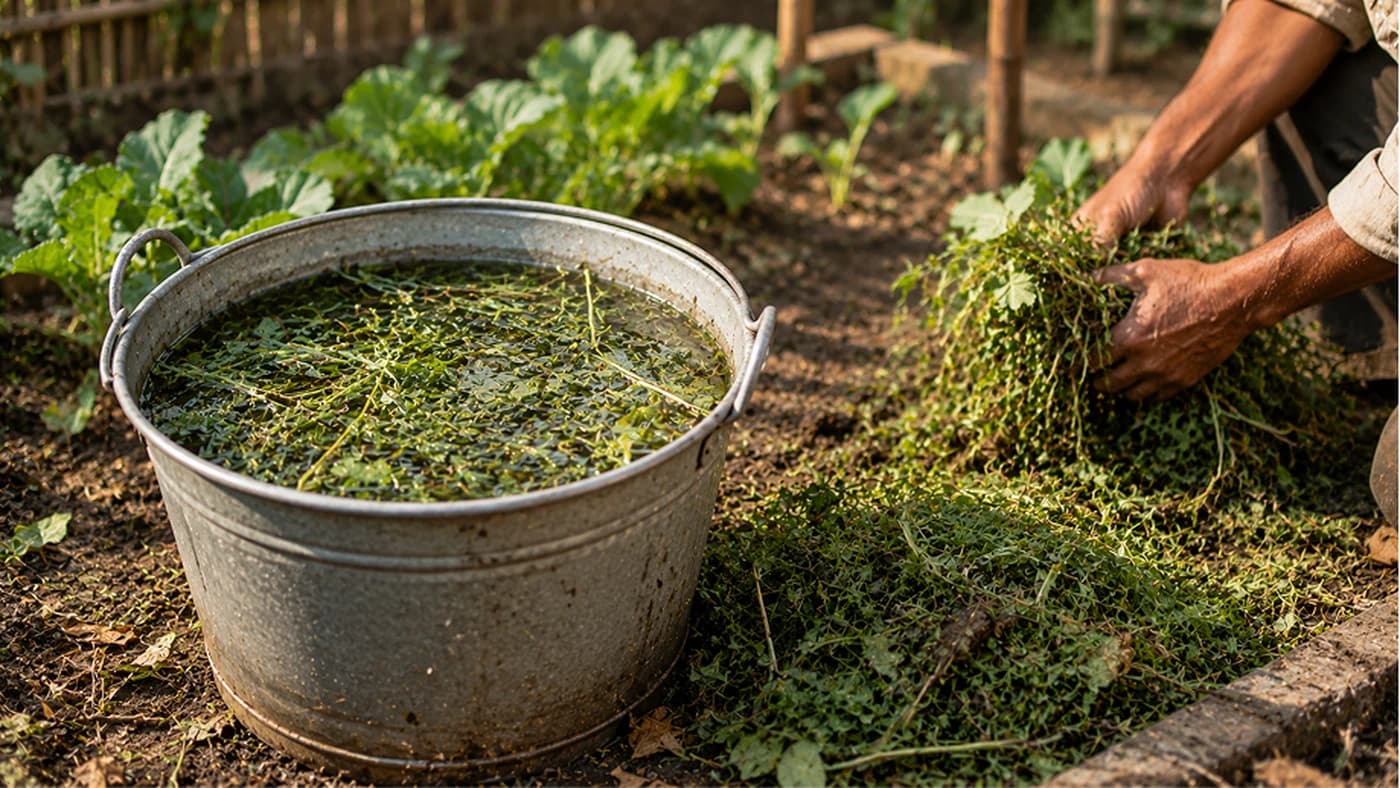
Free Garden Fertiliser From Backyard Weeds (Fermented Plant Juice)
The weeds growing wild along your bund or driveway are nutrient pumps. Korean Natural Farming's Fermented Plant Juice (FPJ) turns them — plus a handful of jaggery — into a potent, nearly free plant tonic.
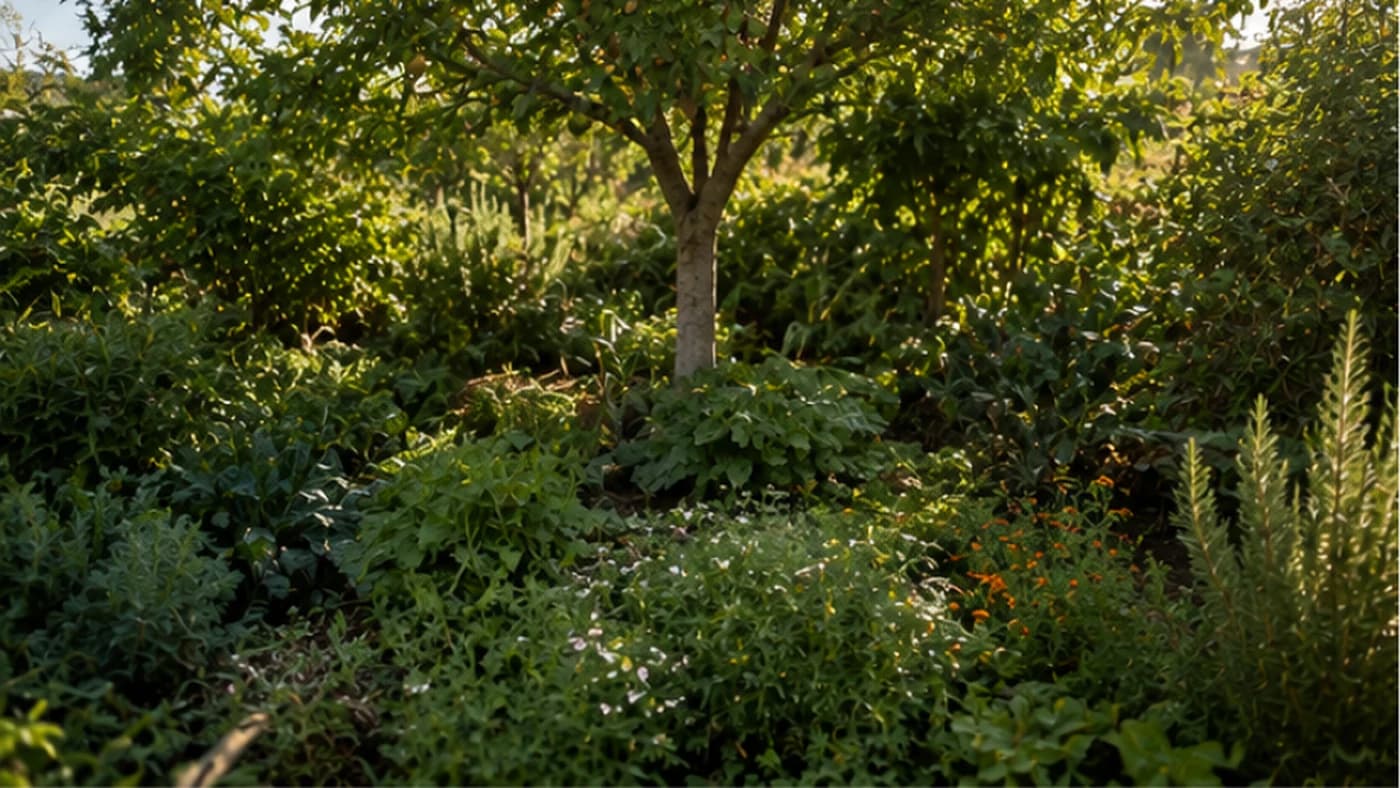
Multi-Layer Food Forest Design: Growing Seven Crops in the Space of One
A natural forest needs no fertiliser or hose, because every layer of it — from tall trees to root crops — fills a different niche. Stacking those same layers in your backyard or farm boundary can multiply what one plot of land produces.
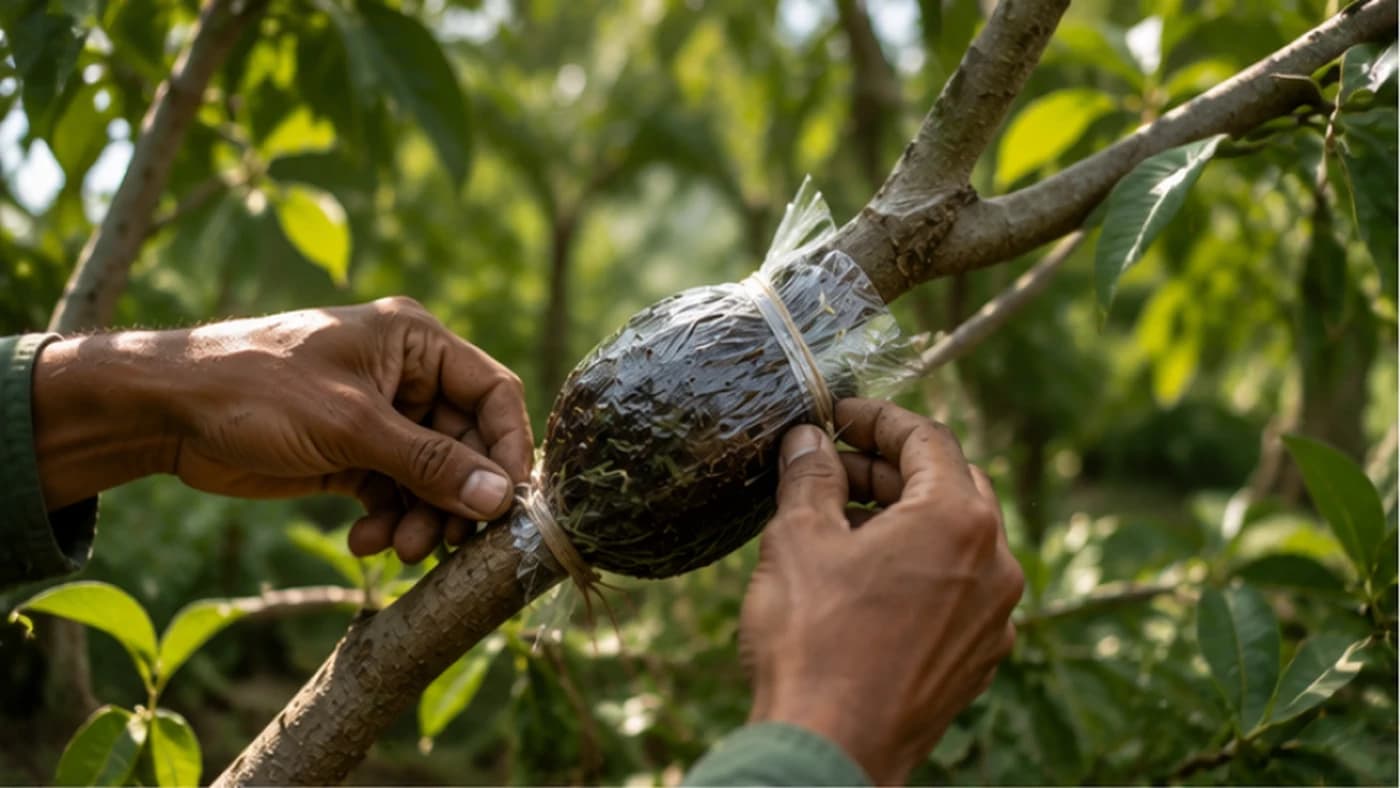
How to Multiply Fruit Trees for Free: Cuttings, Gootee and Grafting
One healthy branch and a bit of soil is often all it takes to turn a single fig, pomegranate or guava tree into an entire orchard — no nursery bill required. Here's how cuttings, air-layering (gootee) and grafting actually work.