

Earth-Sheltered Chicken Coop: Using the Ground to Keep Birds Cool in Summer and Warm in Winter
A coop built partly into the ground barely changes temperature between a 45°C afternoon and a cold winter night. Here's how earth-sheltering works and how to build one for your flock.
Quick answer
An earth-sheltered coop is a one-time investment of labour for a lifetime of stable temperatures — cooler through brutal Indian summers, warmer through genuinely cold hill winters, quieter, more predator-proof, and free of any electricity bill. Get the drainage and ventilation right from day one, since those two details separate a coop that lasts fifty years from one that rots or poisons its own air within a season.
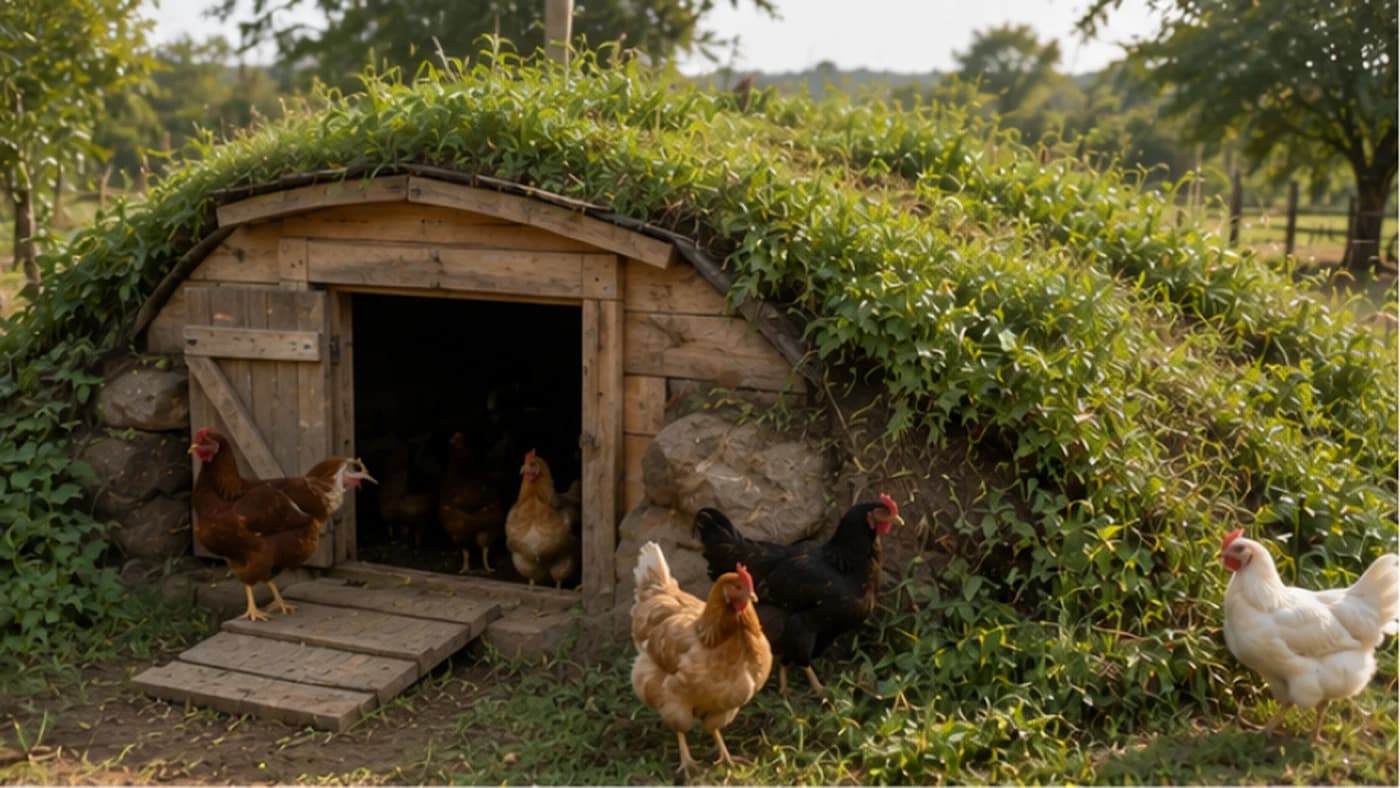
Most poultry keepers fight the weather with electricity — heat lamps in winter, fans and coolers in summer. An earth-sheltered coop, historically called a Garth or bank coop, takes a different approach: build partly into the ground, and let the earth's naturally stable temperature do the work. A few feet below the surface, soil temperature barely moves regardless of the blizzard or heatwave above — which matters enormously in India, where summer heat stress is one of the biggest, least-discussed killers of egg production, and where hill regions of Himachal, Uttarakhand, Kashmir and the Northeast face genuinely cold winters. This is a build-once shelter that works with the ground instead of fighting the sky.
What an earth-sheltered coop is
An earth-sheltered coop is a structure built partly or fully into a bank of earth, so soil on three sides (and often the roof) acts as insulation and thermal buffer. The design has been used for millennia in pit-houses and bank dwellings across many cultures, for one simple reason: dig deep enough, and the ground holds a nearly constant temperature — around 13°C — no matter what the air is doing above it.
For poultry this solves two problems at once: extreme heat and extreme cold. A thin metal or wood coop can swing by 20°C or more in a single day, but an earth-sheltered structure might vary by only 2-3°C, which sharply reduces heat stress on the birds and keeps egg-laying steady through both a heatwave and a cold snap.
Picture it as a cellar with a glass front: one side — ideally facing south in the northern hemisphere, which includes all of India — stays open to let in light and some sun, while the other three sides and often the roof are banked with earth, creating a space that stays bright, dry and insulated from both scorching wind and biting cold.
Why this matters especially for Indian summers
In most of India, the bigger poultry killer is heat, not cold — birds go off lay, eat less and can die during long 40-45°C spells, especially in Vidarbha, Marathwada, Rajasthan, Telangana and the Gangetic plains. The same thermal-mass principle that keeps a Garth warm in a European winter keeps it noticeably cooler in an Indian summer, because the earth pulls heat away from the structure just as reliably as it releases stored warmth on a cold night.
In the colder hill states — Himachal Pradesh, Uttarakhand, Jammu & Kashmir, Ladakh, and the higher parts of the Northeast — the same structure earns its keep in winter instead, keeping water from freezing and birds from huddling and losing condition through the cold months.
The science: thermal mass and the frost/heat line
Thermal mass is a material's ability to absorb and slowly release heat. Soil, concrete and stone all have high thermal mass — on a sunny day the earth around the coop absorbs heat and releases it slowly after dark, so the coop is warmest exactly when birds need it most: at night. In summer the same process runs in reverse, with the cool subsoil pulling heat out of the structure through the day.
This is different from ordinary insulation, which only slows heat movement without storing any of it. Earth-sheltering does both: it insulates and it banks heat (or coolness) for later release. To get the benefit reliably, the floor should sit below the point where ground temperature stops swinging with the surface — typically 0.9-1.2 metres down in most soils — and the open face of the coop should point south for light and, in colder regions, useful winter sun.
How to build one
Site and drainage: never build at the bottom of a slope — a buried structure in a low spot becomes a swimming pool in the monsoon. Choose a gently sloped or raised site, and dig a gravel-filled drainage trench (a French drain) leading water at least 3 metres away from the structure.
Excavation: a 3x3 metre footprint comfortably houses 10-12 birds. Dig deep enough that at least three sides are backed by 1.2 metres or more of earth.
Walls: ordinary wood framing will not survive the load of packed earth — use concrete blocks, stone, or earthbags, and seal the outward-facing surface with a waterproof membrane (a thick rubber liner or bitumen coating) to stop moisture creeping through.
Front wall and roof: the open (south-facing) wall should be largely glass or heavy-duty clear polycarbonate with adjustable vents, acting as a solar collector. The roof needs a generous overhang to block the high summer sun while still letting in the lower winter sun; a simple sheet roof or a living/sod roof both work, provided the rafters are sized for the extra weight.
The real benefits
No dependence on electricity for heating or cooling — a major advantage anywhere with an unreliable grid, since power cuts during a heatwave or cold snap are exactly when birds are most at risk. Predator protection is strong by default, since three sides of solid earth are far harder to dig or chew through than wire or wood; burying wire mesh about 30 cm deep along the open front stops most digging predators.
The earth also muffles sound, which helps if a rooster's crow is a concern for neighbours, and the structure is simply more durable — a masonry-and-earth coop can last 50 years or more, against roughly 5-10 years for a typical wood or thin-metal coop, at the cost of more labour and material up front.
Mistakes that cause real problems
Moisture is the biggest risk: because the coop runs cooler than the outside air in summer and warmer in winter, condensation forms on the walls without enough airflow, and trapped humidity concentrates ammonia from droppings to levels that damage birds' lungs permanently. Never sacrifice ventilation to save warmth.
Poor drainage is the second most common failure — underestimating how much water moves through soil after heavy rain leaves the floor a muddy mess that rots bedding and breeds disease, so the gravel drain described above is not optional. Where a concrete wall is partly buried and partly exposed, insulate the exposed lip; otherwise cold travels down the wall into the coop (thermal bridging).
Ammonia is heavier than air and settles near the floor in a sealed structure, so design ventilation to pull air in low and vent it out high, creating a gentle chimney effect that keeps air moving even without wind.
When earth-sheltering is not a good fit
If your water table sits within about a metre of the surface, skip this design — you will be fighting rising groundwater instead of benefiting from stable soil temperature, and a simple raised coop is the safer choice in flat, waterlogged land. Solid rock makes excavation cost far more than the energy savings justify, while pure loose sand lacks the structural strength to hold a bank without expensive retaining walls — the best sites have deep, stable soil on a gentle slope.
Cleaning is also harder than hosing out a standard coop, so build wide doors and enough headroom for a person to move and clean comfortably — a coop that's a chore to clean will be neglected, and the birds will suffer for it.
Practical tips
Use the deep-litter method on the floor: start with about 15 cm of straw or dry leaves and top it up as it breaks down — the slow composting underneath adds a small amount of its own warmth. Paint interior walls white to bounce available light into every corner and discourage mites, which prefer dark crevices.
For passive ventilation, bury long pipes ('earth tubes') 1.2-1.8 metres deep running from an inlet about 6 metres away, so incoming air is pre-warmed in winter and pre-cooled in summer before it reaches the birds. Place roosts toward the back of the coop where thermal mass is steadiest, fit a well-sealed, insulated door, and in very windy sites add a small airlock-style entry porch.
Advanced option: pairing with an underground greenhouse
Serious homesteaders sometimes pair an earth-sheltered coop with an underground greenhouse (a walipini): birds exhale carbon dioxide that plants use to grow, plants return oxygen, and each bird acts like a small heater, helping protect winter vegetables from frost. Chickens can also be let into the greenhouse in the off-season to till soil and add nitrogen-rich manure. It's a closed-loop system that needs careful planning around smell and keeping birds away from seedlings, but it is one of the most efficient combinations in small-scale permaculture design.
Frequently asked
What temperature does an earth-sheltered coop stay at?+
Deep enough underground, soil holds close to 13°C year-round, so a well-built coop typically stays within a narrow band of that — far more stable than a thin wood or metal coop, which can swing 20°C or more in a single day.
Is this design more useful for heat or cold in India?+
Both, depending on your region — it's especially valuable for reducing summer heat stress in the hotter plains, and for keeping birds and water from freezing in the colder hill states.
How deep does the coop need to be built?+
At least 0.9-1.2 metres of earth on three sides for the thermal benefit to kick in, with the floor ideally below that same depth.
Where should this design NOT be used?+
Avoid it where the water table is within about a metre of the surface, on solid rock, or on loose sand without retaining walls — all of these make it either unsafe or not worth the cost.
What's the biggest risk with an earth-sheltered coop?+
Poor ventilation. Trapped moisture and ammonia buildup can damage birds' lungs, so airflow must never be sacrificed to save warmth.
Where to go next
- AI farming chatbotAsk any farming question in Gujarati, Hindi or English and get an answer in seconds.
- Kheti app for Indian farmersCrop plans, disease diagnosis, weather and mandi rates in one app.
- Agri Bazar marketplaceBuy and sell animals, crops, equipment and dairy near you — and see what buyers want today.
Want this as daily tasks for your farm?
Khetiyaar turns guides like this into a day-by-day plan — in your language, free to start.

Related guides
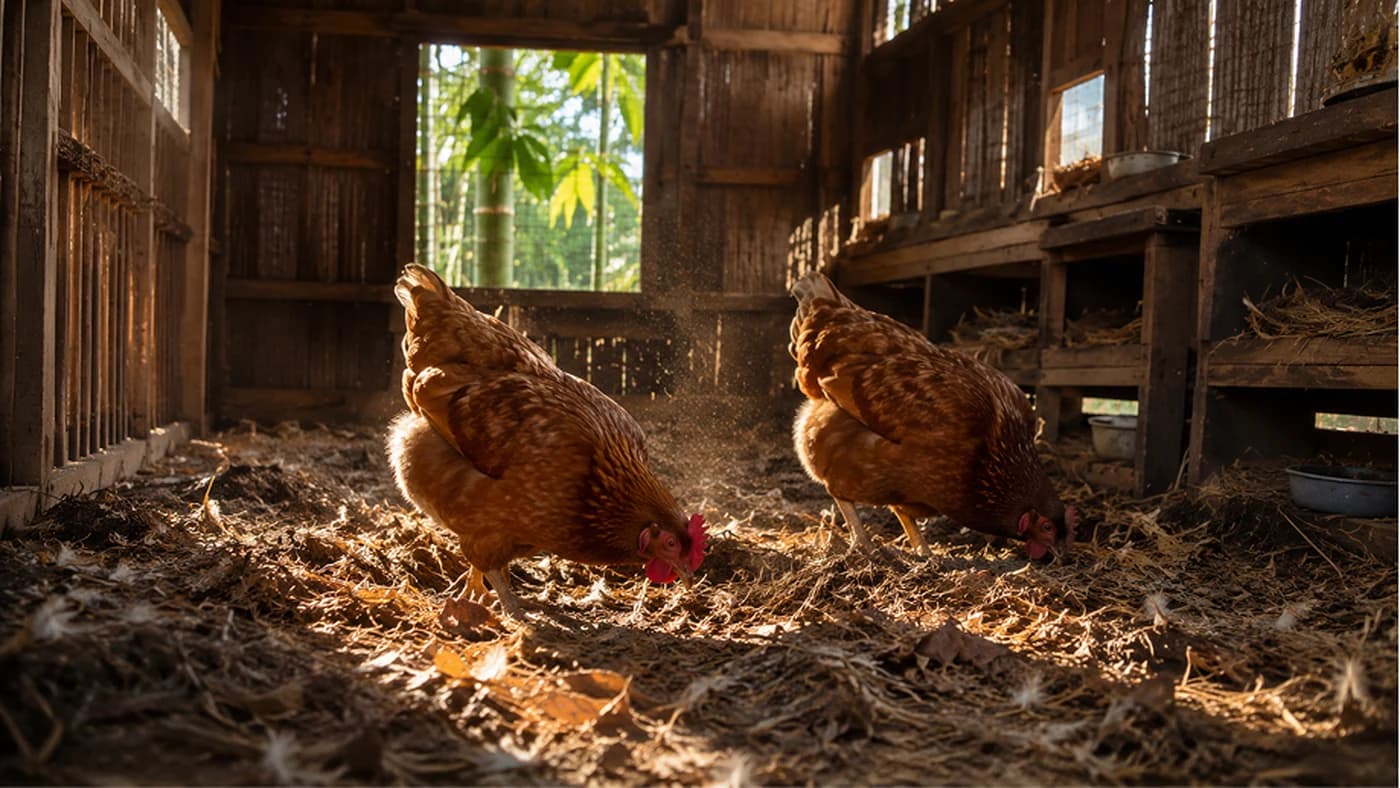
Deep Litter Method: Turn Your Chicken Coop Into a Living Compost System
A scrubbed, bare coop floor is a wasted opportunity. Let a thick carbon bed and billions of microbes do the composting for you — less labour, healthier birds, and free fertiliser for the field.
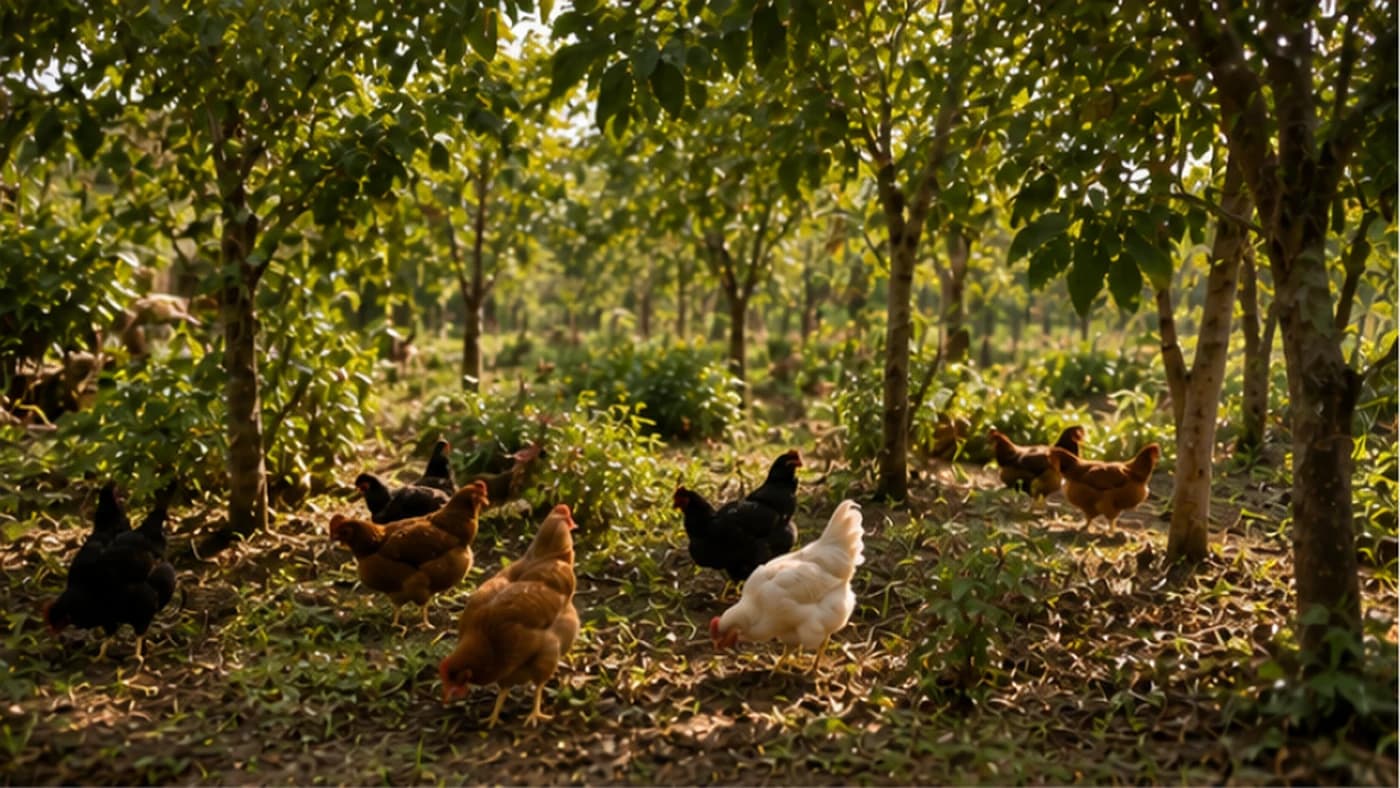
Chicken Forest Design: Cut Your Feed Bill by Letting Birds Forage a Food Forest
A bare chicken run is a nutrient waste site you pay to feed. A layered food forest built around your flock turns droppings into fertiliser and fallen leaves into free protein — cutting grain costs by 30-50%.
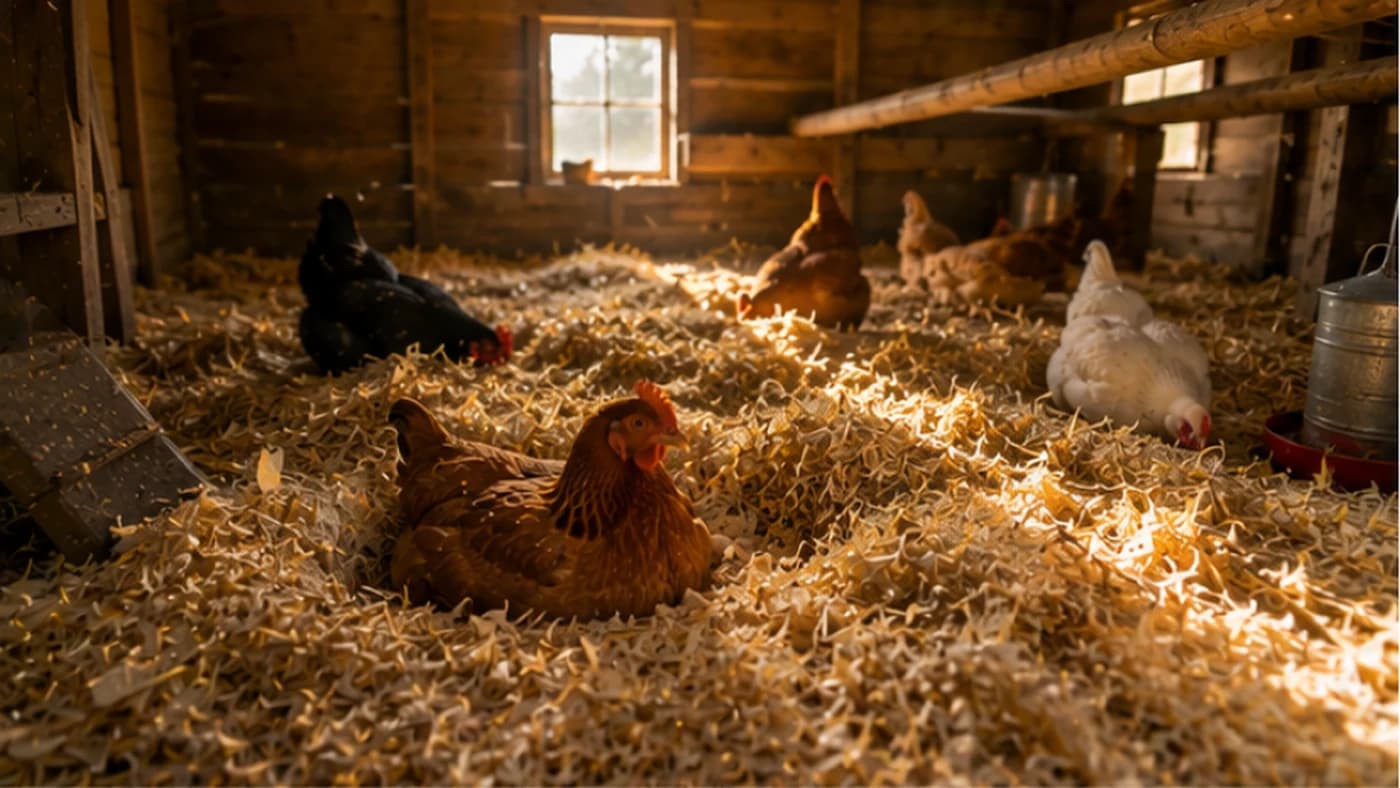
The Deep Litter Method: Stop Cleaning Your Coop Every Week and Start Composting It Instead
Scooping and hauling manure out of a coop every week is exhausting and throws away free fertiliser. The deep litter method lets bedding and droppings build up and compost in place — less labour, better bird health, and a bucket of garden gold every season.