

Choosing a Dairy Breed in India: Gir, Sahiwal, Crossbred, Murrah — and How to Decide
Indigenous, crossbred and buffalo dairy breeds each solve a different problem. This guide explains what Gir, Sahiwal, Tharparkar, HF and Jersey crosses, Murrah and Mehsana actually offer — and gives you a practical framework for deciding which one fits your district, your fodder and your management.
Quick answer
There is no single best dairy breed in India, only the breed that matches your heat, your fodder, your market and your management. Indigenous breeds like Gir, Sahiwal and Tharparkar yield less than a well-managed crossbred but hold their production under heat, coarse fodder and thin veterinary cover. An HF or Jersey cross carries higher genetic potential, but that potential is an obligation you must fund daily in green fodder, cooling, minerals and prompt service — and it collapses fastest where those are missing. Buffalo breeds like Murrah and Mehsana pay off where the market rewards fat and someone is watching the animals closely enough to catch heat. Decide from your own conditions, confirm with your district animal-husbandry office and KVK, and then judge the individual animal — its udder, its mother's record and its calving history — not the breed name on the deal.
Ask ten people which is the best dairy cattle breed in India and you will get ten confident answers, most of them wrong for your farm. The reason is that a breed is not a quantity of milk. It is a package — genetic potential for yield, tolerance of heat and humidity, resistance to ticks and disease, appetite and feed demand, temperament, fat percentage in the milk, and how regularly the animal breeds back. That whole package either fits the conditions on your farm or fights them every single day. An animal that tops the charts on a well-run farm in a cool district with year-round green fodder can be the same animal that quietly drains a household in a hot, humid district where May brings nothing but dry straw. This guide walks through the breeds that actually matter to Indian dairy farmers, explains the one trade-off that sits underneath the whole decision, and ends with a set of questions about your own farm that will get you to an answer far more reliably than any national ranking.
There is no single best breed — only the best breed for your conditions
The most useful idea in this entire subject can be stated in one line: genetic potential sets a ceiling on what an animal can give, but your management decides how close to that ceiling you actually get. Two farmers can buy full sisters from the same herd, and one will get comfortably more milk than the other for years — same genetics, different feeding, different water, different shade, different observation. This is why national breed rankings mislead. They report what a breed can do when everything else is right. They tell you almost nothing about what it will do on your farm, in your summer, on your fodder.
So the honest way to approach the question is backwards. Instead of asking which breed gives the most milk, ask what conditions you can reliably provide — and then choose the animal whose requirements sit comfortably inside those conditions rather than just outside them. An animal working comfortably inside your capacity is profitable. An animal permanently stretched beyond it is a running loss, and usually the first one to fall sick.
A second point worth settling early: buy for a herd you will actually keep, not for one impressive animal. A dairy household earns from lifetime milk across many lactations, not from a single peak yield. An animal that calves regularly, stays healthy, raises a good heifer calf and gives moderate milk for many years earns more than a higher-yielding animal that misses heats, has a long gap between calvings, and needs veterinary attention every few months.
The real question: higher yield potential, or higher hardiness?
Indigenous zebu dairy breeds give less milk than a well-managed crossbred cow. That is simply true, and pretending otherwise does no farmer any favours. What is equally true, and said far less often, is that indigenous breeds hold on to their production when conditions turn difficult, while crossbreds fall away fastest exactly when you can least afford it. In a punishing summer, on coarse dry fodder, with a veterinarian two days away and ticks in the shed, the desi cow's output sags — and the high-potential crossbred's output collapses.
This is not folklore, and it is worth understanding the mechanism rather than just accepting the claim. Zebu cattle evolved in hot climates and carry the physical equipment to match: loose, mobile skin and a heavy dewlap that increase the body surface available for losing heat, a short glossy coat that reflects sunlight rather than absorbing it, more numerous and more active sweat glands, and a lower resting heat production per unit of body weight. They also tend to be markedly less attractive to ticks and to shrug off tick burdens that would pull down an exotic animal, and they generally cope better with the ordinary background of parasites and infections in an Indian village shed.
Holstein Friesian and Jersey, by contrast, were shaped by temperate European conditions. Push either of them past a certain combination of heat and humidity and a predictable chain begins: the animal stops eating enough, starts breathing hard and standing rather than lying, milk drops, and — the expensive part — it stops showing clear heat and stops conceiving. A cow that does not get in calf on time is a cow whose whole next lactation is delayed, and that costs far more than the milk lost in the hot weeks themselves.
So the trade-off is really this: higher genetic potential is not a gift you receive, it is an obligation you take on. The extra milk is real, but it has to be paid for every day in green fodder, clean water, shade and air movement, balanced concentrate, mineral mixture, tick control and prompt veterinary attention. Where you can genuinely pay that bill, a crossbred is the more profitable animal. Where you cannot, it will underperform a good indigenous cow while costing you considerably more to keep — and considerably more to lose.
Gir, Sahiwal and Tharparkar: what the indigenous dairy breeds actually offer
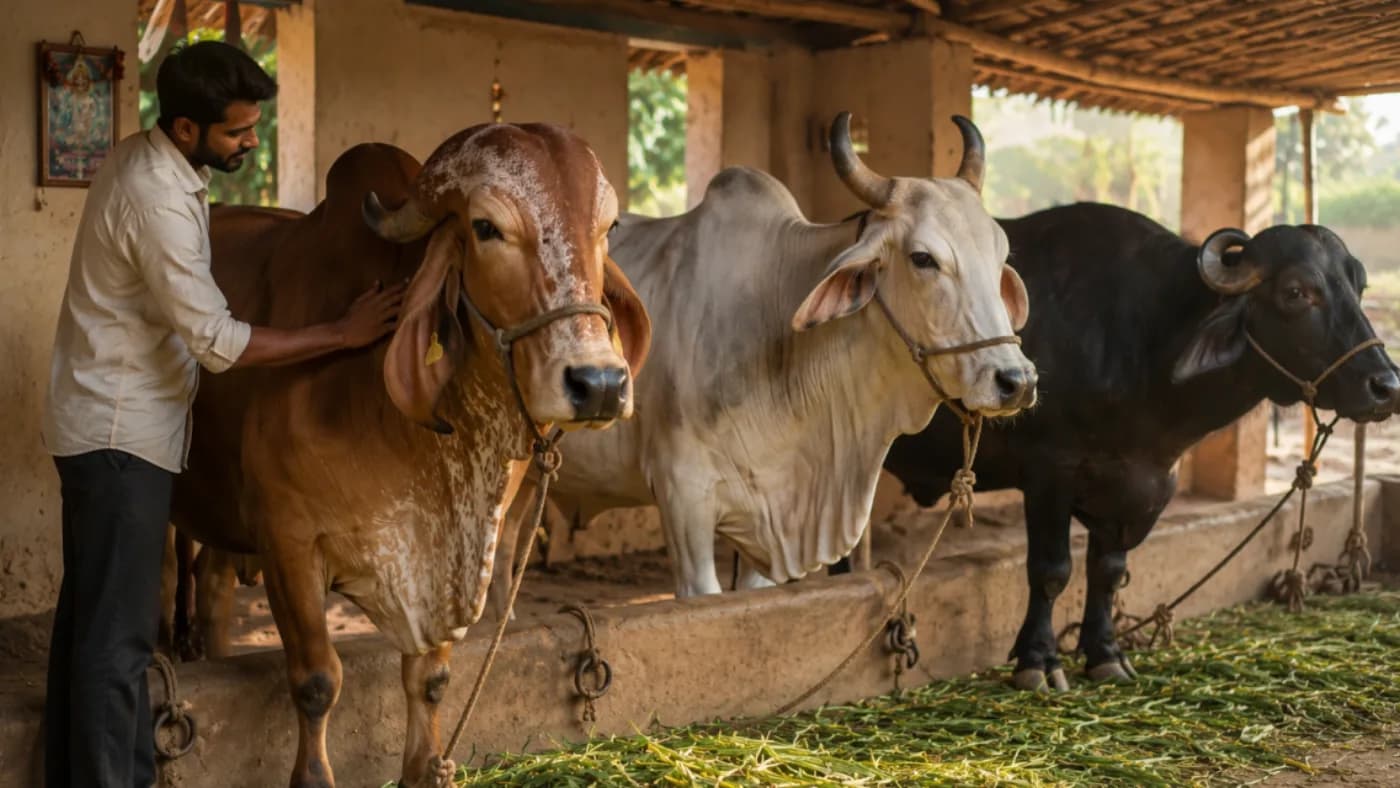
Gir comes from the Saurashtra region of Gujarat and is one of the most recognisable cattle in India: a distinctive domed, convex forehead, long pendulous ears that curl at the tip, and a coat that ranges from white with red or chocolate patches through to almost solid red. It is a genuinely hardy animal — notably heat tolerant, unusually tick tolerant, an active grazer that walks well and forages for itself, and famously docile. That last point is not a sentimental detail. A quiet cow that any member of the household, including women and older family members, can milk and handle safely is worth real money in labour terms, and it is one of the reasons Gir has spread well beyond Gujarat and has been used in breeding programmes abroad, notably in Brazil. There is also active market interest in A2 milk from indigenous breeds such as Gir, and some buyers pay a premium for it — but that premium only exists if a buyer near you actually pays it. Treat it as a bonus where it exists, not as the reason to buy the animal.
Sahiwal is the highest-yielding of the indigenous zebu dairy breeds and, for most farmers who want a desi cow but do not want to give up too much milk, it is the obvious first candidate. It originated around the Sahiwal tract of the Punjab region and is now bred across north-western India and well beyond. It is a heavy, loose-skinned animal, reddish-dun to pale red, with a pronounced dewlap and a well-developed udder. Its real strength is performance under low input: Sahiwal keeps milking respectably on ordinary fodder and ordinary care, tolerates heat, resists ticks, and has a calm, easy temperament. If your conditions are hot but not desperate, and your management is decent but not intensive, Sahiwal is often the breed that gives the best return on what you are actually able to provide.
Tharparkar comes from the arid Tharparkar tract on the margin of the Thar desert and is built for scarcity. Typically white to grey, medium-framed and hard-hooved, it was shaped by long walks to water, sparse thorny grazing and long dry spells between rains. It will not out-milk a Sahiwal under good feeding, but that is not the comparison that matters where it belongs. In a genuinely dry district, where green fodder is a monsoon luxury and animals must forage widely for months on crop residue and browse, Tharparkar's ability to keep producing on whatever is available beats a higher ceiling you will never reach. Its browsing habit also pairs naturally with fodder trees, which our tree fodder guide covers in detail — in dry-land systems, tree leaves are often the only green feed available in the months when it is needed most.
One caution applies to all three. The word indigenous on a deal guarantees nothing. Within every one of these breeds individual animals vary enormously, and a great deal of non-descript cattle is sold with a respected breed name attached to it. The breed on the label matters much less than the animal standing in front of you and the milking record of its mother.
Why so many desi breeds are built for toughness rather than peak milk
It helps to know why indigenous breeds look the way they do, because it reframes the complaint that they give less milk. For most of the period during which these breeds were formed, the male calf was the commercially important one. Bullocks ploughed, drew water and pulled carts, and a household's prosperity depended heavily on the pair of bullocks in its shed. Breeds such as Tharparkar, Kankrej and Hariana — and Gir to a real extent — were therefore selected as dual-purpose animals: strong legs and feet, a frame that could work in heat, the ability to keep condition on poor feed, and cows that reliably produced a good working son and enough milk for the family. Nobody was selecting them for maximum saleable milk, because that was not what the household was selling.
Tractors and pumps changed the value of the male calf almost completely within a couple of generations, but genetics do not turn on that timescale. Today's Gir or Tharparkar cow still carries the hardiness, the appetite discipline and the sound feet that centuries of that selection built in. Judging her only on litres is judging her by a yardstick she was never bred to. The practical lesson is not nostalgia — it is that when you buy an indigenous animal you are buying resilience that was deliberately bred in, and you should site her and manage her in the conditions where that resilience is worth something.
HF cross and Jersey cross: buying yield, and the obligation attached to it
Notice that farmers and extension staff almost always talk about a crossbred rather than a pure exotic cow, and that is deliberate. Crossing an indigenous cow with Holstein Friesian or Jersey genetics lifts milk yield well above the indigenous parent while retaining a useful share of the zebu side's heat tolerance, tick resistance and ability to make use of coarse fodder. A pure HF or pure Jersey herd in most of plains India spends a large part of the year heat-stressed, and the milk you gain on paper is given back in poor summer intake, weak fertility and higher losses. The cross is the compromise that actually works, which is why India's dairy improvement effort has largely been built on crossing local cows using artificial insemination rather than on importing pure exotic animals. The specific breeding programmes, the semen available at your local centre and the breeds recommended for your district are decided by state animal-husbandry authorities and are revised from time to time — confirm the current position with your nearest veterinary dispensary or district animal-husbandry office rather than assuming.
An HF cross is the larger-framed of the two and gives the most volume of any animal commonly within reach of a smallholder — but at a lower fat percentage than either a Jersey cross or a buffalo. It also eats the most, drinks the most, occupies the most shed space, and feels the heat more than any other option here. It is the least forgiving animal on this list: miss the green fodder for a fortnight, let the water trough run dry in the afternoon, delay a veterinary visit, and the loss shows up quickly and takes a long time to recover.
A Jersey cross is smaller-bodied, and almost every practical consequence follows from that. It eats less, needs less shed space, handles heat somewhat better than an HF cross, and is easier for one person to handle and milk. Calving tends to be easier. It gives less volume than an HF cross but at a higher fat percentage, which matters directly if your society or buyer pays on fat. For a household with limited fodder land, limited labour and a fat-based payment system, a Jersey cross is frequently the better economic fit even though it is not the higher-yielding animal.
The important variable that farmers often do not ask about is how much exotic inheritance the animal actually carries. Push the exotic share high enough and most of the zebu heat tolerance and disease resistance is gone, leaving an animal that needs active cooling, consistent green and dry fodder in balance, properly formulated concentrate, mineral supplementation, systematic tick and fly control, and a veterinarian and inseminator who genuinely turn up. Where all of that is in place, such an animal is the most profitable option available. Where any one of it is missing, it is the option that fails first. Ask the seller and, better, the local inseminator what the animal's breeding actually is before you decide.
Murrah and Mehsana: the buffalo breeds worth knowing
Murrah, from the Haryana and Punjab region, is the benchmark buffalo dairy breed and by some distance the most widely used buffalo for improvement work across India and in several other countries. It is unmistakable: jet black, with short, tightly curled horns and a well-developed udder on a heavy, deep body. Its milk carries a high fat percentage, which is the whole commercial point — where payment is on fat and SNF, that fat converts directly into a better rate, and it is why buffalo milk underpins so much of India's ghee, khoa and paneer trade. Murrah is a demanding animal in one specific way, though: buffalo have few sweat glands and a dark hide, so they suffer in direct sun far more than cattle do. A properly shaded shed and either a wallow or reliable sprinkling through the hot hours is not a comfort for a buffalo, it is a production input.
Mehsana was developed in the Mehsana area of north Gujarat from crossing Surti and Murrah animals, and it shows both parents: slightly lighter than Murrah, black to black-brown, with horns that are less tightly curled and often more sickle-shaped. Two of its characteristics are genuinely valuable and often overlooked. First, it tends to have a more persistent lactation — it holds its daily milk steadier for longer through the lactation instead of peaking sharply and then falling away. Second, under some conditions it breeds back more regularly than Murrah, giving a shorter gap between calvings. Both traits are worth real money over an animal's lifetime, because a buffalo that comes into heat on schedule, conceives, and completes a normal roughly nine-month pregnancy delivers more lifetime milk than one with a higher peak and a long, unproductive dry period after every calving.
One buffalo-specific management point deserves emphasis regardless of which of the two you choose. Buffalo commonly show heat far less obviously than cows do — often quietly, often at night, and more so in the hot months. Missing it is the single most common reason a good buffalo turns into a disappointing one. Whoever handles your animals has to be watching for the subtler signs, and you need to be able to call an inseminator at short notice. If nobody in the household is in a position to observe the animals closely twice a day, that is an argument for a cow rather than a buffalo, independent of any breed comparison.
Buying the animal: what to look at, and who to ask first
Before you go anywhere near a cattle market, go to your local veterinary dispensary, the district animal-husbandry office and the nearest Krishi Vigyan Kendra (KVK) and ask what they recommend for your specific area. This advice is worth more than any national list, because those officers know your district's summer, its fodder calendar, its disease pressure, and what the nearby dairy actually pays for. They will also know which breed-improvement and animal-distribution programmes are currently operating locally. Those programmes are run by state authorities, differ substantially between states, and are revised from time to time, so the only reliable source for what is available to you today is the local office itself.
When you are looking at an actual animal, start with the udder, because it is where most of your money will be made or lost. You want a wide udder, well attached to the body, carried up and level rather than hanging pendulously below the hock, with four evenly spaced, sound, functional teats of moderate length. The skin should be soft and pliable, and the milk veins running forward along the belly should be prominent. A deep, swinging pendulous udder is more easily injured, more often stepped on, and more prone to mastitis, and no amount of current milk makes up for that risk over several lactations. Insist on hand-milking the animal yourself, at a normal milking time — and if you can, come back for the next milking and see what she gives then, not just the one measured for your benefit.
Then ask about the family. What did her mother give, and over how many lactations? If the household is connected to a cooperative dairy, the milk society records are a far better guide than anyone's recollection. If artificial insemination was used, ask for the sire details. Check her age from her permanent incisors and cross-check it against the number of calvings she is said to have had — an animal in her first or second lactation has most of her productive life still ahead of her, while a much older animal with several calvings behind her is a shorter investment however good she looks today. Ask specifically about the gap between her previous calvings, because a persistent history of long gaps is a fertility problem you will inherit.
Look at general condition with a sceptical eye: bright eyes, clean muzzle, a smooth coat rather than a staring rough one, no persistent cough or nasal discharge, no lameness, no hard or lumpy quarters in the udder, normal dung, and sound hooves. Watch her get up from lying down and walk a few steps — many problems only show in movement. Ask about vaccination and deworming history and then confirm what she actually needs with a veterinarian; vaccination schedules are set by state animal-husbandry departments, vary between states and are revised periodically, so the local dispensary is the place to get the current position rather than a seller's assurance. Never treat an animal yourself on the basis of a symptom list. Anything beyond obvious good or poor condition is a veterinarian's call, and the cost of having a veterinarian examine an animal before purchase is trivial against the cost of buying a sick one.
On timing, prefer to buy an animal that is in milk, and ideally freshly calved. An in-milk animal lets you see with your own hands what she actually gives, and she starts earning from the day she reaches your shed. A dry or pregnant animal is cheaper, but you are buying a claim rather than a demonstration, and you carry the feeding cost for months before any income arrives. Whatever you buy, change her feed gradually over a week or two rather than abruptly, give her clean water she will actually drink, and keep her separate from your existing animals for a while — both to watch her settle and to avoid importing a problem into a healthy shed. Persistent flies and ticks in the shed will undo a good purchase faster than most people expect, and our guide to natural fly control for animal shelters covers the low-cost measures worth having in place before the animal arrives.
Five questions about your own farm
- How hot and humid does your district actually get, and for how many months? A high, dry heat is hard on animals but a high heat with high humidity is far harder, because the animal loses the ability to cool itself by evaporation — and that is precisely the condition under which crossbred yield and fertility fall away while Gir, Sahiwal or Tharparkar keep going. If your worst weeks are hot and humid and you cannot provide shade with real air movement plus water cooling, weight your choice heavily towards indigenous or well-adapted crossbred animals with a modest exotic share.
- Can you supply green fodder for twelve months, or only during and just after the monsoon? This is the question that quietly decides more dairy outcomes than breed does. A crossbred's higher potential is only realised on a steady supply of green fodder alongside dry fodder and concentrate; feed it monsoon abundance followed by six months of dry straw and it will not just yield less, it will lose condition and breed poorly. If you cannot commit irrigated land to fodder — berseem, lucerne, napier, a maize fodder crop — or lay down silage for the lean months, choose an animal that is genuinely designed to work on what you have.
- Is a veterinarian and an artificial-insemination service actually reachable when you need them, not just listed somewhere? Reachable means someone who answers and arrives within hours, because heat detection has a narrow window and a sick high-yielding animal deteriorates quickly. Indigenous animals are more forgiving of a delay; a high-exotic crossbred is not. Find out honestly how your village is served before you buy the animal that depends on that service.
- Does your buyer pay for fat or for volume? This turns directly into rupees and it varies. Where payment is weighted towards fat and SNF, a buffalo such as Murrah or Mehsana, or a Jersey cross, converts your fodder into income more effectively. Where a buyer is taking bulk liquid milk and paying mainly on quantity, an HF cross has the advantage. Pricing formulas and rate charts are set by individual cooperatives and dairies, differ between districts and are revised from time to time — get the current basis of payment from your local dairy cooperative society or district milk union, and if you are selling collectively, an FPO is one route to negotiating better terms, as our guide to forming a farmer producer organisation explains.
- How much risk can your household absorb if one animal falls sick, aborts or dies? If a single animal represents a large share of your household income and you have no cushion, the correct choice is the hardier, cheaper, lower-maintenance animal, even though its yield is lower — because your real objective is steady income across years, not the highest number in a good year. Farmers with several animals, savings, and reliable veterinary access can carry the risk of a high-potential crossbred; a household with one animal and no margin generally cannot, and there is no shame in that arithmetic.
Putting it together
For most Indian dairy households, the decision resolves along fairly clear lines. If your conditions are hot, your fodder supply is irregular, veterinary support is thin, or one animal carries a large share of your income, an indigenous breed suited to your region — Sahiwal where you want the most milk from a desi cow, Gir where hardiness and an easy temperament matter and an A2 buyer may exist, Tharparkar where the land is genuinely dry — will earn you more over a decade than a crossbred you cannot properly support. If you have irrigated fodder land, a shed with real shade and air movement, a reachable veterinarian and inseminator, and someone observing the animals twice a day, a crossbred is the more profitable animal, with a Jersey cross the safer entry point and an HF cross the higher-volume option for the best-managed sheds. If your buyer pays well for fat and someone in the household is genuinely watching the animals closely, a good Murrah or Mehsana buffalo is a strong earner.
Whichever way you lean, do two things before you spend money. Ask your district animal-husbandry office and KVK what they recommend for your area and what is currently available through local programmes — their answer beats anything you read, including this. And when you look at an individual animal, judge the animal rather than the breed name: the udder, the mother's record, the calving history, the age, the condition. The best dairy breed in India is not a name on a list. It is the animal whose needs your farm can meet comfortably, year after year, without you having to hope for a good season.
Terms explained in this guide
Frequently asked
Which is the best dairy cattle breed in India?+
There is no single answer, because the best breed depends on your district's heat and humidity, whether you can supply green fodder all year, how reachable a veterinarian and AI service are, and whether your buyer pays for fat or for volume. Broadly: Sahiwal is the strongest indigenous option where you want good milk under ordinary management, Gir where hardiness and a docile temperament matter, Tharparkar in genuinely dry areas, a Jersey or HF cross where you can reliably support a higher-yielding animal, and Murrah or Mehsana buffalo where the market pays well for fat.
Are indigenous cows or crossbred cows better for a small farmer?+
It depends entirely on management capacity. A crossbred has higher genetic potential and gives more milk when it gets consistent green fodder, shade with air movement, balanced concentrate, mineral mixture, tick control and prompt veterinary and AI service. Where any of those is unreliable, it underperforms and costs far more to keep and to lose, and a good indigenous cow becomes the more profitable choice. Choose the animal whose needs sit comfortably inside what you can actually provide.
Why are crossbred cows recommended instead of pure HF or Jersey cows?+
A cross keeps a useful share of zebu heat tolerance, tick resistance and ability to use coarse fodder while lifting yield well above the indigenous parent. Pure Holstein Friesian and pure Jersey were shaped by temperate European conditions and spend much of the year heat-stressed in most of plains India, where poor summer intake and weak fertility give back the extra milk they promise on paper. The breeds and semen recommended for your district are decided by state animal-husbandry authorities and revised from time to time, so confirm the current position at your local veterinary dispensary.
What is the difference between an HF cross and a Jersey cross?+
An HF cross is larger framed and gives more volume, but at a lower fat percentage, and it eats more, drinks more, needs more shed space and suffers more in heat. A Jersey cross is smaller bodied, so it eats less, needs less space, handles heat somewhat better and is easier for one person to handle, and it gives less volume at a higher fat percentage. Where payment is weighted towards fat, or fodder and labour are limited, a Jersey cross is often the better economic fit even though it is not the higher-yielding animal.
What should I check before buying a milch animal?+
Start with the udder — wide, well attached, carried high and level rather than pendulous, with four evenly spaced sound teats and prominent milk veins. Hand-milk her yourself at a normal milking time and, if possible, see a second milking. Ask what her mother gave and check the milk society records if the household is connected to a cooperative dairy, verify her age from the permanent incisors against the number of calvings claimed, and ask about the gap between her previous calvings. Check general condition and watch her get up and walk. Prefer an animal that is in milk or freshly calved over a dry one, and have a veterinarian examine her before you pay.
Where to go next
- AI farming chatbotAsk any farming question in Gujarati, Hindi or English and get an answer in seconds.
- Kheti app for Indian farmersCrop plans, disease diagnosis, weather and mandi rates in one app.
- Agri Bazar marketplaceBuy and sell animals, crops, equipment and dairy near you — and see what buyers want today.
Want this as daily tasks for your farm?
Khetiyaar turns guides like this into a day-by-day plan — in your language, free to start.

Related guides
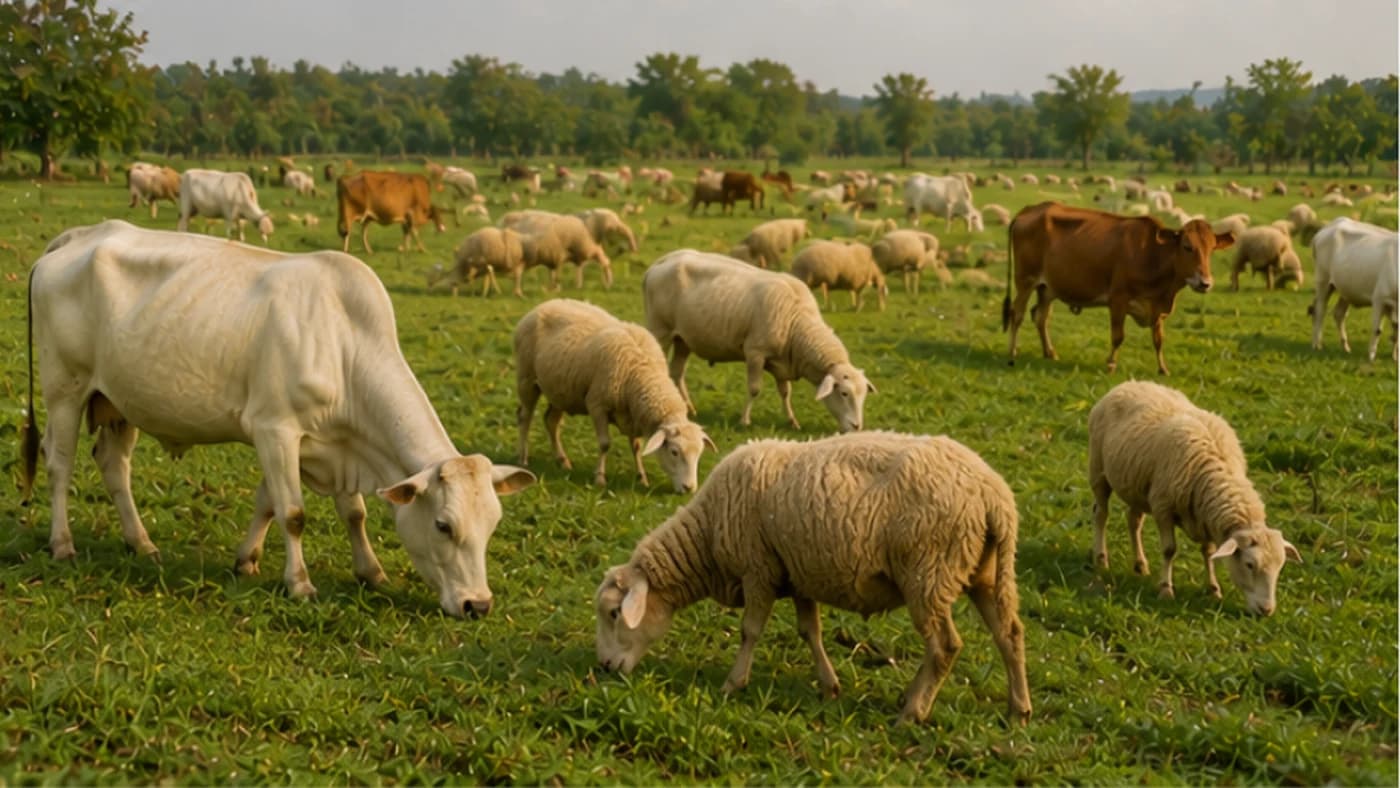
Grazing Sheep and Cattle Together: A Natural Parasite and Pasture Fix
Running sheep and cattle on the same pasture isn't a compromise — it's a biological upgrade. Cattle mop up the parasite larvae that sheep can't shake, sheep clean up the weeds cattle won't touch, and together they can lift how much your land actually produces.
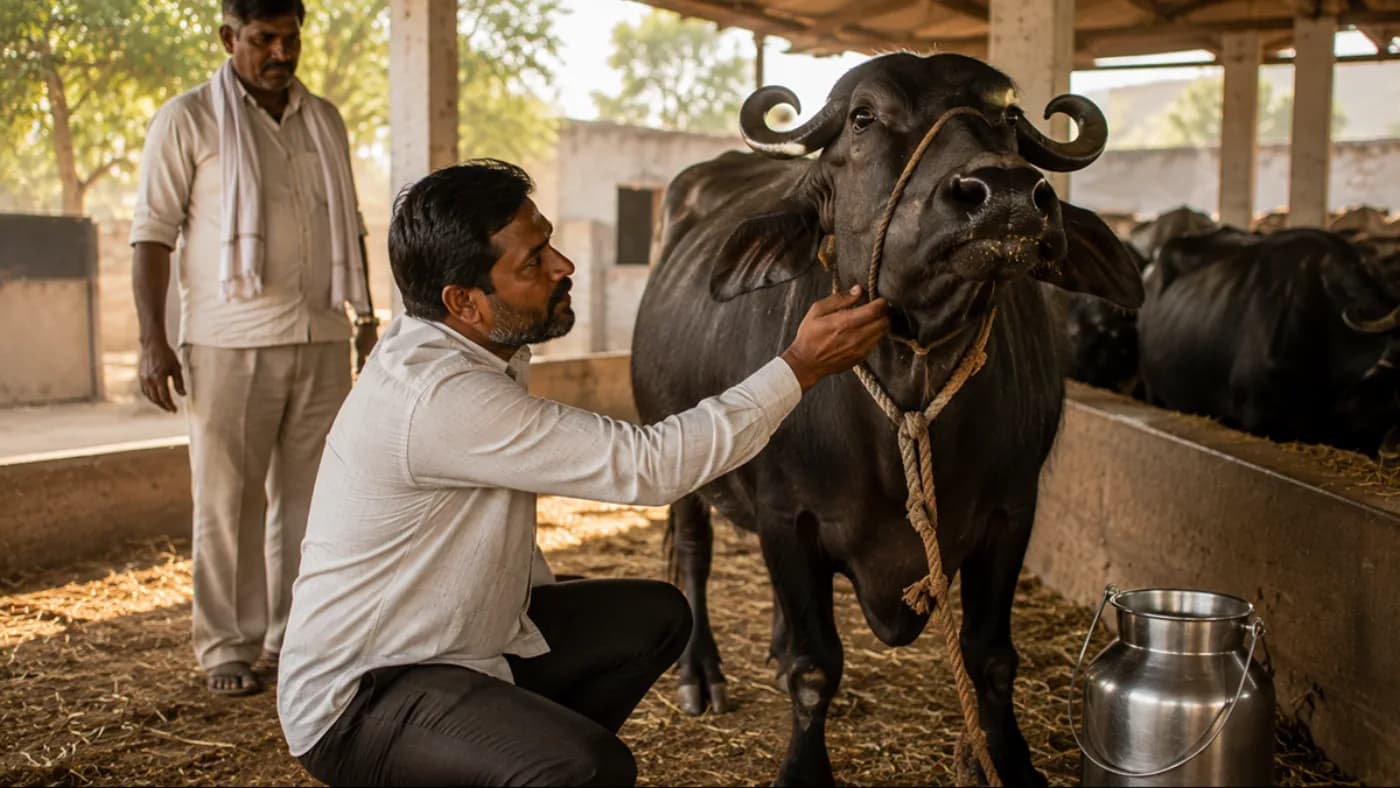
Buying and Selling Cattle Online: What to Check Before You Pay
A milch animal is often the largest single purchase a small farm makes, and the easiest to be cheated on. Listings make discovery far easier — they do not make verification optional. Here is exactly what to check, in what order, and the red flags that should end a deal.
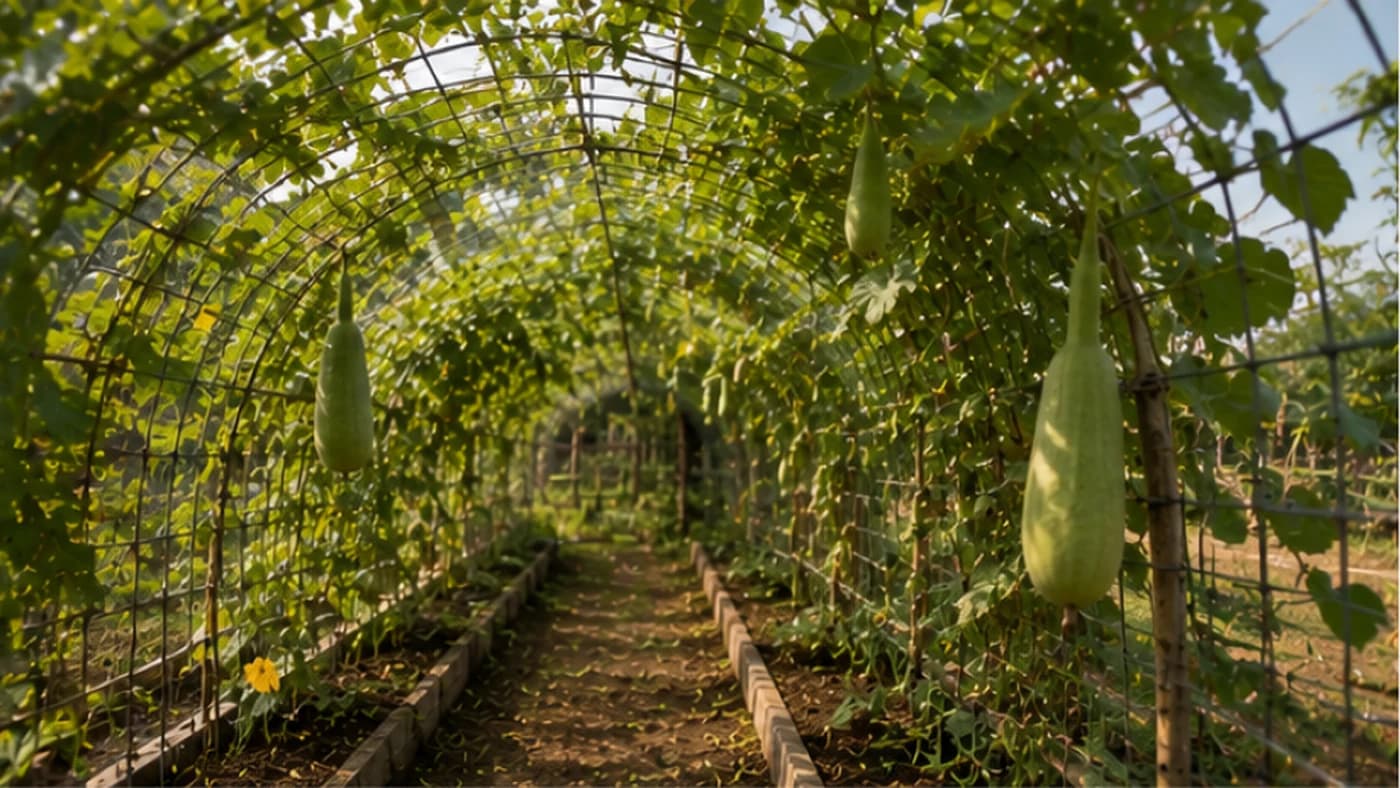
Vertical Gardening With Cattle Panels: Get Vines Off the Ground and Double Your Space
Sprawling cucumber and gourd vines eat up your walking paths, trap humidity, and rot fruit against wet soil. A simple welded-mesh panel arch fixes all three problems and can nearly double the usable growing space in a small plot.