

Chana Farming: Growing Chickpea on Residual Moisture
India's biggest pulse crop is also the one most often ruined by kindness — too much water, too much nitrogen. What chana actually needs, how to beat wilt and pod borer, and desi versus kabuli.
Quick answer
Chana is a rabi crop grown largely on residual moisture after the monsoon. It needs cool dry weather, light soil moisture and very little nitrogen — over-watering and over-fertilising are the two commonest ways to lose the crop. Its main threats are fusarium wilt, answered by resistant varieties and seed treatment, and pod borer, answered by monitoring from flowering onward.
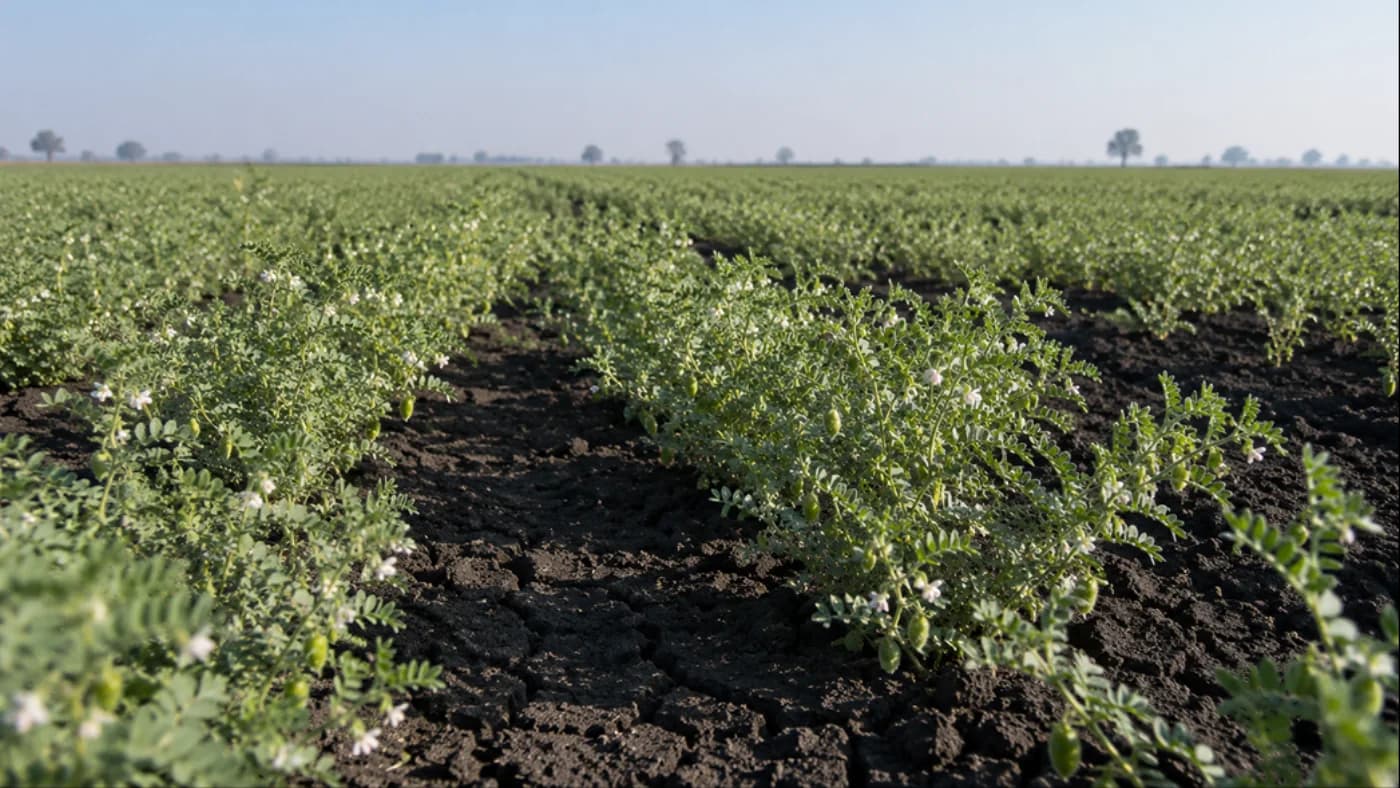
Chana is the largest pulse crop in India and one of the least demanding, which is exactly why it gets mishandled. Farmers used to wheat treat it like wheat — irrigate it well, feed it nitrogen — and end up with a tall green crop carrying very few pods. Chana wants the opposite: cool weather, restraint with water, and almost no nitrogen, because it makes its own. Get those three right and the rest of the season is mostly watching for two problems.
What chana actually wants
Chana is sown in rabi, after the monsoon, and across much of central and western India it is grown on residual moisture — the water the soil still holds from the rains, with little or no irrigation. That is its great advantage. It lets a field produce a second crop where there is no water for wheat, and it is why chana sits so naturally after cotton or a kharif fallow in black cotton soil.
It wants cool, dry weather through its growing period and warm dry weather at maturity. What it does not want is standing water at any stage: chana is more sensitive to waterlogging than almost any other rabi crop, and a heavy irrigation on a heavy soil can do more damage than a missed one. Where irrigation is available, one or two light waterings — around branching and again at pod filling — are usually enough.
It also makes its own nitrogen. Like all legumes it hosts Rhizobium bacteria on its roots, and a heavy nitrogen dose does not help — it produces leaf and stem at the expense of pods. This is the single most common mistake, and it is expensive twice over: you pay for the fertiliser and then harvest less.
Desi or kabuli
Both are chickpea, and the choice is mostly about market and risk rather than agronomy. Decide it before you buy seed, because they are not interchangeable at selling time.
| Desi chana | Kabuli chana | |
|---|---|---|
| Seed | Small, angular, dark — brown to black | Large, round, cream coloured |
| Hardiness | More tolerant of drought and poor soil | More demanding; wants better soil and moisture |
| Disease | Generally better wilt tolerance | More susceptible; variety choice matters more |
| Price | Lower per quintal, steadier demand | Higher, and the premium rises sharply with seed size |
| Best for | Rainfed land, residual moisture, lower risk | Better land with some irrigation, and a buyer who pays for size |
Sowing: get these right and most of the season is set
- Sow into the rabi window your region uses — broadly from late October into November across the main chana belt. Late sowing shortens the cool period the crop needs and usually costs yield.
- Sow deeper than you would wheat where you are relying on residual moisture, so the seed sits in moist soil rather than the drying surface layer.
- Inoculate the seed with Rhizobium, especially if chana has not grown in that field recently. Without the right bacteria the crop cannot fix nitrogen properly, and inoculant is among the cheapest inputs you will buy.
- Treat the seed against wilt and root rot at the same time. Trichoderma is the usual biological option and suits an organic system; order matters, so follow the label on whichever products you use.
- Choose a wilt-resistant variety suited to your district — ask your KVK. In chana this single decision does more against disease than anything you can spray later.
- Keep nitrogen minimal. A small starter dose is normal; a wheat-sized dose is a mistake.
The two problems that decide your yield
Fusarium wilt is the first. It lives in the soil, survives for years, and shows as patches of plants that yellow and die, often when the crop is otherwise doing well. There is no spray that fixes it once the crop is in the ground, so the whole defence is upfront: a resistant variety, treated seed, and a rotation that does not bring chana or another pulse back to the same field too soon. Following chana with chana, or with any other legume, is how wilt becomes permanent — crop rotation explains why the family rule matters so much here.
Pod borer is the second, and it is the one that costs money in a single fortnight. The larvae feed directly on developing pods, so damage is straight yield loss. Start watching at flowering, not at podding — by the time you see holed pods you are late. Scout the field rather than spraying to a calendar, and act on what you find.
The good news is that chana suits non-chemical control unusually well. Pheromone traps tell you when moth activity starts. Bird perches placed through the field let birds do a genuine share of the work on larvae — it is a classic practice in chana precisely because it works. NPV and neem-based options are established against early-stage larvae. Integrated pest management sets out how to combine these rather than picking one.
Where chana fits in the rotation
Chana earns its place twice: it produces a saleable crop on moisture that would otherwise go unused, and it leaves nitrogen behind for whatever follows. Cotton then chana then jowar is a rotation that works across the black soil belt for exactly this reason — a heavy feeder, then a legume that restores, then a cereal from a third family.
The rule it breaks most often is its own. Chana after groundnut, after tur, after moong or after soybean is a legume following a legume, and wilt, root rot and nematodes all carry over. If your land has a wilt history, put two unrelated crops between chana plantings, not one.
The market, and the arithmetic
Gram carries a Minimum Support Price, and unlike some millets, procurement for chana is reasonably active in the main growing states — but it is still worth confirming rather than assuming, because where procurement is thin the announced price does not reach you. Kabuli generally sells outside the MSP system on size-based grading, so if you are growing kabuli your price depends heavily on getting large, uniform seed.
Before switching a field to chana, run the comparison properly. The case for chana is rarely the highest gross return — it is the low input cost, the second crop off residual moisture, and the nitrogen left for the next crop. Those last two are real money that a simple yield comparison misses. Our free cost and profit calculator will let you put your own numbers against the crop you would otherwise grow, without an account.
What we will not give you is a seed rate, a dose or a yield figure. They vary by variety, spacing, soil and season, and the authority is your state package of practices or your KVK — not an article, and not us.
Frequently asked
How much irrigation does chana need?+
Very little, and often none. Across much of central and western India chana is grown entirely on residual moisture left by the monsoon. Where irrigation is available, one or two light waterings around branching and pod filling are usually enough. Chana is highly sensitive to waterlogging, so a heavy irrigation on heavy soil does more harm than a missed one.
Why is my chana plant tall and green but has few pods?+
Almost always too much nitrogen, sometimes combined with too much water. Chana fixes its own nitrogen through Rhizobium bacteria on its roots, so a wheat-sized dose pushes the plant into leaf and stem growth instead of pods. Keep nitrogen minimal and inoculate the seed instead.
How do I control pod borer in chana without heavy spraying?+
Start monitoring at flowering rather than waiting for damaged pods. Pheromone traps show you when moth activity begins, bird perches through the field let birds take a real share of the larvae, and NPV and neem-based options work on early-stage larvae. Combine these and scout the field rather than spraying to a calendar.
What is the difference between desi and kabuli chana?+
Desi is small, angular and dark, tolerates drought and poor soil better, and generally has better wilt tolerance. Kabuli is large, round and cream coloured, needs better soil and moisture, and sells at a premium that rises sharply with seed size. Desi suits rainfed land and lower risk; kabuli suits better land with some irrigation and a buyer who pays for size.
Which crop should I grow after chana?+
Anything that is not another pulse. Chana leaves nitrogen behind, so a cereal such as jowar, bajra or maize benefits directly. Avoid following it with groundnut, tur, moong or soybean — all legumes, so wilt, root rot and nematodes carry straight over.
Where to go next
Want this as daily tasks for your farm?
Khetiyaar turns guides like this into a day-by-day plan — in your language, free to start.

Related guides
Cumin Farming: Growing Jeera When the Weather Decides Everything
Cumin is among the highest-value crops a Gujarat farmer can grow and among the easiest to lose. Two cloudy weeks at flowering can take the whole field. Here is how to give it the best odds.
Isabgol Farming: Growing Psyllium for the Husk, Not the Seed
North Gujarat supplies much of the world's psyllium husk from light land and almost no water. The crop is easy until harvest — and at harvest one shower can take the value out of it.
Crop Rotation: Which Crop After Which, and Which to Never Repeat
The cheapest pest control and the cheapest fertiliser on your farm are the same thing — deciding what follows what. The three rules, the crop families you must not repeat, and what your soil type allows.