

The Zuni Waffle Garden: An Ancient Dryland Method for Water-Scarce Farms
Ordinary sprinklers lose much of their water to wind and evaporation. This centuries-old sunken-bed technique from the American Southwest desert traps every drop close to the roots — and it adapts easily to India's driest tracts.
Quick answer
The Zuni waffle garden proves that in dry, wind-exposed land, the shape of your soil matters as much as how much water you pour on it. Sinking the bed, raising a berm around it, mulching the surface, and watering deeply but rarely will get a young plant through heat and wind that would otherwise kill it — at essentially zero cost beyond labour. For a farmer or kitchen gardener in Kutch, Saurashtra, western Rajasthan, Marathwada or Bundelkhand, this is a technique worth testing on even a single small patch before deciding whether to expand it.
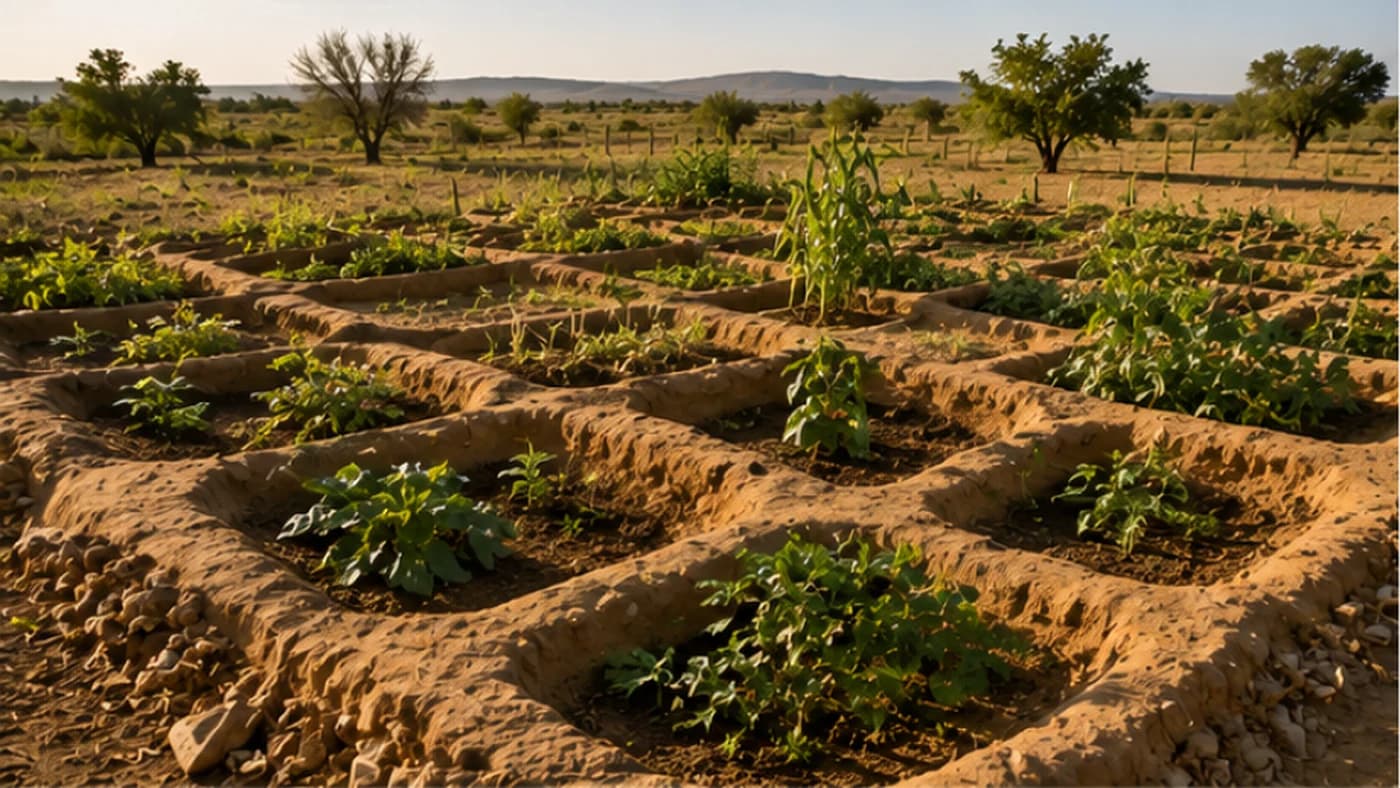
In the deserts of the American Southwest, the A:shiwi (Zuni) people have farmed for centuries in a landscape that gets less than 30 cm of rain a year — drier than most of Kutch or western Rajasthan. Instead of fighting the wind and sun with more water, they changed the shape of the ground itself. Their waffle garden sinks small planting basins into the earth and surrounds each one with a raised mud wall, so every drop of rain or hand-carried water is trapped exactly where the roots need it. It is one of the most water-efficient hand-built growing systems ever devised, and the principle behind it — hold water low, block the wind, use the soil itself as a battery — works just as well in a dry district of India as it did in the New Mexico desert.
What a waffle garden actually is
A waffle garden is a grid of small sunken planting basins separated by raised earthen berms, so that from above it looks like a breakfast waffle. Where a normal raised bed sits above ground level and drains away moisture, the waffle garden does the opposite: it sinks below the surrounding soil so that water collects and stays close to the roots instead of running off.
Historically these were kitchen gardens kept close to the home and river, tended mainly by women, while larger corn and bean fields sat lower down to catch seasonal runoff. The method exists because desert conditions — high heat, low humidity and constant wind — pull moisture out of a young seedling faster than its roots can replace it. The sunken basin creates a small, calmer, cooler microclimate for the plant to establish in.
How to build one, step by step
You need only a spade, a rake and a water source. Choose a flat patch with soil that has enough clay to hold its shape when packed into a wall — pure sand will not work without reinforcement. Clear the area of stones, roots and perennial weeds, then mark out a grid: traditional squares run 30 cm to 60 cm on each side, and smaller squares are easier to manage by hand.
Dig each basin 10–15 cm deep and pile the removed soil into a berm around its edge, about 10 cm wide and 10–12 cm high. Wet the soil slightly as you build the walls — this bonds the clay particles like adobe and makes the berm stable. Level and loosen the floor of each basin so water spreads evenly, then plant in the centre — a small cluster of corn or squash seeds, for example. As the seedlings grow, the surrounding wall shelters the stems from wind. Water by filling the basin to the top of the berm and letting it soak in slowly and deeply.
Why the sunken basin outperforms a flat bed
Water conservation is the biggest win: because the berm stops runoff, essentially all the water you apply reaches the root zone, instead of draining away sideways as it would from a flat field or a raised bed.
Wind protection matters just as much in a dry climate — even a 10 cm wall creates a still-air pocket at ground level that can be the difference between a seedling surviving a hot, dry wind and shrivelling. The earthen walls also act as a thermal battery: clay soil absorbs heat during the day and releases it slowly at night, which in regions with a 20°C or more day-night temperature swing keeps roots cooler at midday and warmer after dark, effectively extending the growing season at both ends. Finally, because each basin is a self-contained unit, it also traps blown sediment and organic matter instead of losing it to erosion.
Common mistakes and how to avoid them
Underestimating the labour is the most frequent error — hand-shaping and compacting a full grid of berms is hard physical work, and walls that are not packed firmly will wash out in the first heavy shower. Get the soil right: if your ground is too sandy the walls will not hold shape, so bring in clay-rich soil or reinforce with stones or wooden slats; if it is pure heavy clay, be careful not to overwater, or roots can rot in the waterlogged basin.
Berms need continuous upkeep — rain, wind and animals wear them down, so plan to patch fresh mud onto the walls through the season. And resist the urge to overplant a basin just because it looks small; most dryland crops need real root space, so one or two vigorous plants per basin usually beats a crowded cluster.
Where this method does — and doesn't — make sense
This is a technique built specifically for arid and semi-arid land: low-rainfall tracts of Kutch and Saurashtra in Gujarat, western Rajasthan, Marathwada, and Bundelkhand are all good candidates, especially on a kitchen-garden or homestead scale. It is not suited to high-rainfall regions or poorly draining soil — there, a sunken basin turns into a small pond, and waterlogged roots rot quickly.
It is also a hand-scale system: you cannot run a tractor through a waffle grid, so it fits a backyard plot, a kitchen garden, or a community garden far better than a large commercial field. And check your water table first — if it sits high, digging down even 10–15 cm can bring you close to saturated ground, which defeats the purpose.
Practical tips that make a real difference
A thin layer of sand or fine gravel spread inside the basin acts as a mineral mulch that breaks capillary action, so water is not pulled back up to the surface and lost to evaporation — this alone can roughly double water efficiency. In a modern setting, straw or dried leaf mulch works too, as long as you don't pile it so high that you lose the windbreak effect of the walls.
Companion planting suits this system well — corn in the centre of a basin acting as a natural trellis for climbing beans, with a spreading vegetable like squash or pumpkin covering the basin floor as a living mulch, is a proven combination. Water in the late evening or very early morning so moisture soaks deep before the sun bakes the surface, and always fill the basin fully and let it drain completely rather than sprinkling lightly and often — this trains roots to grow deep into the cooler, moister subsoil.
Advanced techniques for serious dryland growers
An unglazed clay pot (an olla, or in India a simple unglazed matka) buried in the centre of the basin and filled with water will seep slowly through its porous walls, delivering constant sub-surface moisture directly to the roots — combined with the waffle basin, this is one of the most water-efficient hand-built irrigation systems there is.
Because each basin behaves as its own microclimate, you can succession-plant independently — as soon as a short-duration crop like a leafy green finishes, prepare that one basin for a heat-loving crop like chilli without disturbing its neighbours. On a slight slope, you can also arrange basins to follow the natural contour with small spillways between them, so that during a heavy downpour the topmost basin fills first and any excess flows down into the next, turning the whole plot into a small, managed watershed instead of losing runoff.
Terms explained in this guide
Frequently asked
What soil do I need for a waffle garden?+
Soil with enough clay content to hold its shape when packed into a wall. Pure sandy soil will not hold a berm without reinforcement such as stones or wooden slats; very heavy clay works but needs careful watering to avoid waterlogging.
How deep and how big should each basin be?+
Dig 10–15 cm deep, with berms about 10 cm wide and 10–12 cm high. Basins are typically 30 cm to 60 cm square — smaller squares are easier to build and maintain by hand.
Does this method work in areas that get good rainfall?+
No. It is designed specifically for arid and semi-arid conditions. In high-rainfall areas or poorly draining soil, the sunken basin fills like a small pond and causes root rot.
Can I use a buried clay pot for irrigation like an olla?+
Yes — an unglazed clay pot or matka buried in the basin and filled with water seeps slowly through its walls, giving the roots constant, low-volume moisture with very little evaporation loss.
What crops suit a waffle garden best?+
Corn, beans and squash together (the classic Three Sisters combination) work very well, along with chillies, tomatoes and herbs — generally crops that benefit from a sheltered, moisture-retentive microclimate.
Where to go next
Want this as daily tasks for your farm?
Khetiyaar turns guides like this into a day-by-day plan — in your language, free to start.

Related guides
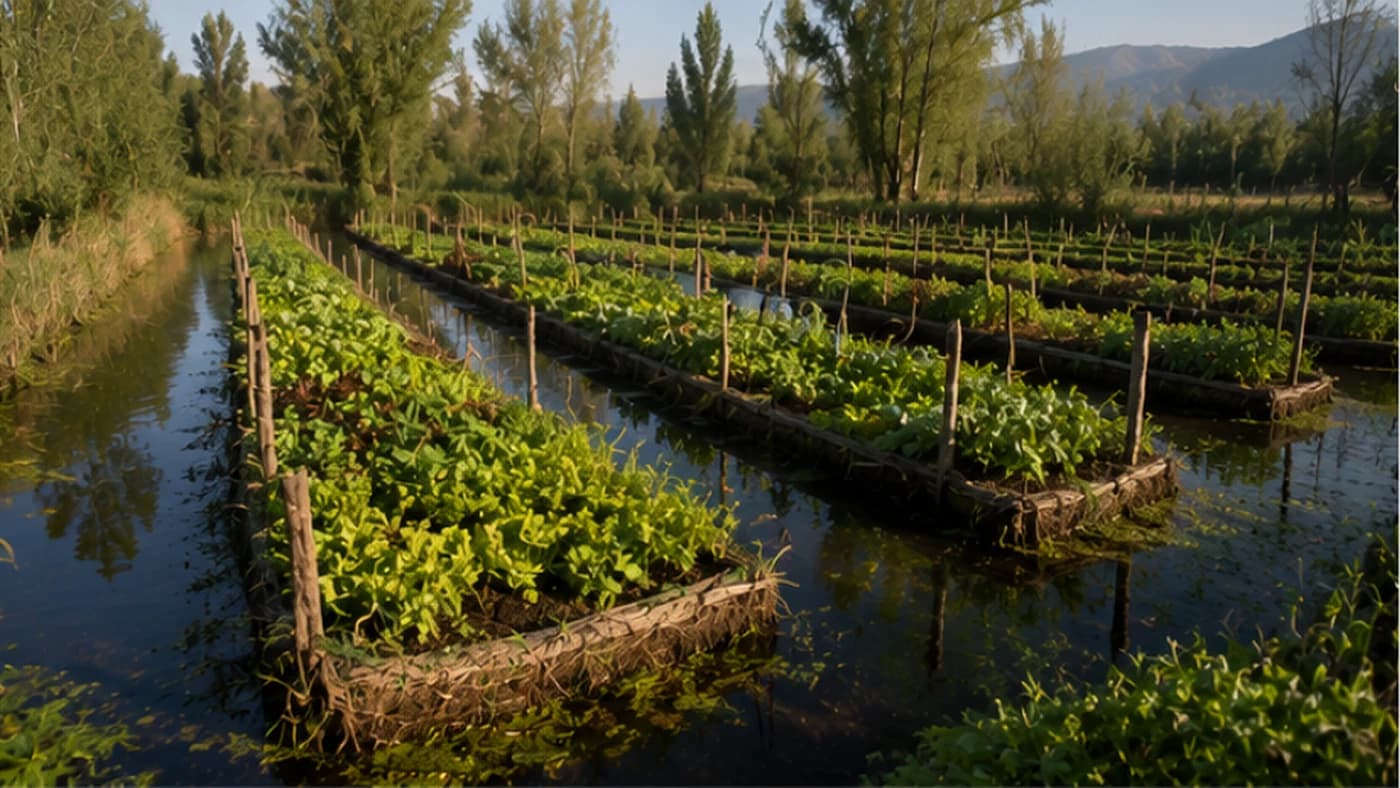
How Chinampas Work: The 700-Year-Old Floating Garden That Never Needed Fertiliser
The Aztecs grew up to seven harvests a year from raised beds built inside a lake, feeding themselves without synthetic fertiliser or piped irrigation. The same closed-loop principle can be scaled down to a pond edge or a wicking bed on an Indian farm.
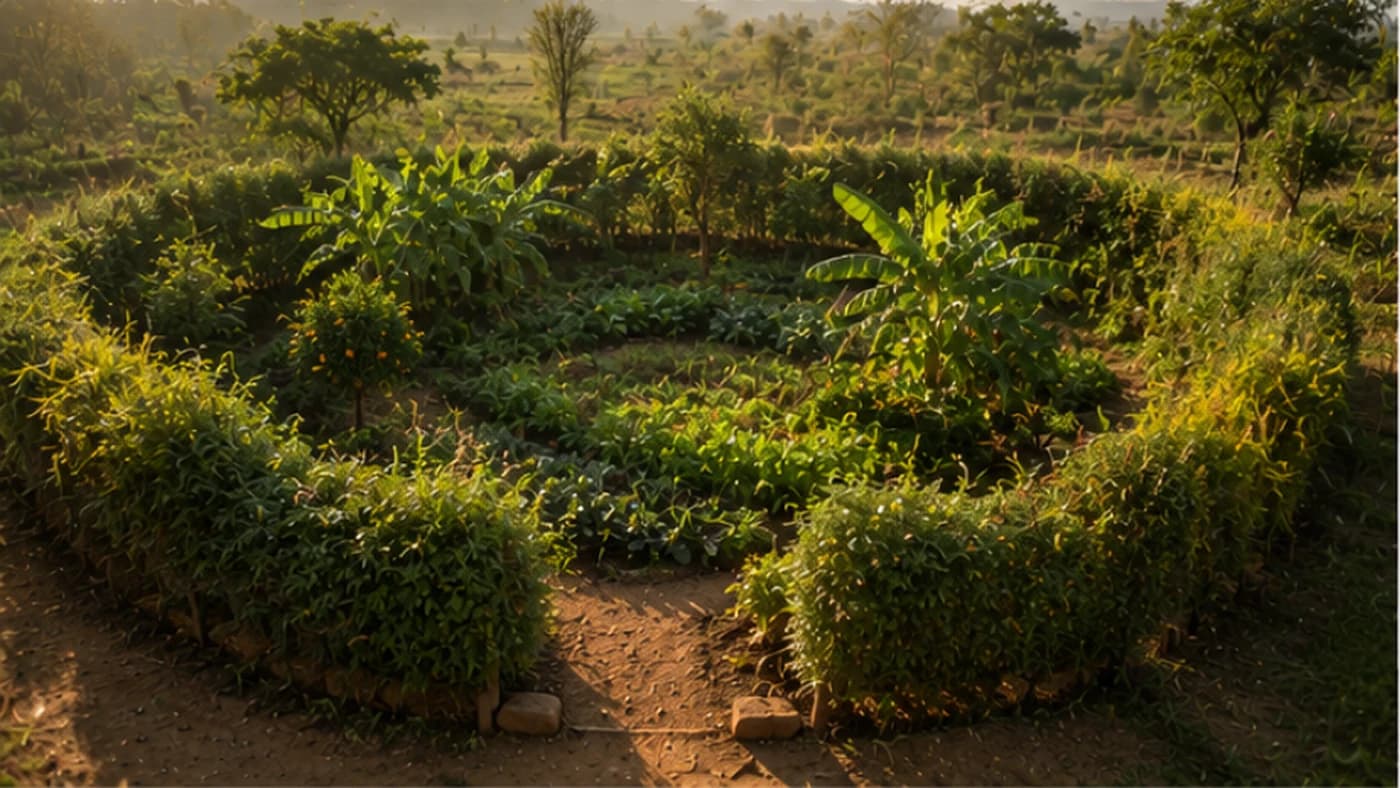
How to Build a Sun Trap: Grow Warm-Season Crops Through a Cold Snap
A U-shaped wall of stone, brick or hedge can make a patch of ground 5-10°C warmer than the open field beside it — enough to grow chillies, tomatoes and marigolds weeks earlier in the hills, or push a crop safely past an unseasonal cold spell.
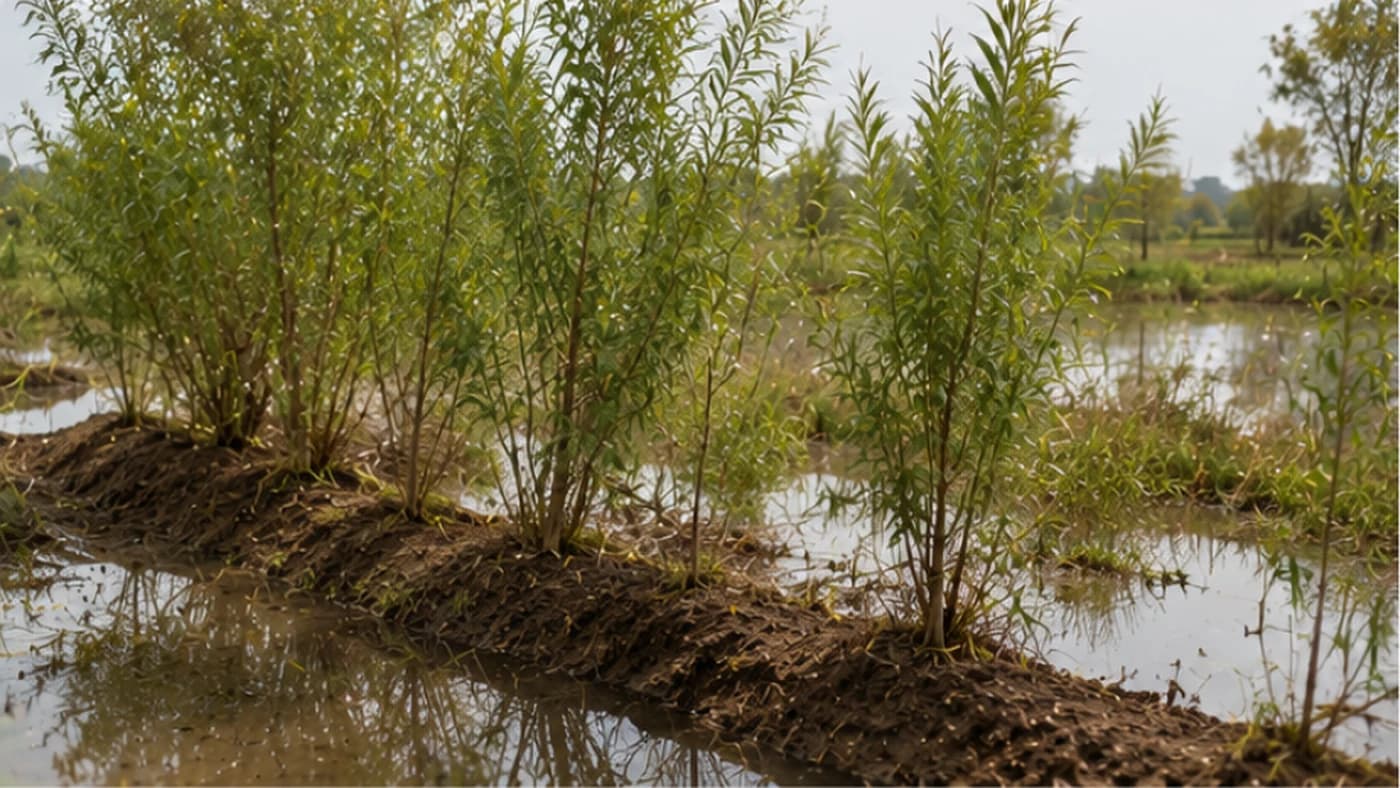
Biodrainage: Using Trees Instead of Pipes to Dry Out Waterlogged Land
Waterlogging quietly ruins more fields than most farmers realise — in canal command areas of Punjab and Haryana alone it affects lakhs of hectares. Trees that pump water out through their leaves can do the job of an expensive drainage system, for a fraction of the cost.