

Seed Patents, Seed Rights and Seed Saving: What Every Indian Farmer Should Know
Patented hybrid and GM seed built the Green Revolution's yield gains — but it also changed what a farmer can legally do with their own harvest. Here's what Indian law actually protects, and how to keep seed-saving alive alongside modern seed.
Quick answer
Patented and hybrid seed genuinely delivered yield and pest-resistance gains many Indian farmers rely on, and companies have a real argument for recovering their breeding investment — but Indian law, through the PPVFR Act, deliberately kept a farmer's right to save, use and exchange seed intact in a way many other countries did not. Know which of your seed is protected and how, keep saving open-pollinated and traditional varieties where good ones exist for your land, and treat every seed purchase as a genuine choice rather than the only option.
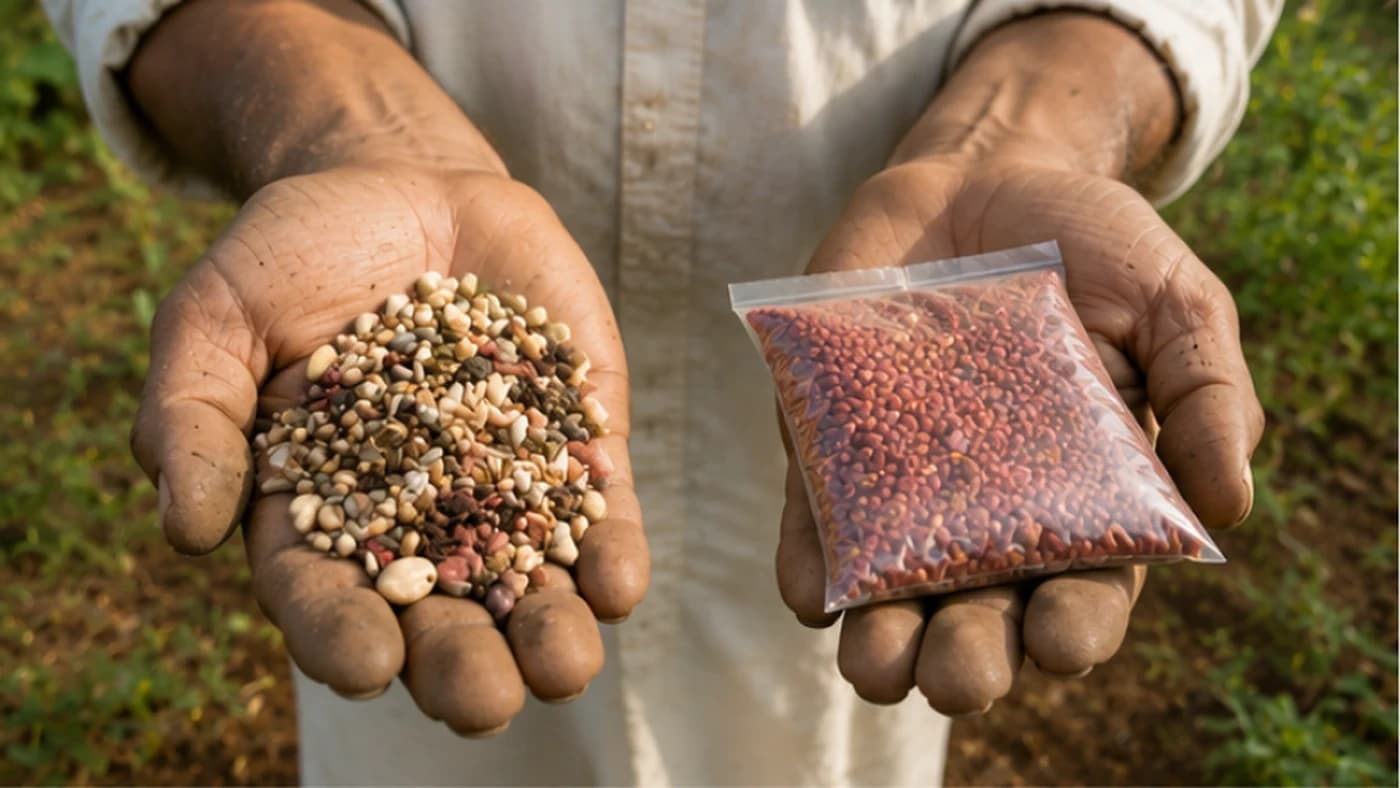
For most of farming history, seed was simply part of the harvest — you kept the best of this year's crop to plant next year, for free, forever. Modern hybrid and genetically modified (GM) seed changed that relationship: companies that spend years and large sums breeding a high-yield or pest-resistant variety now often patent or license it, restricting how the resulting seed can be saved or resold. This is not a settled, one-sided story — it's a real tension between rewarding genuine breeding investment and protecting a farmer's traditional right to save seed, and Indian law has taken its own, distinctive position on it. Understanding both sides helps you make better decisions about what to buy, what to save, and what your rights actually are.
Why companies patent seed at all
Breeding a new high-yield, disease-resistant, or drought-tolerant variety — or engineering a genetically modified trait like Bt cotton's pest resistance — takes years of research and significant investment. Seed companies argue that without patent or licensing protection, anyone could buy one bag, multiply it, and sell it cheaply, leaving no way to recover that investment or fund the next round of breeding. This is the same logic behind patents in any industry, applied to a living organism, which is exactly what makes it controversial.
How hybrid seed licensing actually restricts farmers
When a farmer buys certain patented or hybrid seed, they are often not just buying a product but agreeing to terms that can restrict saving seed from that harvest to replant next season — particularly with genetically modified traits. Separately, ordinary F1 hybrid seed (the kind most Indian farmers already buy for cotton, maize and many vegetables) doesn't need any restriction to prevent saving: its seed simply won't reliably produce plants like the parent next year, since hybrid vigour doesn't carry through to the next generation. So there are two different reasons farmers end up re-buying seed each season — a legal restriction on some patented traits, and the biological nature of hybrids on everything else — and it's worth knowing which applies to what you're planting.
India's own seed-rights law: the PPVFR Act
India took a deliberately different path from many countries by passing the Protection of Plant Varieties and Farmers' Rights (PPVFR) Act, 2001. It lets breeders register and protect new varieties, but it explicitly protects a farmer's right to save, use, sow, re-sow, exchange, and even sell (though not under the registered brand name) seed of a protected variety produced on their own land, the same way farmers always have. This is a genuinely farmer-protective law by international standards, and it's worth knowing it exists — many farmers don't realise how much it actually protects them.
The real Bt cotton royalty disputes
India's most visible real-world dispute over patented seed involves Bt cotton. Through the 2010s, seed companies and Indian state governments repeatedly clashed over the trait fees (royalties) charged on Bt cotton seed, with several states capping seed prices and trait fees by law, and companies at times threatening to withdraw licenses in response. The companies maintained the fees were fair compensation for a genuinely useful, years-in-development pest-resistance trait; state governments and farmer groups argued the fees were excessive relative to the actual yield benefit farmers were seeing on the ground, especially as pink bollworm resistance to the Bt trait grew over time. Both positions have some truth to them — this is a genuinely contested economic and policy question, not a simple villain-and-victim story.
Terms explained in this guide
Frequently asked
Can I legally save seed from my own harvest in India?+
For farm-saved seed of most varieties, yes — the PPVFR Act, 2001 explicitly protects a farmer's right to save, use, sow, re-sow and exchange seed grown on their own land, and even sell it (though not under the registered brand name).
Why can't I get the same plant from saved hybrid seed?+
Ordinary F1 hybrid vigour doesn't carry through to the next generation biologically — it's not usually a legal restriction, it's simply how hybrid genetics work. The offspring reverts toward a mix of the parent lines' traits.
What caused the Bt cotton seed price disputes in India?+
Disagreement over trait fees (royalties) charged for Bt cotton's pest-resistance technology — several state governments capped prices by law, arguing fees were too high relative to farmer returns, while companies argued the fees reflected years of breeding investment.
Is saving seed always the cheaper option?+
Not necessarily — a genuinely useful patented trait (like effective pest resistance) can still pay for itself in reduced spray costs and losses. The point is to know your options, not to avoid modern seed altogether.
Where can I learn more about my seed rights as a farmer?+
Your local Krishi Vigyan Kendra or state agriculture department can explain current PPVFR Act protections and any state-specific rules on seed pricing that may apply to your crop.
Where to go next
Want this as daily tasks for your farm?
Khetiyaar turns guides like this into a day-by-day plan — in your language, free to start.

Related guides
Deep-Rooted Weeds and Cover Crops That Fix Compacted Soil for Free
A weed with a long taproot pushing through hardpan isn't a sign your land has failed — it's the soil trying to repair itself. Here's how deep-rooted plants act as free biological drills, and which ones actually make sense on Indian farms.
Shelterbelts: Plant a Living Windbreak That Protects Your Yield
A strong, dry wind can strip a huge share of your soil's moisture in a single afternoon. A well-designed row of trees along your field boundary slows that wind and measurably lifts yield.
Groundnut Cultivation: Best Practices for Better Returns
Groundnut pods form below the surface — which is why light soil, calcium at pegging and steady moisture decide your pod count and returns.