

Living Mulch: A Chemical-Free Way to Beat Weeds and Build Soil
Plastic sheeting and bare, hoed soil both fight weeds by starving the ground of life. A living mulch — a low groundcover planted on purpose — suppresses weeds while feeding the soil, cooling it, and bringing in pollinators.
Quick answer
Weed control doesn't have to mean plastic sheeting or constant hoeing. A well-chosen living mulch shades out and out-competes weeds while it feeds your soil, cools it, fixes nitrogen if you choose a legume, and brings in pollinators — start with one bed, pick a species suited to your climate and crop, and let it prove itself before scaling up.
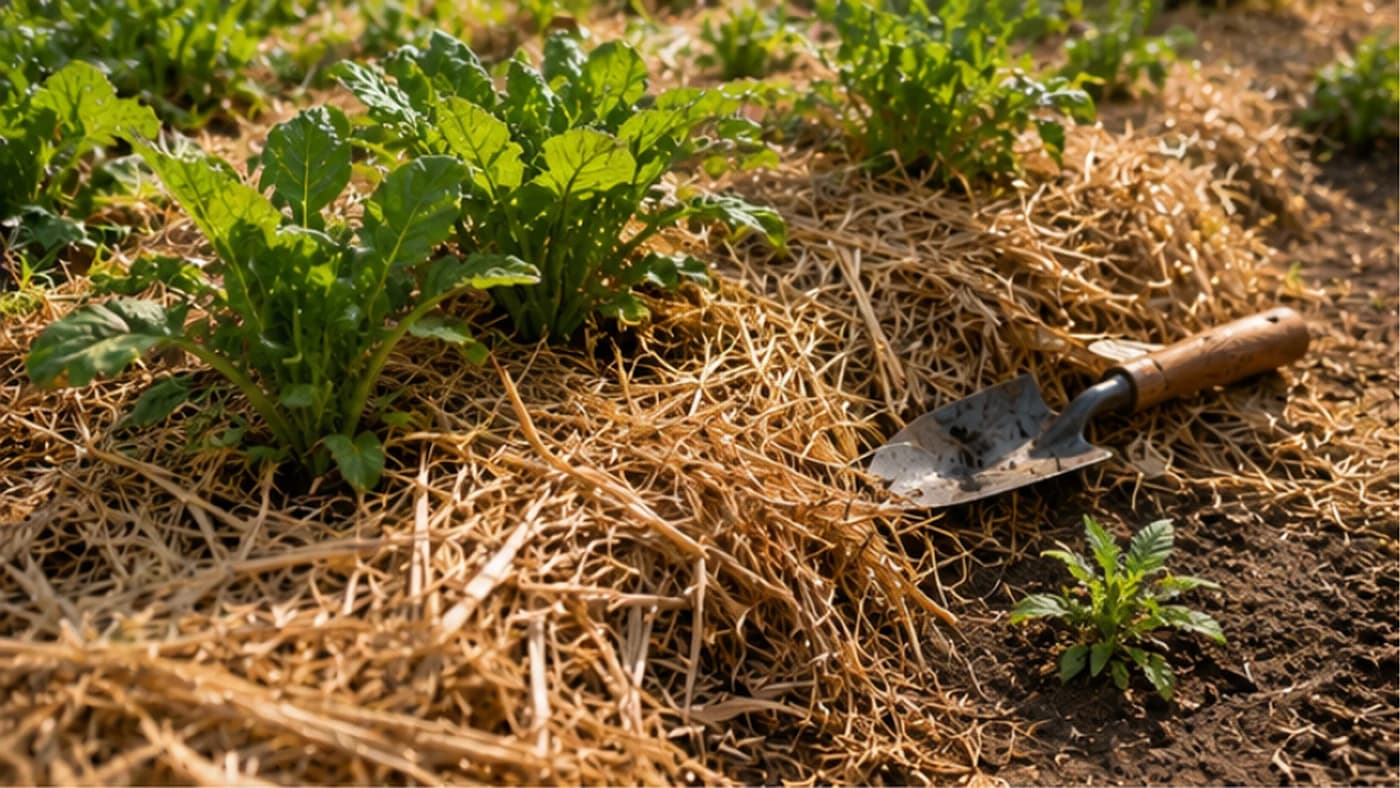
Every patch of bare soil is an invitation for whatever weed seed lands there first. Instead of leaving that ground open — or covering it with plastic sheeting that eventually turns to microplastic and cooks the soil beneath it — a living mulch fills the same niche on purpose: a low, dense groundcover planted between and under your main crops that shades out weeds, competes them out, and in many cases feeds the soil at the same time.
How a living mulch actually stops weeds
Shading is the main mechanism: most weed seeds need direct light and warm soil to germinate, so a dense mat of low groundcover keeps the surface shaded and many weed seeds simply stay dormant or wither after sprouting. Competition does the rest — a vigorous, well-established groundcover out-competes weaker weed seedlings for water, nutrients and space. Some species add a third layer of defence through allelopathy, releasing root chemicals that suppress germination of other seeds nearby (this needs care, since it can also affect your main crop if the wrong species is chosen).
To set one up: clear aggressive perennial weeds first (by hand or light sheet mulching), pick a low-growing species suited to your climate and crop, sow or plant it at high density for fast coverage, and maintain it by periodic mowing or "chop and drop" — cutting it back and leaving the cuttings on the ground to feed the soil.
What it gives you beyond weed control
Living roots constantly feed the soil food web with sugars and carbohydrates — the opposite of plastic sheeting, which cuts the soil off from organic matter and lets it compact and overheat. If you choose a nitrogen-fixing legume as your groundcover (in Indian conditions, cowpea/chawli, horse gram, sunn hemp/sanai, or groundnut work well depending on the crop and climate — white clover, the temperate favourite, needs cooler regions), it pulls nitrogen from the air and stores it in the soil, cutting your need for external fertiliser over time.
A living carpet also cools the soil through transpiration — bare soil or soil under black plastic can get hot enough to injure roots and kill beneficial microbes, while a groundcover keeps the microclimate steadier through summer. And a flowering groundcover feeds pollinators and predatory insects that help control pests, turning ground you'd otherwise just be weeding into a small, working ecosystem.
Where it goes wrong, and where it doesn't fit
The most common mistake is picking a groundcover that grows faster or taller than your main crop, so it ends up stealing the light and nutrients it was meant to protect. Timing matters too: sow the living mulch early enough that it's established before the main weed flush hits, not after weeds already have a head start. In genuinely dry regions, a living mulch can compete with shallow-rooted vegetables for scarce water — in that case a temporary dead mulch (straw, dry leaves, even cardboard) may serve better. And it isn't a set-and-forget solution: skipping maintenance lets the groundcover itself get out of hand and become the weed problem.
It also isn't ideal in every bed. In small, intensive seedling nurseries, a living mulch's competition can overwhelm delicate young transplants — use a dead mulch there instead. In heavily shaded spots, most vigorous groundcovers (like clover) struggle; shade-tolerant options grow more slowly and may not suppress weeds fast enough. And moving from bare soil or plastic to a living system takes an adjustment in expectations — it looks a little "messier" than a swept bed, in exchange for a more resilient one.
Getting the most from the system
Start on a single bed or orchard row before converting your whole plot. Use chop-and-drop maintenance: when the groundcover reaches 10-15 cm, cut it back — this signals the plant's roots to release some of their stored nitrogen into the soil, feeding your main crop directly while keeping the mulch at a manageable height. Sow at 1.5-2 times normal seeding rates so the cover closes in fast, before opportunistic weeds get a foothold.
More advanced growers mix several groundcover species together (a legume with a low grass or an aromatic herb) so that if one struggles in a dry spell, another fills the gap. Rotating poultry or geese through orchard rows to graze the living mulch turns its biomass into manure and eggs or meat — a closed loop of fertility and production. You can also choose a groundcover with a different root depth than your main crop (a shallow-rooted creeper under deep-rooted fruit trees, for instance) so the two aren't competing for the same water and nutrients.
Example: an orchard floor that feeds itself
Picture a fruit orchard where the ground is currently bare or mowed grass — grass is a heavy feeder that competes hard with the trees for nutrients. Replace it with a mixed groundcover: a nitrogen-fixing legume (cowpea or groundnut suit many Indian orchard conditions), a deep-rooted mineral-accumulating plant to mine nutrients from the subsoil and bring them up when cut and dropped, and a flowering trap crop like marigold or nasturtium (grown well in India's cooler months) to draw aphids away from the fruit while giving you an edible or ornamental harvest on the side.
The result is an orchard floor that requires no synthetic fertiliser, no herbicide, and less irrigation than bare ground or turf — the floor is generating its own fertility instead of just being managed.
Frequently asked
What is living mulch?+
A low-growing groundcover planted deliberately between or under your main crops, which suppresses weeds through shading and competition while often improving the soil at the same time — unlike plastic sheeting or dead mulch, it's alive and actively part of the system.
Which plants work as living mulch in Indian conditions?+
Nitrogen-fixing legumes suited to your region — cowpea (chawli), horse gram, sunn hemp (sanai), or groundnut — work well in warmer climates; white clover needs cooler regions. Match the species to your climate and your main crop's needs.
Will living mulch compete with my main crop?+
It can, if you choose an overly vigorous species or skip maintenance. Regular mowing or chop-and-drop keeps it in check, and choosing a groundcover with different root depth than your main crop avoids most competition for water and nutrients.
Is living mulch suitable for very dry regions?+
It needs some water to establish and survive, so in genuinely arid conditions the water it uses can compete with your main crop's needs — a dead mulch (straw, dry leaves) may be the safer choice there.
How is living mulch different from just letting weeds grow?+
You're choosing and planting a specific, useful species (often nitrogen-fixing or otherwise beneficial) at high density on purpose, rather than leaving the space open for whatever seed lands there — and you manage it deliberately through mowing or chop-and-drop.
Where to go next
Want this as daily tasks for your farm?
Khetiyaar turns guides like this into a day-by-day plan — in your language, free to start.

Related guides
Best Water Sources for Your Farm: Why 'Living Water' Beats Tap Water
Borewell and tap water is treated to be sterile — safe for people, but nearly dead for soil biology. Rainwater, pond water and treated greywater carry warmth, nutrients and microbes your soil actually wants.
Terra Preta: The 2,000-Year-Old Soil That Gets More Fertile With Age
Ancient Amazonian farmers built soil that is still 10x more fertile than the surrounding land 2,000 years later — using biochar, organic waste and minerals. Here's how to build a modern version in your own field.
Dynamic Accumulator Plants: Free Fertiliser Mining From Deep Below Your Field
Most crop roots barely reach 30–45 cm down, while a store of potassium, calcium and other minerals often sits much deeper, out of reach. Deep-rooted 'accumulator' plants act as a biological elevator that brings those minerals up for free.