

Selling Milk Through a Dairy Cooperative: How the Amul Model Pays You for Quality
A cooperative dairy measures what your milk actually contains and pays you on that — and because the farmers own the society and the societies own the union, the value added downstream comes back to the village instead of stopping with a trader. Here is how the whole chain is put together, and how a farmer joins one.
Quick answer
The cooperative model is not charity and it is not a scheme — it is a structure. Farmers own the village society, the societies own the district union, the union owns the plant, and so the value added to your milk after it leaves your gate is not lost to you. Inside that structure, fat and SNF testing turns the quality of your milk into money on the same day, which is why feeding, cleanliness and complete milking-out are paid work rather than merely good habits. Join through the secretary of your village dairy cooperative society, read the slip you are handed instead of pocketing it, and attend the one meeting a year where the accounts are placed before you. And take every figure about all of this from the society, its union or the state federation — rate charts, formulas, deductions, share requirements and payment cycles are set locally, revised from time to time, and should never be planned around a number quoted online, this article included.
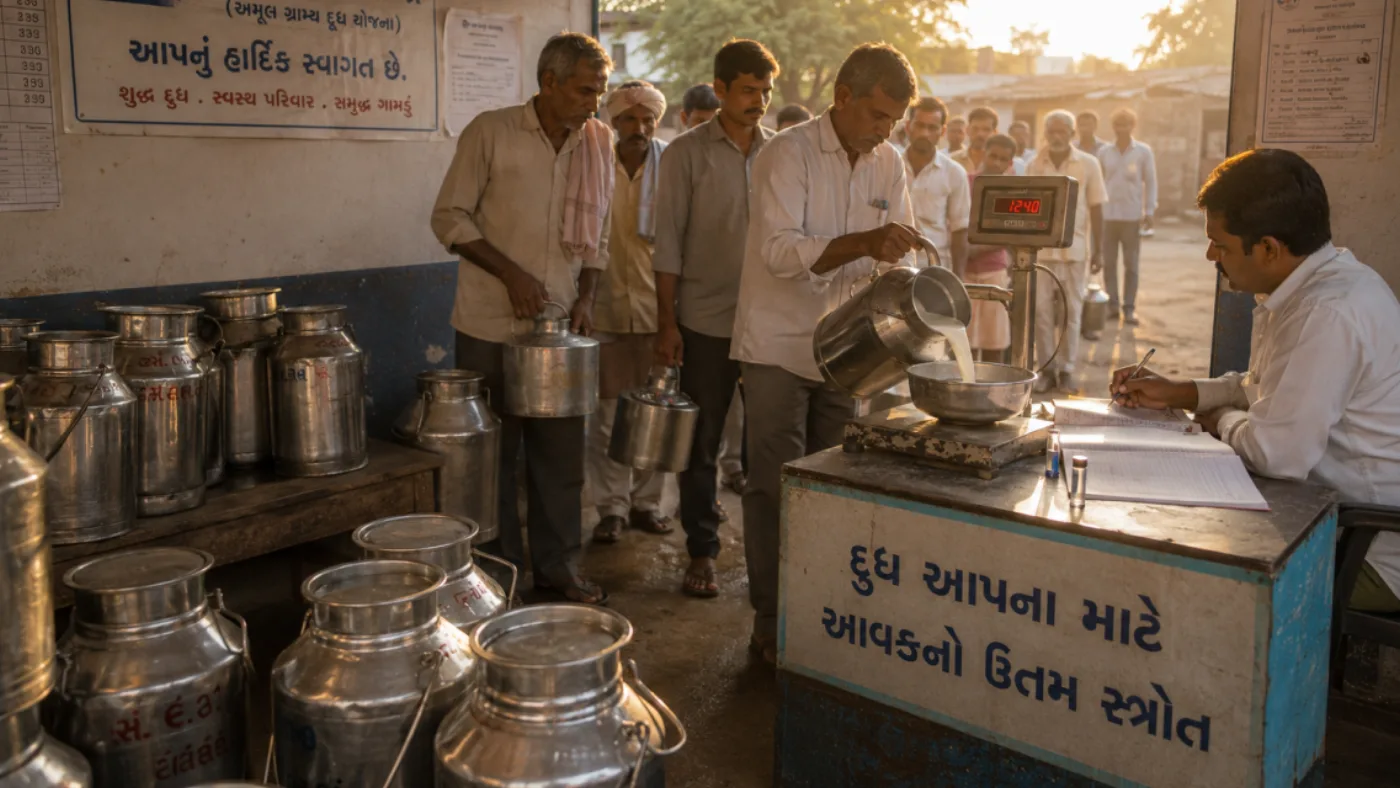
For most milk-producing households in India, the biggest decision about dairy income is not which breed to keep or what to feed — it is who the milk is sold to, and on what terms. A household can feed its animals well, milk them cleanly, and still see very little of that effort in the money that comes back, simply because the buyer at the gate does not measure quality and does not answer to anybody. The cooperative dairy model was built to change exactly that: milk is measured and tested in the village itself, the rate follows what the milk actually contains, and the body doing the buying is one the farmers themselves are members of. This guide explains how that chain is put together from the village upward, how fat and SNF decide what you are paid, how a farmer joins a village dairy cooperative society, and — honestly — where the local milk trader still has the advantage.
The three tiers: village society, district union, state federation
The cooperative dairy chain in India is built in three tiers, and knowing which tier does what explains almost everything else about how you get paid. At the bottom is the village dairy cooperative society — the collection centre in your own village where milk is poured morning and evening, measured, sampled and tested. The important thing about it is what it is not: it is not a company that buys milk from farmers. Its members are the milk producers of that village. You do not sell to it as an outsider; once you are a member, you pour into your own society.
The village societies of a district are, in turn, the members of the district milk union. The union is the industrial half of the chain — it runs the chilling centres that cool the milk within hours of collection, the dairy plant that pasteurises and processes it, and the lines that turn it into pouch milk, ghee, butter, milk powder, curd, buttermilk and sweets. It also runs the services that come back down to the villages: veterinary routes, artificial insemination (AI), cattle feed and mineral mixture, fodder seed and extension staff.
Above the unions sits the state cooperative dairy federation, whose members are the district unions of that state. The federation markets the brand you see on the pouch, handles state-level and national selling, and coordinates procurement between unions so that a district with milk to spare in one season can support one that is short. Between the three tiers, milk moves upward and money moves downward — and the board at each level is generally drawn from the tier below it, so the people taking the decisions are milk producers and society representatives rather than outside appointees.
Why you are a member-owner and not just a supplier
Follow the ownership and the whole point of the model becomes obvious. The farmers own the village society. The village societies own the district union. The district unions own the state federation. So the plant that chills your milk, the machine that fills the pouch, and the brand printed on it are — collectively, through those tiers — yours. Whatever the chain earns above its running costs does not stop with an owner sitting outside the village. It comes back down, partly as the rate paid for milk through the year and partly as whatever surplus the society and the union distribute to their members.
Compare that with selling to a private buyer. There is nothing illegitimate about a trader earning a margin; that is his business, and he takes real risks to do it. But all the value added after the milk leaves your gate — the chilling, the pasteurising, the ghee, the powder, the pouch on a city shelf — belongs to whoever owns the plant that added it. If that plant belongs to a private dairy, the farmer's share of it ends at the gate price. In a cooperative chain the farmers own the plant, so the value added downstream is not lost to them.
This is what people mean by 'the Amul model', or more formally the Anand pattern, after the town in Gujarat's Kheda district where milk producers first organised themselves this way rather than remaining at the mercy of a single contractor buyer. Through Operation Flood the same structure was deliberately replicated across the country as district milk unions and state federations, and today most Indian states have their own. The brand names on the pouch differ from state to state, but look underneath and the three-tier structure is recognisably the same one.
How your rate is actually arrived at: fat and SNF
When you pour at the collection centre, two things happen. The quantity is measured, and a properly mixed sample is drawn and tested for two values: fat, and SNF. SNF stands for solids-not-fat — everything solid in milk other than the fat, chiefly the protein, the lactose (milk sugar) and the minerals. Together, fat and SNF are a fair measure of how much real food is in the milk, and they are what the buying dairy can actually turn into products.
The rate you are paid is a function of those readings, worked out through a rate chart or formula that the union or the federation decides, publishes and revises from time to time. That single fact carries most of the value of the model. Two farmers who pour exactly the same quantity on the same morning can be paid different amounts — and that is the system working correctly, not a mistake at the centre. Milk that tests better is worth more to the dairy, so it is paid more.
Three consequences matter to you. First, quality is directly worth money — what your animal is fed and how the milk is handled shows up in the reading and therefore in the payment, not as some vague long-term benefit but on that day's slip. Second, buffalo milk generally tests considerably higher in fat than cow milk, which is exactly why the same number of litres from a buffalo and from a cow are not worth the same money; the species you keep sets your earning per litre before any other decision does. Third, and this is worth saying plainly, adding water to milk or pouring milk from a badly fed animal and hoping the volume carries you is not a way to earn more. Both are measured, and both are paid accordingly.
What this guide deliberately does not give you is a figure. The actual rate chart, the fat and SNF formula behind it, any deduction the society or the union makes, and the length of the payment cycle are all decided by your own union and federation, differ between states and between unions, and are revised from time to time. Get them from your village dairy cooperative society, from its secretary, or from the district milk union office — and do not plan your dairy around a figure you read online, including anything you may have read in this article.
The testing slip is your receipt — read it
Most collection centres now test electronically. A milk analyser reads fat and SNF in moments, the reading appears on a display the farmer can see, and a slip is printed showing the quantity poured, the readings and the amount credited. This is a bigger change than it sounds, because it takes the argument out of grading. When milk was graded by eye and by hand, a dispute at the centre came down to whose word carried more weight in the village. Now there is a reading, printed, with a record kept at the society.
Which is precisely why the slip should not go into a pocket unread. Ask the secretary or the centre in-charge, once, to walk you through what each figure on it means — most will do it happily, and you only need to understand it once. Then keep the slips. Over a month you can see whether your fat is drifting up or down, and match that drift against what changed: a new fodder, the mineral mixture running out, the onset of summer, the animal moving deeper into her lactation. It is the cheapest record of your animals' performance you will ever have, and somebody else prints it for you.
If you genuinely suspect the sampling was wrong — the can not stirred before the sample was drawn, or the sample taken off the top where the fat has risen — the right move is to raise it at the society rather than quietly stop pouring. The society belongs to its members, and a member has standing to ask the question. With a trader you can only argue; from your own society you can ask for an account.
Cooperative or the local trader: an honest comparison
- The cooperative rate comes from a published formula applied to a measured test, so it is the same for everyone and is not negotiated at the gate; the trader's rate is whatever the two of you settle on that morning, which may be better or worse than what your milk would have tested at.
- Cooperative payment comes on a fixed, announced cycle and increasingly goes straight into a bank account; a trader may pay cash on the spot, which is genuinely worth something to a household that needs money today.
- The society takes milk every day of the year, including the flush season when private buyers cut their offer or stop collecting because milk is everywhere; a trader is under no obligation to keep buying once it stops suiting him.
- A trader will often lend against future milk and adjust it later against your deliveries; a cooperative society is not a moneylender, and where credit is available through it, it comes with its own procedure.
- A trader may collect from your doorstep; a society generally expects you to bring the milk to the collection centre at the announced times, morning and evening.
- A trader who does not test at all suits the farmer whose milk would test poorly and penalises the farmer whose milk is good; the cooperative pays good milk more and poor milk less, by design.
- Membership brings cattle feed, mineral mixture, fodder seed, veterinary and AI service and extension advice on terms a single household could never negotiate alone; a trader sells the milk onward and nothing comes back in return.
- Plenty of households sell to both, and that is a practical decision about their own circumstances rather than a betrayal of either buyer.
- The comparison that actually matters is the whole year — the rate, the certainty that the milk will be taken, the certainty of payment, and the worth of the services — not the best rate offered on one good day.
What membership brings besides the milk rate
For many households the services turn out to be worth as much as the rate. Balanced cattle feed and mineral mixture supplied through the society is the most immediate one — thin mineral and protein supply is the commonest gap in smallholder feeding, and buying through the society removes both the trip to town and much of the adulteration risk that comes with loose feed from an unknown shop.
Then there is breeding and animal health. Unions typically run veterinary routes and artificial insemination (AI) service right down to the village, which gives a smallholder access to semen from properly evaluated bulls — something no individual household can arrange for itself, and the single decision that most changes what the next generation of heifers in your shed looks like. Many unions also supply fodder seed and planting material, run silage and clean-milk-production training, and send extension staff to the societies.
None of this is uniform, and it is worth being clear-eyed about that: a strong, well-run union offers a great deal and a weak one offers very little. What is available, and on what terms, is a question for your own society and union office rather than something to assume from a general description. It is also worth remembering that the cheapest feed improvements are usually not bought at all — as our guide to tree fodder for livestock explains, several fodder trees already standing on Indian farm boundaries carry more minerals than the grass beneath them, and that shows up in the very fat and SNF readings you are paid on.
How to join a village dairy cooperative society
Start by finding out whether a society already exists in or near your village. In most milk-producing parts of the country one does, and the quickest way to find it is to ask a neighbour who already pours, or simply to walk to the collection centre at pouring time and ask who is in charge. The person you want is the society's secretary or the collection-centre in-charge.
Where a society exists, joining generally means three things: applying for membership, satisfying the society's own membership conditions, and taking up a share in the society as its bye-laws require. Once that is done there is nothing elaborate left — you begin pouring at the announced collection times, morning and evening, and the measuring, testing and payment run for you exactly as they do for every other member.
The specific membership conditions, the share to be taken up, the documents asked for and any deduction applied are set in that society's own bye-laws and by the district union above it. They differ between states, between unions, and sometimes between neighbouring societies, and they are revised from time to time. Confirm them at the society itself, in person, before you build any plan around them.
If no society exists nearby, organising one is a real route rather than a dead end, and it is usually the district union that helps — more collection is in the union's own interest, so its staff can tell you what a new society needs and how to get it registered. That is a different thing from a farmer producer organisation, and the two are often confused: our guide 'How to Form a Farmer Producer Organisation (FPO): A Practical Guide' covers the FPO route, which is a company-law structure that can trade in whatever its members produce. It is well worth knowing about, but an FPO is not a dairy cooperative society, and forming one does not by itself give you a union's chilling, testing and payment chain.
What a member owns, and the part members use least
Membership is not only a right to pour milk. A member of a village dairy cooperative society is a voter in its general body and can stand for election to its managing committee — the committee that supervises the secretary, runs the collection centre and takes the local decisions. Once a year the society holds its general meeting, where the accounts are placed before the members, the distribution of surplus is decided, and the committee is elected.
That meeting is the part of ownership members use least. Most farmers do not attend, do not ask how much milk the society collected, what it earned, what it spent or what it is holding — and then wonder why decisions seem to be taken by a small group. Sitting through one meeting a year and reading what your own society reports is the cheapest possible check on the body that handles your milk money.
One more thing worth asking about. In a great many households the woman of the house does the feeding and the milking while the society membership stands in a man's name, so the payment reaches a different hand than the labour did. Many unions now support women's dairy cooperative societies, where the members, the committee and the payments are the women's. If one exists in your area, or the union will help start one, it is worth a conversation at home.
What you actually control in the payment
Since the payment follows the test, it is worth being precise about which parts of it are in your hands. Feeding and body condition drive fat and SNF more than anything else you do. An animal kept on dry fodder with little green and no mineral mixture will test lower than the same animal on a balanced ration, and no amount of arguing at the collection centre changes that reading. Feed the animal properly and the test pays you back for it.
Cleanliness decides something even more basic: whether the milk is accepted at all. A clean, dry udder before milking, utensils washed and properly dried rather than left damp, and the shortest possible gap between milking and pouring are what keep the milk from souring — and in summer that gap is the whole matter. Milk that fails the quality check at the centre earns nothing, however good its fat reading would have been.
Milk the animal out completely. The last milk drawn from the udder is the richest in fat, so a hurried, incomplete milking leaves behind fat the animal has already made and you have already paid to produce — and habitually leaving milk in the udder invites udder trouble as well.
Keep problem milk out of the can. Strip the first few squirts from each teat into a separate vessel and look at them: clots, flakes or thin watery milk point to mastitis, and milk from an affected quarter mixed into the can degrades the whole delivery rather than only its own share. An animal with a hot, swollen or painful udder needs a veterinarian, not a home remedy. And milk from any animal under veterinary treatment must be kept out of the collection for as long as the veterinarian tells you to — ask for that period explicitly when the treatment is given, because it depends on the medicine used and is the veterinarian's call, not a rule of thumb. This is not merely a matter of rules: one household's contaminated milk can spoil a whole tanker, and the loss comes back to your own society.
Terms explained in this guide
Frequently asked
What is the Amul model of selling milk?+
It is a three-tier cooperative structure, also called the Anand pattern after the town in Gujarat where it began. The milk producers of a village are the members of a village dairy cooperative society; the societies of a district are the members of a district milk union, which chills, processes, packs and markets the milk; and the district unions are the members of a state dairy federation, which markets the brand. Because ownership runs upward from the farmers, the value added after the milk leaves the village comes back to them instead of stopping with a trader.
Why do two farmers get paid differently for the same quantity of milk?+
Because the rate follows the test and not just the volume. Each farmer's milk is sampled and tested for fat and SNF, and the rate is worked out from those readings through the union's rate chart. Milk that tests better is worth more to the dairy and is paid more, so two equal quantities can fetch different amounts — which is the system working as intended, not an error at the centre.
What is SNF in milk?+
SNF means solids-not-fat: everything solid in milk apart from the fat, chiefly protein, lactose (milk sugar) and minerals. It is tested alongside fat at the collection centre because the two together decide how much usable product the dairy can make from your milk, and therefore what you are paid for it.
How do I join a village dairy cooperative society?+
Ask at the collection centre in or near your village and speak to the society's secretary or the centre in-charge. Joining generally means applying for membership, meeting the society's membership conditions, taking up a share as its bye-laws require, and then pouring at the announced morning and evening collection times. The exact conditions, share requirement, documents and any deduction are set by the society's bye-laws and by its district union, vary by state and by union, and must be confirmed at the society itself.
Is a dairy cooperative always better than selling to a local milk trader?+
Not on every single day, which is why many households sell to both. The cooperative gives a rate worked out from a measured test rather than a gate negotiation, payment on a fixed announced cycle and increasingly into a bank account, assured daily collection even in the flush season, and access to feed, veterinary, AI and extension services. A trader may pay cash on the spot, lend against future milk and collect from the doorstep, which genuinely helps a household short of money. Compare the whole year — rate, certainty of collection, certainty of payment and the worth of the services — rather than the best rate offered on one day.
Where to go next
- Today's mandi bhavOfficial AGMARKNET rates for your crop, nearby mandis compared, and the net price after travel.
- AI farming chatbotAsk any farming question in Gujarati, Hindi or English and get an answer in seconds.
- Kheti app for Indian farmersCrop plans, disease diagnosis, weather and mandi rates in one app.
Want this as daily tasks for your farm?
Khetiyaar turns guides like this into a day-by-day plan — in your language, free to start.

Related guides
Deep Litter Method: Turn Your Chicken Coop Into a Living Compost System
A scrubbed, bare coop floor is a wasted opportunity. Let a thick carbon bed and billions of microbes do the composting for you — less labour, healthier birds, and free fertiliser for the field.
How to Attract Dung Beetles to Your Pasture (and Why Your Dewormer Might Be Killing Them)
Most farmers see a manure pat as a chore. The smart ones see a biological engine — dung beetles that bury parasites, aerate the soil, and cut fly populations, for free, if you stop poisoning them with routine deworming.
How to Attract Barn Owls to Your Farm for Free Rodent Control
One pair of barn owls can hunt over a thousand rodents in a single season — but only if you give them a properly designed, dark, predator-proof box. Barn owls (Tyto alba) already live across most of India; here's how to bring them onto your farm.