

Restoring Mycorrhizal Fungi to Bring Compacted Soil Back to Life
Soil isn't meant to be a solid block — it's meant to be a living sponge. Reintroducing the underground fungal network that most plants depend on can turn heat-baked, compacted land into something that holds water and stops your crop from wilting.
Quick answer
Feeding the soil's biology, rather than just the plant, is the difference between land that needs more inputs every year and land that gets more resilient every year. Stop tilling where you can, mulch with woody material, keep living roots in the ground, and go easy on high-phosphorus fertiliser — and the fungal network that took 450 million years to evolve will do a great deal of the work of holding water, feeding roots, and defending your crop for you.
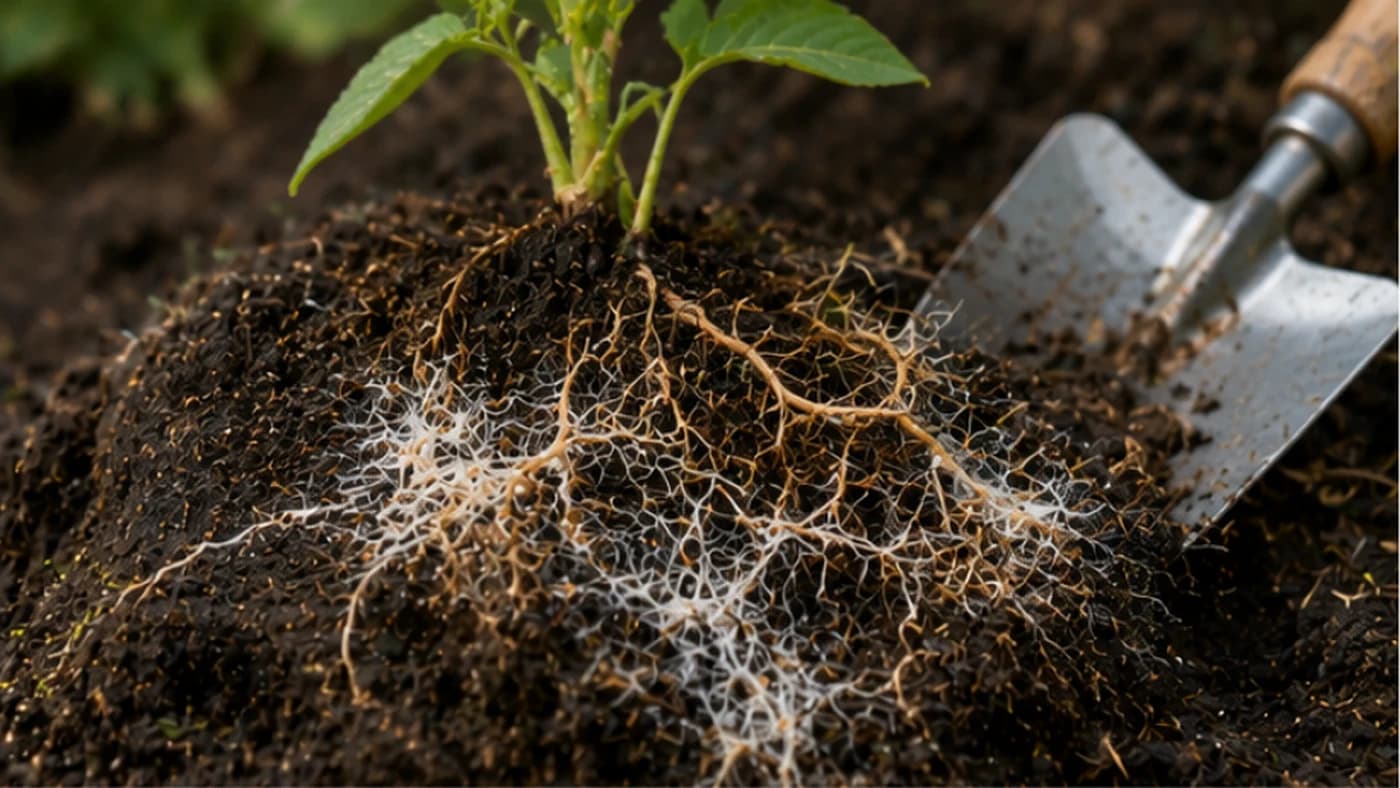
Compacted soil behaves like a sealed tomb: roots struggle to push through it, and water runs straight off the surface, taking topsoil with it. Bags of fertiliser don't fix this — the fix is biological. Mycorrhizal fungi form partnerships with roots that have kept plants alive for over 450 million years, and restoring that partnership is often the single biggest thing you can do for soil that's been hammered by years of heavy tillage and chemical inputs.
What mycorrhizal fungi actually do
Mycorrhizal fungi form a mutualistic partnership with the roots of roughly 80% of all plant species on Earth. The name comes from the Greek for 'fungus root' — and it's not a parasitic relationship. It's a trade: the fungus's thread-like filaments (hyphae) are far finer and more extensive than root hairs, weaving through soil pores too small for roots to enter, effectively multiplying a plant's root reach by hundreds or even thousands of times.
In exchange for sugars the plant makes through photosynthesis, the fungus delivers minerals the plant otherwise can't reach — phosphorus especially, along with nitrogen and trace elements. Both partners do better together than either could alone.
Glomalin: the biological glue that builds good soil
As hyphae mine the soil, they secrete enzymes that release locked-up nutrients, particularly phosphorus. But one of the most important discoveries in soil science is glomalin, a sticky compound produced only by arbuscular mycorrhizal fungi. Glomalin acts as a natural glue, binding silt, sand and clay particles into stable crumbs — the structure soil scientists call good tilth.
That crumbly structure is what gives healthy soil its sponge-like quality: channels for oxygen to reach roots, and paths for water to soak into the subsoil instead of pooling or running off. Without glomalin, soil collapses into a dense, airless mass — the sterile compaction so common in over-tilled and over-fertilised fields.
How to rebuild the network
Commercial mycorrhizal inoculants — sold in India as VAM (vesicular arbuscular mycorrhiza) biofertilisers — are one option. Many growers instead prefer harvesting local, already-adapted fungi using a 'trap pot' method: grow a host plant (a fast-rooting grass works well) in a mix of your own soil and a small amount of soil from a healthy, undisturbed patch nearby. Over a season, fungi from that wild sample colonise the host's roots; at the end of the season, chop up the roots and use them as a potent, locally adapted inoculant for the rest of your land.
Why the effort pays off
Drought resistance is the most immediately visible benefit — fungal hyphae reach microscopic pockets of soil moisture that roots alone can't access, keeping a connected plant hydrated well into a dry spell that would wilt an unconnected one.
A mycorrhizal connection also strengthens a plant's natural defences, triggering protective compounds and, in some cases, forming a physical barrier around roots against soil-borne diseases like Fusarium. And because glomalin locks organic carbon into a stable form, building fungal networks is also a genuine way of storing carbon in your land for the long term, improving structure and resilience season after season.
The habits that destroy the network
Tillage is the single biggest enemy. Every pass of a tiller or spade physically shreds the hyphal network a fungus has spent months building, shattering soil aggregates and releasing stored carbon — which then requires even more mechanical intervention to keep the soil workable, a cycle that gets worse over time.
High-phosphorus synthetic fertiliser tells a plant it no longer needs its fungal partner, so it stops feeding it sugars and the network withers; the salt content in many synthetic fertilisers can also chemically burn delicate hyphae directly. And broad-spectrum fungicides used on a leaf problem don't discriminate — treating a surface fungal issue can wipe out years of underground mycelial growth in a single application.
Where mycorrhizal fungi don't help
Not every crop benefits. The Brassicaceae family — cabbage, broccoli, kale, radish, turnip, and importantly mustard (sarson), one of India's major crops — doesn't form these partnerships at all, and some of these plants even produce compounds that actively inhibit fungal growth. Inoculating a pure mustard or cabbage field won't help those specific plants directly. Waterlogged or strongly anaerobic soils, and soils with extreme pH or heavy-metal contamination, will also prevent the fungi from establishing — restoration works best as part of balancing the whole system, not as a single magic input.
Sterile compaction vs a living fungal network
Sterile compaction: low water retention with high runoff and evaporation; depends on synthetic, soluble fertiliser for nutrients; needs constant tillage and irrigation; costs climb over time as soil health degrades.
Fungal network: high water retention, with soil acting as a biological sponge; nutrients delivered through the mycelial exchange; low-to-no-till, mulch-based care; costs fall over time as the system becomes self-sustaining.
Practical steps for restoring your soil
Switch to no-till or minimal-till methods, using sheet mulching or layered organic matter on the surface instead of turning the soil, to protect existing hyphal networks. Add coarse mulches — wood chips, shredded bark, or crop residue — since fungi thrive on woody material and release nutrients as they break it down. Keep living roots in the ground year-round with a cover crop (clover or a quick-growing green manure) during any fallow period, since fungi need a living host and bare soil kills the mycelium. And where fertiliser is genuinely needed, favour slow-release organic sources like bone meal or fish emulsion over high-phosphorus synthetic blends.
For the more advanced grower: fungal-to-bacterial ratio
Different crops prefer different soil biology. Most annual vegetables do well with a roughly balanced 1:1 ratio of fungi to bacteria, while perennial systems, fruit orchards and food forests prefer fungal-dominant soil, sometimes 10:1 or higher. Serious growers steer this ratio over time by feeding the soil more complex carbon sources — woody debris and fungal-rich compost — when they want to shift it toward the fungal side.
A worked example: transforming dry, sandy soil
Consider a dry, sandy plot where the usual approach — deep planting holes, heavy chemical fertiliser, daily drip irrigation — still leaves trees showing nutrient lockout and heat stress. An alternative: at planting time, add a handful of locally harvested mycorrhizal inoculum directly against each tree's roots, and cover the whole orchard floor with roughly 15 cm of coarse wood chips, with no synthetic fertiliser. Within two growing seasons, the sandy soil visibly darkens and crumbles into loam, and during a month-long dry spell with no rain, the fungal-connected trees show no leaf curl or wilting — the network is pulling moisture up from deep in the subsoil that the roots alone couldn't reach.
Terms explained in this guide
Frequently asked
What do mycorrhizal fungi actually give a plant?+
They act as an extension of the root system, reaching far more soil than roots alone can, and deliver phosphorus, nitrogen and trace minerals in exchange for sugars the plant produces through photosynthesis.
Why does tilling harm soil fungi so much?+
Every pass of a tiller physically shreds the hyphal network a fungus builds over months, shattering the soil aggregates held together by glomalin and releasing stored carbon, forcing you to till again just to keep the soil workable.
Which Indian crops don't benefit from mycorrhizal inoculation?+
Crops in the Brassicaceae family — including mustard (sarson), cabbage, broccoli, radish and turnip — don't form mycorrhizal partnerships and won't respond to inoculation directly.
Can I buy mycorrhizal fungi instead of harvesting them myself?+
Yes — commercial VAM (vesicular arbuscular mycorrhiza) biofertilisers are sold in India. Many growers also collect locally adapted fungi using a 'trap pot' method with a small sample of soil from an undisturbed area.
How quickly can restoring soil fungi show results?+
In dry, degraded soil, visible improvements in structure (sandy soil turning darker and crumbly) and drought resilience (less wilting during dry spells) have been observed within about two growing seasons of consistent no-till, mulch-based care.
Where to go next
Want this as daily tasks for your farm?
Khetiyaar turns guides like this into a day-by-day plan — in your language, free to start.

Related guides
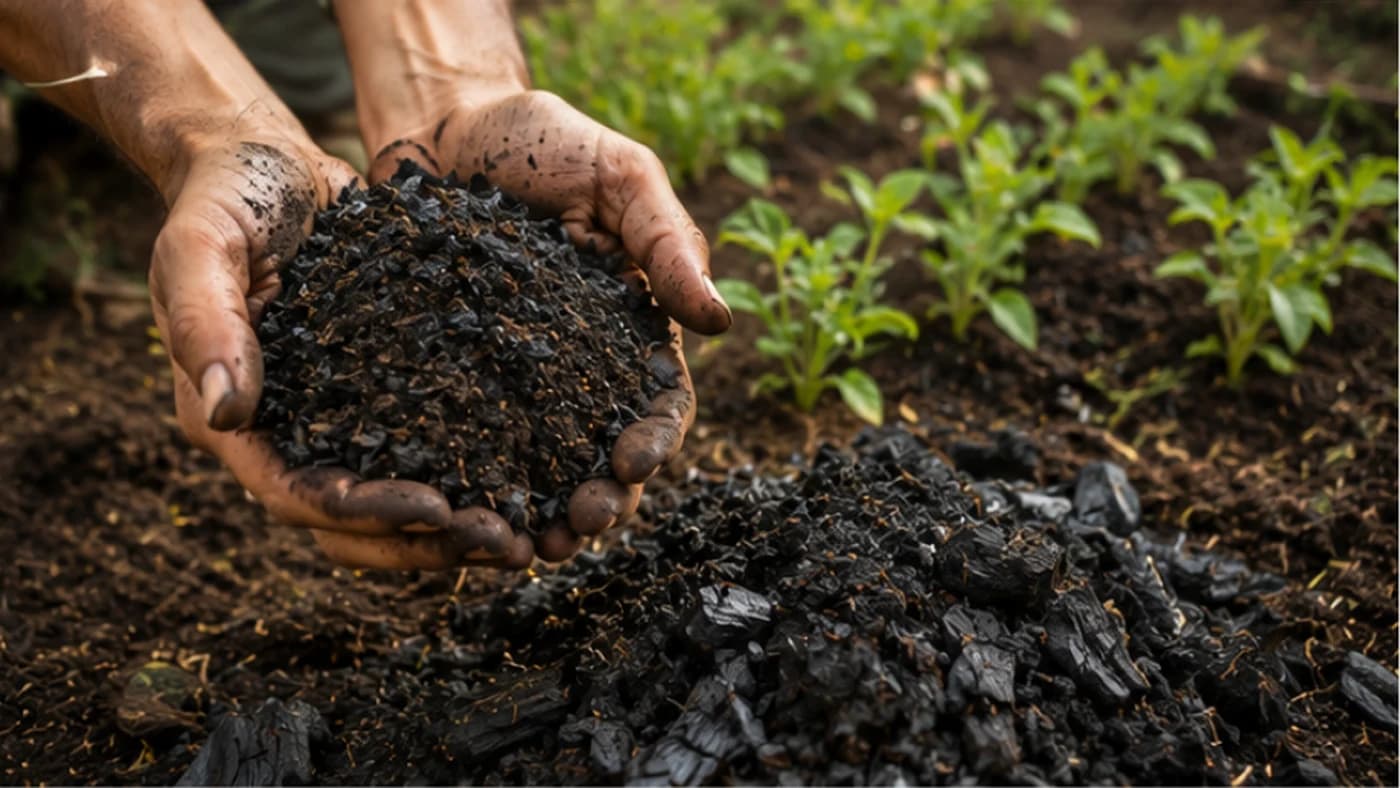
Terra Preta: The 2,000-Year-Old Soil That Gets More Fertile With Age
Ancient Amazonian farmers built soil that is still 10x more fertile than the surrounding land 2,000 years later — using biochar, organic waste and minerals. Here's how to build a modern version in your own field.
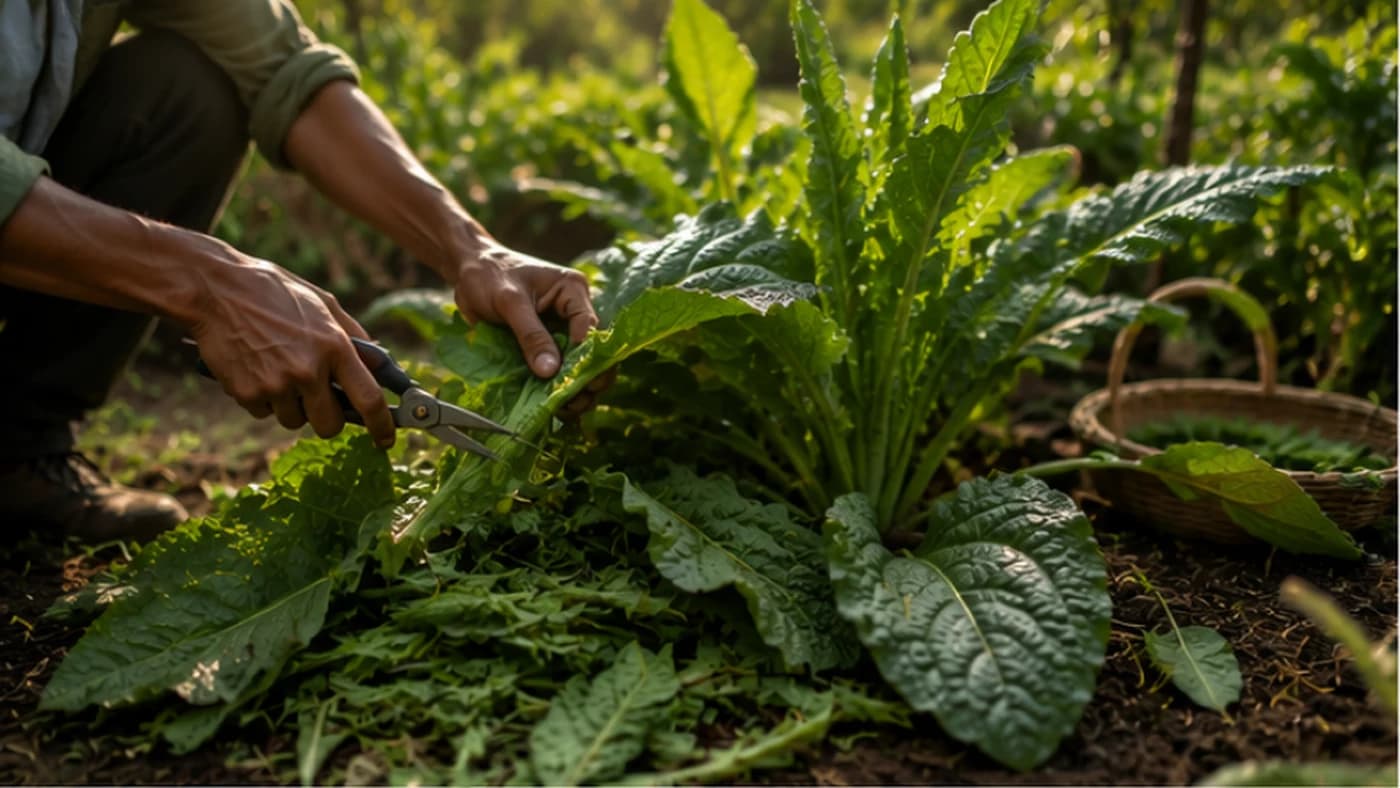
Dynamic Accumulator Plants: Free Fertiliser Mining From Deep Below Your Field
Most crop roots barely reach 30–45 cm down, while a store of potassium, calcium and other minerals often sits much deeper, out of reach. Deep-rooted 'accumulator' plants act as a biological elevator that brings those minerals up for free.
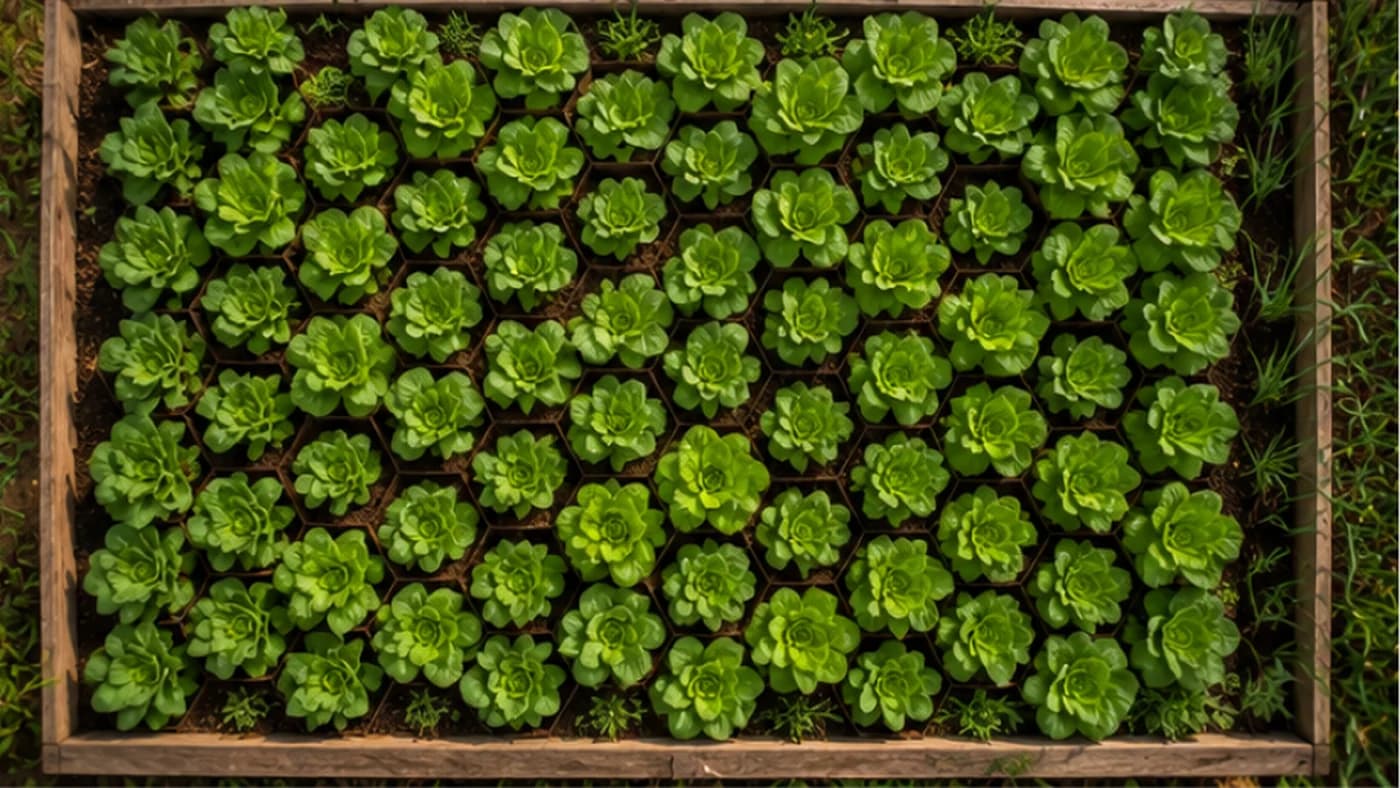
Hexagonal Spacing: Fit 15% More Plants in the Same Bed and Stop Weeding
Plant in a staggered triangle pattern instead of straight rows and the leaves close into a canopy that shades out weeds on its own — 10-15% more plants per bed, far less watering, and far less hoeing.