

Permaculture Swales: The Level Trench That Banks Rainwater in Your Soil
Most farms are built to throw rainwater away as fast as possible. A swale — a level, on-contour trench with a planted mound beside it — banks that water in the soil instead, so your land stays green long after the rain stops.
Quick answer
A swale turns a flood into a slow-release water bank: dig it dead level on the contour, plant its berm heavily, always give it a spillway, and keep it off steep slopes, waterlogged ground and land near your house foundation. Done right, it is a one-time earthworks job that keeps paying you back in soil moisture, fertility and drought resilience for decades with almost no maintenance.
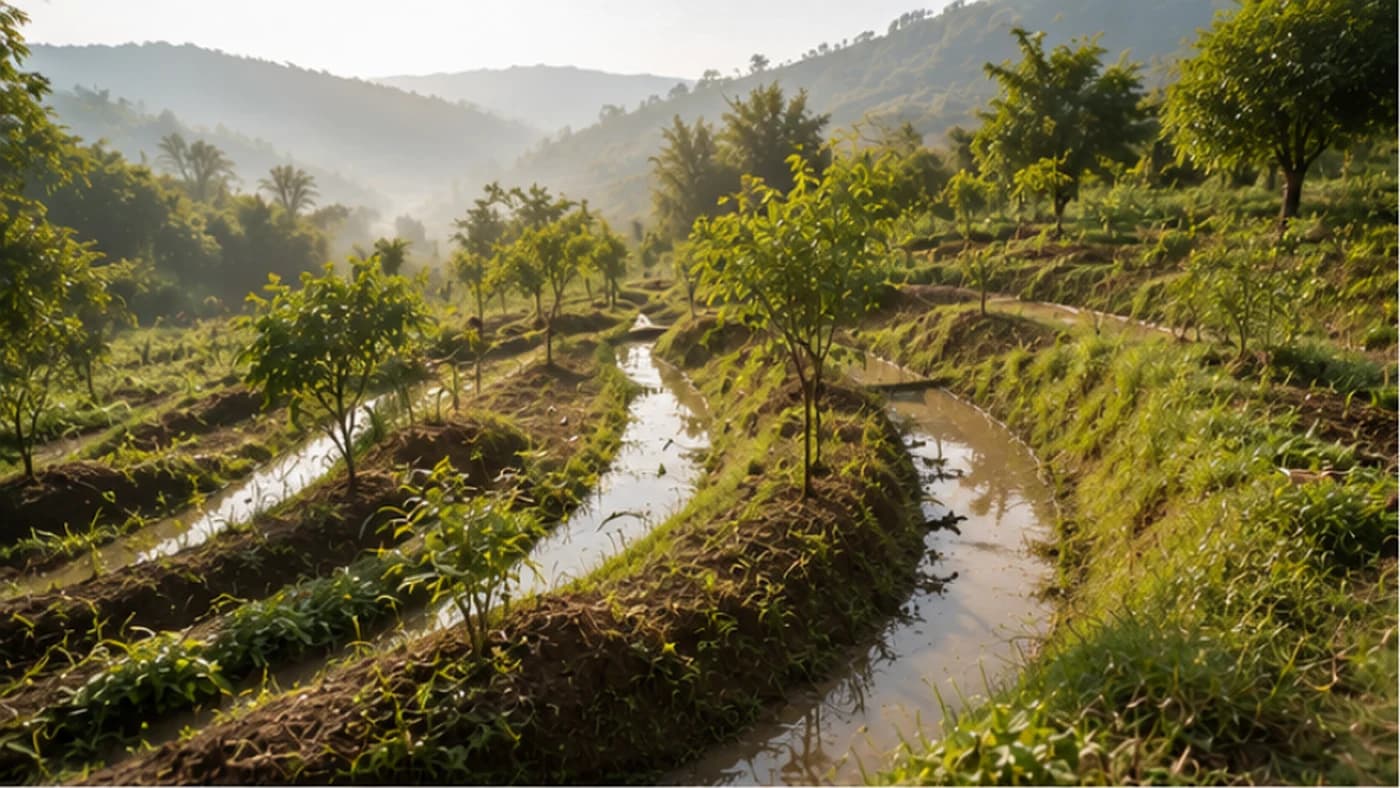
Walk most farms during a good monsoon downpour and you will see the same story: water racing across the surface, cutting small gullies, carrying away topsoil, and disappearing into the nearest drain or stream within minutes. That water was the most valuable thing that fell on your land all year, and most farms let almost all of it leave. A swale is a simple earthwork that changes this: a level, on-contour trench with a mound of loose soil on its downhill side, built to stop water in its tracks and let it soak deep into the ground instead of running off. It needs no pump, no electricity and very little upkeep once it is planted — just careful levelling and a bit of digging.
What a swale actually is
A swale is not a drainage ditch. A drainage ditch is built with a slope so water moves quickly from one point to another and leaves the field. A swale is built dead level along the contour of the land, so water entering it cannot flow anywhere — it can only spread out along the whole length of the trench and sink downward. Every functional swale has three parts: the trench itself (the catchment area where water collects), the berm (the mound of loose, uncompacted soil piled on the downhill side from digging the trench, later planted with trees and cover crops), and the spillway (a reinforced low point in the berm where water can exit safely during an extreme storm without the whole berm blowing out).
Once water is trapped in a level trench it has nowhere to go but down. It moves slowly through the soil profile as a plume of moisture, recharging groundwater and feeding the roots of trees planted on the berm for weeks or months after the rain has stopped — a passive underground irrigation system that runs on gravity alone.
How to size and build one, step by step
Start by watching your land during rain — where does water gather speed, and where does it pool? You cannot judge a level line by eye on a slope; use an A-frame level (three pieces of wood, string and a weight, easily homemade) or a simple line level to mark the contour, walking it across the slope and flagging every point where it reads level, then joining the flags into a line.
As a rough sizing rule, about 90 square metres of catchment area produces roughly 2,500 litres of water for every 25 mm of rain that falls — useful for judging how big a trench you need. For most farm and homestead swales, a trench 45–60 cm wide and about 30 cm deep is a solid starting point. Dig on the downhill side of your marked line and pile the soil immediately downhill of the trench to form the berm, keeping the trench bottom perfectly flat so even light rain spreads evenly along its length rather than pooling at one end.
Shape the berm with a broad, gentle slope — aim for a base at least four times the height of the mound — and mulch it immediately with straw or leaf litter so raindrops do not wash it away before plants establish. Finally, build a spillway: a safe exit point on well-vegetated ground, dug about 10–15 cm lower than the rest of the berm crest and armoured with flat stones, so that in an unusually heavy storm the excess water has somewhere controlled to go rather than tearing a hole in your berm.
Why swales are worth the digging
The biggest payoff is drought resilience: by forcing water into the subsoil, a swale system keeps land hydrated from the inside out, so plants on a swale often stay green through a dry spell while unswaled land nearby is already stressed. Swales also build fertility over time — leaves, twigs and organic debris collect and rot in the moist trench, feeding the berm — and they control erosion, since every swale acts as a speed bump that breaks a long slope into shorter segments so runoff never gathers enough speed to strip topsoil. The combination of standing moisture and dense planting also cools the immediate area and buffers against early-season temperature swings, letting a wider range of crops establish successfully.
Mistakes that ruin a swale
The single most common failure is building off-contour: even a slight unevenness turns the trench into a channel, water rushes to the lowest point, and the berm blows out — often carving a gully worse than the one you were trying to prevent. Skipping the spillway is the second-biggest mistake; without one, an extreme storm will find its own exit, usually by destroying the berm. Compacting the berm with foot or vehicle traffic defeats its purpose, since roots need loose, aerated soil to grow into. And leaving the berm bare, even for a season, invites erosion — have seed and mulch ready before you dig the first spadeful, not after.
When a swale is not the right answer
Swales are generally recommended only on slopes under about 15%; on steeper ground the extra water saturating the soil can actually increase landslide risk, and terracing or check-dam-style structures are safer. Land with a high water table or already-soggy soil will only get wetter with a swale, since its whole purpose is to increase infiltration — diversion drains are the better tool there. Heavy clay soils can hold standing water in the trench for weeks without it soaking in, which can rot tree roots and breed mosquitoes, so clay-heavy swales often need extra woody debris mixed in or a very slight fall built in. And never build a swale within 3–6 metres of a house foundation, well or septic system — deliberately saturating the ground that close to a structure can undermine it.
Practical tips and India-specific notes
Mulch the trench floor with woodchips or coarse gravel rather than leaving bare soil, so it does not seal over and can keep absorbing water. As a rule of thumb, a healthy swale should drain within 24–48 hours; if water is still standing after three days, suspect compaction or heavy clay. Always build your first swale near the top of the slope, not the bottom, so you learn to manage smaller volumes before tackling the full runoff from above. Plant nitrogen-fixing species on the berm — in an Indian context, subabul (Leucaena leucocephala), gliricidia or pigeon pea work well depending on region — to build fertility quickly, and use tough, water-loving grasses like vetiver at the spillway, since vetiver's dense fibrous roots are exceptional at holding soil against fast-moving water.
Swales fit naturally alongside India's existing watershed and rainwater-harvesting push — many states already require or incentivise farm ponds and contour bunding under schemes tied to watershed development and MGNREGA; a system of on-contour swales feeding into a farm pond is a natural extension of the same logic your local agriculture office may already support.
Terms explained in this guide
Frequently asked
What is the difference between a swale and a drainage ditch?+
A drainage ditch is sloped to move water away quickly. A swale is dug perfectly level along the contour so water cannot flow anywhere — it spreads out and soaks straight down into the soil instead of running off.
How wide and deep should a swale be?+
For most farm and homestead use, a trench 45–60 cm wide and about 30 cm deep is a good starting size, adjusted upward if your catchment area or local rainfall intensity is high.
Do swales work on any slope?+
They work best on slopes under about 15%. On steeper land, water trapped in the soil can increase landslide risk, so terracing or check dams are usually the safer choice instead.
How do I know if my swale is built correctly?+
It should drain within 24–48 hours after rain. If water stands for three days or more, you likely have a compaction or heavy-clay problem that needs extra organic matter or a very slight fall.
Can I build a swale close to my house?+
No — keep swales at least 3–6 metres away from any house foundation, well or septic system, since deliberately saturating soil that close to a structure can weaken it.
Where to go next
Want this as daily tasks for your farm?
Khetiyaar turns guides like this into a day-by-day plan — in your language, free to start.

Related guides
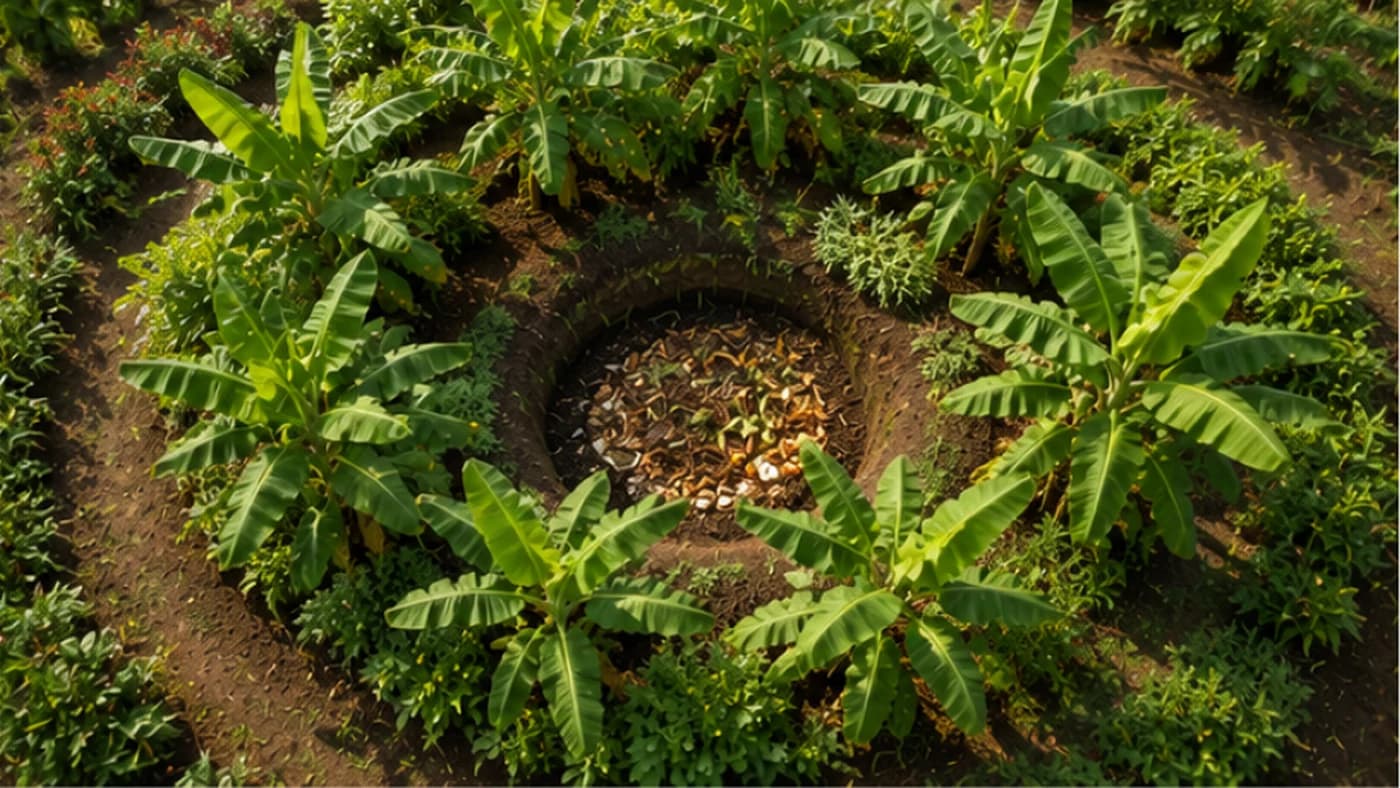
How to Build a Banana Circle: Turn Kitchen Greywater into a Banana Harvest
A banana circle captures your kitchen and bathroom greywater, composts organic waste, and grows a steady harvest of bananas — all in one self-managing pit-and-mound system that suits most of India's climate.
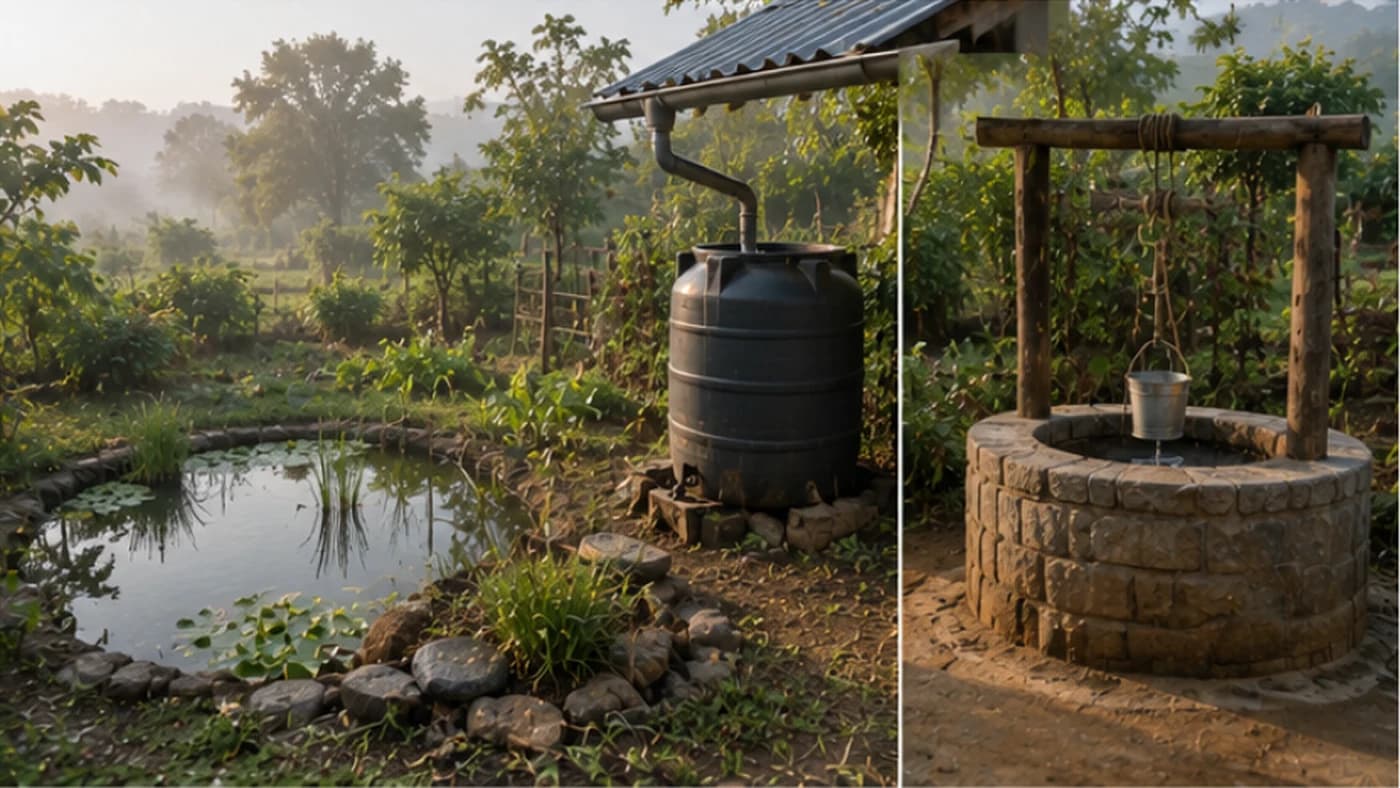
Best Water Sources for Your Farm: Why 'Living Water' Beats Tap Water
Borewell and tap water is treated to be sterile — safe for people, but nearly dead for soil biology. Rainwater, pond water and treated greywater carry warmth, nutrients and microbes your soil actually wants.
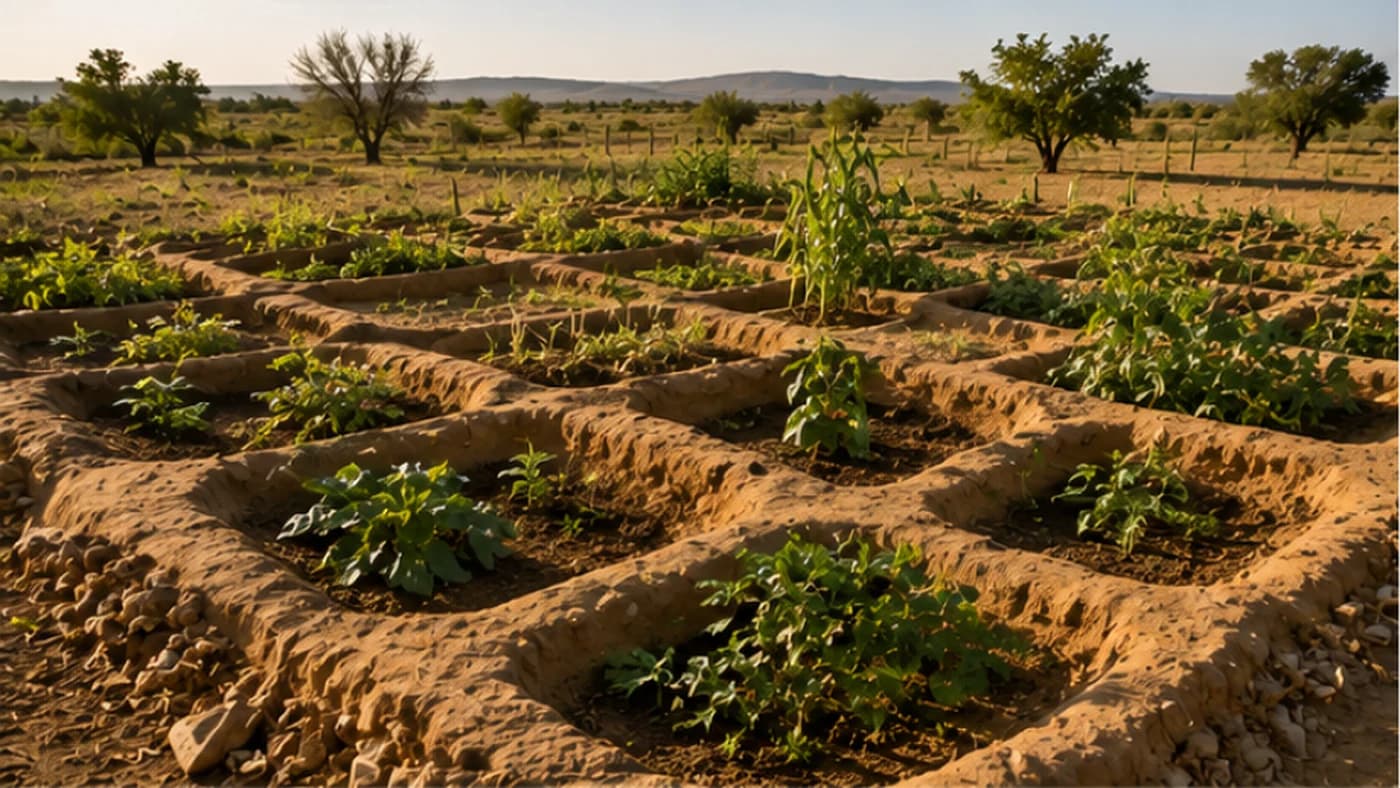
The Zuni Waffle Garden: An Ancient Dryland Method for Water-Scarce Farms
Ordinary sprinklers lose much of their water to wind and evaporation. This centuries-old sunken-bed technique from the American Southwest desert traps every drop close to the roots — and it adapts easily to India's driest tracts.