

How to Build a Banana Circle: Turn Kitchen Greywater into a Banana Harvest
A banana circle captures your kitchen and bathroom greywater, composts organic waste, and grows a steady harvest of bananas — all in one self-managing pit-and-mound system that suits most of India's climate.
Quick answer
A banana circle turns a waste problem into a harvest: dig the pit, build the mound, fill it with mulch, plant bananas and companions around the edge, and let your kitchen and bathroom greywater do the watering. Get the mulch level, drainage and plant spacing right, and it keeps producing bananas, papaya and sweet potato for years with almost no external input — a genuinely useful system for most of India's climate.
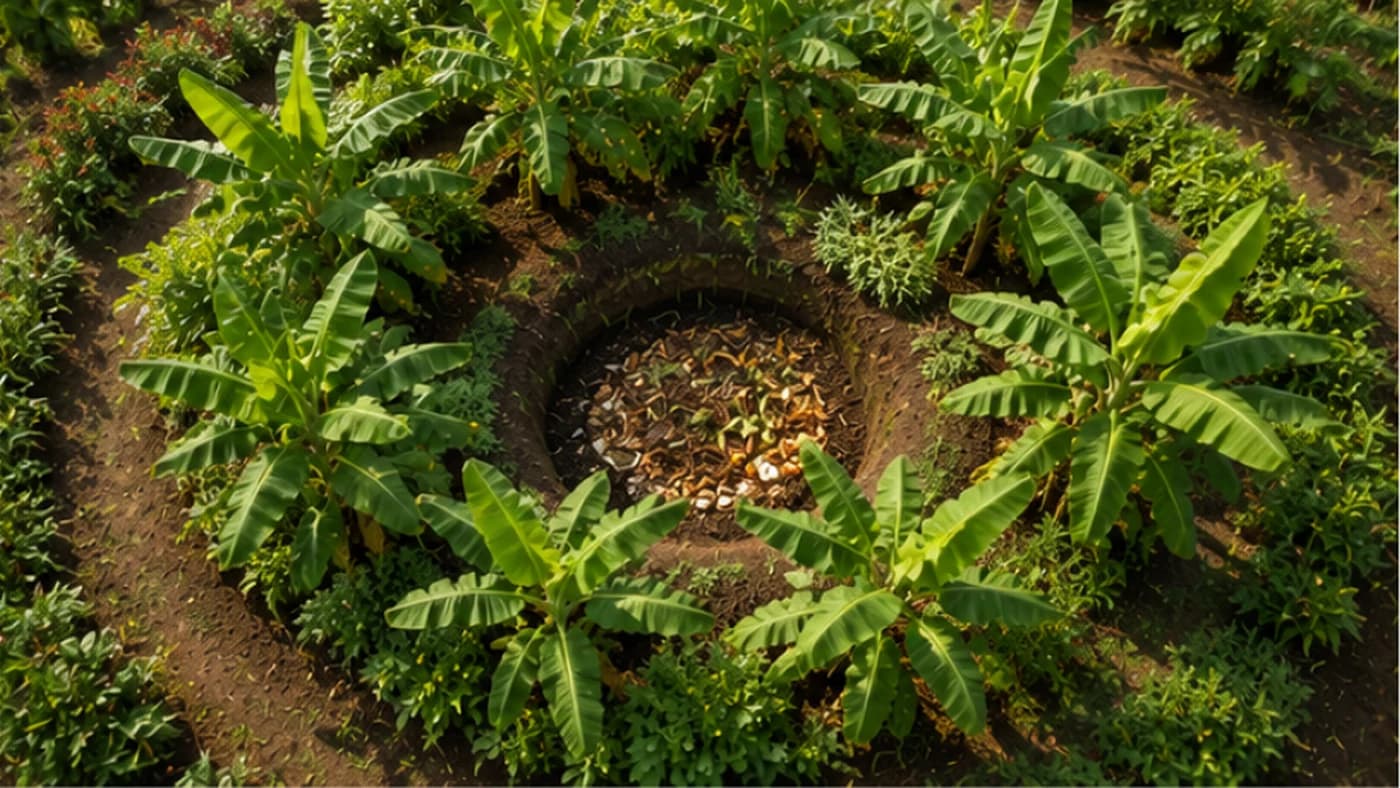
Most homes treat wastewater as something to get rid of as fast as possible — piped away, out of sight, out of mind. A banana circle treats the same water as a resource: a hollow-centred mound where a pit of composting organic matter soaks up greywater and slowly releases it to a ring of banana plants around the edge. It works like a living filter, a composting station and a fruit orchard rolled into one, and because bananas already grow across most of India — from Maharashtra and Gujarat to Tamil Nadu, Kerala, Karnataka, Bengal and the North-East — a banana circle fits naturally into an Indian kitchen garden or farm boundary.
What a banana circle is and why it works
A banana circle is a garden bed shaped like a hollow mound: a central pit surrounded by a raised ring of earth where the plants grow. It mimics a rainforest floor, where organic matter collects in hollows, holds moisture, and feeds the plants growing around the rim. The central pit is filled with carbon-rich material — logs, branches, dry leaves, kitchen scraps — so when water from a sink, wash-basin or bathroom drain reaches the pit, the organic matter soaks it up instead of letting it run off, and it seeps slowly into the surrounding mound where the banana roots are waiting.
The design works especially well in most of India's climate: bananas need warmth and consistent moisture, and the pit-and-mound structure keeps the roots above standing water (bananas hate wet feet) while still drawing on the moisture stored below. Only in the colder Himalayan belt and high hill stations does the system struggle, since bananas need year-round warmth to keep processing water through the winter.
How the living filter works
The system runs on three parts working together: the pit, the mound, and the mix of plants around it. The central pit is usually dug 50 cm to 1 metre deep and about 2 metres across — the digestive organ of the system, where bacteria, fungi and earthworms break down carbon and nitrogen and release minerals straight into the root zone. The mound, built from the soil you dug out of the pit, keeps the banana corms well-drained even while their roots reach down into the moist, nutrient-rich pit below.
Greywater piped in from a wash-basin, laundry area or outdoor bathing space is filtered physically by the mulch layer, which catches solids, while the soil's own microbial life breaks down soap residues; the plants then draw the water up and release it as clean vapour, filtering and cooling at the same time.
Step-by-step construction
Site it where it gets at least six to eight hours of sun and, if possible, close to a greywater outlet. Mark a circle about 2 metres across using a stake and a 1-metre string.
Dig the central pit in a bowl shape, deepest in the middle, tapering up towards the edge; if you're digging into heavy clay, rough up the walls so water doesn't just glaze over and pool. Pile the dug-out soil in a ring around the outside to form the raised mound.
Fill the pit with coarse organic matter — start with logs or thick branches at the bottom for air pockets, then layer smaller sticks, dry leaves and green waste until the fill sits slightly higher than the surrounding ground.
Plant four to six banana suckers evenly spaced around the top of the mound, and fill in with companion plants — papaya or pigeon pea between the bananas, and a spreading groundcover like sweet potato vine on the outer slope to hold the soil.
What it gives back
A well-built banana circle can process 100–200 litres of greywater a day depending on climate and soil, filtered by mulch and soil biology before it ever reaches the water table — a real saving in areas where a soak pit or septic system would otherwise cost a fair amount to install and maintain. It's also a passive composting system: kitchen scraps, grass clippings and pruned branches go straight into the centre, and the heavy-feeding bananas take up the nutrients as they're released, with no smell and no leaching.
Because the system is layered vertically as well as horizontally, a roughly 3-metre-wide circle can produce a steady supply of bananas alongside papaya, sweet potato and shade-loving herbs like ginger or turmeric — a lot of food from a small footprint. Over a few seasons, the constant chop-and-drop mulching also turns compacted, poor soil into rich dark humus.
Mistakes that cause problems
Not enough mulch is the most common failure — a bare pit dries out fast and stops working biologically, and it also loses the mulch's job of keeping mosquitoes from breeding in standing water. Over-planting is the second: bananas multiply quickly, and a crowded circle loses airflow and becomes prone to fungal problems like Sigatoka leaf spot or Panama wilt, both present in Indian banana-growing regions — so thin ruthlessly, keeping only one fruiting plant, one successor sucker, and one young sucker per station.
Poor drainage is the quiet killer: in heavy clay, the pit can act like a bathtub and hold water until roots rot, so if your soil doesn't drain well, dig a small overflow channel on the downhill side to let excess water escape safely.
Where it doesn't fit
A functional circle needs roughly 3–4 metres of footprint once you allow for a walking path around it, which can be too much for a very small urban plot — a half-circle or a linear banana swale along a boundary wall is a reasonable adaptation. The system also can't tolerate harsh chemicals in the greywater: bleach, strong disinfectants and some synthetic soaps will kill the bacteria and fungi that make it work, so switch to plant-safe, biodegradable soap and detergent for any water that feeds the circle.
Banana circle vs a conventional soak pit or septic system
A conventional septic or soak-pit system needs real construction cost and periodic desludging or pumping, produces no usable output since the waste is simply buried, and typically lasts 20–30 years before it needs rebuilding. A banana circle costs little beyond the labour and a few suckers, needs only annual chop-and-drop maintenance, produces a steady stream of food, mulch and biomass, and — with basic upkeep — keeps working indefinitely while building soil instead of just holding waste. A septic system is still necessary for toilet (blackwater) waste in most areas, but for kitchen and bathing greywater, a banana circle is a far more productive way to handle it.
Practical tips
Always let new suckers grow on the outer edge of the circle rather than the centre, so the planting keeps spiralling gently outward and the central pit stays clear. Plant a nitrogen-fixing pigeon pea (Cajanus cajan, already a familiar crop across India) on one side — it can be pruned hard for green mulch. If standing water lingers, keep the mulch layer at least 30 cm thick above the water line so it acts as a physical barrier against mosquito breeding. Aim for roughly 70% brown material (dry leaves, straw, wood chips) to 30% green material (kitchen scraps, fresh grass clippings) in the pit, to keep it from turning smelly and anaerobic.
Scaling up
One circle is a good start, but several linked by shallow swales can form a small filtration network — greywater enters the first circle, and any overflow travels on to the next, supporting a whole family orchard. Where soil fertility is poor, some growers integrate output from a well-managed composting toilet as an additional nutrient source, though this needs careful management and attention to basic hygiene. In cooler weeks, lining the northern edge with dark stones or water drums that absorb daytime heat and release it at night can help extend the growing season.
Picture a home with a soggy patch of compacted clay behind the wash area, where standing water was breeding mosquitoes. Digging a 2.5-metre banana circle there, piping the wash-basin outlet into the centre filled with old fronds and cardboard, can turn that boggy corner into a stand of banana plants and a carpet of sweet potato vines within six months — and by the end of the first year, deliver a real harvest of bananas and tubers from what used to be a waterlogged nuisance.
Terms explained in this guide
Frequently asked
What is a banana circle?+
A circular garden bed with a mulch-filled central pit that absorbs greywater, surrounded by a raised mound planted with bananas and companion crops — it filters wastewater while producing fruit.
Does a banana circle work in the Indian climate?+
Yes, across most of the country — bananas already grow widely in India. Only the high-altitude Himalayan belt is too cold for the system to work reliably year-round.
How much greywater can a banana circle handle?+
A well-built circle can process roughly 100–200 litres a day depending on climate and soil, filtered through mulch and soil biology before it reaches the groundwater.
What soap or detergent is safe to feed into a banana circle?+
Only plant-safe, biodegradable soaps and detergents. Bleach and strong synthetic disinfectants will kill the bacteria and fungi that make the system work.
What's the biggest mistake people make with banana circles?+
Not keeping enough mulch in the pit, and letting the circle get overcrowded with too many suckers, which cuts airflow and invites fungal disease.
Where to go next
Want this as daily tasks for your farm?
Khetiyaar turns guides like this into a day-by-day plan — in your language, free to start.

Related guides
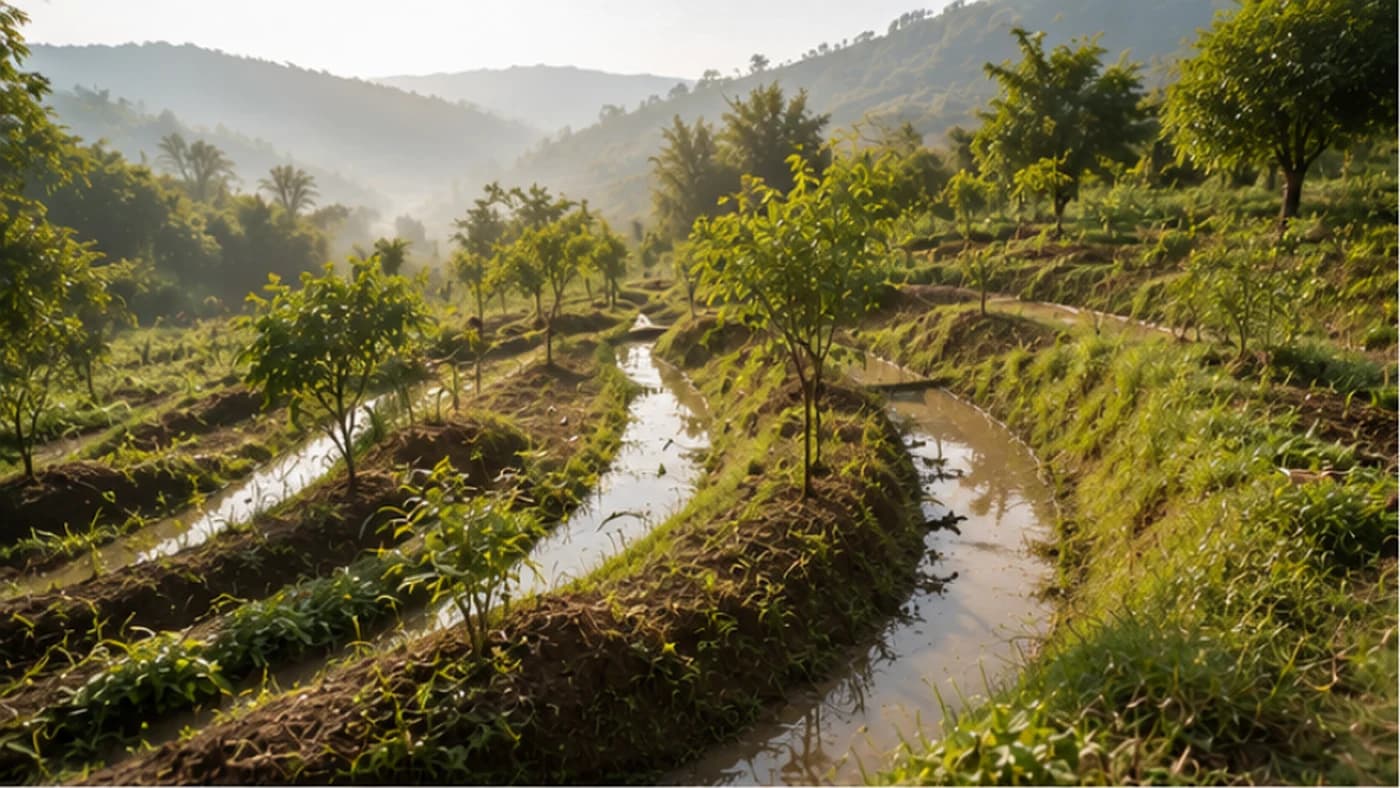
Permaculture Swales: The Level Trench That Banks Rainwater in Your Soil
Most farms are built to throw rainwater away as fast as possible. A swale — a level, on-contour trench with a planted mound beside it — banks that water in the soil instead, so your land stays green long after the rain stops.
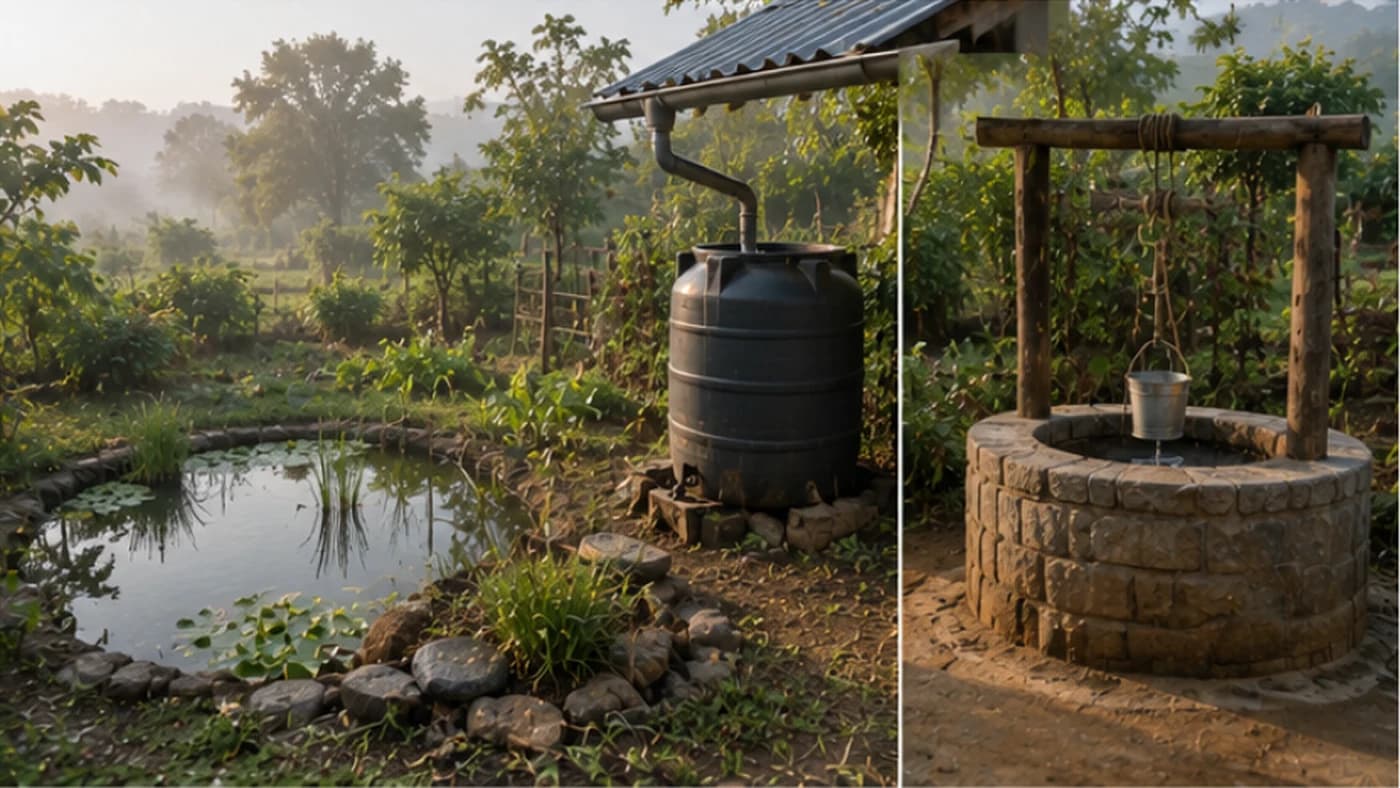
Best Water Sources for Your Farm: Why 'Living Water' Beats Tap Water
Borewell and tap water is treated to be sterile — safe for people, but nearly dead for soil biology. Rainwater, pond water and treated greywater carry warmth, nutrients and microbes your soil actually wants.
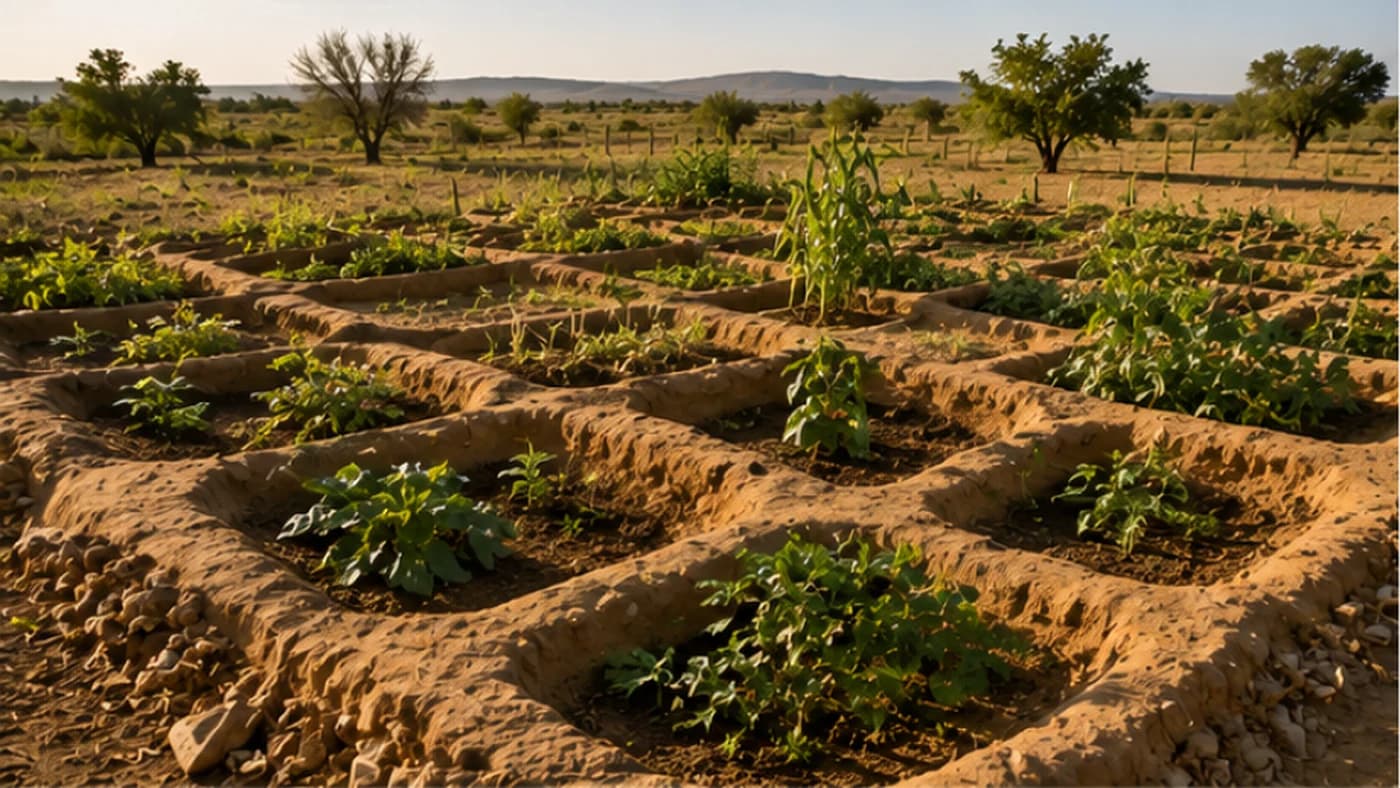
The Zuni Waffle Garden: An Ancient Dryland Method for Water-Scarce Farms
Ordinary sprinklers lose much of their water to wind and evaporation. This centuries-old sunken-bed technique from the American Southwest desert traps every drop close to the roots — and it adapts easily to India's driest tracts.