

Chemical-Free Parasite Control for Sheep and Goats
Common dewormers are now failing in the gut of the very worms they're meant to kill — on many farms efficacy has dropped to 21-34% for some species. Rotational grazing and tannin-rich fodder can do what the bottle no longer can.
Quick answer
A drench bottle only ever buys you time against a parasite that keeps adapting. Rotational grazing built around the 4-day and 4-inch rules, tannin-rich browse like subabul or Sesbania, FAMACHA scoring to treat only the animals that need it, and breeding toward resistance together do something no chemical can: they get stronger every year instead of weaker. Keep the drench for genuine emergencies, and let the pasture do the daily work.
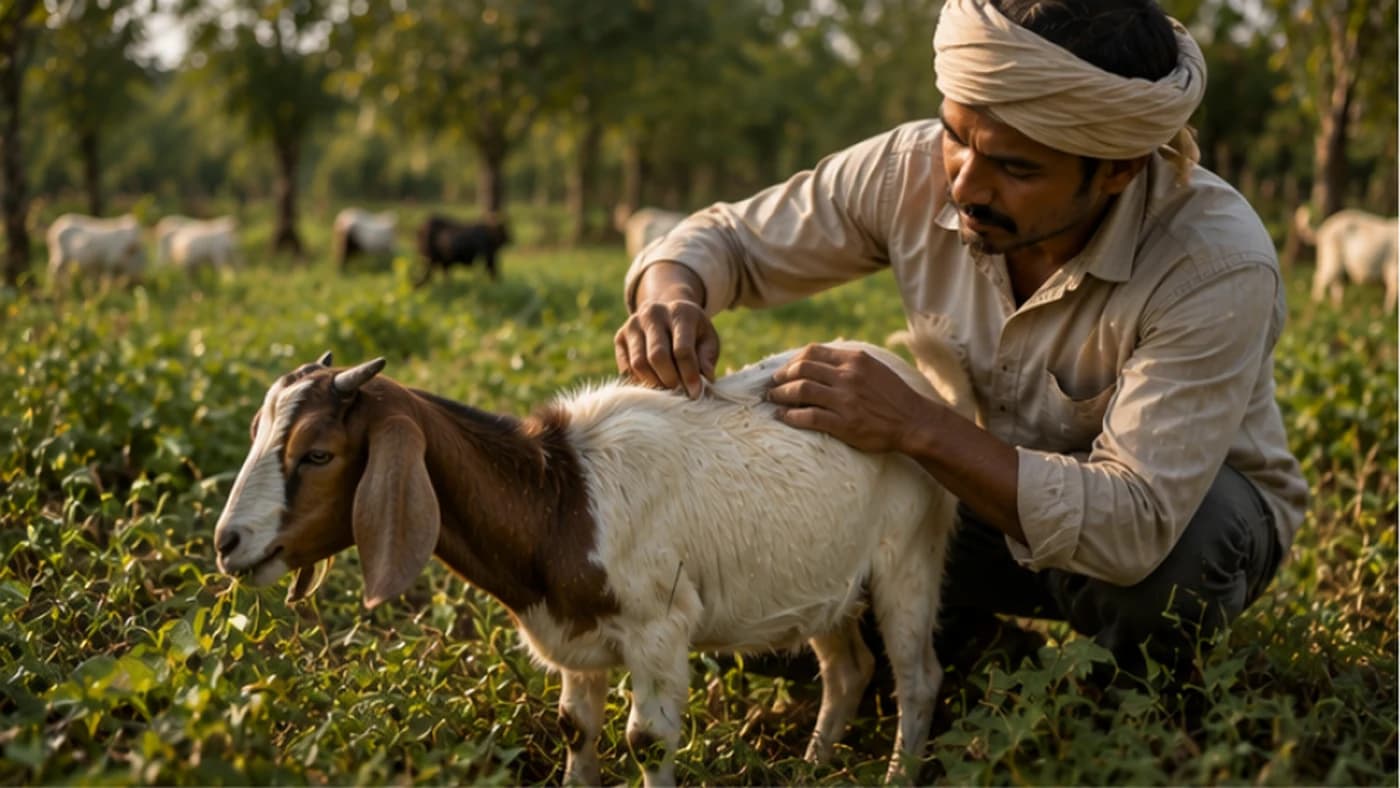
For generations the answer to a wormy flock was simple: reach for the drench bottle. That answer is running out of road. On many farms, common dewormers now kill barely a third of the worms they're used against, because parasites like Haemonchus contortus (the barber's pole worm) have evolved resistance to almost every chemical class available. Every drench that fails still poisons the dung beetles and soil microbes that keep a pasture healthy — money spent for damage instead of relief. The alternative isn't neglect; it's turning the pasture itself into your first line of defence, so your goats and sheep need the bottle far less often.
Why the chemical approach is breaking down
Chemical-free parasite control is a management strategy that protects animal immunity and pasture health instead of trying to kill every worm in the flock. The goal isn't zero parasites — it's keeping the parasite population low enough that it never causes real disease or production loss. This matters because worms like the barber's pole worm have out-evolved almost every dewormer class we've thrown at them, and resistance is now a present reality on many Indian sheep and goat farms, not a distant risk.
The approach rests on two pillars: forage defence (using specific plants that fight parasites naturally) and rotational strategy (using time and paddock movement to starve the parasite lifecycle). Think of it less as removing every enemy piece from the board and more as making the board too difficult for the parasite to win on.
Understanding the worm's lifecycle
To beat a parasite without chemicals, you need to understand its life cycle better than it does. An adult worm lives in the gut and sheds eggs into the manure. Once on the ground, those eggs hatch into larvae that, in warm, moist weather, crawl up blades of grass to be eaten by the next grazing animal. Every rule below exists to break this loop at its weakest point.
The 4-day rule: most worm eggs need 5-6 days in summer heat to become infective larvae. Move your flock to a new paddock every 3-4 days and they walk away before the next generation becomes dangerous.
The 4-inch rule: 80-90% of infective larvae live in the bottom 2-4 inches (5-10 cm) of pasture. Never let animals graze below about 4 inches, leaving a 6-8 inch (15-20 cm) residual, and they simply won't eat most of the parasite load.
Rest and recovery: once animals leave a paddock, larvae start dying off if nothing eats them — in hot, dry weather within about 30 days, but they can survive for months in cool, moist conditions. A rest of 40-65 days between grazings sharply cuts the number of survivors waiting for your flock's return.
The multi-species buffer: sheep and cattle don't share the same parasites. Grazing cattle behind sheep lets the cattle 'vacuum up' sheep-specific larvae that can't survive in a cow's gut — effectively cleaning the pasture before the next batch of lambs or kids arrives.
Tannin-rich fodder: a natural pharmacy in every bite
If rotational grazing is the shield, tannin-rich fodder is the sword. Plants containing condensed tannins can inhibit worm-egg hatching and slow larval movement in the gut. In temperate systems this often means chicory, sainfoin, and birdsfoot trefoil, which aren't common across most of India — but Indian sheep and goat research (including work at ICAR's Central Sheep and Wool Research Institute) has looked at tanniniferous fodder trees and shrubs already familiar to Indian herders, such as subabul (Leucaena leucocephala), babul (Acacia nilotica) pods, and Sesbania, as browse that can play a similar role alongside good grazing management.
These deep-rooted plants also pull minerals like zinc, copper, and selenium up from deep in the soil profile. A well-mineralised animal simply has a stronger immune system and resists the worms it does encounter far better than one running on bare pasture alone.
What you gain by working with biology instead of against it
The biggest win is protecting dung beetles — the pasture's clean-up crew. They bury manure (and the parasite eggs inside it), pulling them off the grazing surface entirely, while synthetic dewormers such as ivermectin are highly toxic to them. Stop blanket-drenching every animal and you also preserve refugia: a small population of susceptible worms survives and interbreeds with resistant ones, diluting the 'super-worm' genetics — so if you ever do need a chemical in an emergency, it still works.
Tanniniferous fodder trees and legumes are also more drought-tolerant than many pasture grasses, and nitrogen-fixing legumes can add well over 150 kg of nitrogen per hectare to the soil, cutting your fertiliser bill at the same time.
Common mistakes to avoid
Overgrazing is the single most frequent error — if you let animals graze down to the roots, you're forcing them to eat the most parasite-contaminated grass on the farm, and no amount of tanniferous browse overcomes that. Set-stocking (leaving animals in one large field for weeks) creates a permanent reinfection loop. And many keepers simply don't watch their animals closely enough: natural control isn't less management, it's different management. Use FAMACHA scoring — checking the colour of the inner eyelid for anaemia — to spot the individual animals that actually need treatment, rather than drenching the whole flock blindly.
Where this method has real limits
This is not a cure-all. On very small holdings or high-density systems, long rest periods simply aren't possible, and an unusually hot, wet season can produce a parasite bloom that outruns your rotation. Young weaned lambs/kids and does or ewes in late pregnancy have naturally lower immunity, so there will be times when a targeted chemical treatment is genuinely the right call to save an animal's life. Forage defence is your primary tool; the drench bottle is the break-glass-in-emergency option, used sparingly and strategically rather than on a routine calendar.
Chemical drench vs forage defence, side by side
Chemical drench: a recurring per-animal cost that keeps rising; often toxic to dung beetles and soil life; effectiveness falling as resistance spreads; low long-term sustainability as super-worms build up.
Forage defence: a one-time seeding cost plus your grazing-management time; builds organic matter and fixes nitrogen in the soil; effectiveness improves over time as soil and animal health improve; high sustainability, moving toward a closed-loop system.
Practical steps to start this season
Overseed existing pasture or bunds with hardy tanniniferous fodder — subabul, Sesbania, or babul where suited to your region. Learn FAMACHA scoring so you can identify the roughly 20% of the flock carrying 80% of the parasite load, and treat only those animals. Use temporary poly-wire fencing and step-in posts to split large fields into smaller paddocks you can rotate every 3-4 days. And monitor with a fecal egg count (FEC) test rather than guessing — a simple lab or veterinary-college test tells you exactly which worms you're dealing with and how heavy the burden is before symptoms like weight loss or bottle jaw appear.
Going further: breeding for resistance
For the committed keeper, the long game is breeding for resistance. Not every animal responds to parasites the same way — some are genetically better at fighting them off. Identify and gradually cull animals that consistently need drenching, and over several generations you build a flock that thrives on your fodder and grazing system with minimal chemical input — self-reliant livestock built for your specific land.
Frequently asked
Why are dewormers failing on so many farms?+
Parasites like the barber's pole worm have evolved resistance to nearly every chemical dewormer class. On many farms, common drenches now kill only 21-34% of certain worm species, so chemical control alone is no longer reliable.
What is the 4-day, 4-inch rule?+
Move animals to a new paddock every 3-4 days (before worm eggs become infective larvae), and never let them graze below about 4 inches (10 cm), since 80-90% of larvae live in the bottom few inches of pasture.
What is FAMACHA scoring?+
A simple check of the colour of an animal's inner eyelid to estimate anaemia caused by blood-feeding worms. It lets you identify and treat only the roughly 20% of animals carrying most of the parasite load, instead of drenching the whole flock.
Which Indian fodder plants can help with natural parasite control?+
Tanniniferous browse such as subabul (Leucaena), Sesbania, and babul (Acacia nilotica) pods have been studied as natural aids to parasite management in Indian small-ruminant systems, alongside good rotational grazing.
Should I stop using chemical dewormers completely?+
No. Forage defence and rotational grazing should be your primary tools, but targeted chemical treatment is still the right call for animals with genuinely low immunity, such as newly weaned young or late-pregnancy females, or during a parasite bloom the system can't keep up with.
Where to go next
- AI farming chatbotAsk any farming question in Gujarati, Hindi or English and get an answer in seconds.
- Kheti app for Indian farmersCrop plans, disease diagnosis, weather and mandi rates in one app.
- Agri Bazar marketplaceBuy and sell animals, crops, equipment and dairy near you — and see what buyers want today.
Want this as daily tasks for your farm?
Khetiyaar turns guides like this into a day-by-day plan — in your language, free to start.

Related guides
Natural Fly Control for Animal Shelters: Building a Living Barrier Instead of Spraying Chemicals
Flies can cut cattle weight gain by 10-25% and spread over 65 diseases. Instead of a fresh can of spray every week, a planted barrier of repellent trees and shrubs can keep them out permanently — here's how, using plants that actually grow in India.
How to Attract Barn Owls to Your Farm for Free Rodent Control
One pair of barn owls can hunt over a thousand rodents in a single season — but only if you give them a properly designed, dark, predator-proof box. Barn owls (Tyto alba) already live across most of India; here's how to bring them onto your farm.
Living Fences for Livestock: Grow a Boundary That Never Needs Replacing
A wire fence rusts and sags within 20–30 years. A well-managed living fence of thorny trees and shrubs gets stronger every winter, blocks wind, feeds your animals, and can outlast the farm itself.