

Heat Stress and the Monsoon: Managing Dairy Cattle Through India's Two Hardest Seasons
Summer heat and monsoon damp punish a dairy animal in completely different ways, which is why one set of shed arrangements never covers both. Here is how to read heat stress early, why buffaloes suffer most, and how to keep the monsoon from costing you feet, udders and fodder.
Quick answer
Summer and the monsoon both cut milk, but for opposite reasons, and each needs its own preparation. In the heat, the animal cannot shed the heat she makes and absorbs, so she leaves her dry fodder first, then bunches and stands, then pants — and your job is shade, a roof that does not radiate, moving air, and clean shaded water available all day, with buffaloes and crossbreds looked after first because they cope worst. In the monsoon, humidity blocks her cooling and permanent wet under her feet brings foot rot, mastitis, flies and mouldy fodder — and your job is drainage, a dry raised place to lie, daily removal of slurry, and dry roughage alongside the watery green. Get the pre-season jobs done before each season arrives, and call the veterinarian early for any lame animal or any swollen quarter.
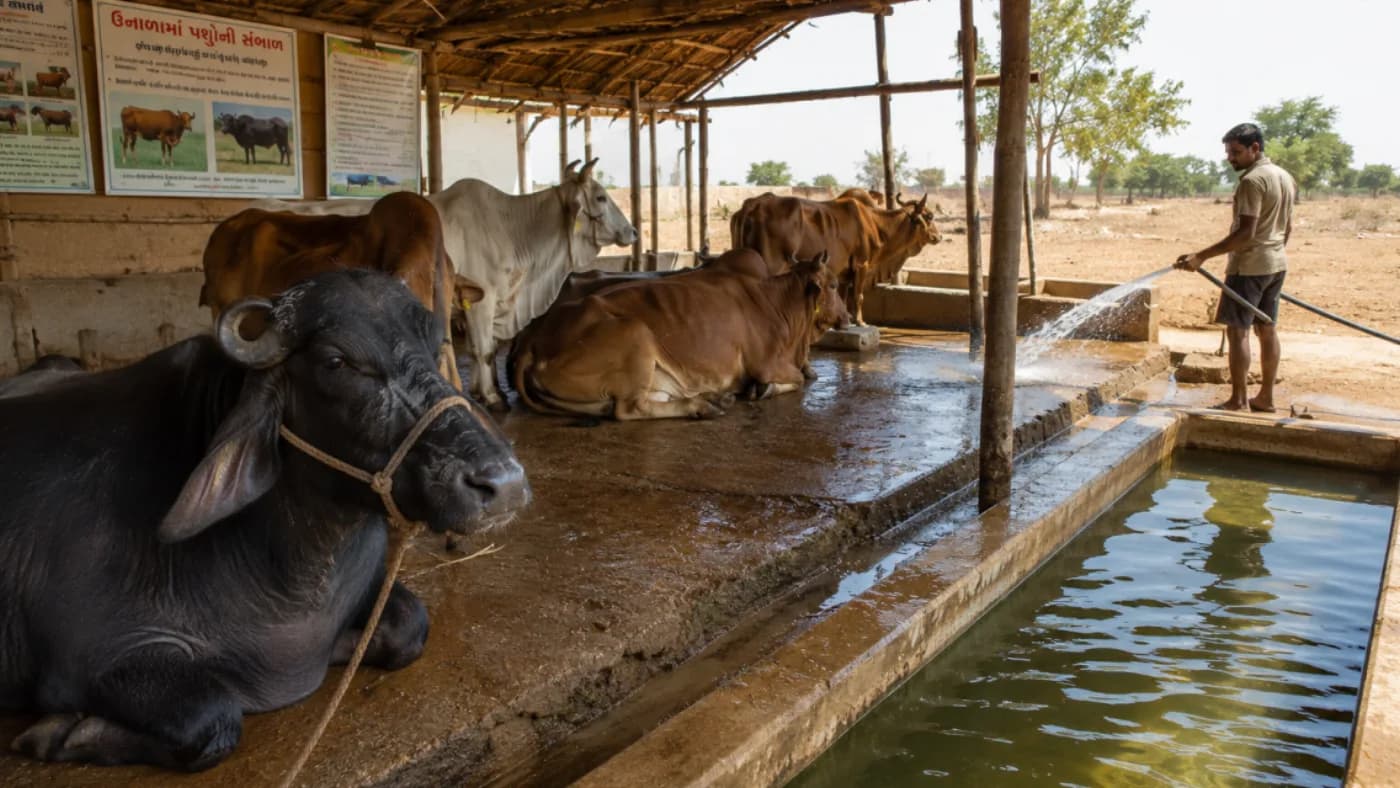
Ask any dairy farmer in India when the milk falls off and you will hear the same two answers: the peak of summer, and the middle of the monsoon. Those two slumps look similar in the milk record but they have almost nothing in common underneath. Summer is a heat problem — the animal cannot get rid of the heat she is making and absorbing, so she stops eating and the milk follows. The monsoon is a wet problem — humidity that blocks her cooling, ground that never dries, feet that soften and rot, flies that never stop, and green fodder that is abundant and yet somehow leaves her short. The shed arrangements that fix one do not fix the other. This guide walks through both seasons the way they actually arrive: what is happening inside the animal, what you will see first, and what you can change on a smallholding without spending much.
Two seasons, two completely different problems
From roughly March to June, across most of the country, the problem is heat load. The sun beats on the roof and radiates down, the air is hot, and the animal has to shed more heat than she can. From late June the temperature actually drops a little, and many farmers assume the hard part is over. It is not. The monsoon replaces dry heat with humidity, and humidity is what breaks an animal's cooling system. On top of that it soaks the standing area, and a dairy animal standing day and night in wet dung and urine develops an entirely new set of problems that have nothing to do with temperature at all.
This is why it is worth thinking about the shed as needing two different sets of features. A shed built only against the sun — low roof, closed sides to keep the glare out, floor flat because rain was never the concern — will drown the animals in mud in July. A shed built only for drainage — deep drains, sloped floor, but a bare tin roof with no overhang and no height — will bake them in May. Almost every improvement in this guide is cheap; the ones that cost anything, like extending a roof overhang or re-cutting a drain, cost far less than one lame animal or one lost lactation.
How a cow or buffalo sheds heat — and why humidity is the real enemy
An animal loses heat in a few ways, and in Indian summer conditions only two of them matter much. The first is evaporation — sweating from the skin, and breathing out air loaded with moisture from the lungs. The second is air moving across her body, carrying warm air away and replacing it with cooler air. She also radiates heat to any surface cooler than she is, which is why a hot tin roof directly overhead is so damaging: instead of taking heat away from her, it sends heat down onto her.
The part farmers underestimate is how much heat she makes on her own. Rumen fermentation — the breakdown of fibre by microbes in her stomach — is a heating process, and the more she eats and the more milk she produces, the more internal heat she generates. So the animal at greatest risk in your shed is not the weakest one; it is your best milker. She is carrying the heaviest internal heat load and the least spare capacity to get rid of it. High-yielding animals are the first to go off feed and the first to drop milk, every single summer.
Now put humidity on top. Evaporation only works when the surrounding air can accept more moisture. When the air is already close to saturated, sweat does not evaporate and the moisture she breathes out does not carry heat away — her main cooling route simply stops working. This is why a moderately hot, sticky day on the coast of Gujarat or in coastal Kerala, or the muggy weeks just before and after the monsoon breaks, can be harder on an animal than a hotter but bone-dry day in interior Rajasthan. It also explains the single most practical rule in this whole guide: in humid weather, moving air matters more than anything else you can do.
The signs, in the order you will actually notice them
The first sign is almost always feed, not breathing. She goes off her ration, and specifically she leaves the dry fodder — the straw, the dry stover, the coarse bulk — and picks at the green and the concentrate instead. That is not fussiness. Digesting fibre is what generates the most internal heat, so an animal already struggling to stay cool instinctively avoids the feed that will heat her further. If you notice nothing else, notice this: dry fodder left uneaten in the manger on a hot afternoon is the earliest reliable warning you will get.
Next comes her posture and where she chooses to be. She stands instead of lying down, because standing exposes more of her body to whatever air movement there is, while lying presses her against a floor that has been soaking up heat all day. She crowds into whatever shade exists and bunches tightly with the other animals — which is self-defeating, because a knot of animals pressed together traps their combined body heat and cuts off the breeze between them. A bunched, standing herd in the middle of the day is telling you the shade is not enough.
Then the breathing. It becomes fast and shallow first, which is easy to miss. As it worsens she breathes with her mouth open, tongue out, neck stretched forward, drooling; she may sweat visibly around the muzzle and flanks, and she becomes dull and reluctant to move. She drinks far more than usual. By the time you see open-mouth panting, she has been under real strain for a while — this is the late sign, not the early one.
And then the milk falls. But the cost of a bad summer is not just the milk in this month's record. A heat-stressed animal does not come into heat clearly — the signs are weak or silent, so she is missed, and even when she is served the conception rate is poorer. She loses body condition because she is eating less while still milking. In a pregnant animal, heat stress late in gestation can mean a weaker calf and a poorer start to the next lactation. So a summer you handle badly is paid for twice: once in this year's milk, and again in a stretched calving interval and a lactation that never reaches what it should have.
Buffaloes, zebu cows and crossbreds do not suffer equally
A buffalo is not built for standing in the sun, and this is anatomy, not habit. She has far fewer functional sweat glands than cattle do, which cripples her main cooling route, and her skin is dark and thinly haired, so it absorbs solar radiation instead of reflecting it. Put those two facts together and a buffalo in direct sun heats up faster than a cow and cools down slower. That is exactly why buffaloes seek water on their own the moment they are free to — wallowing, or a good hosing down, is not a comfort for them, it is a substitute for the sweating they cannot do. A Murrah or any other buffalo denied a wallow or a daily wetting through the hottest weeks is being asked to do something she is physically not equipped for, and her milk will say so.
Among cows, indigenous zebu breeds are generally the most heat-tolerant of the common options — loose skin and a larger surface area to lose heat from, lighter and often shinier coats that reflect more sun, and a lower metabolic heat load to begin with. Exotic-cross animals are the least tolerant; they carry temperate-climate ancestry into an Indian summer, and they also tend to be your highest yielders, which is the worst possible combination of high internal heat and poor heat tolerance. The practical instruction is simple: when shade, fan space, wetting and trough access are limited, your crossbred cows and your buffaloes get them first.
A hot-weather shed you can actually afford
Start with which way the shed faces, because it costs nothing at the time of building and cannot be changed later. Run the long axis of the shed roughly east to west, so that the long roof and its overhang stand between the animals and the sun through the hottest middle hours, rather than letting the sun rake straight in along the length of the standing area. Then give the roof a real overhang on both long sides — wide enough that at no point in the day does direct sun land on the floor where the animals actually stand. Walk the shed at midday before summer sets in, see exactly where the sunlight falls on the standing area, and extend the shade over that patch, whether with a roof extension, a shade net, or thatch on a bamboo frame.
Then height and openness, which are what let hot air leave. Hot air rises, so it needs somewhere to go and something to replace it. A roof high at the eaves — around ten feet in most well-built sheds — and higher still at the ridge lets the heated air collect above the animals' heads and escape, especially if there is an opening or a raised ridge cap along the top. Keep the long sides open, or at most a low wall with everything above it open, so a cross-breeze can actually pass through at animal level. A low roof with closed sides is an oven, and no amount of good intention makes up for it. Do not block the ends with stacked fodder either, which is the most common way a well-designed shed loses its through-draught.
Roofing material decides how much heat comes down onto the animals rather than staying outside. Bare metal sheet is the worst common choice: it heats up fast and radiates that heat straight down. The cheap fixes work well. Lay a layer of thatch, straw, sugarcane trash or coconut leaf over the sheet, or fix a false ceiling of dry grass or matting a little below it so there is an insulating air gap, or simply whitewash the upper surface white so it reflects sunlight instead of absorbing it. Country tiles and thatch roofs are naturally cooler than bare sheet. Whitewashing is the cheapest of all of these and needs redoing each year, which is a small enough job to fold into pre-summer repairs.
Trees are the cheapest cooling you will ever get, and they do something a roof cannot: as well as blocking the sun they cool the air itself through transpiration, so the air arriving at the animals is genuinely cooler and not just shaded. Plant on the sun-facing side and to the west, where the afternoon sun is worst. If you are planting anyway, choose species that also give usable fodder so the same tree does two jobs — our guide on tree fodder for livestock covers which species are worth having on the boundary and how to cut them without killing them.
Water and air together are the strongest tools you have. Wetting the roof at midday, splashing the floor down, running fans where power allows, and hosing or sprinkling the animals themselves all work — but only with one caveat that matters enormously in India. Wetting an animal cools her only if air moves over her afterwards, because the cooling comes from the water evaporating, not from the water being there. In still, humid air, water sitting on the coat does the opposite: it forms a warm wet layer against the skin that traps heat and blocks what little evaporation was happening. So wet her properly down to the skin rather than misting the top of her back, do it where there is a breeze or a fan, and let her dry off between wettings instead of keeping her permanently damp. In a closed, humid shed with no air movement, hosing animals makes things worse, not better.
Water, feeding time, and the working day
Water intake climbs steeply as the weather heats up, and an animal that cannot drink enough cannot cool herself, cannot eat properly, and cannot milk. The fix is not more water at milking time; it is water available all the time. Twice-a-day watering, which is still common, means she spends most of a hot day mildly short of water and quietly eating less because of it. Beyond that, where the trough sits matters as much as whether it is full: a trough standing in the sun holds water too warm to be attractive, and animals will drink less of it, so site it in the shade of the shed or a tree. And clean it often. Animals refuse slimy, algae-lined, dung-fouled water long before they are desperate enough to drink it, and in summer a refused trough is a lost day of intake. A shaded, clean, always-full water trough is very likely the single cheapest yield-protecting change available on most smallholdings.
Next, shift the feeding day. She will eat in the cool early morning and again in the evening and into the night; she will barely touch the manger through the hot middle hours. So put the bulk of the ration — and especially the dry fodder she is already reluctant about — into those cooler windows, and feed the concentrate then too rather than at midday. If you offer anything in the heat of the day, make it green fodder and water. Do not leave chopped fodder sitting in the manger through the afternoon sun, where it dries out, heats up and sours, because she will reject it in the evening as well and you will have lost the feed twice.
Finally, manage the working day around the heat rather than through it. Move ploughing, cart work and any transport to the early morning and the late evening, and let animals rest through the middle of the day in shade. Water them before work and again after it. And never leave an animal tethered out in open sun with no shade and no water within reach, even for an hour or two — a tethered animal cannot walk to shade the way a loose one will, so she simply stands there absorbing heat until someone comes for her. This is the most common and most avoidable cause of serious heat trouble on a smallholding.
The monsoon shed: standing in wet, foot rot, and the udder
The core monsoon problem is simple to state and hard to live with: the standing area never dries out. Rain comes in, the roof leaks somewhere, dung and urine cannot drain away, and within a week the floor is a permanent slurry that the animals stand and lie in around the clock. Hoof horn is not designed for that. Constant wet softens the horn and the skin between the claws, small cracks and abrasions open up, and bacteria that are always present in dung get in. The result is foot rot and related foot lesions, and it is one of the most common monsoon losses on Indian smallholdings.
You will see it before you understand it. She limps, or favours one leg, or stands with her weight shifted off one foot. There is swelling above the hoof or between the claws, often warm to the touch, and a distinctly foul smell close up. She lies down more than usual, walks reluctantly to the manger and the trough, eats less because of it, and the milk drops. A lame animal loses condition fast, because she is unwilling to move to feed and water and she is in pain. Lameness in the monsoon is also easy to misread: foot rot, a foot-and-mouth lesion between the claws, a stone bruise and a simple injury can all look alike to a farmer's eye, and they do not call for the same handling at all. Any lame animal is a call for the veterinarian rather than a home remedy, and the earlier that call is made the less it costs you.
Prevention, though, is almost entirely construction and routine rather than medicine. Give the floor a gentle, continuous fall towards a drain — an inch or so of drop over every three or four feet is plenty — and make sure the drain actually carries away to somewhere outside rather than pooling at the end of it. Test it with a bucket of water before the rains and watch where the water goes. Repair pitted and broken flooring, because every hollow holds slurry. Remove dung and urine-soaked bedding at least daily through the monsoon, more often if the shed is crowded. Most important of all, make sure every animal has a genuinely dry place to stand and lie down — a slightly raised, well-drained area with dry bedding, big enough that she can lie fully stretched out without lying in the drain or on top of a neighbour, and not so crowded that animals cannot move away from each other's body heat. Where hooves have grown long or misshapen, get them trimmed through the veterinary service rather than attempting it yourself; a badly cut hoof creates the exact injury you were trying to prevent.
Mastitis risk rises sharply in the monsoon for exactly the same reasons. Bedding is wet, the udder and teats are in contact with mud and dung whenever she lies down, and the teat canal stays open for a while after milking, so an animal that lies straight down onto wet bedding after being milked is at real risk. The seasonal response is hygiene and dry standing space: replace wet bedding rather than adding a layer on top of it, wash and then properly dry the udder before milking, milk with clean dry hands, and keep her standing and fed for a while after milking so the teat canal closes before she lies down. Mastitis deserves a full treatment of its own, and any hot, hard or swollen quarter, or milk with clots or flakes, is a veterinarian's job — but the seasonal point is that the monsoon is when it arrives, and the shed floor is where it is prevented.
The monsoon is also the season when several serious contagious diseases classically appear, including haemorrhagic septicaemia (HS), black quarter (BQ) and foot-and-mouth disease (FMD). These are prevented by vaccination, not by shed management, and vaccination against them is organised through the state animal husbandry service. The vaccines used, the timing, and how often boosters are due vary from state to state and are revised from time to time, so rather than following any fixed calendar you read, ask at your local veterinary dispensary or the district animal husbandry office which vaccinations are due for your animals and get them done before the rains rather than during them. Your dairy cooperative society or the nearest KVK can usually tell you when the local vaccination round is happening.
Flies, ticks, mould and the green fodder that is not enough
Warm wet weather multiplies flies, mosquitoes and ticks faster than any other condition of the year, and it is a mistake to file this under nuisance. Biting flies and ticks transmit disease between animals, and ticks feeding heavily on a young or thin animal cause real anaemia. Even setting disease aside, they cost you milk directly: an animal that spends her day stamping, swishing, shaking her head and shifting position is not resting, not ruminating properly and not eating properly. A herd being eaten alive goes off feed just as surely as a herd standing in the sun.
The answer is to attack breeding sites rather than only the adult insects. Get rid of standing water around the shed — puddles, blocked drains, discarded containers, hoofprint hollows that hold water. Move wet dung heaps well away from the shed and downwind of it, and keep the heap managed and covered so flies cannot breed freely in it. Clear spoiled fodder and wet feed residues out of the mangers every day rather than letting them sit and sour. Keep the drains flowing. For the rest — the plants, barriers and biological measures that reduce fly pressure without chemical spraying — our post on natural fly control for animal shelters goes through the practical options, and our guide to natural barn sanitation and odour control with effective microorganisms covers how treating the floor and the manure heap itself cuts both the smell and the breeding.
Humid weather also spoils feed fast, and mould is a genuine animal-health problem rather than simply wasted fodder. Mouldy dry fodder, mouldy concentrate and badly made or spoiled silage can carry fungal toxins that suppress appetite, upset the gut, damage fertility and, in some cases, pass into the milk. The rule is straightforward: do not feed visibly mouldy, dusty or musty-smelling fodder to a milch animal or a pregnant one, however much it hurts to throw it out. Prevention is storage. Get stored dry fodder up off the ground on a raised platform, pallets or a bed of stones so damp cannot wick up into the stack from below, keep it properly covered, and stack it where roof runoff does not reach it. Check the stack by smell through the season, not just by looking at the outside of it. With silage, make sure the pit is covered and sealed and that rainwater is diverted away from the pit rather than running into it.
Finally, the monsoon paradox that costs the most milk and is noticed the least: green fodder is suddenly abundant, and yet the animal falls short. Monsoon green fodder is very high in water. She fills her rumen with it, feels and looks full, and still takes in far less actual dry matter than she needs, so the milk drops even though the shed looks awash with feed. The fix is to keep offering dry roughage alongside the lush green — straw, dry stover, hay, tree fodder — so that she gets real substance with every fill. It also firms up the loose, watery dung that an all-green monsoon diet produces, and it avoids the digestive upset and bloat risk that comes from switching an animal abruptly onto nothing but young, wet, fast-growing green. If you have stored dry fodder well through the rains, this is where it earns its keep.
Before summer and before the monsoon: a working checklist
- Walk through the shed at midday before summer sets in, mark exactly where sunlight is falling on the standing area, and extend the roof overhang or hang a shade net over that patch.
- Whitewash the upper surface of a metal roof, or lay thatch, straw or leaf over it, so it reflects sunlight instead of radiating heat down onto the animals.
- Check that hot air has a way out of the shed: eaves high, ridge higher, an opening along the top, and the long sides and both ends clear rather than blocked by stacked fodder.
- Repair every hole and loose sheet in the roof before the rains, because a single leak over the standing area keeps a patch of floor wet for the entire monsoon.
- Clear, deepen and re-cut the drains before the monsoon, then pour a bucket of water on the floor and watch where it goes to confirm the fall actually reaches the drain.
- Repair broken and pitted flooring so slurry cannot collect in hollows, and make sure there is a raised, dry, bedded area where every animal can lie down fully stretched out.
- Site the water trough in the shade, keep it full through the whole day rather than filling it twice, and scrub it often enough that the animals drink without hesitating.
- Arrange a wallow, a tank or a routine daily hosing for the buffaloes before the hottest weeks arrive, since they cannot sweat their way out of the heat the way a cow partly can.
- Clear standing water, spoiled fodder and wet dung from around the shed at the start of the rains, and shift the manure heap well away from the animals and downwind of them.
- Get the fodder store off the ground, under cover and clear of roof runoff before the first heavy rain, and check the stack by smell through the season for any musty patch.
- Ask at the local veterinary dispensary before the rains which vaccinations are due for your animals, since the programme and its timing vary by state and are revised from time to time.
Frequently asked
What are the first signs that my cow or buffalo is under heat stress?+
The earliest reliable sign is that she goes off her feed and specifically leaves the dry fodder, because digesting fibre generates internal heat. After that she stands rather than lying down, crowds into shade and bunches with other animals, drinks much more, and breathes fast and shallow. Open-mouth panting with the tongue out and drooling is a late sign, not an early one, and the milk usually falls somewhere along the way.
Why do buffaloes suffer more in summer than cows do?+
A buffalo has far fewer functional sweat glands than cattle, so her main cooling route barely works, and her dark, thinly haired skin absorbs solar radiation instead of reflecting it. That is why buffaloes depend so heavily on shade, on wallowing and on being hosed down — those are substitutes for sweating, not luxuries. Among cows, indigenous zebu breeds cope best and exotic-cross animals worst.
Does spraying or hosing water on animals help in humid monsoon weather?+
Only if air is moving over them afterwards. The cooling comes from water evaporating off the skin, so in still, humid air the water simply forms a warm wet layer that traps heat and makes matters worse. Wet her right down to the skin where there is a breeze or a fan, and let her dry off between wettings rather than keeping her permanently damp.
What causes foot rot in the monsoon and how do I prevent it?+
Standing continuously in wet dung and urine slurry softens the hoof horn and the skin between the claws, letting bacteria in. Prevention is a floor that slopes gently to a working drain, slurry removed at least daily, and a raised dry area where each animal can stand and lie down out of the wet; overgrown hooves should be trimmed through the veterinary service. Any lame animal — swelling above the hoof, a foul smell, weight shifted off one foot — is a case for the veterinarian, not a home remedy.
Why does milk fall in the monsoon even when green fodder is plentiful?+
Monsoon green fodder carries a great deal of water, so the animal fills her rumen and still takes in much less dry matter than she needs. Offer dry roughage such as straw, dry stover or tree fodder alongside the green so she gets real substance, which also firms up loose dung. Humidity blocking her cooling, fly and tick worry cutting into feeding and resting time, and wet standing conditions all add to the drop.
Where to go next
- AI farming chatbotAsk any farming question in Gujarati, Hindi or English and get an answer in seconds.
- Kheti app for Indian farmersCrop plans, disease diagnosis, weather and mandi rates in one app.
- Agri Bazar marketplaceBuy and sell animals, crops, equipment and dairy near you — and see what buyers want today.
Want this as daily tasks for your farm?
Khetiyaar turns guides like this into a day-by-day plan — in your language, free to start.

Related guides
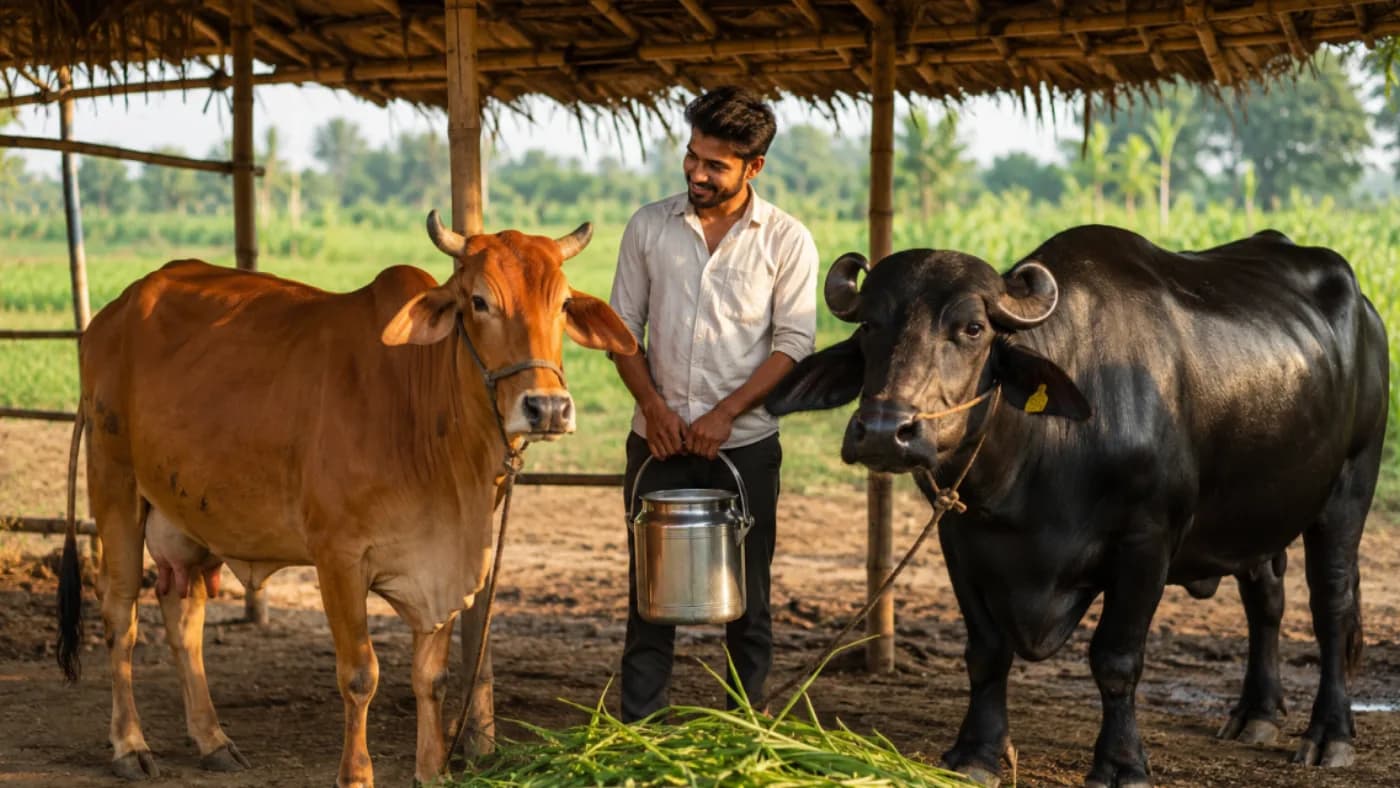
Cow vs Buffalo Dairy: Which One Actually Suits Your Farm?
Buffalo milk earns a better rate per litre at the collection centre — but the animal that earns it also eats more bulk, needs water to wallow in, and suffers far more in the sun. Here is how the two compare on the things that actually decide whether your dairy pays.
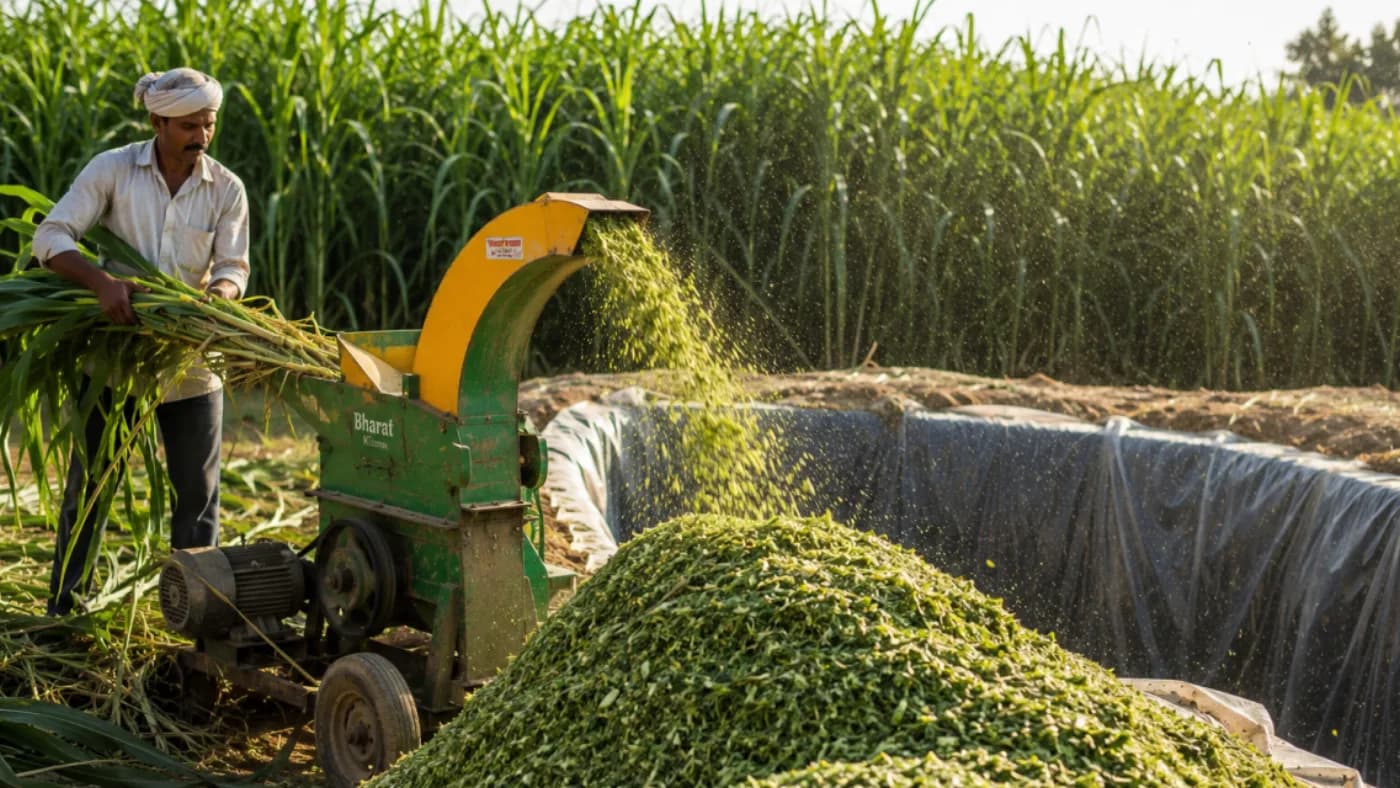
Fodder and Silage Management for Milch Cattle: Green Feed in Every Month of the Year
A dairy animal needs green fodder all 365 days, but every fodder crop in India is seasonal. This is a practical guide to staggering your fodder sowings, making silage in a pit or a bag, and closing the summer gap without buying fodder at peak price.
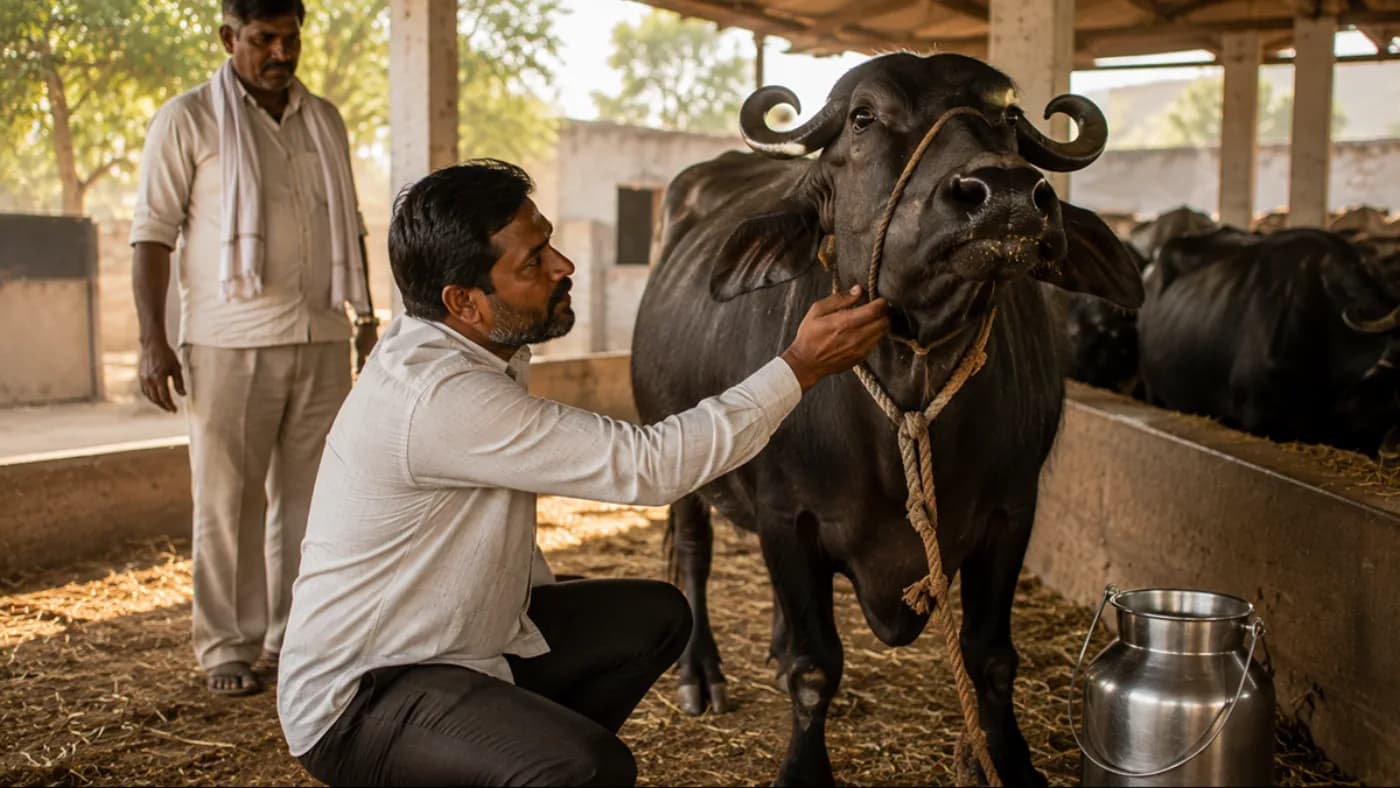
Buying and Selling Cattle Online: What to Check Before You Pay
A milch animal is often the largest single purchase a small farm makes, and the easiest to be cheated on. Listings make discovery far easier — they do not make verification optional. Here is exactly what to check, in what order, and the red flags that should end a deal.