

Cow vs Buffalo Dairy: Which One Actually Suits Your Farm?
Buffalo milk earns a better rate per litre at the collection centre — but the animal that earns it also eats more bulk, needs water to wallow in, and suffers far more in the sun. Here is how the two compare on the things that actually decide whether your dairy pays.
Quick answer
Buffalo milk earns a higher rate per litre because it genuinely carries more fat and solids, and where payment is quality-based that is real money. But the rate is only one term in the sum. The buffalo eats more bulk, must have water to cool in, loads heat badly in open sun, reaches first calving later, hides her heat, and costs more to buy. A crossbred cow reverses almost all of that and gives more litres — but only if you can truly feed her green fodder every day and keep her cool. So make the decision from your own fodder base, your summer water, your local market and your capital, and not from the rate written on the collection-centre board.
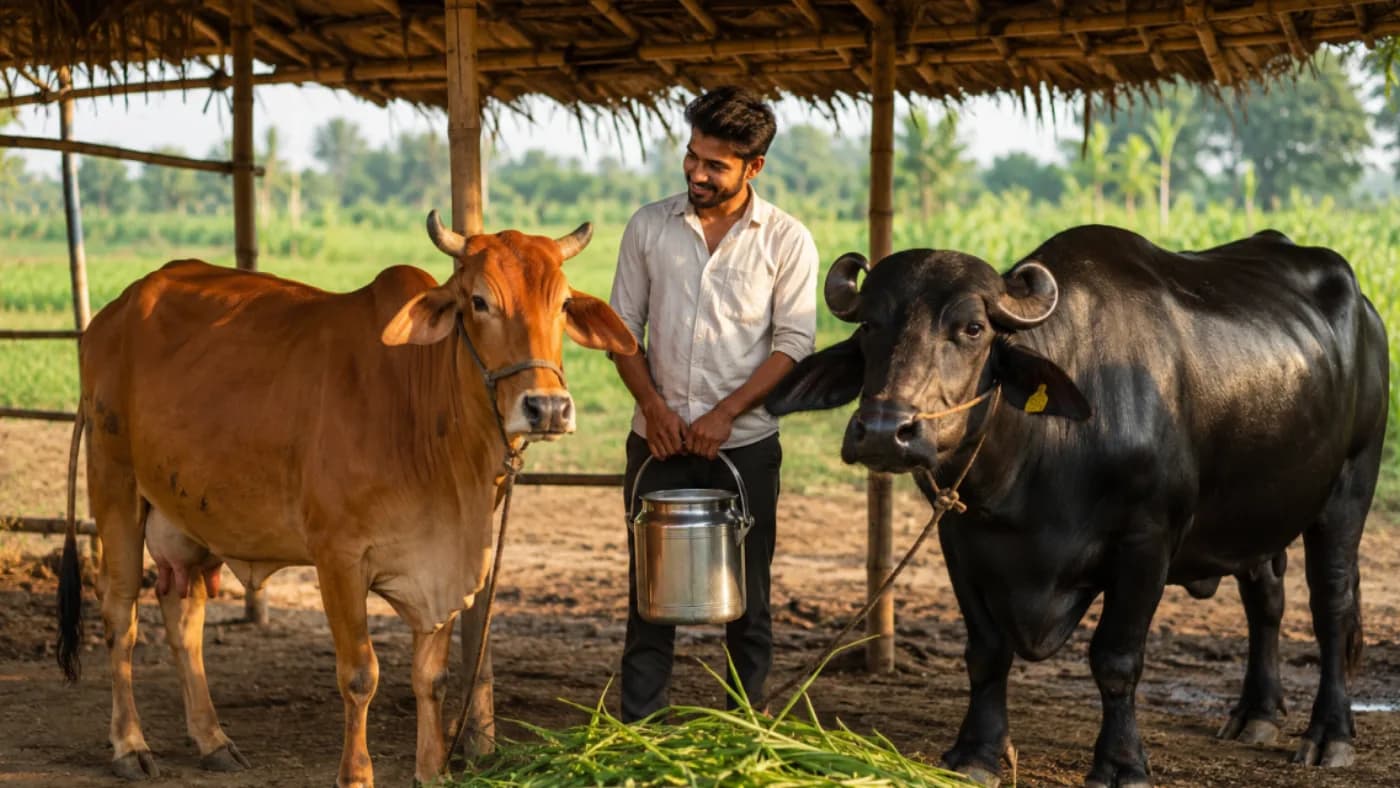
Ask around a village and you will get a confident answer either way: buffalo, because the rate is better; cow, because she is easier to keep. Both answers are right on the farm they came from and wrong on somebody else's, because a cow and a buffalo are not two versions of the same animal with different price tags. They eat differently, drink differently, handle heat differently, breed differently, and sell into different markets. This guide puts them side by side on the things that actually decide whether a smallholder's dairy pays — what the milk tests at and how that becomes money, what the animal costs to feed and water, how she copes with your particular summer, what your local market is willing to pay for, and how much capital and risk the household is taking on.
Two different animals, not two grades of the same one
Indian dairying rests on both animals, and the balance between them shifts sharply from one part of the country to another. In much of Gujarat, Punjab, Haryana, western Uttar Pradesh and coastal Andhra the buffalo is simply the default dairy animal and the whole local trade is built around thick, high-fat milk. In Kerala, Tamil Nadu, Karnataka and the hill states the crossbred cow dominates instead. Neither region is making a mistake. Each has settled on the animal that its fodder, its water, its climate and its buyers support.
There is a second choice sitting inside the first one — which breed within the species. A Gir or Sahiwal is a very different proposition from an HF or Jersey cross, and a Murrah is not the same animal as a Mehsana. That layer is covered separately in our breed-selection guide; this post deliberately stays at the species level, because the species decision is the one that depends on your land and your market rather than on genetics.
The honest summary, before the detail: buffalo milk is richer, earns more per litre where payment is based on quality, and the animal makes comparatively good use of coarse fodder that a crossbred cow would waste. Against that, she eats more bulk, must have water to cool in, loads heat badly in open sun, comes to her first calving later, and hides her heat so well that many farmers lose months getting her back in calf. A crossbred cow reverses nearly all of that and gives more litres — but only if you can genuinely feed and cool her. Almost everything below is an elaboration of that trade.
Fat and SNF: why the same litre is not worth the same money
A cooperative collection centre measures three things about your delivery: how much milk there is, what its fat content is, and what its SNF is. SNF stands for solids-not-fat — the protein, lactose and minerals left once the fat is set aside. Your rate is derived from what the milk actually tests at, not from the volume alone. The logic is simple once you see it: the dairy is buying milk solids, and water is not a solid. Two farmers can deliver identical volumes on the same morning and be paid different amounts, and that is the system working correctly rather than the clerk playing favourites.
This is where the buffalo's real advantage sits. Buffalo milk is markedly higher in fat than cow milk, and somewhat higher in SNF as well. Wherever payment is fat-and-SNF based, the same litre of buffalo milk therefore fetches a higher rate than the same litre of cow milk. That is not a preference or a prejudice; it is a measurement.
But a higher rate per litre is not the same thing as a higher income, and this is the single most common mistake in the whole comparison. What lands in your account is the rate multiplied by the litres, minus what it cost you to produce them. A well-fed crossbred cow generally gives noticeably more litres per day than a buffalo of comparable keep. It is entirely possible for the cow's larger volume of thinner milk to out-earn the buffalo's smaller volume of richer milk, and equally possible for it not to. The only way to know is to compare the value of a whole lactation against the feed bill for that lactation, for the animals actually available to you locally, rather than comparing the two rate figures written on the collection-centre board.
One caution on figures. The rate chart itself, how fat and SNF are weighted against each other, and any incentive, transport deduction or society deduction applied on top, are set by your district milk union and its federation, differ between states and unions, and are revised from time to time. Ask at your own dairy cooperative society or its secretary for the basis currently in force, and do not plan on any figure quoted online, including in this article.
What each animal eats, and how forgiving she is about it
Fodder is the largest running cost in any smallholder dairy, so the species you can feed from your own land is usually the species you should be keeping. The two animals differ less in how much they need than in how fussy they are about its quality.
A buffalo is the more forgiving feeder. Her digestive system makes comparatively better use of coarse, fibrous roughage — wheat and paddy straw, sugarcane tops, coarse crop residue, the bulky low-grade material that most Indian farms have plenty of after harvest. A farm that is rich in residue and short on green fodder can carry a buffalo far more cheaply than it can carry a crossbred cow. That single fact explains a great deal of India's regional buffalo geography.
A crossbred cow works the other way. Her higher genetic yield potential is only realised if the feeding is genuinely there — good green fodder every day and concentrate matched to what she is actually milking. Feed her straw and she does not simply give a little less milk; she loses body condition, fails to come back into heat on time, and becomes a liability rather than an asset. The genetics do not lower their demands to match your fodder. An indigenous cow sits in between: modest yield, but very forgiving about what she is offered, which is precisely why those breeds survived centuries of being fed whatever was left over.
Against all of that, the buffalo's larger frame means more total bulk feed going in every single day, in milk or dry. So the fair comparison is not a simple cheaper-or-costlier; it is whether the feed your land already produces is the kind of feed the animal can use. Where dry roughage dominates and green is seasonal, tree fodder is worth building into the plan as well, and our guide Tree Fodder for Livestock: The Free Mineral Feed Growing on Your Farm covers how to do that.
Water: the requirement nobody puts in the budget
Milk is overwhelmingly water, so both animals drink a great deal, and both drink far more in hot weather and on dry-fodder rations. Clean water available at all times, rather than filled twice a day, is a yield decision for either species — an animal that cannot drink freely gives less milk within a day, and nobody ever attributes the loss to the trough.
The buffalo, though, has a second and quite separate water requirement that is easy to overlook when you are pricing the animal. She needs water to wallow in, or to be hosed and sluiced with, through the hot months. This is not indulgence or village habit. It is her cooling system, and the next section explains why she has so little else to fall back on.
The practical consequence is blunt. A holding with a pond, a canal, a village tank or a genuinely reliable tubewell can keep buffaloes. A holding where summer water is scarce and every litre is contested is choosing an animal it will not be able to cool, and the milk will show it every hot season. Be honest about your April-to-June water, not your monsoon water, when you make this call.
Heat, sun and skin: the difference that decides your summer
A buffalo has far fewer functional sweat glands than cattle, and her hide is dark and sparsely haired, so it absorbs solar radiation rather than reflecting it. Put those two facts together and you have an animal that gains heat quickly in open sun and has very little ability to shed it by sweating. What she has instead is behaviour — seeking shade, and getting into water. Deny her both in a dry Indian summer and the sequence is predictable: she stops eating properly, especially dry roughage, she stands rather than lies down, the milk falls, and she stops showing heat at all, so the breeding calendar slips too. A bad summer for a buffalo costs you the next lactation as well as this one.
Indigenous zebu cows are the most heat-tolerant of the common options. They sweat more effectively, their lighter coats reflect more sunlight, they carry loose skin and a dewlap that help shed heat, and they tend to be more tick-tolerant into the bargain. Crossbred cows are the least tolerant of the three, and for an unsurprising reason: the exotic genetics that raise the yield also carry the heat sensitivity of animals bred for temperate climates.
So under a harsh dry summer with minimal infrastructure, the rough order of who copes is: indigenous cow first, then a buffalo that has shade and a wallow, then a crossbred cow with good shelter and cooling, and last a buffalo with neither shade nor water. Under humid coastal heat the buffalo does comparatively well, provided she can get wet. Notice that the buffalo's position in that list is not fixed by the animal — it is fixed by what you are able to provide, which makes it a decision about your farm rather than a fact about the species. Shelter design, ventilation and low-cost cooling are covered separately in our guide to hot-weather and monsoon cattle care.
What your local market is actually paying for
Fat is not just a number on a rate chart; it is what several whole categories of Indian food are made from. Ghee, khoa, paneer, thick dahi and most traditional sweets all depend on fat, and buffalo milk is where that fat comes from most cheaply. In the buffalo belts this shapes everything, right down to households buying loose milk who expect to see a thick layer of malai and will quietly switch vendors if they do not get it.
Cow milk has its own markets and they are large ones: packeted liquid milk, everyday tea and coffee consumption, and — in some urban markets — a branded premium for indigenous-cow milk sold on its A2 protein type. That premium is worth mentioning honestly, because it is real where a buyer for it exists and worth exactly nothing where one does not. A Gir cow in a district with no such buyer is simply a Gir cow.
If any part of your milk is sold outside the cooperative — to a sweet shop, a tea stall, a hotel kitchen, or directly to neighbouring households — then fat usually has a keener and better-paying local buyer than volume does. The practical instruction is the same either way, and it is the one most often skipped: find out what your own collection centre and your own local buyers actually pay for before you buy the animal, not after she is standing in your shed.
Cow and buffalo, side by side
- Milk composition: buffalo milk is markedly higher in fat and somewhat higher in SNF than cow milk, so it tests better and earns a higher rate per litre wherever payment is quality-based.
- Volume: a well-managed crossbred cow generally gives more litres per day than a buffalo, so the buffalo's better rate does not automatically translate into a bigger monthly payment.
- Feed quality tolerance: a buffalo makes comparatively better use of coarse straw and crop residue, while a crossbred cow needs good green fodder and matched concentrate to deliver what her genetics promise.
- Feed quantity: the buffalo's larger frame means more total bulk feed going in every day, whether she is in milk or dry.
- Water: both need clean drinking water available at all times, but only the buffalo also needs water to wallow in or be hosed with through the hot months.
- Heat tolerance: indigenous cows cope best with dry heat, buffaloes cope well only if they can wallow or be wetted, and crossbred cows cope worst of the three.
- Heat detection: cows show heat clearly, whereas buffaloes are well known for silent heat, so a buffalo needs much closer daily observation if inseminations are not to be missed.
- Age at first calving: buffalo heifers generally reach their first calving later than cows, so a buffalo eats for longer before she earns her first rupee.
- Lactation shape: crossbred cows tend to hold their yield more evenly across a longer lactation, while a buffalo's lactation is often shorter and more front-loaded.
- Purchase price: a good milch buffalo generally costs more to buy than a comparable cow, so the same capital buys fewer animals and concentrates more risk in each one.
- Market fit: buffalo milk suits markets driven by ghee, khoa, paneer and traditional sweets, while cow milk suits packeted liquid milk and everyday tea consumption.
- Handling: buffaloes are generally calm but heavy and slow to move, while crossbred cows are lighter to handle but more easily put off their feed by heat and disturbance.
Capital, risk, and how fast the money comes back
A good milch buffalo generally commands a higher purchase price than a comparable cow. For a household with limited capital that has a consequence beyond the invoice: the same money buys fewer animals, and a single expensive animal concentrates the entire investment in one body. If she falls sick, fails to conceive, or is lost, the earnings stop completely. Two cheaper animals will almost always earn less at their peak but they fail independently, and for a household with no cushion that matters more than the peak does.
Timing compounds it. The buffalo's later age at first calving and her tendency toward a longer calving interval are not only biological facts, they are cash-flow facts. Every extra month before first calving, and every extra dry day between one calving and the next, is a month of feeding an animal that is producing nothing. Over an animal's working life that arithmetic is often larger than the difference in rate per litre that drew the farmer to the buffalo in the first place.
Two things worth being clear-eyed about while planning. First, male calves of both species have very little market value in most places today, so no purchase decision should be built on what the calves will fetch. Second, if you are counting on a livestock loan, cattle insurance, or a subsidised animal-purchase or dairy-development programme to make the numbers work, treat the terms as something to confirm rather than assume: these are run by banks, state animal-husbandry departments and dairy development boards, they differ by state, and they are revised from time to time. Ask at your bank branch, your district animal-husbandry office or your dairy union before you commit, and get the current terms from them rather than from any figure you have heard quoted.
A decision framework you can actually apply
Work through it in this order, because the early questions can rule out an option regardless of how the later ones come out. First, what does your land actually produce? If your fodder base is mostly straw and crop residue with green available only seasonally, you are looking at a buffalo or an indigenous cow. If you can genuinely supply green fodder every day of the year, including through summer and the pre-monsoon gap, then a crossbred cow becomes a real option and not just an ambition.
Second, water — specifically your April-to-June water, including whether a buffalo could be wallowed or hosed. If the answer is no, the buffalo is off the list whatever the rate chart says. Third, how harsh is your summer and what shelter do you already have? Fourth, what does your market pay for: fat, or volume? Fifth, how much capital do you have, and could the household absorb one animal failing to earn for several months? Sixth, and most underrated: is there somebody at home who will watch the animals closely enough every day to catch a silent heat, and is an AI technician and a veterinarian genuinely reachable when needed?
One last piece of advice that is worth more than any comparison table. For most smallholders, the best first animal is whichever species the neighbourhood already keeps well — because that is where the fodder supply, the buyer, the AI technician, the veterinarian and, above all, the accumulated local knowledge already are. Improving the animal within that species is nearly always a better first move than switching species. Switching is worth doing when one of the constraints above has genuinely changed: irrigation has arrived and you can now grow green fodder year-round, or a new buyer has appeared who pays for something your current animal does not produce. Change the animal because a constraint moved, not because a rate looked better on a board.
Frequently asked
Which is more profitable in India, a cow or a buffalo?+
Neither is more profitable in general. It depends on your fodder base, your summer water, your local market and how much management you can give. Buffalo milk earns a higher rate per litre because of its fat and SNF, while a well-fed crossbred cow generally gives more litres. Compare the value of a whole lactation against the feed bill for that lactation, and ask your own dairy society what rate basis is currently in force.
Why is buffalo milk paid at a higher rate than cow milk?+
Because cooperatives pay on measured fat and SNF rather than on volume alone, and buffalo milk is markedly richer in fat and somewhat higher in SNF. The rate chart itself, and how fat and SNF are weighted against each other, are set by your district milk union, differ between states and unions, and are revised from time to time — so confirm the current basis at your own society rather than relying on a quoted figure.
Which animal handles Indian summer heat better, a cow or a buffalo?+
An indigenous cow copes best with dry heat, because she sweats more effectively and her lighter coat reflects sunlight. A buffalo copes well only if she has shade and water to wallow in or be hosed with, because she has far fewer functional sweat glands and a dark hide that absorbs sun. A crossbred cow is the least heat-tolerant of the three, since the exotic genetics that lift her yield also carry temperate-climate heat sensitivity.
Is a buffalo cheaper to feed than a cow?+
Not in total quantity — her larger frame needs more bulk feed every day. But she makes comparatively better use of coarse straw and crop residue, so on a farm with plenty of residue and little green fodder she is often the cheaper animal to keep. A crossbred cow only repays her cost if you can actually supply good green fodder and concentrate matched to her yield.
Why is it harder to get a buffalo in calf than a cow?+
Buffaloes commonly show silent heat, meaning the signs are far less obvious than in a cow, so the heat is missed and insemination is delayed. Buffalo heifers also generally reach first calving later. Closer daily observation and advice from your AI technician or veterinarian on the right timing for your animal are what shorten the gap.
Where to go next
- AI farming chatbotAsk any farming question in Gujarati, Hindi or English and get an answer in seconds.
- Kheti app for Indian farmersCrop plans, disease diagnosis, weather and mandi rates in one app.
- Agri Bazar marketplaceBuy and sell animals, crops, equipment and dairy near you — and see what buyers want today.
Want this as daily tasks for your farm?
Khetiyaar turns guides like this into a day-by-day plan — in your language, free to start.

Related guides
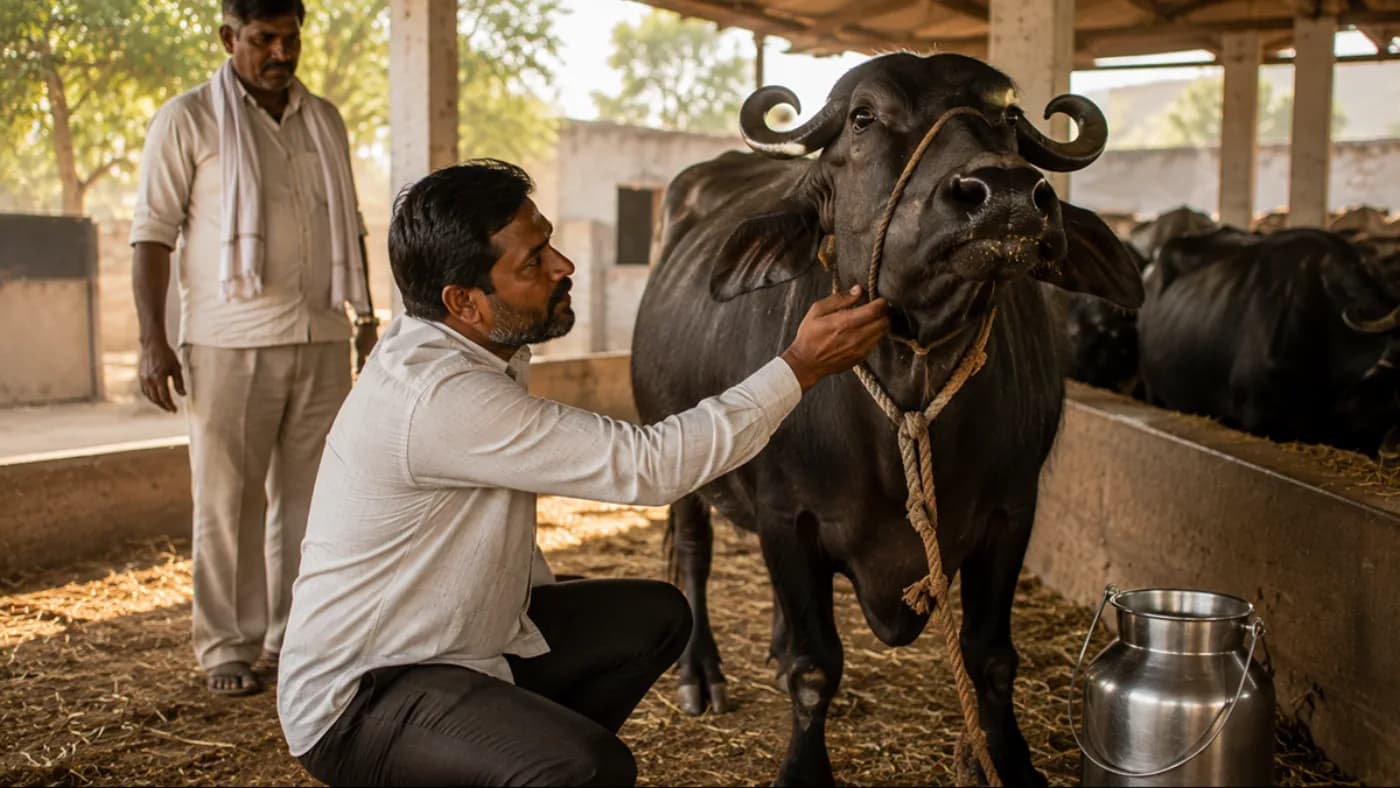
Buying and Selling Cattle Online: What to Check Before You Pay
A milch animal is often the largest single purchase a small farm makes, and the easiest to be cheated on. Listings make discovery far easier — they do not make verification optional. Here is exactly what to check, in what order, and the red flags that should end a deal.
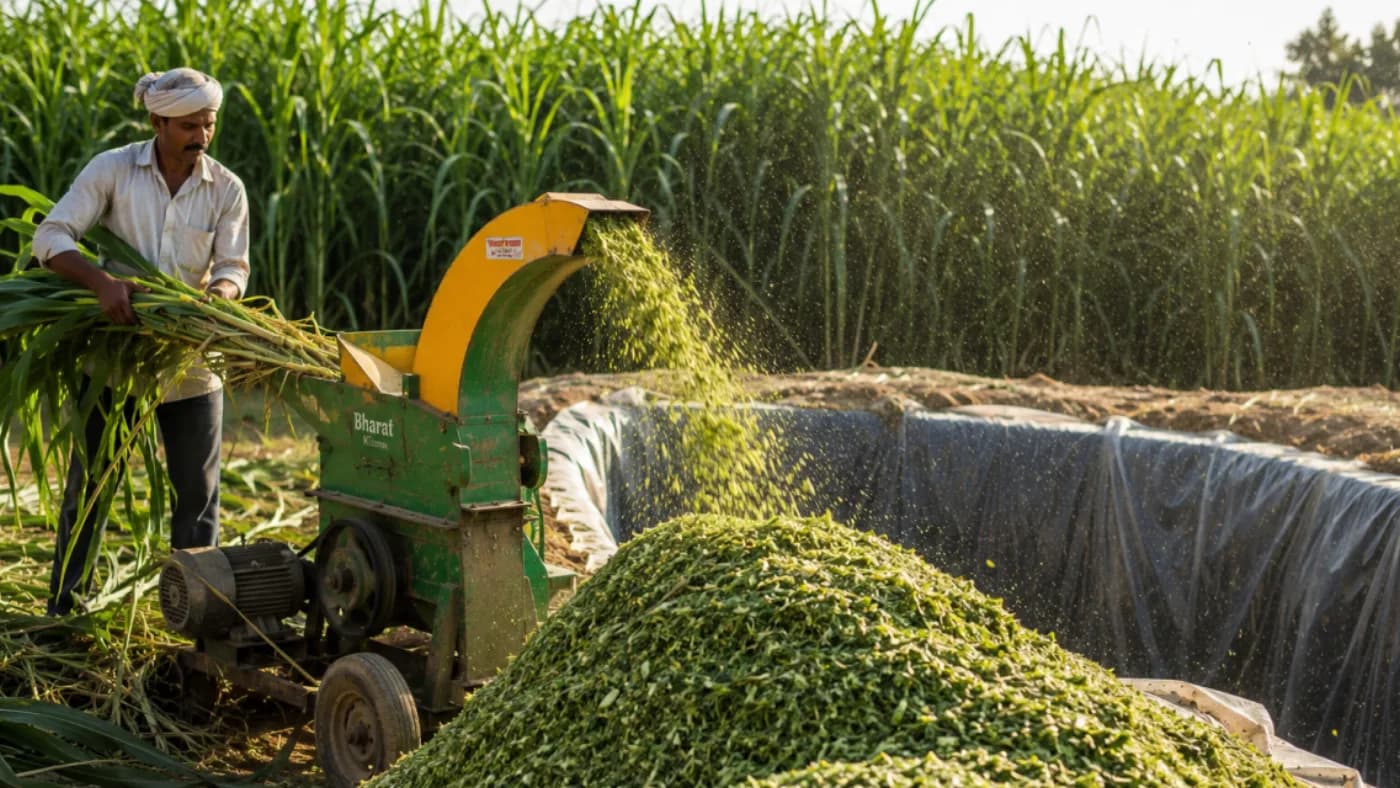
Fodder and Silage Management for Milch Cattle: Green Feed in Every Month of the Year
A dairy animal needs green fodder all 365 days, but every fodder crop in India is seasonal. This is a practical guide to staggering your fodder sowings, making silage in a pit or a bag, and closing the summer gap without buying fodder at peak price.
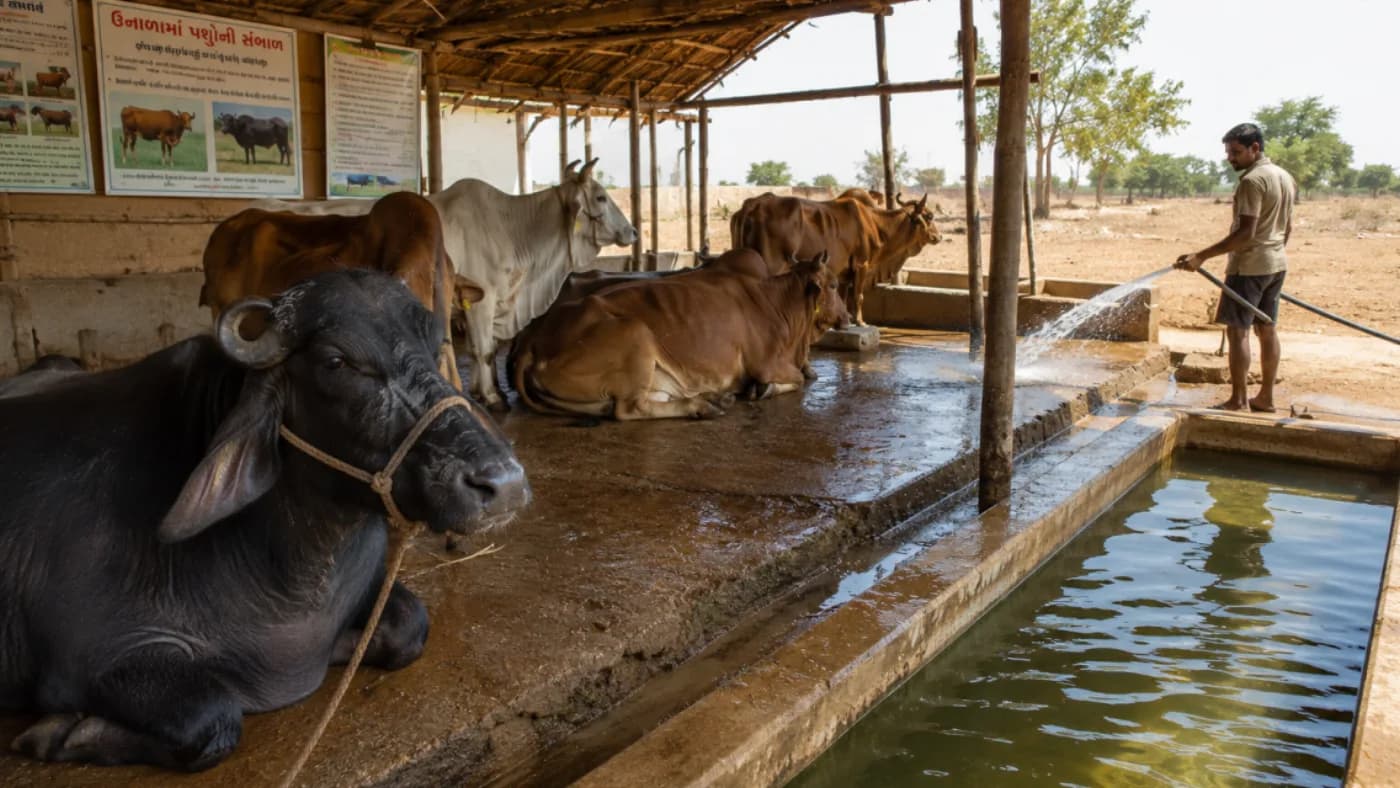
Heat Stress and the Monsoon: Managing Dairy Cattle Through India's Two Hardest Seasons
Summer heat and monsoon damp punish a dairy animal in completely different ways, which is why one set of shed arrangements never covers both. Here is how to read heat stress early, why buffaloes suffer most, and how to keep the monsoon from costing you feet, udders and fodder.