

Fodder and Silage Management for Milch Cattle: Green Feed in Every Month of the Year
A dairy animal needs green fodder all 365 days, but every fodder crop in India is seasonal. This is a practical guide to staggering your fodder sowings, making silage in a pit or a bag, and closing the summer gap without buying fodder at peak price.
Quick answer
A milch animal's requirement for green fodder is flat across the year; Indian fodder supply is not. Close that gap deliberately rather than by luck: map the months where green fodder is actually missing, hold a perennial block such as hybrid napier as your backbone, stagger seasonal sowings so cuts roll instead of piling up, keep a cereal and a legume fodder overlapping, and turn the kharif surplus into silage by chopping it fine at the dough stage, packing it airtight and sealing it the same day. Back it with chopped straw and tree fodder, respect the prussic acid risk in young jowar and the bloat risk on lush berseem, and you stop buying fodder in the month it costs the most.
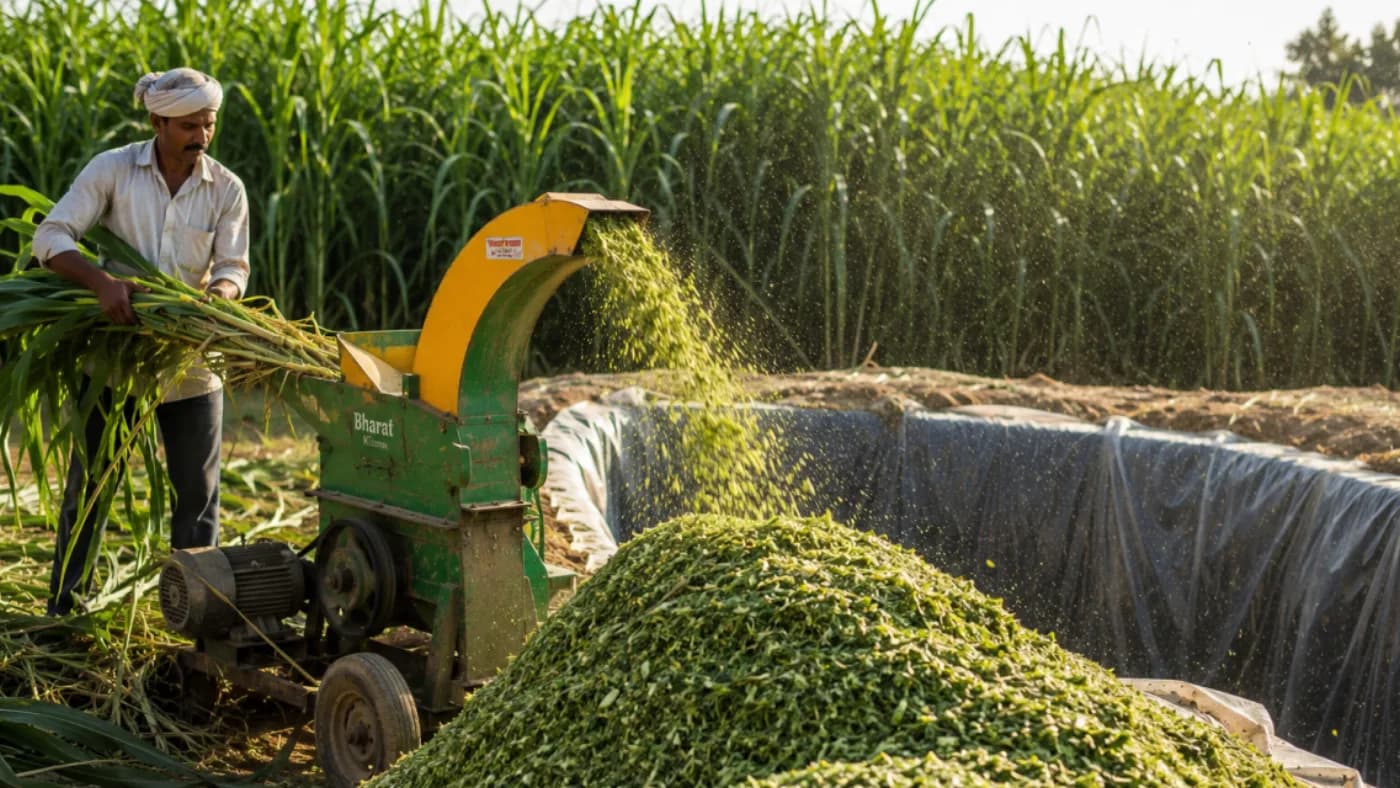
Ask a dairy farmer where his money goes and the answer is feed. Ask where his milk goes when yield suddenly drops in May, and the answer is almost always the same too: the green fodder ran out. A cow or buffalo in milk needs green fodder every single day of the year, but almost nothing grown for fodder in India is available every day of the year. That mismatch — a flat daily requirement against a supply that comes in seasonal peaks and troughs — is the whole problem of fodder management, and it is solved with two tools: staggered sowing so that something is always ready to cut, and preservation so that the surplus from a good month can be fed in a bad one. This guide covers both, along with the fodder crops that actually carry an Indian dairy and the two of them that can hurt your animals if handled carelessly.
Why year-round green fodder decides your milk cheque
Green fodder does things for a milch animal that dry fodder simply cannot. It carries moisture, it carries carotene which the animal converts to vitamin A, it carries digestible fibre that keeps the rumen working steadily, and in the case of legume fodders it carries genuinely useful protein. An animal on plentiful green fodder holds its yield, keeps its coat and skin in condition, comes back into heat on time, and needs less bought concentrate to reach the same litres. The same animal shifted abruptly onto dry straw alone will drop milk within days, and its fat and SNF readings at the collection centre start to wobble.
The trap is what farmers do when green fodder disappears. The shortfall gets covered by buying more concentrate, or by buying green fodder from someone else — and both are the most expensive possible way to buy nutrition, at exactly the time of year when everybody else in the village wants the same thing. A load of green maize in the pre-monsoon weeks costs a multiple of what the same fodder cost the farmer who grew it in the season. Fodder management is not really an agronomy exercise; it is the cheapest cost-control lever a small dairy has.
One boundary worth stating before we go further: this guide is about growing, preserving and supplying fodder. How much of it to feed each animal each day, how to balance roughage against concentrate and mineral mixture, and how water intake affects yield are ration questions, and they are covered separately. Here we are only making sure that when the ration says green fodder, green fodder actually exists in your shed.
Plan in cutting windows, not sowing dates
The single most useful change in thinking is to stop planning fodder by sowing date and start planning it by cutting window. Take a sheet of paper, write the twelve months down one side, and mark honestly which weeks of the year you currently have green fodder standing and ready to cut. Almost every dairy farmer who does this exercise finds the same two holes: the hot dry weeks before the monsoon breaks, and a shorter gap between the end of the rabi legume cuts and the establishment of the kharif crop. Those holes are where the yield is being lost, and you cannot fix a hole you have not located.
Once the calendar is on paper, staggering becomes obvious. Instead of sowing your whole fodder maize plot in one go, sow it in two or three batches two to three weeks apart. A single large sowing matures all at once: for a week you have far more green fodder than the animals can eat, and after that the crop stands there getting taller, woodier and less digestible while you feed it anyway. Two or three staggered batches turn the same land into a rolling supply of fodder at the right stage.
Then overlap the two families of fodder deliberately. Cereal fodders such as maize, jowar and napier give bulk, energy and dry matter; legume fodders such as berseem, lucerne and cowpea give protein and improve palatability. Having one of each available in the same week lets you feed them as a mix, which suits the rumen far better than either alone and reduces both the concentrate bill and the risk that comes with a pure legume feed. Where land is tight, growing a legume as an intercrop in the maize rows is a way to get both from one plot.
How much land should stay under fodder? Deliberately, this guide gives no per-unit-area figure, because the honest answer is that it depends on your farm and not on a formula. The share of your holding that should sit permanently under green fodder depends on how many animals are actually in milk (dry animals and young stock need far less), on what the rest of the land has to earn for the household, on whether you have wheat or paddy straw of your own to provide the dry portion, on whether irrigation is reliable through summer, and on whether green fodder can be bought locally at a sane price. Work backwards from your calendar instead: if the calendar shows two months with no green fodder, either a perennial fodder block or a silage pit has to fill those two months, and you size that from the number of animals you are actually feeding.
The fodder crops that carry an Indian dairy
- Fodder maize is the standard workhorse and the standard silage crop: it establishes fast, produces a large quantity of soft, sweet, highly palatable green material in a short season, and it is single-cut, so the whole plot comes off together — which is exactly what you want when you are filling a silage pit in one operation. Its high sugar content is also why it ferments so reliably. For sowing, spacing and nutrition detail, our guide Maize (Makka) Farming Guide: Kharif and Rabi, Grain and Feed goes into the agronomy properly.
- Sorghum, or jowar, is the crop for land and seasons where maize would struggle. It tolerates drought and poorer soils far better, and multi-cut fodder types regrow after cutting so one sowing yields several cuts. Farmers value it for exactly that resilience — but young, stunted or stressed jowar carries a real prussic acid risk, covered in the next section, and that is not a detail to skip.
- Berseem is the rabi legume workhorse of north and central India: sown as the winter crop, it gives repeated cuts through the cool months, it is highly palatable, and it is rich in protein, which visibly lifts milk yield when it replaces part of a straw-heavy diet. Its one caution is bloat when hungry animals are turned onto lush pure berseem, also covered below.
- Lucerne, also called alfalfa or rijka, is the perennial legume answer where you can spare a piece of well-drained land for a few years. Once established it gives many cuts per year over several years without resowing, and its protein content is excellent. It dislikes waterlogging and needs the crown to be treated carefully at cutting, but a well-kept lucerne plot is one of the best protein assets a dairy farm can own.
- Hybrid napier — the Bajra-Napier crosses and the CO-series clones widely promoted in India — is the perennial bulk fodder. It is planted from stem cuttings or root slips rather than seed, establishes into a permanent block, and is then cut again and again for several years. The yield of green material is very high, but it must be cut young: allowed to grow tall it turns stemmy, fibrous and unpalatable, and very lush young growth can be high in oxalates and low in dry matter, so it works best cut at a moderate stage and fed alongside dry fodder rather than as the whole diet.
- Cowpea, guar and other quick legumes are the gap-fillers: short-duration, sown as a catch crop or intercropped in maize rows, and useful precisely because they mature quickly enough to slot into a two- or three-week hole in the calendar rather than committing a plot for a full season.
Two safety points you cannot skip: prussic acid in jowar, bloat on berseem
Young sorghum, and sorghum regrowth that has been checked by drought, carries hydrocyanic acid, also called prussic acid or HCN — a genuine poison that can kill an animal quickly. The concentration is highest in young shoots and in stunted, stressed regrowth, and it falls as the plant grows out and matures. So the practical rules are: do not graze or cut jowar when it is very young and short, let it grow out properly first; do not graze regrowth that has been stunted by drought or by a cold spell until it has recovered and grown on; and never turn a hungry animal into a young sorghum plot, because a hungry animal eats fast and eats the tender tips, which is the worst combination. Cutting the crop and letting it wilt before feeding lowers the risk considerably, and so does making it into silage, because the fermentation itself reduces the acid. If your jowar is drought-stressed and you have no other fodder, ask your veterinarian or the nearest KVK before feeding it rather than after.
Berseem, lucerne and other lush legumes carry a different risk: bloat. When an animal fills up quickly on wet, tender, pure legume growth, gas builds up in a stable foam in the rumen that the animal cannot belch out, the left flank swells visibly, breathing becomes distressed, and a badly bloated animal can die within a short time. The prevention is simple discipline. Feed some dry fodder or straw before turning animals onto lush legume so they are not ravenous, mix legume fodder with a cereal fodder or chopped straw rather than feeding it pure, avoid feeding it soaking wet with dew or rain, and increase the quantity gradually over several days when you first bring it into the ration rather than switching overnight.
Both of these are conditions where the time between noticing and losing the animal is short. Learn to recognise them — a jowar-fed animal that suddenly staggers, breathes hard and shows bright red gums, or a legume-fed animal with a swelling left flank — and call your veterinarian immediately rather than trying remedies yourself. Our separate guide on common cattle diseases covers bloat recognition in more detail.
What silage actually is, and why it works
Silage is green fodder that has been chopped and packed airtight so that it pickles instead of rotting. Naturally present lactic acid bacteria feed on the sugars in the green material, produce lactic acid, and drop the acidity to a level at which spoilage organisms can no longer function. The crop is then stable and keeps its green-fodder character — moisture, palatability, much of its feeding value — for months. It is important to understand that this is preservation by fermentation, not by drying: you are not making hay, you are making something closer to a pickle.
That means air is the enemy, and everything in the method exists to remove it. Where oxygen remains trapped in the mass, moulds and yeasts grow instead of lactic bacteria, the material heats up, dry matter is burnt off as waste, and you open the pit to find a spoiled, foul-smelling layer that no animal will touch. Fine chopping, hard packing and an airtight seal are not three separate tips — they are three ways of doing the same one job, which is getting the air out and keeping it out.
Silage suits Indian conditions particularly well for two reasons. First, hay-making needs several consecutive dry, sunny days, which the monsoon simply does not reliably provide; silage does not care about the weather once it is sealed. Second, it maps exactly onto the Indian fodder problem — the kharif season produces more green fodder than the animals can eat, and the pre-monsoon months produce almost none. Silage moves fodder from the first period into the second, which no other technique does as cheaply.
Making silage: pit or bag, and the steps that decide the result
Start with the crop and its stage. Fodder maize is the usual choice, and the stage to harvest it is when the grain has passed the milky stage and reached the dough stage — the cob has filled, but the plant is still green, sweet and moist. There is a reason for that specific window: the fermentation needs sugar and it needs moisture, and a crop cut too green is watery and low in sugar, which gives a sour, seepy silage, while a crop left until it is dry and mature has lost the moisture and no longer packs down, so air stays trapped inside the mass however hard you tread it.
Judge the moisture by hand rather than by any number. Take a handful of the chopped fodder and squeeze it hard. If water runs out between your fingers, it is too wet — let the cut fodder wilt in the field for a few hours before filling. If the ball springs apart the moment you open your hand and your palm is dry, it is too dry — either you cut it late or it has wilted too long. What you want is a ball that holds its shape loosely and leaves your palm just damp.
Chop the fodder fine, in the range of roughly two to three centimetres. This is the step farmers most often skimp on, and it decides everything downstream. Finely chopped material settles into a dense mass with no air pockets between long stems, releases its sugars for the bacteria to work on, and later gets eaten at the manger without the animals sorting out and wasting the coarse pieces. Long, unchopped fodder cannot be packed airtight no matter how much weight you put on it.
Choose the pit or the bag according to the size of your herd. A pit or above-ground bunker suits a larger, permanent operation: site it on high ground so rainwater can never run into it, keep the walls smooth and plastered or lined so no air channels form, and above all plan to fill and seal it in one continuous operation rather than over a week. Bags, drums and small bales suit a household with a few animals: they cost little, they can be moved and stored under a shed, and crucially you open one unit at a time, so a small dairy does not have to expose a whole pit to feed two animals.
Fill in layers and tread each layer down hard — by foot for a small pit, or with a tractor for a large one — because compaction is what expels the air. Overfill the pit into a dome above ground level so that as the mass settles the top still sheds rainwater instead of collecting it. Then seal completely: a plastic sheet with no tears, tucked in at the edges, weighted down with soil, old tyres or a plaster of dung and mud, and checked after rain for water pooling or entering. A pit sealed the same day the fodder was chopped ferments cleanly; a pit left half-open for several days has already started spoiling before it was ever closed.
Additives such as molasses, salt or a commercial bacterial culture come up in every conversation about silage. Be clear about their place: they are optional. They can help with crops that are naturally low in sugar or when the moisture is not ideal, but they will never rescue coarse chopping or a leaky seal, and good chopping plus airtight packing on a well-timed maize crop routinely produces excellent silage with nothing added at all. If you do want to use them, get the quantities from your KVK, your veterinary dispensary or your district milk union rather than from a shopkeeper's estimate. Once sealed, leave the pit undisturbed for roughly six to eight weeks before you open it; the fermentation needs that time to finish and stabilise.
Opening the pit: reading good silage from spoiled
You can judge silage with your nose, eyes and hands before an animal ever sees it. Good silage smells pleasantly sweet-sour, the way a pickle or fresh curd smells, and the smell stays on your hands agreeably rather than offensively. Its colour is greenish-yellow through olive to a light golden brown. Its texture is firm and springy, the chopped pieces are still individually recognisable, and it does not stick together as a slimy mass. Animals that have been introduced to it eat it readily.
Spoiled silage announces itself just as clearly. A sharp rancid smell, a smell like manure or rotten butter, or an ammonia sting in the nose all mean the wrong fermentation took over. Tobacco-brown or blackened material means the mass overheated because air was trapped in it. A slimy, soft, mushy texture that smears between your fingers, or visible white, blue or green mould, means spoilage organisms have grown. Discard mouldy and rotten portions rather than mixing them in to avoid waste — mouldy feed can genuinely make a milch animal sick, and it will also put her off silage entirely.
How you take silage out matters as much as how you put it in. Open one end or one face only, and remove the day's requirement from that face in a clean vertical slice from top to bottom, then re-cover the exposed face immediately. Do not peel the whole top sheet off the pit: everything you expose to air begins to spoil again, and a pit that is opened all over will lose more to secondary spoilage than the animals eat. Take out roughly what will be eaten the same day rather than stockpiling it in the shed. And when you first introduce silage, offer a small quantity mixed with the usual green fodder and increase it over about a week — the smell is new to the animals and some take a few days to accept it.
Closing the lean-season gap without buying fodder at peak price
Silage is the main answer to the summer and pre-monsoon gap, but it is not the only one, and a dairy that leans on three or four sources rides out a bad year better than one that leans on a single pit.
Crop residue is the cheapest bulk you own. Wheat and paddy straw are low in protein and poorly digested, but two simple things make them work much harder. Chopping straw before feeding raises how much the animal actually eats and sharply cuts what gets trampled and wasted at the manger. And treating straw with a urea-and-molasses solution — sprayed over the straw as it is stacked in layers, then covered airtight for a few weeks so the urea breaks down the tough bonds in the straw and raises its nitrogen — genuinely improves both digestibility and feeding value. Understand the principle, but get the mixing rate from your veterinary dispensary, KVK or district milk union rather than guessing, because too much urea is dangerous to animals, and never feed urea-treated straw to young calves.
Tree fodder is the source most farmers already have and under-use. Fodder trees on bunds and field boundaries stay green through exactly the months when field fodder has finished, they need no seasonal sowing, and their leaves are often notably richer in minerals than field fodder. Our guide Tree Fodder for Livestock: The Free Mineral Feed Growing on Your Farm goes into which species are worth planting, how to lop them without killing them, and which need to be fed in moderation. Farmers with a pond or a tank have another option in our guide Duckweed as Livestock and Poultry Feed: Free Protein Growing on Your Pond, which grows on standing water in the hot months when nothing on the land is growing.
Finally, look at the money honestly. Fodder bought in the lean season is bought in a seller's market: the price per load is highest in exactly the weeks when every dairy in the area is short, and it lands as cash outgo at a time when yields are already down. Every kilogram of green fodder you preserve when it was abundant and nearly free is a kilogram you do not buy at that peak price. That arbitrage — work in the surplus season instead of cash in the lean season — is the actual return on a silage pit, and it is why a fodder calendar deserves as much of your planning as your main cash crop does.
Putting a fodder year together
Pulled together, a well-run fodder year looks like this. Map your twelve months and mark the weeks where green fodder is genuinely missing. Keep a perennial block — hybrid napier, or lucerne where the land allows — as the backbone that produces without resowing. Stagger your seasonal sowings in batches two to three weeks apart so that cuts roll rather than pile up, and keep a cereal and a legume fodder overlapping so you can feed them mixed. Handle young or stressed jowar with respect, and never turn a hungry animal onto lush berseem. In the kharif surplus, chop the excess maize fine at the dough stage, pack it airtight in a pit or in bags, seal it the same day, and leave it alone for six to eight weeks. In the lean months, feed from one face of that pit, back it up with chopped and treated straw and with tree fodder, and stay out of the fodder market.
Some of the specifics worth confirming locally: which fodder varieties and which napier or CO-series clone actually perform in your district, whether your state animal husbandry or dairy department is running silage demonstrations or making chaff cutters and silage bags available, and what your district milk union advises for your particular herd. These recommendations differ from state to state and are revised from time to time, so treat your KVK, the local veterinary dispensary, the district animal husbandry office and your dairy cooperative society as the authority on the numbers, and this guide as the explanation of why they matter.
Terms explained in this guide
Frequently asked
What is silage, and why does it matter for a dairy farm?+
Silage is green fodder chopped fine and packed airtight so that lactic acid bacteria ferment its sugars and pickle it, keeping it usable for months. It matters because it moves fodder from the kharif surplus, when there is more green fodder than the animals can eat, into the hot pre-monsoon months when there is almost none — which is exactly when milk yield falls and bought fodder costs the most.
When should maize be harvested for silage, and how moist should it be?+
Cut it when the grain has passed the milky stage and reached the dough stage, while the plant is still green and sweet — the fermentation needs both sugar and moisture. Judge the moisture by hand rather than by a number: squeeze a handful of the chopped fodder, and if water runs out it is too wet and should wilt a few hours, while if the ball springs apart dry it is too dry to pack airtight. The right feel is a ball that holds its shape loosely and leaves your palm just damp.
Is it safe to feed young or drought-stressed jowar to cattle?+
No. Young sorghum shoots and stunted, drought-stressed regrowth carry hydrocyanic acid, also called prussic acid, which can kill an animal quickly. Let the crop grow out and mature before cutting or grazing, do not graze stressed regrowth until it has recovered, and never turn a hungry animal into a young jowar plot. Cutting and wilting the fodder before feeding lowers the risk, and so does making it into silage. If you have no alternative fodder, ask your veterinarian or KVK before feeding it.
How do I stop berseem from causing bloat?+
Feed some dry fodder or straw before offering lush berseem so animals are not ravenous, mix the legume with a cereal fodder or chopped straw instead of feeding it pure, avoid feeding it soaking wet with dew or rain, and increase the quantity gradually over several days rather than switching overnight. If an animal's left flank swells and its breathing becomes distressed, call a veterinarian at once — bloat can kill quickly.
How do I know whether my silage has turned out well or spoiled?+
Good silage smells pleasantly sweet-sour like a pickle or fresh curd, is greenish-yellow to light golden brown, and is firm and springy with the chopped pieces still recognisable. Spoiled silage smells sharp, rancid, manure-like or of ammonia, looks tobacco-brown or blackened, and feels slimy or mushy, often with visible white, blue or green mould. Discard spoiled and mouldy portions rather than feeding them, and always take silage out from one open face and re-cover it immediately.
Where to go next
- AI farming chatbotAsk any farming question in Gujarati, Hindi or English and get an answer in seconds.
- Kheti app for Indian farmersCrop plans, disease diagnosis, weather and mandi rates in one app.
- Agri Bazar marketplaceBuy and sell animals, crops, equipment and dairy near you — and see what buyers want today.
Want this as daily tasks for your farm?
Khetiyaar turns guides like this into a day-by-day plan — in your language, free to start.

Related guides
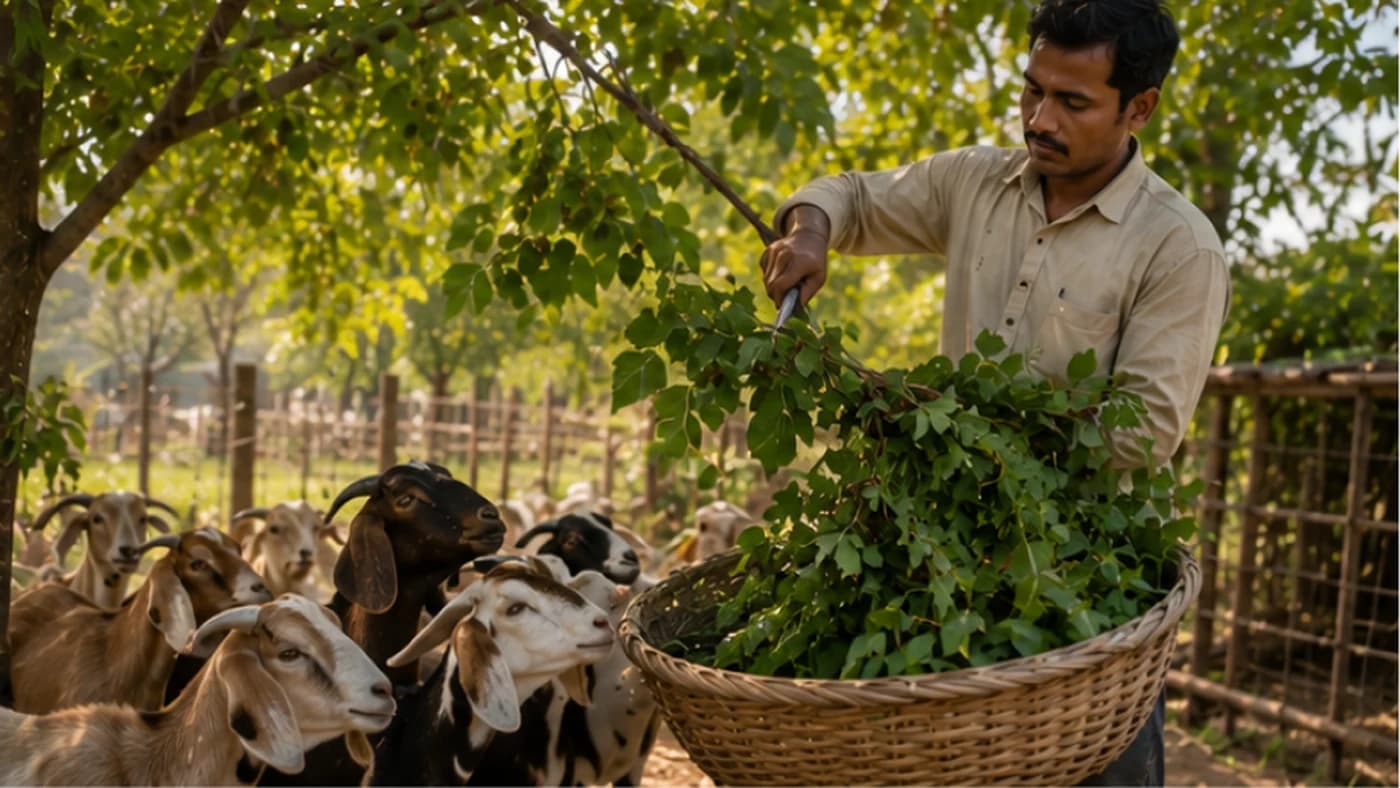
Tree Fodder for Livestock: The Free Mineral Feed Growing on Your Farm
Neem, mulberry, subabul and banyan leaves aren't just shade trees — they're a protein- and mineral-rich feed that costs nothing but a pair of loppers. Here's how to harvest, dry and use tree fodder to feed goats and cattle through lean months.
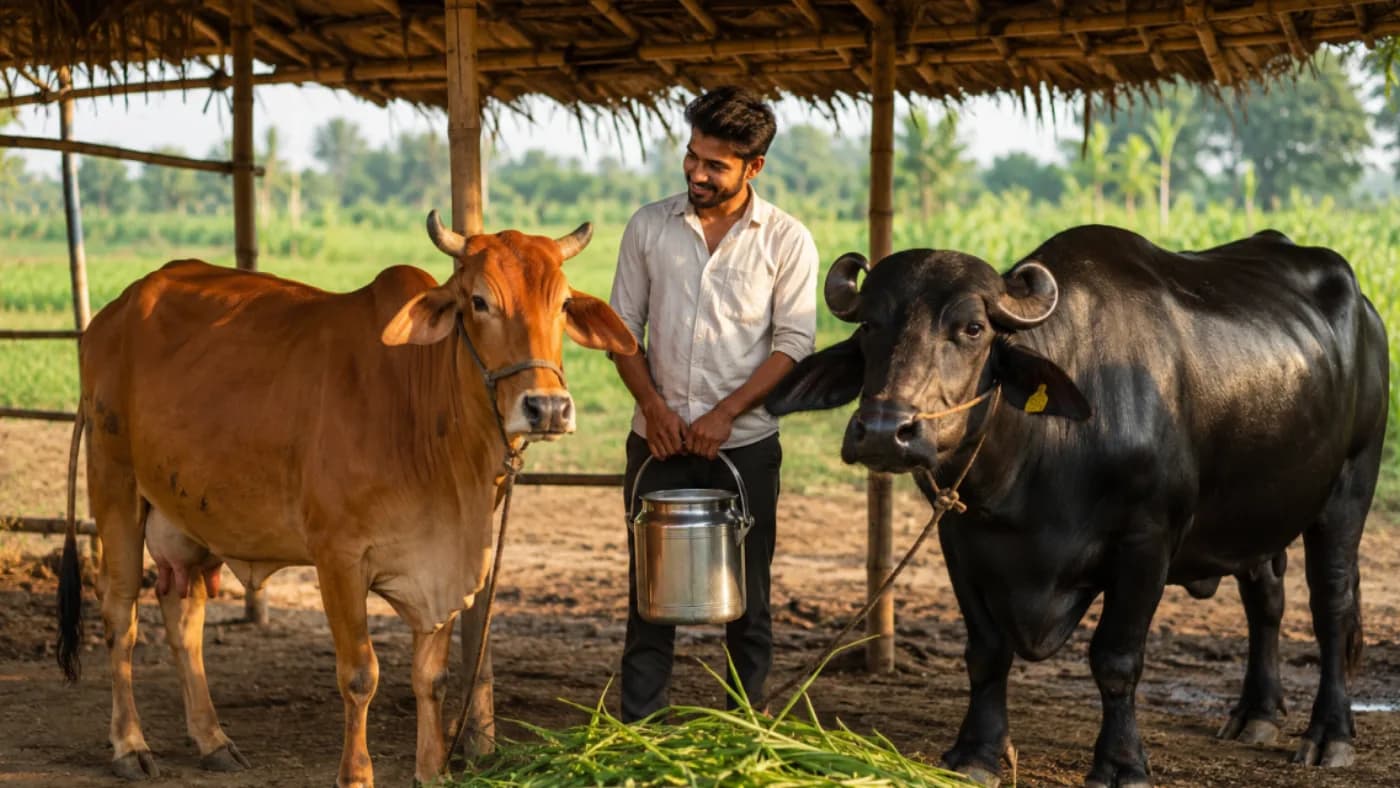
Cow vs Buffalo Dairy: Which One Actually Suits Your Farm?
Buffalo milk earns a better rate per litre at the collection centre — but the animal that earns it also eats more bulk, needs water to wallow in, and suffers far more in the sun. Here is how the two compare on the things that actually decide whether your dairy pays.
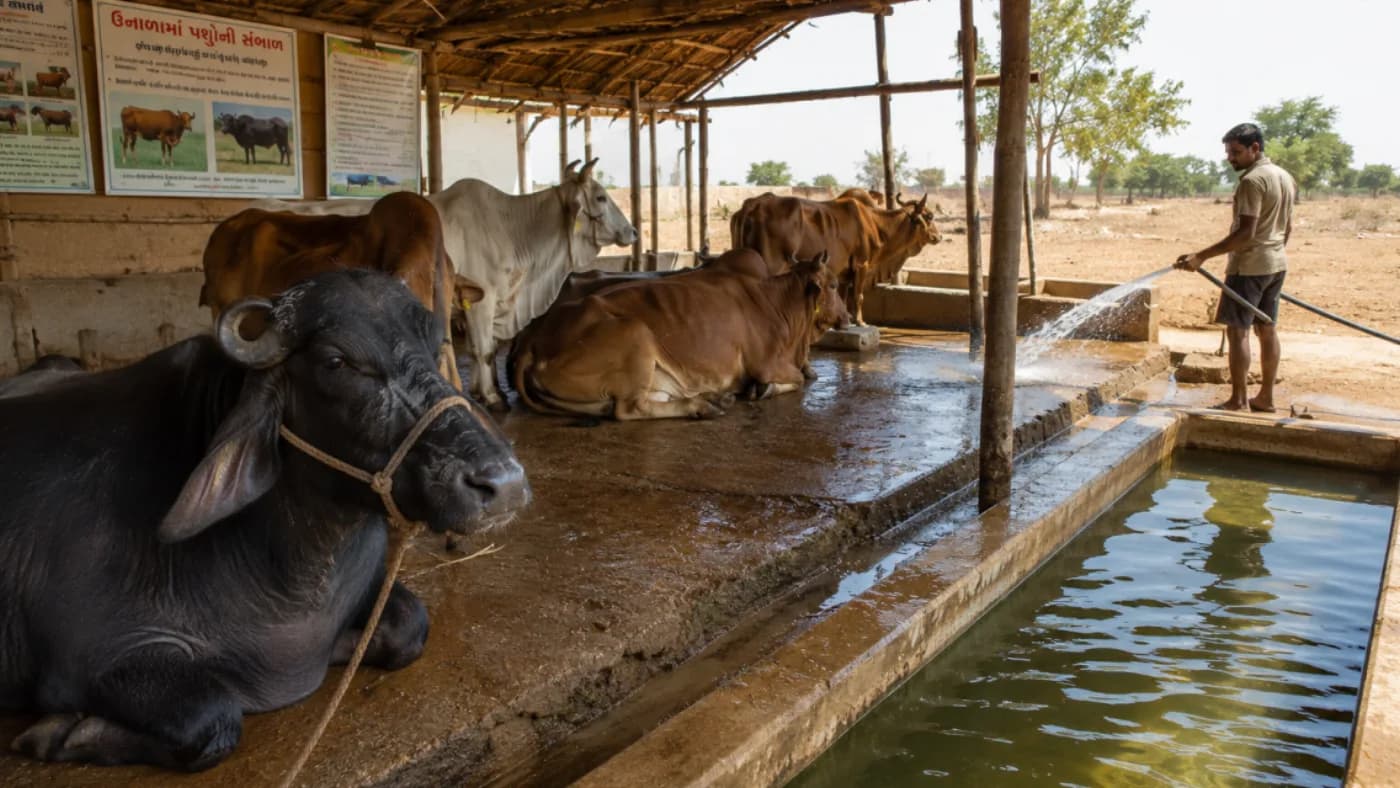
Heat Stress and the Monsoon: Managing Dairy Cattle Through India's Two Hardest Seasons
Summer heat and monsoon damp punish a dairy animal in completely different ways, which is why one set of shed arrangements never covers both. Here is how to read heat stress early, why buffaloes suffer most, and how to keep the monsoon from costing you feet, udders and fodder.