

The Medieval Folding Technique: Using Sheep and Goats to Fertilise Your Field Overnight
One night of penned sheep on a patch of land delivers more usable nitrogen than months of hauled, stored manure. Here's how the old European folding system works — and why Indian farmers already know a version of it.
Quick answer
Folding is not a historical curiosity — it is a precise, low-cost way to turn a flock's manure into targeted soil fertility instead of a hauling chore, and it is already familiar in principle to many Indian farmers who pay shepherds to pen animals on their fields before sowing. Try it first on a small plot: divide a quarter-acre into a dozen or more small cells, move a fold of sheep or goats through them on a daily cycle, and by sowing time you will have a dark, moist, biologically alive seedbed built almost entirely by animals doing what they do naturally — for the cost of a length of fencing and a few minutes a day.
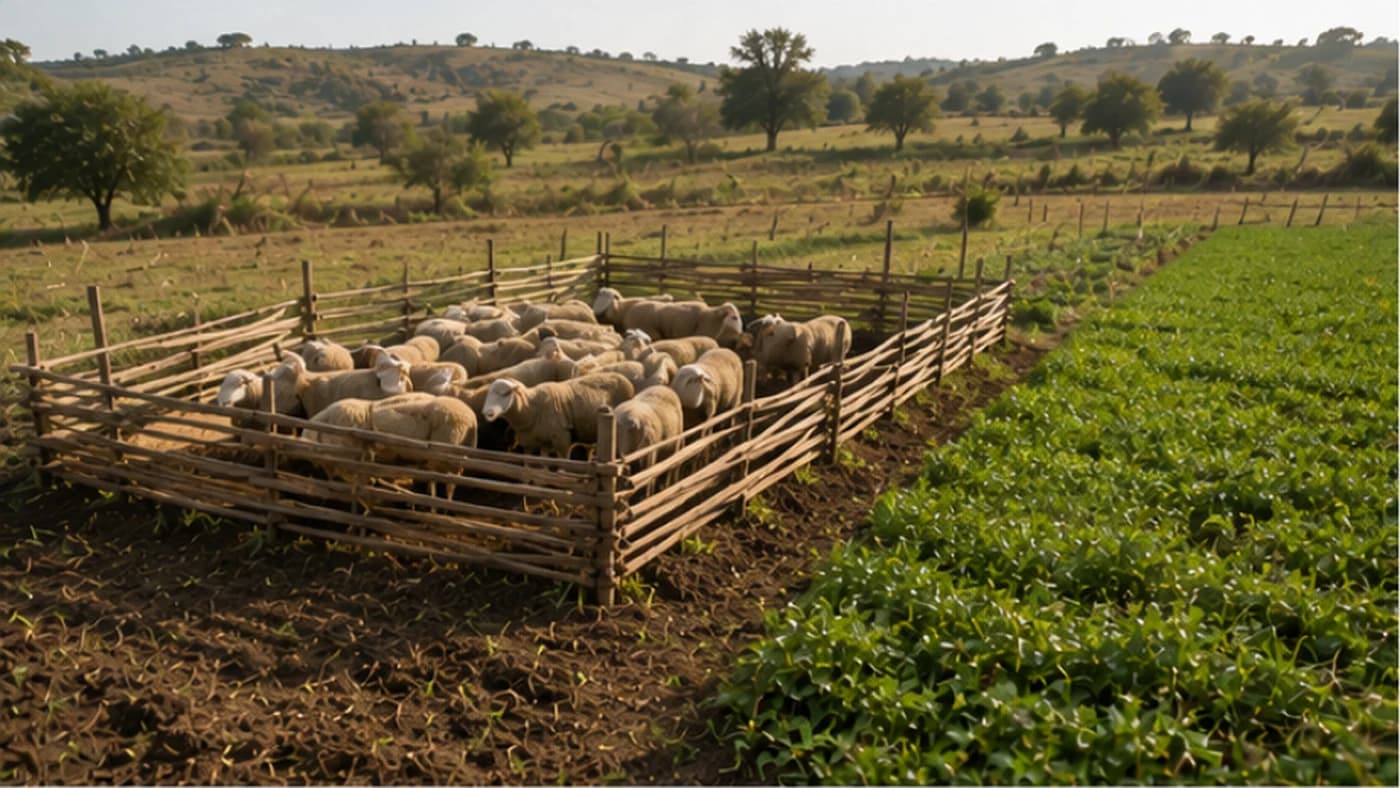
Before chemical fertiliser existed, European farmers had a trick that turned a single night of sleep into a fully fertilised seedbed: folding. Instead of grazing sheep across an open field and letting the manure fall wherever it landed, shepherds used light, movable fences to pen the flock overnight on the exact patch of land that needed feeding — usually a field about to be sown the next morning. It sounds almost too simple, but the effect is dramatic: manure and urine are delivered with precision to the root zone, instead of being scraped from a barn floor, piled for six months, and hauled back out with a tractor. Indian farmers will recognise the core idea immediately — paying a shepherd to pen his flock of sheep or goats on your field before sowing is a traditional practice in parts of Maharashtra, Karnataka, Rajasthan and beyond. This is that same principle, explained in enough detail to set it up deliberately on your own land.
What folding actually is
Folding means confining animals — historically sheep, but goats and cattle work too — to a small, temporary pen placed directly on the land you want to fertilise, then moving that pen every day so a fresh patch gets treated each night. During the day the flock grazes normally on pasture, hillside or roadside verges; as evening falls, they are walked into a small enclosure on the target field and left there overnight.
This is different from ordinary rotational grazing, which is designed to protect pasture and regrow forage. Folding has one job: concentrate dung and urine on a specific patch of cropland so it becomes fertile enough to sow. It was valuable enough in medieval Europe that landlords created a legal right — the "fold-soke" — forcing tenant flocks to be folded on the lord's own fields rather than the tenant's.
In India, the same principle survives as a living tradition: farmers in several states arrange with migratory shepherds (dhangars and other pastoralist communities) to pen their sheep or goats on a field for a few nights before sowing, paying either in cash or in grain. If you have ever heard of this practice in your area, folding is simply the same idea, explained with the numbers needed to do it deliberately and safely.
Why penning beats hauling manure
The reason folding works so well comes down to nitrogen chemistry. Around 70-80% of the nitrogen in sheep urine is highly volatile — if urine sits in a barn or a manure heap, that nitrogen escapes into the air as ammonia gas within hours or days. But when an animal urinates directly onto soil, that nitrogen soaks in immediately and becomes available to the next crop.
Manure that is scraped out, stored in a heap for months, and then spread can lose up to half its nitrogen value before it ever reaches the field. Folding skips all of that: the animal is the delivery truck, the field is the destination, and there is no storage step where nutrients leak away.
There is a second benefit that has nothing to do with manure: hoof action. As animals move around inside a small pen, their hooves create tiny indentations that catch rainwater, break up surface crusting, and press manure into the top layer of soil — waking up earthworms and soil bacteria in the process. And because you are not scraping out a barn and hauling a load to the field, you save real labour and, on a diesel-run farm, real fuel.
Setting up a fold: stocking density and timing
The equipment has changed since medieval times — willow hurdles have been replaced by electric poultry/sheep netting, which sets up in minutes and doubles as basic predator protection. For cattle, simple polywire on a reel with step-in posts works well.
A workable stocking density for fast folding is roughly 45,000-225,000 kg of live animal weight per hectare for a single night — for example, 10 sheep at 68 kg each can be confined to just 14-18 square metres overnight. The fold is moved daily: set the fence, leave the animals overnight, then shift the fence to the adjoining patch the next morning, building a checkerboard of fertilised ground over the season.
Clean water is non-negotiable even for an overnight pen — a towed trough or a hose with a quick-connect valve is the simplest setup. Release the animals as early as possible in the morning; this encourages them to finish depositing manure in the pen rather than on the walk back to pasture.
Mistakes that turn fertility into damage
The most common error is leaving animals on one patch too long, especially during rain. Hoof action that gently tills the soil in dry conditions turns destructive in wet conditions — the soil structure collapses, turns anaerobic, and the fertility you were trying to build becomes toxic to the next crop instead. Be ready to move the fold even mid-storm if the ground starts to puddle.
If you are relying on electric netting for predator protection, test it with a voltmeter — a reading of at least 3,000-5,000 volts is generally needed to deter dogs, jackals or foxes. And do not let the water run dry: thirsty, restless animals in a concentrated pen are far more likely to push down a temporary fence.
A simple check for correct density and timing is the smell test: a properly folded patch should smell like fresh earth within 48 hours. If it smells strongly of ammonia for days afterward, your stocking density was too high or the animals stayed too long — reduce the cell size or the duration for your next move.
Where folding works — and where it doesn't
Soil type matters a great deal. On heavy clay, hooves can create deep pugging that bakes into a concrete-like crust when dry, so folding is best suited to sandy, loamy or well-drained soils. On clay-heavy land, restrict folding to the driest months or frozen ground.
Season matters too — avoid folding through prolonged cold, wet weather unless animals have extra bedding, since cold mud is a common cause of hoof rot and respiratory illness. And consider scale: folding is superb for a kitchen-garden plot or a fraction of an acre, but on a large grain farm it becomes logistically demanding without investing in automated, quick-move fencing.
Folding vs. traditional manure spreading
Static penning in one fixed spot leads to over-concentrated nutrients, runoff, heavy manual labour to remove manure, high parasite build-up because animals stay on the same contaminated ground, soil compaction, and higher cost for permanent structures.
Mobile folding, in contrast, spreads nutrients evenly across the field, needs only light daily labour to shift fencing, keeps parasite risk low because animals move to fresh ground daily, aerates and biologically stimulates the soil instead of compacting it, and costs far less because the fencing is portable rather than permanent.
Multi-species folding for more advanced setups
Once the basic fold is working, you can layer species for extra benefit. In a "leader-follower" system, a milking cow or buffalo folds on a patch first, taking the best forage and leaving a large, phosphorus-rich manure load; a follower flock of sheep, goats or poultry is then folded on the same patch afterward, eating the rougher growth the larger animal ignored and scratching through the dung to spread it evenly (poultry also pick out fly larvae in the process).
This mimics the diversity of a natural grazing ecosystem and helps break parasite cycles, since many internal parasites are species-specific and cannot survive if their eggs pass through a different animal's gut — cleaning the pasture biologically rather than chemically.
Frequently asked
What is livestock folding in simple terms?+
Penning animals like sheep or goats overnight in a small, movable enclosure placed directly on the field you want to fertilise, then shifting the enclosure daily so the manure and urine are delivered exactly where the next crop will grow.
How many animals do I need per square metre?+
A workable density is roughly 45,000-225,000 kg of live animal weight per hectare for one night — as a rough guide, 10 sheep of about 68 kg each can be folded on 14-18 square metres overnight.
Is this the same as the shepherd-penning practice used in some Indian states?+
Yes — arranging for a migratory shepherd's flock to pen overnight on your field before sowing is a traditional Indian version of the same folding principle described here.
What soil is folding best suited to?+
Sandy, loamy or well-drained soil. On heavy clay, hooves can cause deep pugging that bakes hard when dry, so restrict folding on clay to the driest months.
How do I know if I've left animals on a patch too long?+
A well-folded patch smells like fresh earth within about 48 hours. A strong, lingering ammonia smell means the stocking density was too high or the animals stayed too long.
Where to go next
- AI farming chatbotAsk any farming question in Gujarati, Hindi or English and get an answer in seconds.
- Kheti app for Indian farmersCrop plans, disease diagnosis, weather and mandi rates in one app.
- Agri Bazar marketplaceBuy and sell animals, crops, equipment and dairy near you — and see what buyers want today.
Want this as daily tasks for your farm?
Khetiyaar turns guides like this into a day-by-day plan — in your language, free to start.

Related guides
How to Attract Dung Beetles to Your Pasture (and Why Your Dewormer Might Be Killing Them)
Most farmers see a manure pat as a chore. The smart ones see a biological engine — dung beetles that bury parasites, aerate the soil, and cut fly populations, for free, if you stop poisoning them with routine deworming.
Living Fences for Livestock: Grow a Boundary That Never Needs Replacing
A wire fence rusts and sags within 20–30 years. A well-managed living fence of thorny trees and shrubs gets stronger every winter, blocks wind, feeds your animals, and can outlast the farm itself.
DIY Livestock Grooming Stations: Let Your Animals Scratch Themselves Instead of Your Fence
Cattle, goats and buffaloes will find something to scratch against — usually your fence or shed wall. Give them a sturdy, purpose-built scratching post instead, and you save your infrastructure while improving their skin health and even milk yield.