

DIY Livestock Grooming Stations: Let Your Animals Scratch Themselves Instead of Your Fence
Cattle, goats and buffaloes will find something to scratch against — usually your fence or shed wall. Give them a sturdy, purpose-built scratching post instead, and you save your infrastructure while improving their skin health and even milk yield.
Quick answer
A grooming station costs little more than a sturdy post, a few stiff brushes, and an afternoon of work, but it protects your fencing, improves coat and skin health, and can lift milk yield slightly in dairy animals through reduced stress — all for a task the herd is happy to do for itself, 24 hours a day. Build it strong, place it where animals already gather, and check it monthly, and you'll likely find your fence stops taking the abuse within days.
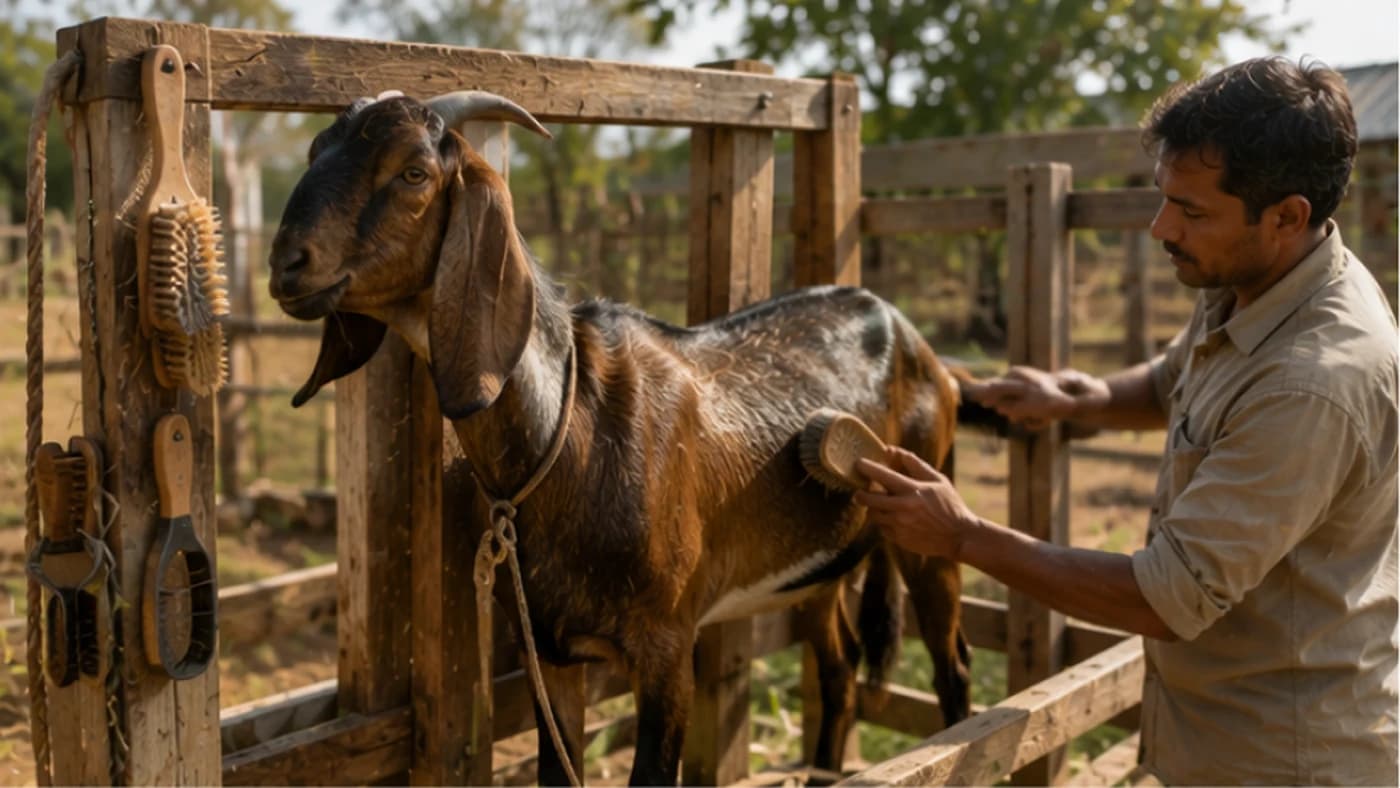
In the wild, animals scratch against trees, rocks and rough ground to remove old hair, dried mud and parasites. On a farm, without that option, they turn to your fencing, gate posts or shed corners instead — and the structure usually loses. A grooming station is simply a dedicated, sturdy scratching post that gives your herd a better option than your infrastructure, letting them manage their own hygiene while you save your fence, your shed siding, and a fair amount of your own time.
Why animals need to scratch, not just be brushed
Grooming isn't a luxury for livestock — it's a biological need. Left unmet, animals will find their own outlet, usually your fence line or a shed corner, leading to loosened posts, torn siding and worn wire. A grooming station channels that same instinct somewhere it won't cost you repairs.
A grooming station is a permanent or semi-permanent post or wall fitting with abrasive material — stiff brushes, textured rope, or coarse matting — positioned where animals naturally want to rub. Once it's in place and animals discover it, most herds largely stop using your fence for the purpose.
Building a post-mounted brush for cattle or buffaloes
A thousand-kilogram animal leaning into a brush puts real force through the mount, so the post has to be genuinely sturdy: a heavy wooden post (an old telephone pole section works well) or a thick steel pipe, buried at least 0.9-1.2 metres deep and set in concrete if the soil is loose. Mount the brush so its top sits roughly at the animal's shoulder height, and cap the post with a wide disc of wood or metal to stop the brush being lifted off as animals lean and twist against it.
For the brush itself, worn-out stiff-bristle brooms, coir (coconut-fibre) scrubbing brushes, or discarded industrial brushes from a local workshop all work well and are inexpensive — the stiffness that makes coir brushes good for scrubbing floors is exactly what makes them effective for scratching hide.
A wall-mounted version for goats and smaller animals
For goats, sheep or pigs, three stiff broom heads mounted on a corner post work well: one fixed vertically for side and flank scratching, a second mounted horizontally above it and angled slightly downward to catch the head and neck, and a third at a diagonal for horn and jaw areas. Secure every head with long deck screws and wide washers rather than nails — nails pull straight out under repeated leaning and twisting within days.
Adding basic pest control to the station
You can combine grooming with fly and tick control by wrapping a section of the post in heavy burlap or thick rope soaked periodically in a mix of mineral oil and a vet-approved livestock insecticide — as the animal rubs against it, a small amount transfers onto its coat. This turns a passive scratching post into passive pest control at the same time, with no extra labour once it's set up.
Why self-service grooming pays off
The most obvious benefit is time — instead of catching and hand-brushing every animal, the herd grooms itself, which matters most during seasonal coat-shedding when animals are especially itchy and irritable. Regular scratching also increases blood flow to the skin, which can improve coat condition and, in dairy animals, has been linked to a modest boost in milk yield through reduced stress, while removing caked mud and manure helps prevent skin infections and discourages lice and mites.
There's a behavioural benefit too: grooming is a natural, calming activity, so giving animals a constructive outlet reduces boredom and the low-level bullying that develops when a herd has nothing to do and no safe place to relieve an itch.
Mistakes that break a grooming station fast
The single biggest mistake is under-building it — a brush attached with ordinary nails will be pulled off within a day by a leaning animal, so always use heavy lag bolts or long deck screws with washers that spread the load across the brush's frame.
Watch for over-grooming in the first few weeks: an unusually abrasive brush, or an animal with an undiagnosed skin condition, can rub one spot raw. And be careful with placement — a station crammed into a narrow corner or right next to a gate invites a dominant animal to guard it and block the rest of the herd, so put it in an open area animals can approach from more than one side.
Where a DIY station isn't enough
A scratching post is for general maintenance, not veterinary treatment — a severe mange or lice infestation needs proper treatment, and a shared brush can actually spread parasites between animals if one is already badly infested, so treat sick animals separately first. In humid climates, natural-fibre brushes like coir or sisal can rot or grow mould without good airflow, so a synthetic bristle brush lasts longer in wetter regions. And remember herd size variation — a post sized for adult cattle is useless for a calf, so a mixed herd may need more than one station at different heights.
Getting the most out of your station
Placement matters more than almost anything else: put your station near a water trough, mineral lick, or shaded rest area, since animals are far more likely to groom when they're already relaxed and stationary rather than mid-graze. Check the bristles about once a month — built-up hair and skin oil blunt a brush's effectiveness — and clean synthetic brushes with a stiff wire comb or a quick blast of water. For a more thorough scratch, mounting the brush on a flexible or spring-loaded arm lets it move with the animal instead of staying rigid, which also takes some strain off your mounting bolts.
On larger holdings, consider making the station portable — mounted on skids or heavy concrete blocks — and moving it every so often to avoid a permanent mud patch forming underneath, the same logic used in rotational grazing.
Frequently asked
What can I use instead of expensive commercial brushes?+
Worn-out stiff brooms, coir (coconut-fibre) scrubbing brushes, or discarded industrial brushes from a local workshop all work well and cost very little.
How deep should the post be buried?+
At least 0.9-1.2 metres, set in concrete if the soil is loose — a leaning adult animal puts serious force through the post, and a shallow post will eventually lean or fall.
Can a grooming station really improve milk yield?+
Regular scratching increases blood flow and reduces stress, which has been linked to a modest improvement in milk yield in dairy animals — it's a small effect, not a substitute for good nutrition and health care.
Where should I place the station?+
In an open area near a water trough, mineral lick, or shaded rest spot, so animals can approach from multiple sides — never in a narrow corner or beside a gate, where a dominant animal can block others from using it.
Is a grooming station a substitute for treating lice or mange?+
No — it's for general maintenance only. A severe infestation needs proper veterinary treatment, and a shared brush can even spread parasites if one animal is already badly infested.
Where to go next
- AI farming chatbotAsk any farming question in Gujarati, Hindi or English and get an answer in seconds.
- Kheti app for Indian farmersCrop plans, disease diagnosis, weather and mandi rates in one app.
- Agri Bazar marketplaceBuy and sell animals, crops, equipment and dairy near you — and see what buyers want today.
Want this as daily tasks for your farm?
Khetiyaar turns guides like this into a day-by-day plan — in your language, free to start.

Related guides
Silvopasture: Letting Livestock and Your Orchard Feed Each Other
Why manage a pasture and an orchard as two separate jobs when they can shade, feed and protect each other in one system? Silvopasture combines trees, forage and animals on the same land for more income per acre, not less.
Living Fences for Livestock: Grow a Boundary That Never Needs Replacing
A wire fence rusts and sags within 20–30 years. A well-managed living fence of thorny trees and shrubs gets stronger every winter, blocks wind, feeds your animals, and can outlast the farm itself.
The Medieval Folding Technique: Using Sheep and Goats to Fertilise Your Field Overnight
One night of penned sheep on a patch of land delivers more usable nitrogen than months of hauled, stored manure. Here's how the old European folding system works — and why Indian farmers already know a version of it.