

Good Insects vs Bad Insects in Your Farm and Garden — Plus How to Identify Common Crop Diseases
Not every insect in your field is an enemy — most are neutral, and some are your best free workers. A full visual guide to the beneficial insects worth protecting, the pest insects worth acting on, and the diseases behind common crop symptoms.
Quick answer
Most insects in your field are neutral or actively helpful — ladybirds, lacewings, hoverflies, Trichogramma wasps, praying mantis, ground beetles, spiders, bees, dragonflies and earthworms are all working for you for free, and protecting them is often the single best pest-control decision available. When a real pest does appear — aphid, whitefly, bollworm, armyworm, stem borer, thrips, mealybug, jassid, fruit fly, spider mite or termite — identifying it correctly points you straight to the right, targeted response instead of a blanket spray that kills your allies too. And when disease symptoms show up on a leaf, fruit or stem, recognising the pattern — fungal spot or powdery growth, bacterial water-soaking or sudden wilt, viral mottling or curling — tells you whether you're managing a spreadable outbreak or a one-off, and whether an insect vector needs controlling as well as the plant itself. Walk your field regularly, look closely, and let identification — not habit — decide when and whether to act.
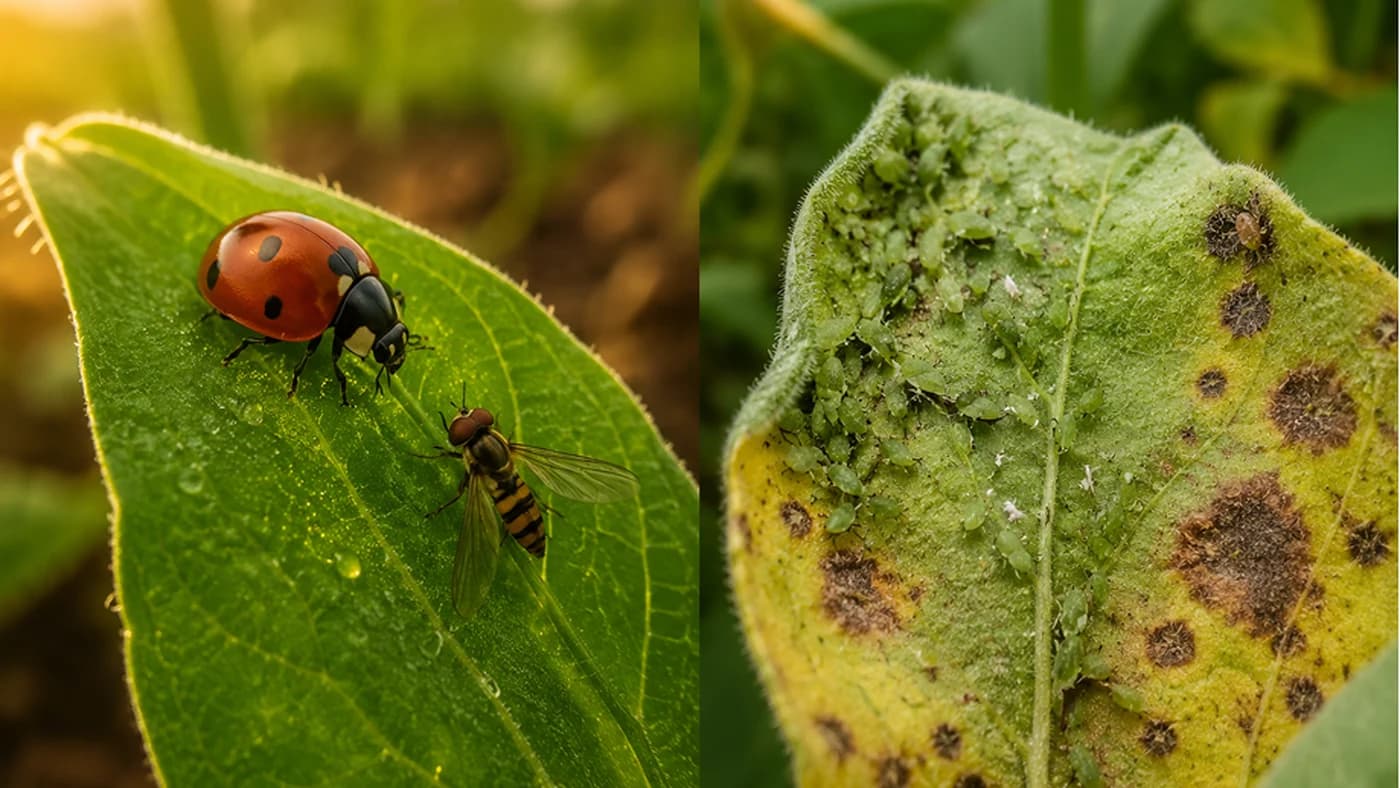
Walk into any field and you'll find dozens of insect species moving through the crop — and it's tempting to treat every one of them as a threat. In reality, only a small fraction of insects actually damage crops. Many are harmless, and a good number are actively working for you: hunting the pests, parasitising their eggs, and pollinating your flowers for free. Spraying without knowing who's who kills the good along with the bad, and often makes the real pest problem worse the following season. This guide is a practical field companion — what the common beneficial insects look like and why to protect them, what the common pest insects look like and what to do about them, and how to read the symptoms that common crop diseases leave behind on your plants.
Why most insects in your field are not the enemy
A healthy field is not an insect-free field — it's a field with a balance of predators, parasitoids, pollinators and a manageable number of plant-feeders. Predatory and parasitic insects need pest insects to survive, so a total absence of pests usually also means an absence of the beneficial insects that would otherwise keep them in check. The goal of good pest management isn't zero insects; it's recognising which species are working against your crop and which are working for it, and acting only when a real pest crosses a damaging level.
This matters economically too. Broad-spectrum insecticide sprayed on a whim kills natural enemies for weeks, while pests — which reproduce faster and recover sooner — often bounce back in bigger numbers than before. This is called pest resurgence, and it's one of the most common reasons a field needs more and more spraying over time. Learning to identify the insects in your own field is the cheapest input you'll ever use.
The 30-second field test: friend or foe?
- Is it eating another insect, or sitting motionless waiting to ambush one? Likely a beneficial predator.
- Is it visiting flowers and moving pollen between them? Likely a pollinator — leave it alone completely.
- Is it clustered densely on tender new growth or the underside of leaves, not moving much, in the same spot for days? Likely a sap-sucking pest.
- Is the leaf sticky, with black sooty mould growing on it? That's honeydew from aphids, whiteflies or mealybugs — a strong sign of a sap-sucker problem even if you can't see the insect itself.
- Are there neat round holes bored into a stem, pod, fruit or boll, often with fine sawdust-like frass at the entrance? That's a boring caterpillar working inside, not visible from outside.
- Are leaf edges ragged and chewed, or is there a leaf-mining trail (a pale winding tunnel inside the leaf)? That's a chewing or mining pest.
- Is the insect tiny, fast, jumping sideways the moment your shadow falls on the leaf? That's often a jassid/leafhopper — check for leaf margins curling downward afterward.
🟢 Meet the beneficial insects, at a glance
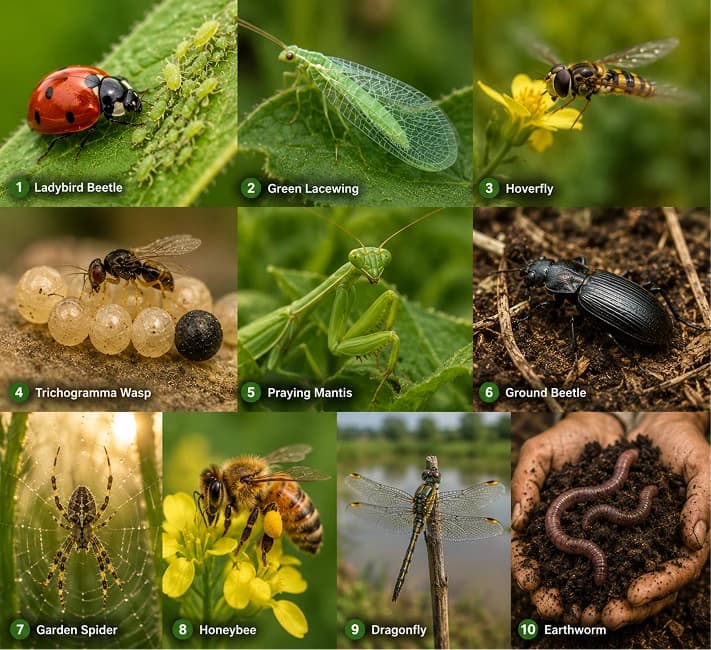
Before you reach for a spray, learn to recognise these ten first — they're the insects (and one very useful worm) already doing free pest control and pollination on your land. Every one below is covered in full detail further down the page.
🟢 Ladybird Beetle (Ladybug) — the aphid hunter
Identify it: a small, dome-shaped, shiny beetle, usually red, orange or yellow with black spots (the number of spots varies by species). Its larva looks completely different — a longer, grey-blue, alligator-shaped grub with orange markings — and is actually the hungrier of the two life stages.
Why it matters: both the adult and larva hunt aphids, mealybugs and small soft-bodied pests, and a single larva can eat several dozen aphids a day before it pupates. If you see ladybird larvae on a plant with an aphid problem, leave the colony alone for a few days before reaching for a spray — they are often already bringing the outbreak under control.
🟢 Green Lacewing — the aphid lion
Identify it: a delicate, pale green insect with long thread-like antennae and lacy, net-veined transparent wings held tent-like over its body. It's a weak, fluttery flier, usually seen at dusk near lights. Its larva — nicknamed the 'aphid lion' — is a small, spindle-shaped, mottled brown-and-cream grub with visible sickle-shaped jaws.
Why it matters: lacewing larvae are ferocious predators of aphids, whiteflies, mites and small caterpillar eggs, and are widely reared and released as a biological control in Indian cotton, vegetable and sugarcane fields. The adults mostly feed on nectar and pollen and do no harm at all, so never mistake either stage for a pest.
🟢 Hoverfly — the bee mimic that works twice
Identify it: looks like a small bee or wasp with yellow-and-black bands, but has only one pair of wings (bees and wasps have two) and can hover perfectly still in mid-air before darting sideways — a trick true bees and wasps can't do. It is completely harmless and cannot sting.
Why it matters: adult hoverflies pollinate flowers as they feed on nectar, while their small, legless, slug-like larvae hidden among leaves are voracious aphid predators, capable of clearing a heavy infestation on their own. Encourage them by leaving a few flowering plants (coriander, dill, mustard left to flower) at field edges.
🟢 Trichogramma Wasp — the invisible bodyguard
Identify it: almost impossible to see with the naked eye — under a magnifier it's a tiny, dark, delicate wasp less than a millimetre long. In practice, you'll recognise its work rather than the insect itself: pest eggs (such as bollworm or stem borer eggs) that have turned black or grey instead of their normal colour have very likely been parasitised.
Why it matters: the female wasp lays her own egg inside a pest egg, and her larva consumes it from within before the pest ever hatches. Trichogramma is one of the most widely used biological control agents in Indian cotton, sugarcane and maize, released commercially on small paper 'Trichocards' pinned to the crop — a genuinely free and self-sustaining form of pest control once established.
🟢 Praying Mantis — the ambush generalist
Identify it: unmistakable — a triangular, swivelling head, large forward-facing eyes, and folded, spiked forelegs held as if in prayer, ready to snap forward in an instant. Usually green or brown, camouflaged to match the plant it sits on, moving very little until it strikes.
Why it matters: a general ambush predator that eats almost any insect it can catch, including moths, grasshoppers and caterpillars. It isn't selective — it will occasionally take a beneficial insect too — but overall its presence is a good sign of a healthy, insect-diverse field, and it should never be harmed.
🟢 Ground Beetle — the night-shift predator
Identify it: a fast-moving, dark, shiny beetle usually seen scurrying across the soil surface or hiding under mulch, stones and crop residue during the day. Most species are active at night, which is why they're rarely seen in the act of hunting.
Why it matters: ground beetles and their larvae prey on cutworms, slugs, snails and soil-dwelling caterpillar stages that damage seedlings at the base. Leaving a layer of mulch or crop residue at field edges gives them daytime shelter and keeps this free pest control active on your land.
🟢 Garden Spider — the web and ground hunter
Identify it: not an insect but a close relative worth including — an eight-legged arachnid, either building a circular orb web between plants (orb-weavers) or hunting on foot across the soil (wolf spiders). Web-builders are stationary and easy to spot; ground hunters are fast and low to the soil.
Why it matters: spiders are generalist predators that catch a very wide range of flying and crawling pests, and most species found in Indian fields and gardens are harmless to people and not aggressive. Avoid disturbing webs at field margins — each one is a small, permanently working pest trap.
🟢 Honeybee — the pollinator you're paid by
Identify it: a fuzzy, golden-brown, banded bee, usually seen moving methodically from flower to flower collecting nectar and pollen, with pollen baskets visible on its hind legs. The Indian honeybee (Apis cerana indica) nests in tree hollows, wall cavities and hive boxes, and is distinct from wasps by its rounder, hairier body.
Why it matters: bees pollinate a large share of fruit, vegetable and oilseed crops, directly increasing fruit set and yield — this is not a side benefit, it's often the single biggest yield factor for crops like cucurbits, mustard and many fruit trees. Never spray insecticide on open flowers during the day when bees are foraging; if a spray is essential, apply it in the evening after bees have returned to the hive.
🟢 Dragonfly — the flying-pest controller
Identify it: a large-eyed insect with a long, slender body and two pairs of transparent, vein-patterned wings held out flat at rest, often seen darting over ponds, canals and irrigated fields. Damselflies are a smaller, more delicate relative that fold their wings along the body at rest.
Why it matters: dragonflies are aerial predators that catch mosquitoes and other small flying insects on the wing, and their presence is a good sign of clean water nearby. They are completely harmless to people — they don't bite or sting — despite their intimidating appearance.
🟢 Earthworm — not an insect, but your best worker
Identify it: a segmented, soft-bodied worm found in moist, organically rich soil — technically not an insect at all, but it belongs on every list of a farmer's best allies. Plenty of earthworms turning up when you dig is one of the simplest signs of living, healthy soil.
Why it matters: earthworms tunnel and aerate the soil, break down organic matter, and produce nutrient-rich castings that improve fertility and water retention. Their numbers fall sharply with heavy tillage and broad-spectrum pesticide use, and rise with compost, mulch and reduced chemical load — a living indicator of how your soil management is actually doing.
How pests actually damage your crop
Pest insects harm crops in three broad ways, and knowing which one you're looking at points you straight to the right insect. Sap-suckers (aphids, whiteflies, thrips, jassids, mealybugs) pierce plant tissue and drain its fluids, causing curling, yellowing, stunting and often sticky honeydew with black sooty mould — and several of them also spread plant viruses in the process, which can be far more damaging than the feeding itself. Chewers and borers (caterpillars like bollworm, armyworm and stem borer) eat leaf tissue or tunnel inside stems, pods and fruit, often leaving visible holes, frass or a dead central shoot. Root and soil pests (termites, some beetle grubs) work unseen below ground, weakening or killing the plant from the roots up, usually noticed only once the plant wilts or falls over.
🔴 Meet the common pest insects, at a glance
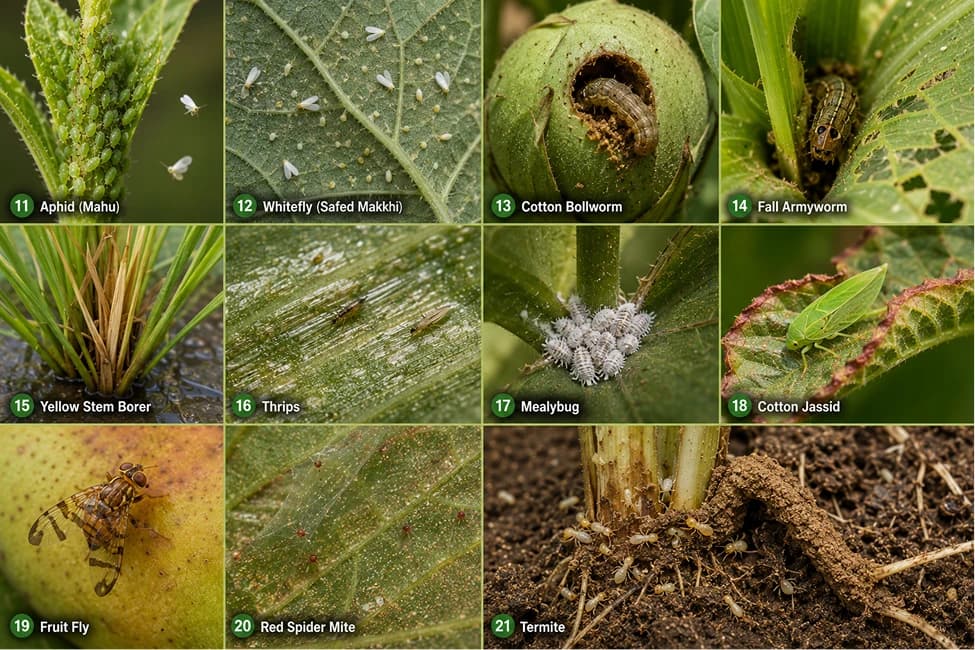
These eleven are responsible for the vast majority of insect damage in Indian fields and gardens. Learn their look and their damage pattern, and you'll know within seconds whether what you're seeing needs action — every one is covered in full detail further down the page.
🔴 Aphid (Mahu) — the tiny sap-sucker with big consequences
Identify it: tiny (1–3 mm), soft-bodied, pear-shaped insects — green, black, yellow or pink depending on species — clustered densely on tender new shoots, buds and the undersides of young leaves. Look for sticky honeydew on and beneath the leaves, often with black sooty mould growing on top of it.
What to do: aphids reproduce extremely fast, so check plants twice a week during the growing season. A strong jet of water knocks small colonies off; ladybirds and lacewings usually arrive on their own if you haven't sprayed recently. Only use a targeted spray (like neem oil or an insecticidal soap) if numbers keep climbing after a week — aphids are also a major virus vector, so early control matters more than the direct feeding damage.
🔴 Whitefly (Safed Makkhi) — the virus courier
Identify it: tiny, moth-like white insects that rise up in a visible cloud when you shake or brush the plant, settling back down within seconds. Turn a leaf over and you'll often find flat, oval, scale-like nymphs stuck to the underside — these don't fly and are easy to miss.
What to do: whitefly is one of the most damaging pests in Indian cotton, tomato, chilli and cucurbit crops mainly because it transmits leaf curl viruses, which have no cure once a plant is infected. Use yellow sticky traps to monitor and reduce numbers, encourage natural predators (lacewings, ladybirds), avoid excess nitrogen fertiliser (which whiteflies favour), and remove and destroy visibly virus-infected plants early rather than letting them stay as a source of spread.
🔴 Cotton Bollworm / American Bollworm — the boll-and-pod borer
Identify it: a stout caterpillar, colour ranging from green to brown to pink with faint stripes along the body, boring a clean round hole into cotton bolls, chickpea (gram) or pigeon pea pods, or tomato fruit, often with fine granular frass visible at the entry point. It rarely feeds fully exposed — most of the damage happens hidden inside the boll or pod.
What to do: scout weekly for entry holes and frass rather than waiting to see the caterpillar itself, since by the time you spot it the damage is already done. Pheromone traps help detect and track moth activity early; encourage Trichogramma wasps and other natural egg predators; rotate any chemical control between different modes of action, since Helicoverpa armigera develops insecticide resistance quickly when the same product is used repeatedly.
🔴 Fall Armyworm — the newer maize threat
Identify it: a caterpillar with a distinctive inverted-Y or Y-shaped marking on its head capsule, feeding deep inside the maize whorl and leaving characteristic 'window-pane' feeding damage — thin, papery patches where it has scraped through the leaf without eating all the way through — along with ragged holes and visible frass packed into the whorl.
What to do: this is a relatively new invasive pest in India (first reported in 2018) that spreads and multiplies fast, so check the whorl of young maize plants weekly from early growth stages. Hand-picking caterpillars from small plots, encouraging natural enemies, and applying targeted biopesticides early (before the caterpillar burrows deep into the whorl, where sprays struggle to reach) all help; avoid relying on any single chemical repeatedly.
🔴 Yellow Stem Borer — the rice pest with two faces
Identify it: a pale yellow caterpillar that bores into the rice stem itself rather than feeding externally, so the insect is rarely seen — instead, you'll notice its two signature symptoms: a 'dead heart', where the central shoot of a young plant dries up and can be pulled out easily, and a 'white ear', where an infested panicle at the reproductive stage turns white and produces no grain.
What to do: check fields regularly from the tillering stage onward for dead hearts, since catching an infestation early prevents it from reaching the more costly white-ear stage. Balanced nitrogen use (excess nitrogen encourages the pest), light traps to monitor adult moth activity, and encouraging natural enemies like Trichogramma all reduce pressure without relying purely on chemical sprays.
🔴 Thrips — the tiny virus-spreading scratcher
Identify it: extremely small (about 1 mm), slender, fast-moving insects best seen by tapping a flower or leaf over white paper — they'll fall out and be visible as tiny moving specks. Their feeding leaves silvery or bronze streaks and scarring on leaves and flowers, along with curling and distortion of new growth.
What to do: thrips are a major vector of destructive plant viruses in chilli, onion, cotton and groundnut, so damage often outpaces what the feeding alone would suggest. Blue sticky traps are more effective than yellow ones for monitoring thrips specifically; keep field margins free of alternate weed hosts, and act early since thrips populations can explode quickly in hot, dry weather.
🔴 Mealybug — the cottony sap-sucker
Identify it: soft-bodied insects covered in a white, waxy, cottony coating, clustering in leaf axils, along stems, and sometimes on roots — they look almost like small tufts of cotton wool stuck to the plant, and don't move very fast.
What to do: mealybugs suck sap and excrete honeydew that leads to sooty mould, weakening the plant over time; they're common on cotton, papaya, guava and grapes. A strong water jet or a soft brush dipped in soapy water can physically remove light infestations; for heavier outbreaks, biological control has worked exceptionally well in India — the release of the parasitoid wasp Acerophagus papayae brought the invasive papaya mealybug under control nationally within a few years, a model worth encouraging locally rather than reaching first for a broad-spectrum spray.
🔴 Cotton Jassid / Leafhopper — the sideways jumper
Identify it: a small, wedge-shaped, pale green insect that moves sideways and flies off quickly the moment it senses movement or a shadow — much faster to react than an aphid or whitefly. Look at the leaf itself for the telltale sign: margins curling downward and turning bronze, yellow or red, a symptom called 'hopper burn'.
What to do: common on cotton, okra (bhindi) and brinjal, jassids thrive in hot, dry conditions and multiply fast once established. Yellow sticky traps help monitor numbers; avoid excess nitrogen, which produces the soft, sap-rich growth jassids prefer; and act once hopper-burn symptoms appear on a meaningful share of plants rather than waiting for visible heavy infestation.
🔴 Fruit Fly — the invisible fruit spoiler
Identify it: the adult is a small, brownish fly with patterned wings, rarely noticed until fruit is already ripening. The real damage is invisible from outside at first — the female punctures the fruit skin to lay eggs, and maggots feeding inside cause the fruit to rot and drop well before you'd normally expect spoilage.
What to do: fruit fly is a major pest of mango, guava, cucurbits and other soft fruit. Methyl eugenol pheromone traps are highly effective and widely used in India to attract and kill male fruit flies, breaking the breeding cycle. Collect and destroy fallen and infested fruit promptly rather than leaving it in the field, since it becomes a breeding source for the next generation.
🔴 Red Spider Mite — the near-invisible leaf stippler
Identify it: technically an arachnid, not an insect, and barely visible to the naked eye — you'll usually spot the damage before the mite itself. Look for a fine, dusty stippling or bronzing on the upper leaf surface, and check the underside for delicate silk-like webbing, especially along leaf veins.
What to do: red spider mites thrive in hot, dry weather and multiply explosively when conditions favour them, common on cotton, brinjal, papaya and roses. Regular overhead misting or water spraying (where the crop tolerates it) disrupts their preferred dry conditions; avoid broad-spectrum insecticides that also kill their natural predatory mites, since that often makes an outbreak worse rather than better.
🔴 Termite — the pest working below the surface
Identify it: pale, soft-bodied, ant-like insects rarely seen out in the open, since they build mud tubes or tunnels to travel while staying hidden from light and predators. The first sign is usually a plant wilting or falling over with no visible above-ground cause — pull it gently and you'll often find the roots or lower stem hollowed out or damaged.
What to do: termites mainly attack seedlings, weakened or drought-stressed plants, dead wood, and stored crop residue. Removing dead roots and crop debris after harvest, maintaining good soil moisture (termite attack is worse in dry, stressed fields), and using neem-based soil treatments at sowing all reduce pressure without needing a broad soil-wide chemical treatment.
Reading the leaf: what plant diseases are telling you
Plant diseases are caused by three very different kinds of organism — fungi, bacteria and viruses — and each tends to leave a different kind of signature. Fungal diseases usually show as spots, powdery or fuzzy growth, or rot, and spread through spores carried by wind, rain-splash or contaminated tools; most thrive in humid or wet conditions. Bacterial diseases often show as water-soaked lesions, streaks, or sudden wilting, and spread through water, wounds and contaminated seed or tools; wilts in particular can progress alarmingly fast once conditions favour them. Viral diseases typically show as mottling, mosaic patterns, curling or severe stunting, are usually spread by an insect vector (whitefly, aphid or thrips) rather than by the weather alone, and have no direct cure — management is entirely about prevention and controlling the insect that spreads them.
🦠 Meet the common plant diseases, at a glance
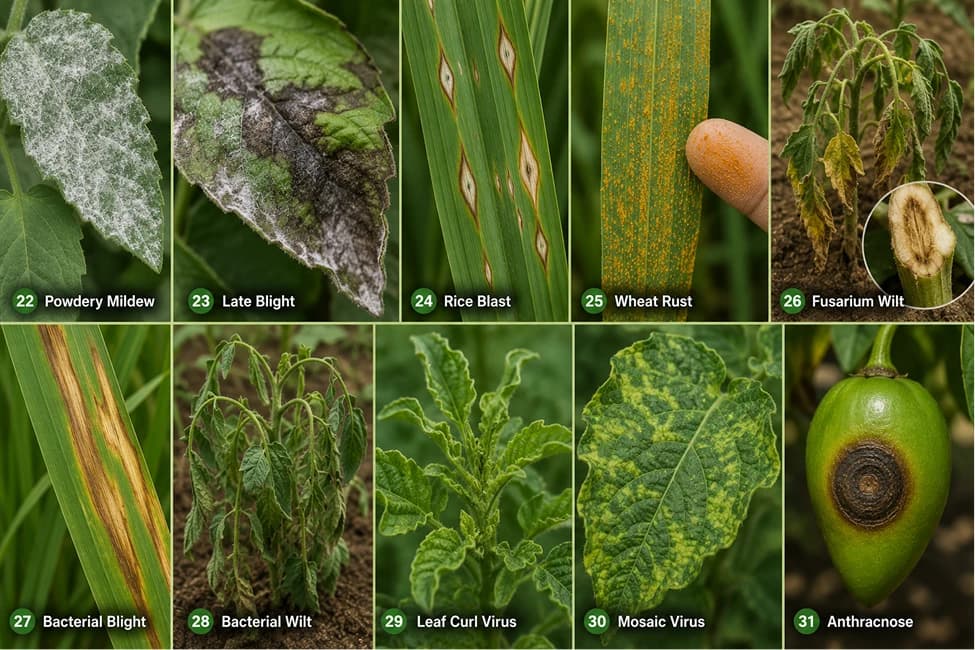
These ten cover the fungal, bacterial and viral diseases you're most likely to run into. Match the symptom pattern on your plant to the photo, then read the full description further down the page before deciding on treatment.
🦠 Powdery Mildew — the dusty white coating
Symptoms: a white to greyish, powdery, dust-like coating on the upper surface of leaves, stems and sometimes fruit, which can be rubbed off with a finger. Heavily affected leaves may yellow, curl and drop early, and photosynthesis drops sharply even before the leaf looks badly damaged.
What to do: powdery mildew favours warm days with cool, humid nights and is common on cucurbits, peas, grapes and mango. Improve air circulation with proper plant spacing, avoid excess nitrogen, and remove badly affected leaves early; sulfur-based sprays and neem oil are widely used preventive and early-stage treatments.
🦠 Late Blight — the fast-moving crop killer
Symptoms: dark, water-soaked, irregular lesions on leaves that expand quickly, often with a pale fuzzy fungal growth visible on the underside during humid weather. Stems can develop dark lesions too, and infected potato tubers show a reddish-brown dry rot beneath the skin.
What to do: late blight spreads explosively in cool, wet weather and can destroy a potato or tomato crop within days if unchecked — it is the same disease that caused the historic Irish potato famine. Use certified disease-free seed potatoes, ensure good drainage and spacing for airflow, remove and destroy infected plants promptly, and apply protectant fungicides preventively during known high-risk weather rather than waiting for symptoms to appear.
🦠 Rice Blast — the diamond-shaped lesion disease
Symptoms: diamond or spindle-shaped spots on leaves with a grey or whitish centre and a brown border, which can merge and kill large sections of leaf in a bad outbreak. When the fungus reaches the neck of the panicle ('neck blast'), the stem there turns black and breaks, and the panicle above it dries up with little or no grain filling.
What to do: rice blast is one of the most destructive rice diseases worldwide and is worse under high humidity, dense planting and excess nitrogen. Use resistant varieties where available, avoid excessive nitrogen fertiliser, ensure fields aren't overcrowded, and treat seed before sowing; fungicide application timed to protect the neck stage is critical once blast is confirmed in a region.
🦠 Wheat Rust — the orange powder on your fingers
Symptoms: small, raised, orange-yellow pustules on leaves and stems that rub off as a rust-coloured powder on your fingers — arranged in narrow stripes along the leaf veins for yellow (stripe) rust, or scattered more randomly for brown (leaf) rust. Severe infection dries out leaves early and sharply reduces grain fill.
What to do: wheat rust spreads on wind-blown spores over very long distances, so regional monitoring matters as much as field-level action. Sow resistant varieties recommended for your region and season, avoid very early or very dense sowing where rust pressure is known to be high locally, and apply fungicide promptly once pustules are confirmed rather than waiting, since rust can spread through a field within days under favourable weather.
🦠 Fusarium Wilt — the one-sided yellowing
Symptoms: yellowing and wilting that typically starts on one side of the plant or one set of lower leaves before spreading, unlike a sudden all-over wilt. If you cut the stem crosswise, the vascular tissue just under the bark shows a distinct brown discolouration — this internal browning is the clearest confirming sign.
What to do: Fusarium is a soil-borne fungus that can persist in field soil for years and affects cotton, tomato, chickpea and banana (where it's known as Panama disease) among others. There is no cure once a plant is infected, so management is entirely preventive: use resistant varieties, rotate with non-host crops over several seasons, avoid moving infected soil or water between fields, and remove and destroy infected plants rather than composting them on-site.
🦠 Bacterial Blight — the water-soaked streak
Symptoms: water-soaked streaks or lesions, often starting at leaf tips or margins with a wavy yellow-to-brown edge, that can enlarge and cause whole leaves to dry out. In humid conditions, a milky bacterial ooze may be visible on the lesion surface, especially in the early morning.
What to do: bacterial blight spreads through wind-driven rain, irrigation water, contaminated tools and infected seed, and is a major disease of rice and cotton in India. Use certified disease-free seed, avoid working in fields when foliage is wet, disinfect tools between fields, ensure balanced (not excess) nitrogen use, and improve field drainage since standing water strongly favours spread.
🦠 Bacterial Wilt — the sudden green collapse
Symptoms: the plant wilts suddenly while its leaves are still green — unlike Fusarium wilt, there is often little or no yellowing before the collapse. A simple confirming test: cut the stem near the base and suspend it in a glass of clear water; if milky-white bacterial streaming flows out within a minute or two, bacterial wilt is very likely.
What to do: caused by Ralstonia solanacearum, this disease affects tomato, brinjal, potato and chilli and survives in soil and water for long periods. There is no cure for infected plants — remove and destroy them immediately rather than leaving them in the field. Prevention relies on resistant rootstock varieties (especially for grafted tomato/brinjal), crop rotation with non-host crops, and avoiding movement of soil, water or tools from an infected field to a clean one.
🦠 Leaf Curl Virus — the whitefly's calling card
Symptoms: leaves curl upward or downward, often thickened along the veins, with stunted overall plant growth and reduced flowering or fruit set. Symptoms tend to appear first on newer growth and worsen as the plant matures, especially in cotton, chilli and tomato.
What to do: leaf curl viruses are transmitted by whitefly and have no cure once a plant is infected — management means controlling the whitefly vector and limiting spread. Use whitefly-resistant or tolerant varieties where available, control whitefly populations early with yellow sticky traps and targeted treatment, remove and destroy infected plants promptly rather than letting them serve as a virus reservoir, and avoid planting new susceptible crops immediately next to a heavily infected field.
🦠 Mosaic Virus — the mottled leaf pattern
Symptoms: an irregular mottled pattern of light and dark green patches on the leaf, sometimes with distortion, blistering or a slightly crinkled texture, along with stunted growth and reduced fruit size or quality. Affected fruit (as in papaya ring spot virus) can also show ring-shaped blemishes.
What to do: mosaic viruses are spread mainly by aphids and sometimes mechanically (through hands, tools or plant-to-plant contact during pruning), and have no cure once established. Control the aphid vector, disinfect tools between plants when pruning a suspected outbreak, remove and destroy infected plants, and use virus-free certified seed or planting material as the single most effective preventive step.
🦠 Anthracnose — the sunken fruit rot
Symptoms: sunken, dark, circular lesions on fruit, often with visible concentric rings, along with similar spotting on leaves and stems in humid conditions. In chilli, this is widely known as fruit rot or 'die-back' and can cause major post-harvest losses even in fruit that looked healthy at picking.
What to do: anthracnose spreads through rain-splash and is worse in warm, humid weather, and can also be carried on infected seed. Use certified, treated seed, avoid overhead irrigation late in the day (which leaves foliage wet overnight), remove and destroy infected fruit and plant debris rather than composting it in the field, and ensure good spacing for airflow to reduce the humid microclimate the disease needs.
Turning identification into action: a simple weekly routine
Knowing these insects and diseases only pays off if it turns into a habit. Walk your field or garden once or twice a week, looking specifically at the undersides of leaves, growing tips and any wilting or discoloured plants rather than just glancing at the crop from a distance. Note what you find — this is the entire basis of Integrated Pest Management (IPM): act only when a real pest crosses a damaging level, protect the beneficial insects already doing free work for you, rotate any chemical control between different modes of action so pests don't build resistance, and treat disease prevention (clean seed, resistant varieties, good spacing and drainage, field sanitation) as more valuable than any cure, because for most of the diseases on this list, there isn't one.
Terms explained in this guide
- Anthracnose
- Aphid (Mahu)
- Bacterial Blight
- Bacterial Wilt
- Beneficial insect
- Cotton Bollworm
- Cotton Jassid
- Dragonfly
- Earthworm
- Fall Armyworm
- Fruit Fly
- Fusarium Wilt
- Garden Spider
- Green Lacewing
- Ground Beetle
- Honeybee
- Hoverfly
- Ladybird Beetle
- Late Blight
- Leaf Curl Virus
- Mealybug
- Mosaic Virus
- Pollinator
- Powdery Mildew
- Praying Mantis
- Red Spider Mite
- Rice Blast
- Termite
- Thrips
- Trichogramma Wasp
- Wheat Rust
- Whitefly (Safed Makkhi)
- Yellow Stem Borer
Frequently asked
How can I tell if an insect in my field is helpful or harmful?+
Watch its behaviour: insects that are hunting other insects, sitting motionless waiting to ambush prey, or visiting flowers to feed are usually beneficial. Insects clustered densely on tender new growth, sucking sap without moving much, or leaving chewed holes, bore holes or sticky honeydew behind, are usually pests.
Will spraying insecticide get rid of all my pest problems?+
Broad-spectrum insecticide also kills the beneficial insects that would otherwise keep pests in check, which can cause pests to rebound in even larger numbers afterward — a problem called pest resurgence. It's better to identify the specific pest, confirm it has crossed a damaging level, and use a targeted response.
Which insects should I never spray or harm in my field?+
Protect ladybirds, lacewings, hoverflies, Trichogramma and other parasitic wasps, praying mantis, ground beetles, spiders, bees, dragonflies and earthworms — all are either predators of pests, pollinators, or soil-health workers, and removing them usually makes your pest problem worse over time.
Why do some plant diseases have no cure?+
Bacterial wilts and viral diseases (like leaf curl virus and mosaic virus) generally have no direct cure once a plant is infected. Management focuses entirely on prevention — resistant varieties, clean certified seed, and controlling the insect that spreads the disease — and on removing infected plants promptly so they don't spread it further.
How often should I check my field or garden for pests and disease?+
Once or twice a week during the growing season is a good baseline, checking the undersides of leaves and new growth specifically rather than just glancing at the crop. Catching aphids, whitefly, bollworm entry holes or early disease spotting in the first week is far cheaper and easier to manage than waiting until damage is obvious.
What is Integrated Pest Management (IPM) in simple terms?+
IPM means combining regular field monitoring, protecting natural predators and pollinators, using resistant varieties and good field hygiene, and reaching for chemical control only as a targeted last step once a pest has crossed a real damaging level — rather than spraying on a fixed schedule regardless of what's actually in the field.
Where to go next
- Kheti app for Indian farmersCrop plans, disease diagnosis, weather and mandi rates in one app.
- AI farming chatbotAsk any farming question in Gujarati, Hindi or English and get an answer in seconds.
- Agri Bazar marketplaceBuy and sell animals, crops, equipment and dairy near you — and see what buyers want today.
Want this as daily tasks for your farm?
Khetiyaar turns guides like this into a day-by-day plan — in your language, free to start.

Related guides
Integrated Pest Management (IPM) for Indian Farms
IPM doesn't mean 'no chemicals' — it means 'chemicals last'. Done well, it cuts spraying costs and stops pests becoming resistant to your sprays.
Crop Disease Detection Apps in 2026: How to Photograph, Read and Trust the Diagnosis
A plant disease app can identify a problem in seconds — or confidently give you the wrong answer and cost you a spray. The difference is almost entirely in how you photograph the plant and how you read the result.

Natural vs Chemical Pesticide: Which to Use, When, and What Each One Costs You
One kills fast and takes your beneficial insects with it. The other works slowly but keeps working season after season. Here is an honest comparison of natural vs chemical pesticide — and the framework for deciding which belongs in your sprayer this week.