

Duckweed as Livestock and Poultry Feed: Free Protein Growing on Your Pond
The green mat covering your farm pond isn't a nuisance — it's up to 40% protein, doubles its own weight in a couple of days, and can replace a real share of your soybean or feed bill for ducks, chickens, fish and even goats.
Quick answer
Duckweed already growing on farm ponds across much of India is a genuine protein source, not pond scum to be cleared away. Set up a shallow, sheltered pond fed by diluted manure runoff, harvest at the right density, dry it quickly with good airflow, and introduce it gradually alongside your existing feed — a modest pond can meaningfully cut your feed bill for poultry, ducks and fish.
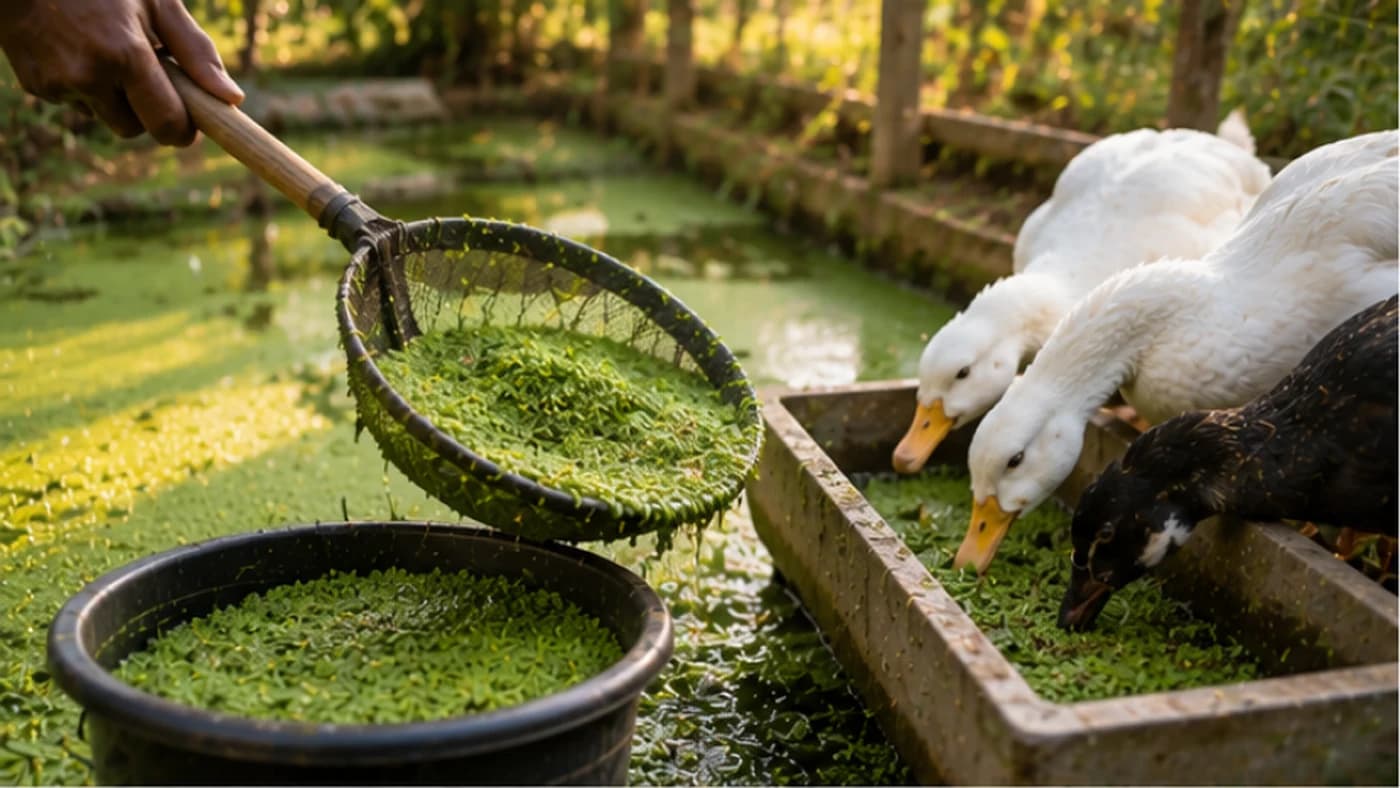
Most farmers look at a pond covered in green scum and see a drainage problem. Look closer and it's actually one of the most efficient protein factories available to a small farm — duckweed. Dried duckweed commonly runs 25-45% crude protein, close to soybean meal, and under good conditions a colony can double its mass in just one to two days. It needs no arable land, grows on water you already have, and in many parts of India — Bengal, Bihar, Odisha, Kerala's backwaters, and countless village ponds — it's already there, waiting to be put to use instead of cleared away.
What duckweed actually is
Duckweed is a family of tiny floating aquatic plants (Lemnaceae) — among the smallest flowering plants on earth — built almost entirely of active leaf tissue rather than stems and deep roots, which is why it grows so fast: under good conditions it can double its biomass in as little as one to two days. Its protein content varies with water nutrients but commonly falls between 25% and 45% crude protein on a dry basis, putting it close to soybean meal (roughly 44-48%), with a well-balanced amino acid profile including good lysine and methionine levels. It's already a traditional feed in many places — Southeast Asian carp and tilapia ponds have used it for centuries — and works for poultry (it deepens egg yolk colour), pigs, fish, and in smaller amounts, ruminants like cattle and goats.
Setting up a duckweed pond
Duckweed grows best in shallow, still or slow-moving water, roughly 10-30cm deep — wind or strong current pushes it to one side, piling it up until the bottom layer dies from lack of light, so choose a sheltered spot or add simple floating barriers (PVC pipe works fine) to break up the surface. It's a heavy feeder, best fertilised with diluted manure or compost tea — a pond catching runoff from a cattle shed or poultry pen is often already primed for duckweed. Keep water pH between 6.5 and 7.5 for best growth (it survives 5.0-9.0 but grows slowly at the extremes), and start a new pond by inoculating with a few handfuls of local duckweed covering about a fifth of the surface. Growth is fastest between 20-30°C and slows or stops below about 7°C, so expect a seasonal dip in colder winters in northern India.
Why it's worth the effort
Per unit of area, duckweed produces far more protein than any land crop — a well-run system can output roughly 8-10 tonnes of protein per hectare per year, compared to about 0.6-1.2 tonnes for soybeans, 2-2.5 tonnes for alfalfa, and 0.4-0.8 tonnes for maize, largely because it grows on water rather than competing for arable land. A dense duckweed mat also cuts pond evaporation by roughly 20-30%, and because it actively pulls nitrogen and phosphorus out of the water as it grows, it doubles as a simple water-cleaning system — useful downstream of a shed or coop. It's rich in pigments like beta-carotene, which is why duckweed-fed layers often produce visibly deeper-orange yolks, and it carries useful trace minerals.
The catch: water content and handling
Fresh duckweed is roughly 92-94% water, so 100kg of green scoop-up gives you only about 6-8kg of actual dry feed — and it spoils within 2-3 days if fed fresh and not used quickly, so plan to feed or dry it promptly rather than stockpiling it wet. Getting the harvest density right matters too: too thin a mat wastes energy spreading instead of growing, too thick a mat shades and kills the lower layers, so aim to harvest when fronds are just touching in a complete, thin carpet. One real risk to know: duckweed readily absorbs whatever is in its water, including heavy metals or agricultural chemical runoff, so never harvest duckweed from a pond you know or suspect is contaminated.
Realistic limits
Duckweed shouldn't replace all of a monogastric animal's diet — it's higher in fibre and ash than corn-soy rations, so keep it under roughly 25% of the ration for broilers or 40% for layers to avoid slowing growth from excess bulk. In cold weather growth stops almost entirely, so you'll still need conventional feed for a few months of the year unless you have a warmer, sheltered growing area. A few species carry calcium oxalate crystals that can affect calcium absorption in sensitive animals in excess — the common Lemna minor is lower in this than some others, and drying or fermenting further reduces the concern.
Harvesting and drying without heavy equipment
A simple pool skimmer or a homemade fine-mesh net on a frame is enough for a small pond; a floating boom works for larger systems, corralling the mat toward a collection point. To speed drying, spin harvested duckweed in a pillowcase using an old top-loading washing machine's spin cycle to remove much of the free water, then spread it on a tarp in the sun (or a solar dryer) until brittle and hay-like, and store it in airtight bags in a cool, dark place — this dried meal mixes easily into a standard grain ration. When introducing fresh duckweed to poultry for the first time, mixing in a little grain often encourages birds wary of the floating green mat to start pecking at it.
A worked example
A flock of 50 laying hens eats roughly 6kg of feed a day; replacing 25% of that with duckweed means producing about 1.5kg of dry duckweed daily. At a typical yield of around 15 grams dry matter per square metre per day, that needs roughly 100 square metres of pond surface — a single 10m x 10m pond, or several smaller ones. Fertilise that pond with runoff or diluted waste from the coop itself, and you've built a closed loop: the birds' manure feeds the duckweed, the duckweed feeds the birds, cutting the feed bill while the pigmentation lifts egg quality.
Terms explained in this guide
Frequently asked
How much protein is really in duckweed?+
Dried duckweed commonly runs 25-45% crude protein, close to soybean meal (44-48%), with a good balance of essential amino acids including lysine and methionine.
Can duckweed fully replace commercial poultry feed?+
No — keep it to roughly 25% of the ration for broilers or up to 40% for layers. Beyond that its higher fibre and ash content can slow growth. It works best as a partial, cost-cutting replacement.
Is it safe to harvest duckweed from any pond?+
No. Duckweed absorbs whatever is in the water, including heavy metals and farm chemical runoff. Only harvest from ponds with water you trust, and avoid any pond near contaminated drainage.
How fast does duckweed actually grow?+
Under good conditions (warm water, adequate nutrients, pH 6.5-7.5) a duckweed colony can double its biomass in as little as one to two days, though growth slows sharply below about 7°C.
What's the easiest way to dry duckweed at home?+
Spin freshly harvested duckweed in a pillowcase using an old washing machine's spin cycle to remove most of the water, then spread it in the sun until brittle before storing it in an airtight container.
Where to go next
- AI farming chatbotAsk any farming question in Gujarati, Hindi or English and get an answer in seconds.
- Kheti app for Indian farmersCrop plans, disease diagnosis, weather and mandi rates in one app.
- Agri Bazar marketplaceBuy and sell animals, crops, equipment and dairy near you — and see what buyers want today.
Want this as daily tasks for your farm?
Khetiyaar turns guides like this into a day-by-day plan — in your language, free to start.

Related guides
Free High-Protein Duck Feed: Turn Garden Pests Into Eggs
Slugs, snails and beetles are richer in protein than soyabean meal. Learn how duck keepers turn garden pests into free, high-quality feed — and where this trick runs into its limits.
Living Fences for Livestock: Grow a Boundary That Never Needs Replacing
A wire fence rusts and sags within 20–30 years. A well-managed living fence of thorny trees and shrubs gets stronger every winter, blocks wind, feeds your animals, and can outlast the farm itself.
The Medieval Folding Technique: Using Sheep and Goats to Fertilise Your Field Overnight
One night of penned sheep on a patch of land delivers more usable nitrogen than months of hauled, stored manure. Here's how the old European folding system works — and why Indian farmers already know a version of it.