

Drip vs Sprinkler vs Flood Irrigation: Which One Actually Fits Your Field?
Every farmer already irrigates somehow. The real question is whether the method you inherited is the one your crop, your soil and your water source actually call for — and what you gain or give up by switching.
Quick answer
Ranked purely on water-use efficiency, drip beats sprinkler and sprinkler beats flood, and that order comes from simple geometry: drip wets only the root zone, sprinkler wets the whole surface but distributes it evenly, and flood wets the largest area and the deepest profile while forcing you to over-water the head of the field to reach the tail. But efficiency is only one of the inputs to the decision. Crop spacing decides whether drip is even the right shape of solution; soil and slope decide whether flood can ever be efficient on your land; and your water source decides how much any of it is worth. Widely spaced, high-value crops on scarce or expensive water make drip an easy call. Close-drilled cereals usually make sprinkler the practical step up from flood. Puddled paddy stays on flood, with the savings coming from smarter scheduling. Whatever you choose, get your state's current subsidy position from the department rather than a dealer, get a written quotation for your own field instead of working from a remembered per-acre or per-hectare figure, convert one block at a time, and budget for maintenance from the start — an unmaintained drip system is less efficient than a well-managed flood field.

Most Indian farms irrigate the way the farm has always irrigated — water released into channels and let loose across the field, because that is what the land was shaped for and what the canal turn or the tubewell was built around. But as tubewells go deeper, diesel and electricity get more expensive, and canal turns get shorter, the choice between drip vs sprinkler vs flood irrigation stops being a matter of preference and becomes a matter of whether there is enough water to finish the season. This guide is a straight three-way comparison: what each method actually does to the water you pump, which crops and fields each one genuinely suits, and how the upfront cost weighs against what you save. It is not a drip installation manual — for that depth, see our dedicated guides, mentioned in the relevant sections below.
The real difference: where the water actually goes
All three methods deliver water to a crop. The difference between them is what share of the water you pump or receive actually ends up inside the root zone, where a plant can use it — and that difference comes almost entirely from the geometry of how the water is applied. Flood irrigation spreads water across the whole soil surface and lets gravity move it; sprinkler irrigation throws it into the air as droplets that land on the canopy and the soil like rain; drip irrigation releases it slowly from emitters set along a pipe at the base of the plants, wetting only a bulb of soil around each plant's roots and leaving the ground between rows dry.
Once you see it that way, the water-use efficiency ranking follows on its own, and you do not need a table of percentages to trust it: flood is the least efficient of the three because it wets the largest area and the deepest profile, sprinkler sits in the middle because it wets the whole surface but distributes it far more evenly and controllably, and drip is the most efficient because it wets the least soil and loses the least to air, runoff and depth. Published savings figures for each method vary widely by crop, soil type, climate and how well the system is actually operated, so treat any single number you hear as indicative rather than a promise — your state agricultural university or Krishi Vigyan Kendra can give you figures measured for your crop on your soil type, which is the only version worth planning around.
Why flood irrigation loses the most water
Flood irrigation loses water in four ways at once. The first and biggest is deep percolation — water soaking down past the root zone, especially on light and sandy soils, where it is gone for good along with the soluble nitrogen it carries with it. The second is evaporation from a very large wetted surface: when the entire field is shining wet under an afternoon sun, the loss is not a rounding error. The third is unevenness. Water moving by gravity always reaches the head of the field first and the tail last, so to get the tail end properly wet you have to over-irrigate the head — meaning one part of the same field is waterlogged while another is still short. The fourth is plain leakage and tail-end runoff from broken bunds and unlined channels.
On top of the water itself, flood irrigation carries agronomic costs that farmers often attribute to something else: waterlogging and rising salinity on heavy soils with poor drainage, nitrogen leached below the roots so that fertiliser you paid for never gets used, and weeds germinating across the whole wetted surface instead of only in a wetted strip.
None of that makes flood irrigation a foolish choice, and it is worth being honest about why it remains the most common method in India. It needs almost no equipment, no pumping pressure, and no filtration — a gravity-fed canal turn works perfectly. It tolerates the silty, algae-laden water that would clog a drip emitter within days. It needs no maintenance skill and nothing that can break in the middle of a critical irrigation. And in puddled paddy, standing water is not just irrigation but part of the crop's weed management. Before spending on any new system, know also that flood irrigation can be made significantly better for very little money: levelling the land properly (laser land levelling where it is available through a custom-hiring centre), shortening and narrowing the basins or furrows so water reaches the tail faster, lining or covering the field channel, and irrigating at night rather than in peak afternoon heat all recover real water without a single new pipe.
Where sprinkler sits in the middle
Sprinkler irrigation applies water like rain — through the air, over the whole area — which makes it the natural fit for crops you simply cannot put an emitter next to, because there is no distinct 'plant position' to aim at. Drilled or broadcast crops like wheat, mustard, gram, groundnut, fodder and closely spaced onion and garlic fall in this category. Because sprinkler does not depend on gravity dragging water across the surface, it also gives far more even coverage than flood on undulating land and on sandy soils where flood water disappears downward before it ever reaches the tail of the field.
Its losses are real but different from flood's. Droplets travelling through the air evaporate, and wind carries part of them off target entirely — the single largest avoidable loss in sprinkler irrigation, and the reason experienced farmers run their sets in the early morning or the evening when the wind has dropped rather than in the middle of a windy afternoon. Water also lands on soil between plants where no roots are waiting for it, and it wets the foliage, which raises fungal disease pressure in humid weather and can wash off a foliar spray applied a day earlier. Sprinkler also needs pumping pressure to work at all, so it carries a running electricity or diesel cost that flood irrigation from a canal turn does not.
Practically, a sprinkler set is judged on overlap: nozzles have to be spaced and pressured so that each one's throw pattern overlaps its neighbours', because a sprinkler waters heavily near itself and lightly at the edge of its reach. Get the spacing or the pressure wrong and you get dry rings between sprinklers that show up later as patchy, uneven crop. Larger rain guns and mini-sprinklers are widely used on crops like sugarcane and groundnut where the canopy is tall or dense enough that a low, fine spray would not carry through.
Why drip is the most efficient — and what it asks in return
Drip irrigation is the most water-efficient of the three for one straightforward reason: it wets the least soil. Water is released slowly, close to the plant, directly into the root zone, so there is very little to evaporate from an open surface, nothing to run off the tail end, nothing blown away by wind, and — if the system is scheduled sensibly rather than run for hours out of habit — very little pushed down past the roots. The soil between rows stays dry, which means far fewer weeds germinate and you can walk, spray or harvest in the field on the same day you irrigate. Because water and nutrients can be delivered through the same line, drip also makes fertigation possible: small, frequent doses of soluble fertiliser placed exactly where the roots are, instead of broadcast across ground the roots never reach. And it works on land where flood irrigation simply cannot be made efficient — sloping or undulating fields, and sandy soils that drain faster than water can spread across them.
What drip asks in return is attention. It needs reasonably clean water, which in practice means a filtration unit sized for your water source and actually maintained. It needs pumping pressure. It needs someone to flush the laterals, check for clogged emitters and leaks, and walk the line while the system is running so a blocked section is caught before the crop shows it. Emitters clog from silt, algae, and salt precipitation; rats and field rodents chew laterals; and a drip system that nobody maintains quietly delivers uneven water and gets blamed for a poor crop. It is also the largest upfront investment of the three, and the least portable, because the laterals are laid out for one crop's row spacing.
This guide's job is the three-way comparison, so it stops there on the technical side. For how much water drip actually saves, how it affects yield, and how to design and schedule a system for your own field, see our dedicated guide, Drip Irrigation: Save Water and Increase Yield.
The three, side by side
- Water-use efficiency — flood: the lowest of the three, losing water to deep percolation, evaporation from a large wet surface, and the over-watering needed to get the tail end wet. Sprinkler: middling, with losses mainly to wind drift and droplet evaporation. Drip: the highest, because only the root zone is wetted.
- Upfront cost — flood: essentially nil beyond field channels and bunds. Sprinkler: moderate, for a pump, mains and portable laterals with nozzles. Drip: the highest, and it scales with how closely spaced your crop is.
- Running cost — flood: no pressure needed, so nothing beyond lifting the water. Sprinkler: needs the highest operating pressure of the three, so the highest energy cost per irrigation. Drip: needs pressure too, but operates at lower pressure and shorter effective volumes than sprinkler.
- Portability — flood: not applicable. Sprinkler: good; a set can be shifted plot to plot, which spreads its cost across more area. Drip: poor; the layout is built for one crop's spacing on one block.
- Crops it suits — flood: puddled paddy, and close-growing crops on well-levelled heavy soil. Sprinkler: drilled and broadcast crops — wheat, mustard, gram, groundnut, fodder, onion, garlic. Drip: wide-spaced and high-value crops — orchards, grapes, banana, cotton, sugarcane, tomato, chilli, brinjal, capsicum, and vegetables on beds.
- Land and soil demands — flood: needs level land and reasonably heavy soil to be even remotely efficient. Sprinkler: handles undulating land and sandy soils well. Drip: handles slope, sand and awkward plot shapes better than either.
- Water quality tolerance — flood: tolerates almost anything, including silty canal water. Sprinkler: tolerates moderate silt but nozzles can block. Drip: the least tolerant — silt, algae and hard water clog emitters, so filtration is not optional.
- Weed pressure — flood: highest, because the entire wetted surface invites germination. Sprinkler: also high, for the same reason. Drip: lowest, because the inter-row strip stays dry.
- Disease risk from wetting — flood: leaves stay dry, but waterlogging invites root and collar rots. Sprinkler: wets the foliage, raising fungal pressure in humid weather. Drip: leaves stay dry and the canopy stays open, the lowest foliar disease pressure of the three.
- Skill and maintenance — flood: least demanding; nothing to break mid-season. Sprinkler: moderate; nozzle spacing, pressure and overlap have to be right. Drip: the most demanding; filtration, flushing and emitter checks are ongoing work, not one-time setup.
Matching the method to your crop and your field
Start with crop spacing, because it decides more than anything else. Where plants sit at identifiable, well-separated positions — mango, pomegranate, guava, citrus and other orchards, grapes, banana, coconut, and row crops grown on beds or ridges such as cotton, sugarcane, tomato, chilli, brinjal and capsicum — one emitter can serve one plant, and drip is the clear technical fit. The wider the spacing and the higher the crop's value, the stronger the case, because you are wetting a smaller share of the field for a larger return per unit of water.
Where the crop covers the ground more or less continuously, that logic weakens. Wheat, mustard, gram, groundnut, fodder crops and closely drilled onion and garlic have no distinct plant position to aim an emitter at, so the practical efficiency step up from flood is usually sprinkler rather than drip. Drip on wide beds is being taken up for crops like wheat and onion in some areas, and the results reported are encouraging in specific conditions — but whether it makes sense on your soil, your spacing and your water source is exactly the kind of question your Krishi Vigyan Kendra or state agriculture department is there to answer, so ask locally rather than deciding from a general article.
Puddled paddy is its own case. Standing water in a paddy field is not only irrigation — it is how the crop's weed pressure is held down and how the field is managed through the season, so flood remains the norm and the efficiency gain there comes from changing when and how long you flood rather than from replacing the hardware. Alternate wetting and drying, where the field is allowed to dry down between irrigations except during the two moisture-sensitive stages, is the established way to cut paddy's water use, and our complete paddy guide, Rice (Paddy) Cultivation: The Complete Guide From Nursery to Harvest, covers it in detail.
Then look at your soil and your land. Sandy soil drains downward faster than flood water can spread sideways, so flood on light soil wastes water no matter how carefully you manage it — that is a strong signal for sprinkler or drip. Undulating land cannot be flood-irrigated evenly at all without levelling first. Heavy black soil holds water well and floods more evenly, but it is also the soil most likely to waterlog and turn saline under repeated over-irrigation.
Finally, look hard at your water source, because it constrains everything. Silty canal water will clog drip emitters unless the filtration is sized properly, and very silty water may need a settling tank ahead of the filter. A tubewell with a falling yield, or water you buy by the tanker, makes the case for drip almost by itself — when every litre is expensive or scarce, the method that puts the highest share of it into the root zone wins on economics alone. But a canal turn that arrives on a fixed rotation and has to be taken when it comes, whether or not the crop needs it that day, pushes you either toward flood or toward building storage so a drip system can draw from it on the crop's schedule rather than the canal's.
Upfront cost versus water saved
The honest way to compare cost is to count all of it, not just the equipment. Flood irrigation's equipment cost is close to nothing, but its real costs are the water itself, the labour of managing bunds and channels through every irrigation, and the yield quietly lost to unevenness, waterlogging and leached fertiliser. A sprinkler set is a moderate upfront investment — pump, mains, portable laterals and nozzles — and its portability genuinely matters, because one set moved between plots spreads its cost over far more area than its own footprint. Drip is the largest upfront cost and the least portable, since the layout is built around one crop's row spacing on one block.
On running cost the ranking shifts. Flood from a gravity canal turn needs no pressure at all. Sprinkler needs the highest operating pressure of the three and therefore costs the most in electricity or diesel per irrigation. Drip needs pressure too, but works at lower pressure and moves smaller effective volumes, so its energy cost per irrigation sits between the two — and it is the method most likely to reduce your total pumping hours over a season.
What actually decides payback is not the equipment price but four things around it: how valuable the crop is, how expensive your water is (free canal water and diesel-pumped water are not remotely the same calculation), how much yield you gain from applying water evenly and on time, and how much labour and fertiliser you save. Payback is fast on high-value horticulture irrigated with expensive pumped water. It is much slower on a low-value cereal with cheap canal water — and pretending otherwise is how farmers end up with an expensive system they resent.
Cost per unit area is the one figure worth refusing to carry in your head. It varies enormously with crop spacing, plot shape and size, water source and current material prices, and published estimates are quoted sometimes per acre and sometimes per hectare, which makes remembered numbers genuinely misleading — one hectare is a little under two and a half acres, so a figure recalled with the wrong unit is off by that much. Get a written quotation for your own field from an empanelled vendor and work from that.
A large part of this calculation is changed by the government's micro-irrigation subsidy under the Pradhan Mantri Krishi Sinchayee Yojana (PMKSY), which exists specifically to bring the upfront cost of drip and sprinkler systems within reach of ordinary farmers. We are deliberately not stating a percentage or a rupee figure here, because the central-state funding split, any state-specific top-ups, category-based variations (many states offer a larger share to small, marginal, SC and ST farmers) and the farmer's own contribution are all set at the state level and revised from time to time by government notification. Get the current figure for your state, your category and your crop directly from your state horticulture or agriculture department or your Krishi Vigyan Kendra before you budget anything, and treat any percentage quoted by a dealer as a number to verify rather than a number to plan on. Our guide, PMKSY Drip Irrigation Subsidy Guide: How the Micro-Irrigation Scheme Actually Works, walks through eligibility, empanelled vendors and the application sequence in full.
A practical way to choose
Work through it in this order, because the earlier questions constrain the later ones. First, your water source and how much water you actually have — a scarce or expensive source makes efficiency the deciding factor rather than a nice-to-have. Second, your crop's spacing and value, which decides whether drip is even the right shape of solution or whether sprinkler is the sensible step. Third, your soil and your land's slope, which determine whether flood can ever be made efficient on your field. Fourth, what you can genuinely afford after the subsidy for your state and category has been confirmed by the department, not by a dealer. And fifth — the question that is skipped most often and matters most in the second year — who is going to maintain it.
If the answer for now is that you are staying on flood, spend the small money first: level the land, shorten and narrow the runs so water reaches the tail faster, move from wild flooding to proper furrow, ridge-and-furrow or check-basin layout, line or cover the field channel, and irrigate at night instead of peak afternoon. These recover real water for a fraction of the cost of new hardware, and they also make the field ready if you do convert later.
And do not think of this as one choice for the whole farm. Mixed systems are normal and usually correct: drip on the orchard and the cotton block, sprinkler on the wheat block, flood on the paddy. Convert one block at a time, learn the maintenance on a small area where a mistake is cheap, and extend from there once you know what the system actually demands from you.
Mistakes that make a new system underperform
The most common mistake is buying drip and then operating it on flood habits — running it for hours 'to be sure the crop got enough', which pushes water straight past the root zone and throws away the entire advantage you paid for. Drip works on short, frequent applications matched to what the crop is using, not on long soakings. The second is skimping on filtration or installing it and never cleaning it, which is the single biggest reason drip systems quietly fail; clogged emitters do not announce themselves, and by the time the crop shows patchy stress you have already lost part of the season. Never flushing laterals, never walking the line while the system runs, and ignoring rodent damage all belong in the same family of neglect.
On the sprinkler side, the two recurring errors are wrong nozzle spacing or pressure, so the throw patterns do not overlap and dry rings appear between sprinklers, and irrigating in the wind and heat of the afternoon, which hands a share of every irrigation to the atmosphere. And on the paperwork side, do not assume the subsidy will follow whatever you buy — in most states the installation has to be done through a government-approved, empanelled vendor for the assistance to apply at all, so confirm that before you sign anything.
Terms explained in this guide
Frequently asked
Which is the most water-efficient: drip, sprinkler or flood irrigation?+
Drip is the most efficient, sprinkler sits in the middle, and flood is the least. The reason is how much soil each one wets: drip wets only a bulb around the roots, sprinkler wets the whole surface but spreads it evenly, and flood wets the entire field and the profile below the root zone. Published savings figures vary widely by crop, soil and region, so ask your Krishi Vigyan Kendra for figures measured locally rather than planning around a general number.
Is drip irrigation worth it for wheat or paddy?+
For wheat and other closely drilled crops, sprinkler is usually the more practical efficiency step up from flood, since there is no distinct plant position to place an emitter at — though drip on wide beds is being adopted in some areas, so check with your Krishi Vigyan Kendra for your conditions. For puddled paddy, standing water is part of the crop's weed management, so flood remains the norm and the water savings come from scheduling — letting the field dry down between irrigations outside the moisture-sensitive stages — rather than from changing the system.
How much does a drip system cost and how much subsidy will I get?+
We deliberately do not state either figure. System cost varies enormously with crop spacing, plot size and shape, water source and current material prices, and the PMKSY micro-irrigation subsidy share varies by state, farmer category and crop and is revised periodically by government notification. Get a written quotation from an empanelled vendor for your own field and confirm the current subsidy position with your state horticulture or agriculture department before budgeting.
Can I run a drip system on canal water?+
Yes, provided the filtration is sized for the water you are actually using. Silt and algae in canal water will clog emitters, so a properly specified filter unit, regular flushing of the laterals, and — for very silty water — a settling tank ahead of the filter are what make it work. Skipping the filtration is the most common reason drip systems on canal water fail.
Can I use more than one irrigation method on the same farm?+
Yes, and it is usually the right answer rather than a compromise. Drip on the orchard or cotton block, sprinkler on the wheat block, and flood on the paddy is a perfectly sensible farm. Convert one block at a time so you learn the maintenance where a mistake is cheap.
Where to go next
Want this as daily tasks for your farm?
Khetiyaar turns guides like this into a day-by-day plan — in your language, free to start.

Related guides
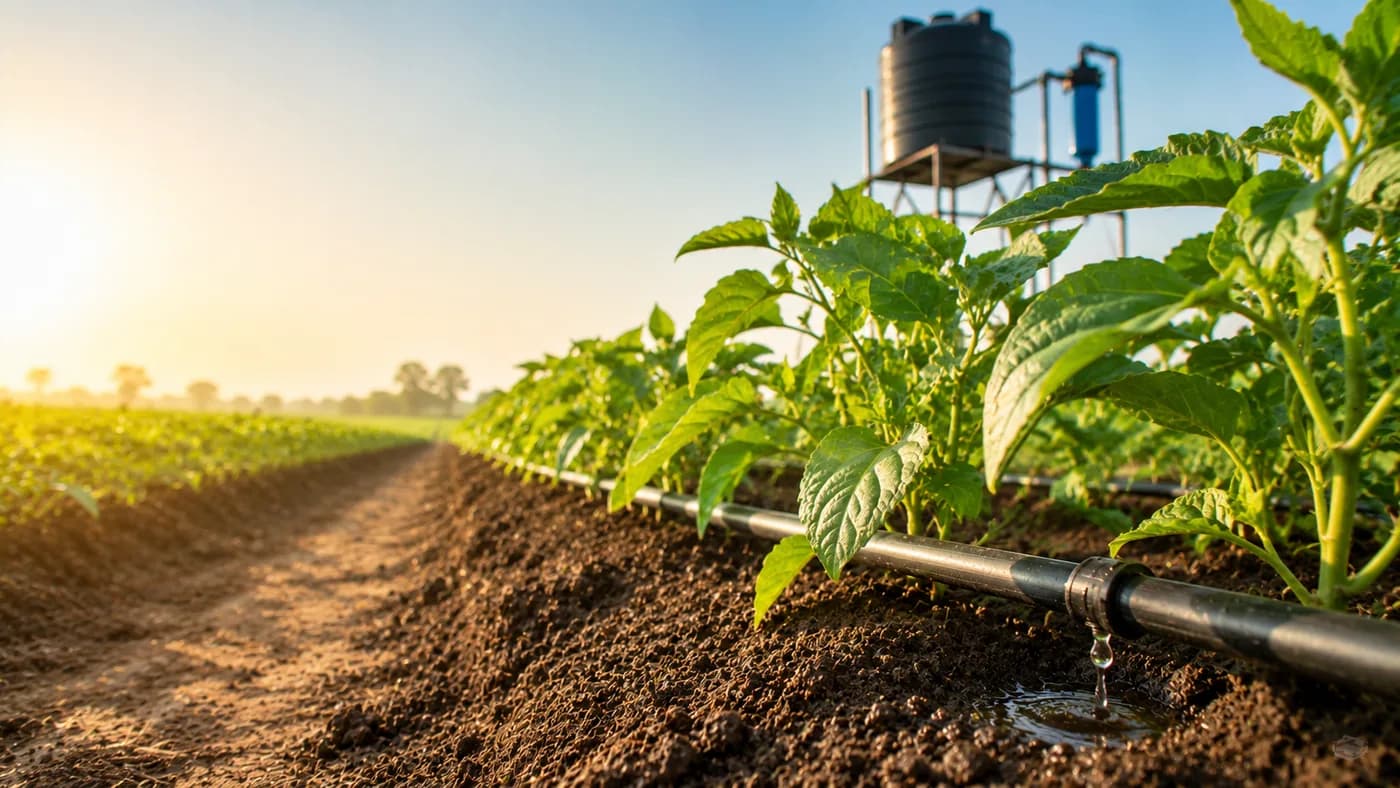
Drip Irrigation: Save Water and Increase Yield
Drip delivers water directly to the roots, drop by drop — saving a large share of your water while lifting yield and cutting weeds.
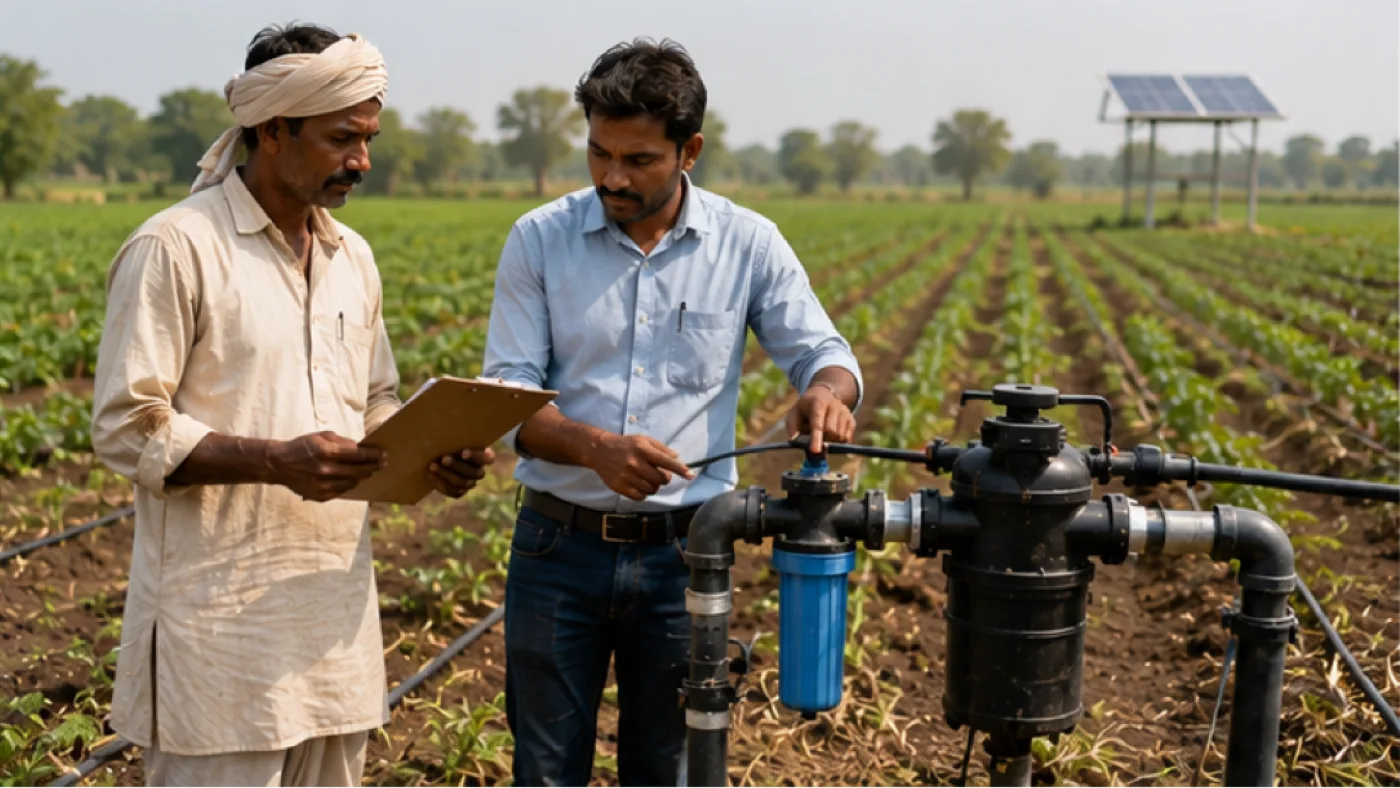
PMKSY Drip Irrigation Subsidy Guide: How the Micro-Irrigation Scheme Actually Works
Drip irrigation pays for itself over time, but the upfront cost of pipes, emitters and a filtration unit stops many smallholders before they start. This guide focuses on the subsidy and application side — the part that decides whether you can actually afford to install it.
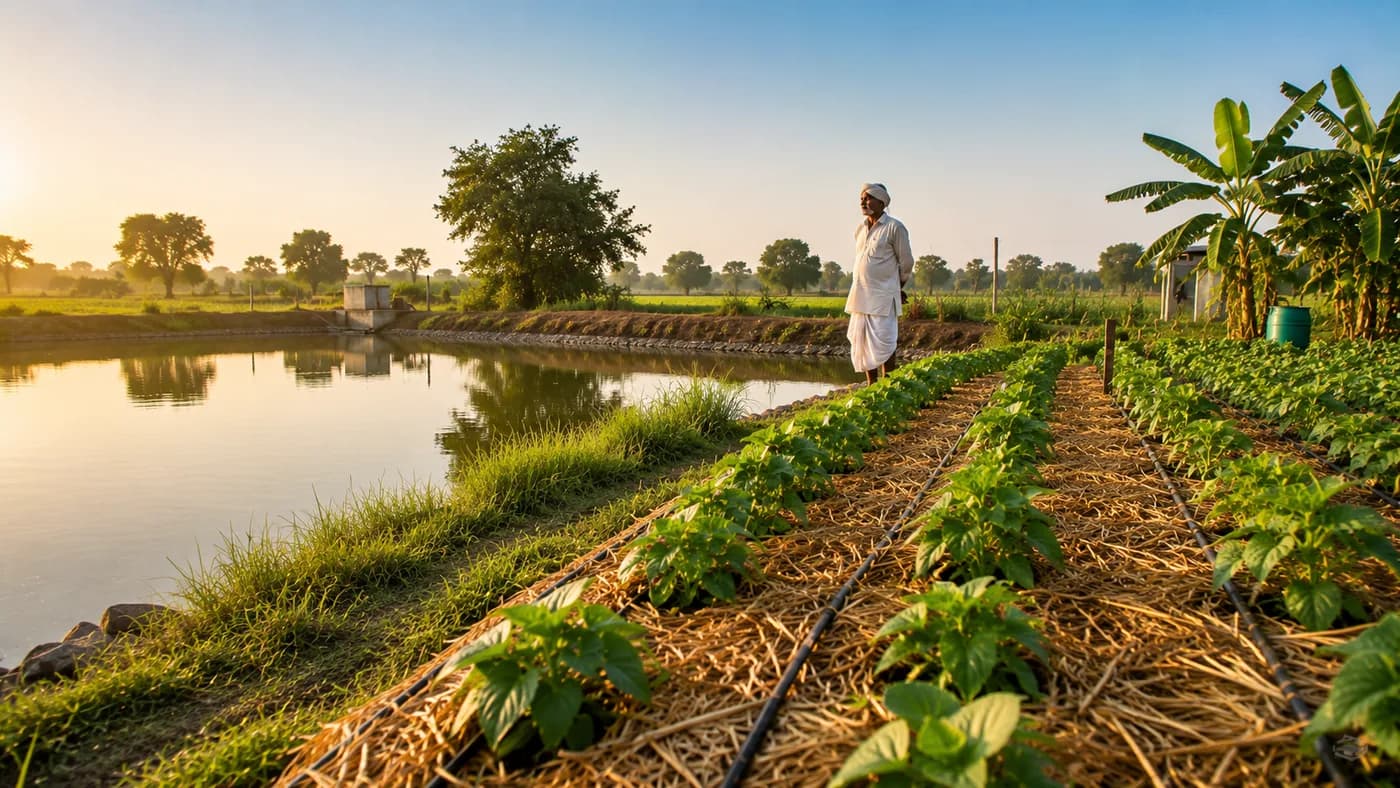
Water Management Tips for Small Farmers
No farmer controls the rain, but every farmer controls how much of the available water actually reaches the crop. Low-cost habits make the difference.