

Coppicing: How to Grow Free Fence Posts and Firewood on Your Own Land
Instead of buying bamboo poles or timber every year, a well-managed coppice stool gives you free, strong building material for generations — without ever killing the tree.
Quick answer
Coppicing turns a small, well-managed patch of trees into a permanent, free source of fence posts, tool handles and firewood — cut in the dormant winter months, protected from grazing animals while shoots are tender, thinned to the strongest stems, and harvested in rotation so a fresh crop is always ready. It costs nothing but patience and a sharp blade, and it gets more productive with every year you manage it.
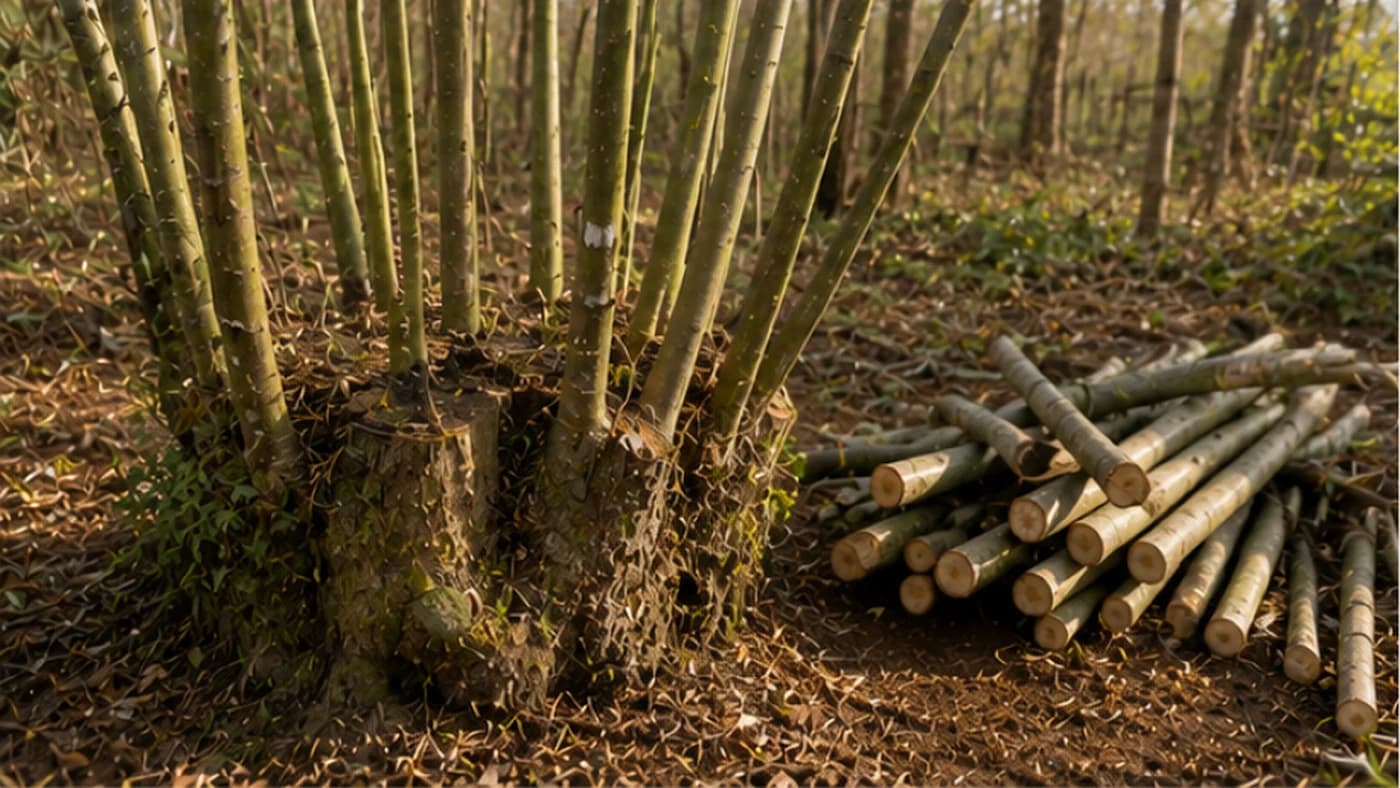
Every season, many farmers spend real money buying bamboo, poplar poles or timber for fencing, farm tools and firewood. There is an older, cheaper way. Coppicing is the ancient practice of cutting a tree down to its base in the dormant season and letting it send up a flush of new, straight shoots from the same root system — shoots you can harvest again and again without ever replanting. It turns a small strip of your land into a living lumber yard that gets more productive the more you use it, and it is exactly the kind of self-reliant, zero-cost system that fits well alongside a kitchen garden or a farm boundary.
What coppicing actually is
Coppicing means cutting a tree down to its base, or 'stool', while it is dormant — for most of India this is the cool, dry post-monsoon to winter window (roughly November to February), when sap has withdrawn into the roots. Instead of dying, the tree uses its large, established root system to push out a flurry of new shoots, often growing several feet in a single season. This works because it mirrors disturbances trees evolved to survive — fire, storm damage, animal browsing — so a farmer is simply directing a natural survival response toward useful wood.
Once you make this first cut, you never fell the whole tree again. You simply harvest the new stems once they reach the thickness you need, on a repeating cycle called a rotation. Species like willow (grown in Kashmir and Himachal for basket and cricket-bat wood) and subabul (Leucaena leucocephala) respond well to short rotations of 3–7 years, giving thin, flexible rods for weaving, stakes and pea sticks. Medium rotations of 7–15 years, used for species like bamboo, shisham (Dalbergia sissoo) or babul (Acacia nilotica), yield sturdy poles for fencing and tool handles. Long rotations of 20–50 years, typical for teak-type hardwoods, produce heavy timber for posts and beams.
Cutting the stool correctly
How you cut matters as much as when. Cut the stems as close to the ground as possible — within 10 to 20 centimetres — which encourages the new shoots to form their own root systems over time and strengthens the stool. Angle the cut slightly so rainwater sheds off rather than pooling in the centre, which would otherwise rot the stool during the monsoon.
In most of rural India, the single biggest risk to a new coppice cut is not disease but free-ranging goats, cattle and even camels. New shoots are tender and irresistible to browsing animals, and one hungry animal can wipe out an entire year's growth in an afternoon. Protect fresh cuts with a simple thorn-branch fence, cut wire, or by piling the leafy brash (the leftover branch tops) directly over the stump as a natural barrier until the shoots harden.
Why it pays off
A managed coppice can produce far more usable wood per hectare than a stand of trees left to grow to full maturity, because you are harvesting renewable underwood, not felling whole trees. Because the canopy stays open, sunlight reaches the ground and biodiversity around the plot increases too.
Coppicing also extends a tree's working life dramatically — an unmanaged willow might live 60–70 years, while a coppiced stool of the same species can be productive for centuries. And because there's no diesel-run machinery, no chemical treatment and no transport cost, the wood you cut is essentially free after the first year or two of establishment, compared to buying bamboo or timber poles from the market every season, where prices only rise.
Common mistakes to avoid
The most common beginner mistake is cutting during the hot, sap-rising months instead of the dormant season — this shocks the stool, weakens regrowth, and can kill it outright. Wood cut when sap is high is also less durable and more prone to rot and insect attack.
Second, don't skip protection from grazing animals — as above, this is the single most common reason a new coppice fails in Indian conditions. Third, don't let every shoot grow unchecked: a stool can send up thirty or more thin shoots in its first year, and if you leave them all to compete for light you get a bundle of spindly, weak sticks. After the second year, thin down to the strongest 8–12 stems so they grow into proper, usable poles.
When coppicing won't work
Not every tree can be coppiced. Most conifers and a number of softwoods simply die if cut to the ground — coppicing works reliably with broadleaf, deciduous-type species. If your land is already committed to a single non-coppicing crop, you'll need to plant a small dedicated stand instead.
It also needs real physical labour — felling, dragging and processing poles by hand is honest, tiring work, so if you have limited physical capacity, plan for a smaller plot or shared labour. And coppice stools need sunlight to regrow vigorously: if your plot has heavy shade from large uncut trees overhead, keep the canopy open (no more than about 40% cover) or the stools will slowly weaken and die.
Tools and the coupe system
You don't need much equipment: a strong sickle or dranti-style curved blade for cutting and stripping thin stems, and a folding saw or bowsaw for thicker ones. Keep the blade sharp — a dull blade needs more force and is more likely to slip and injure you.
Instead of cutting your whole plot in one go, divide it into sections called coupes and harvest just one section each year. With a seven-year rotation, for example, divide your land into seven strips, so you get a fresh crop of poles every single winter while the rest of the plot matures — and you create a natural mosaic of habitats for birds and insects along the way. Before use, let poles season (dry) under a simple roof or tarp for about a year for good airflow; green wood is fine for garden stakes used immediately, but construction or firewood poles need seasoning first for strength and clean burning.
Growing more for free: layering and coppice with standards
Once you're comfortable with basic coppicing, you can propagate new stools without buying a single sapling. Take a long, flexible shoot from a healthy stool, bend it down to the ground, and bury a section of it under a few centimetres of soil. Over the following year it grows its own roots; once established, cut it free from the parent plant and you have a brand-new stool ready to manage.
Serious growers sometimes leave a few select trees to grow to full height among the coppiced ones — a system called 'coppice with standards'. These full-height trees are harvested on a much longer cycle (80–100 years) for heavy beams or high-value timber, while the coppiced trees around them keep providing your yearly fencing and fuel needs — giving you a layered, multi-story woodlot that is productive at every level.
A worked example: fencing a plot for free
Consider fencing a small plot using your own coppiced wood instead of buying material. In winter, cut poles from an older, rot-resistant coppice — species like babul or shisham that naturally resist decay make good posts. Strip the bark, sharpen the ends and drive them into the ground as your main uprights. Then take flexible young rods from a shorter-rotation patch (willow or subabul) and weave them between the posts in a simple lattice pattern. The result is a sturdy, wind-resistant fence that costs nothing but a few days' labour — and by the time it needs replacing, your coppice will have regrown the material for the next one, several times over.
Terms explained in this guide
Frequently asked
When is the right time to coppice a tree in India?+
During the dormant, cool-dry season — roughly November to February for most of the country — when sap has withdrawn into the roots. Cutting in the hot months shocks the tree and produces weaker, less durable regrowth.
Which trees work well for coppicing on an Indian farm?+
Willow (in hill regions), subabul (Leucaena leucocephala), babul (Acacia nilotica), shisham (Dalbergia sissoo) and bamboo all respond well, each suited to a different rotation length and use — from flexible weaving rods to heavy fence posts.
How do I stop goats and cattle from destroying new shoots?+
Fresh cuts are the most vulnerable stage. Fence off the stool with thorn branches or cut wire, or pile the leftover leafy branches directly over the stump as a natural barrier until the new shoots have hardened.
How often can I harvest from the same stool?+
Depending on the species and the thickness of pole you need: every 3–7 years for thin, flexible rods, 7–15 years for sturdy fencing poles, or 20–50 years for heavy timber. The same stool can be harvested this way for decades, even centuries.
Is coppicing realistic on a small farm or kitchen-garden plot?+
Yes — even a narrow strip along a boundary or fence line is enough to start. Divide it into small yearly sections (coupes) so you always have a fresh supply without ever clearing the whole plot at once.
Where to go next
Want this as daily tasks for your farm?
Khetiyaar turns guides like this into a day-by-day plan — in your language, free to start.

Related guides
Stop Tossing Wood Ash: From Chulha Waste to Garden Gold
Every farm and home with a wood-fired chulha or stove produces a mineral-rich waste product for free. Wood ash raises soil pH like garden lime, feeds potassium-hungry crops, deters slugs and mites, and even makes traditional soap — if you know its limits.
Permaculture Swale Design for Beginners: A Step-by-Step Build Guide
You don't need machinery or an engineering degree to build your first swale — just an A-frame level, a shovel, and patience. Here is the beginner's hands-on guide to laying out, digging and planting one correctly.
Gravity-Fed Water Systems: Reliable Water Supply Without a Pump
If your farm or hill homestead has any real slope, gravity can deliver pressurised water to your home, livestock trough, or field — with no electricity bill, no pump to fail, and no water stoppage the moment the power goes out.