

Common Cattle and Buffalo Diseases: Recognising FMD, Mastitis and Bloat Early
Most of what destroys a smallholder dairy announces itself a day early, as an animal that went off her feed. Here is how to recognise FMD, mastitis and bloat, what to do in the first hour, and why your vaccination schedule has to come from your own veterinary department rather than from the internet.
Quick answer
For the diseases that matter most in cattle and buffalo, there is no treatment that undoes the damage — so prevention is not the cautious option, it is the only effective one. Learn to recognise the three you are most likely to meet: FMD by mouth blisters, ropey drooling and lameness in several feet at once; mastitis by a hot swollen quarter and clots in the first streams you draw; bloat by a drum-tight left flank and laboured breathing. Isolate, stop feeding where relevant, and call your veterinarian rather than reaching for a remedy. Keep flooring dry, quarantine every new animal, control flies, and walk your shed daily looking for the animal that has gone off her feed. And get your vaccination schedule from your own veterinary department or dairy society, in writing, because that schedule differs by state and changes over time and is not something any article can tell you.
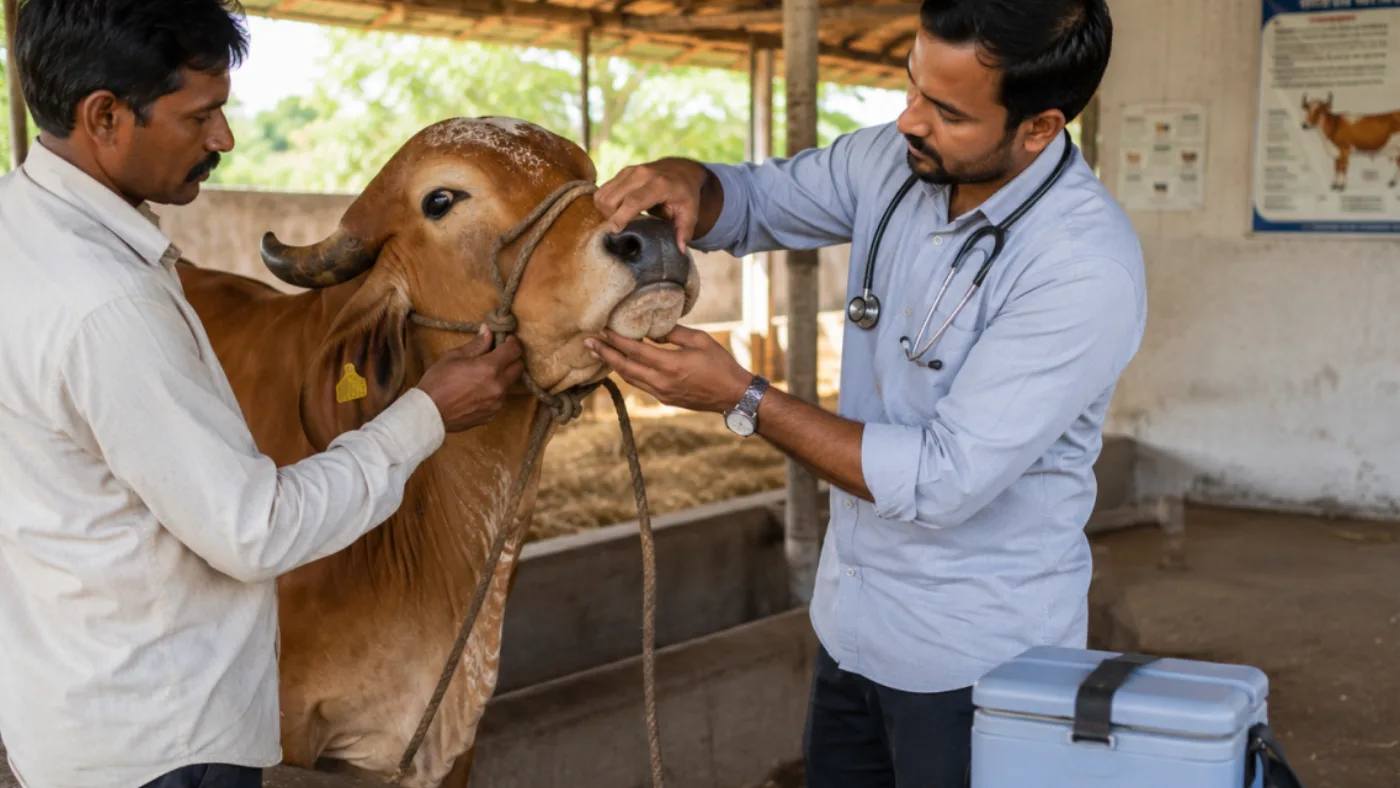
A dairy animal is the largest single asset most smallholder households own, and the diseases that threaten her are not exotic or rare. They are the same handful, every year, in every district. What separates a farm that loses an animal from a farm that does not is almost never access to some better medicine — it is whether somebody noticed on the first day. This guide covers the three problems a dairy farmer is most likely to face in practice, foot-and-mouth disease, mastitis and bloat, at the level that matters most: what you actually see, what you should do in the first hour, and what stops it happening again. It also explains what a vaccination calendar is and why the only trustworthy version of yours is the one your local veterinary department gives you.
Why prevention is almost the whole game
There is an uncomfortable truth at the centre of cattle health: for several of the worst diseases, there is no treatment that gives you your animal back as she was. Foot-and-mouth disease is a viral infection, so once it has taken hold in an animal there is no cure to reach for, and even a recovered animal often never returns to her previous yield. Haemorrhagic septicaemia and black quarter can kill so fast that an animal is found dead before anyone realised she was ill. Against that class of disease, the vaccine given months earlier is the entire defence, and everything a farmer does after the animal is sick is damage control.
The second thing worth understanding early is that a dairy shed is a shared-air, shared-water, shared-attendant environment. Disease in one animal is a threat to every animal, and disease in one village's herd is a threat to the next village's. That is why the interventions that work best are collective ones, and why the habits described in this guide — quarantine, hygiene, not sharing equipment, reporting outbreaks — matter more than any single product you could buy.
Finally, a rule that runs through this whole article: this guide is written to help you recognise a problem and respond correctly in the first hour. It deliberately contains no medicine names, no doses, and no treatment regimens, because prescribing for a living animal you can see is a veterinarian's work and cannot be done from a page. Every section below ends where the veterinarian begins.
Foot-and-mouth disease (FMD): what you see, and why the damage lasts
FMD is a viral disease of cloven-hoofed animals — cattle, buffalo, sheep, goats and pigs — and it is extraordinarily contagious. It moves on the breath of an infected animal, on saliva and discharges, on shared feed and water, and just as readily on your own footwear, hands, clothes, buckets, ropes and vehicle tyres. That last point is the one farmers underestimate: you can walk it home from somebody else's shed.
The picture is fairly distinctive once you know it. The animal runs a fever and goes dull and off her feed. Then blisters, and afterwards raw eroded patches, appear inside the mouth — on the tongue, gums, dental pad and inside the lips — and on the muzzle, and in the soft skin between and just above the hooves. Because her mouth hurts, she drools long ropey strings of saliva, smacks or champs her lips in a way you can hear across the shed, and refuses feed she would normally rush at. Because her feet hurt, she goes lame, shifts her weight from foot to foot, is reluctant to stand or walk, and may lie down far more than usual. In buffalo the mouth lesions are sometimes less dramatic while the foot lameness is very obvious, so do not wait for a textbook mouth picture before you suspect it.
The reason FMD deserves the fear it gets is not the acute illness — most adult animals survive that — but what it leaves behind. Milk yield collapses during the illness and frequently never comes back fully within that lactation. Some recovered animals are permanently poorer producers, become chronically heat-intolerant panters, lose condition and never regain it, or turn out infertile. Young calves can die outright. For a household whose whole income runs through one or two animals, an FMD outbreak is often an economic event they are still recovering from two years later.
If you suspect FMD, act as though you are certain. Isolate the affected animal immediately and stop all movement of animals in or out. Keep separate feed and water for her and, if at all possible, a separate attendant; if the same person must handle both, do the healthy animals first and the sick animal last, and wash hands and change or disinfect footwear in between. Do not share troughs, ropes, brushes or milking utensils between sick and healthy animals. Keep visitors, traders and vehicles away from the shed. Then call your veterinarian or veterinary dispensary at once. FMD is a notifiable disease, meaning an outbreak is a matter for the animal-husbandry authorities and not a private problem to be managed quietly — reporting it is what allows a district to contain it, and concealing it is how a village loses a season's milk.
Mastitis: the most expensive disease in a smallholder dairy
Mastitis is inflammation of the udder, usually where bacteria have got in through the teat canal. It is not dramatic like FMD and it never makes the news, but across a dairy's working life it very probably takes more money out of Indian smallholders than anything else on this page, because it is common, it recurs, and it quietly damages the udder tissue itself.
Clinical mastitis is the form you can see. One quarter of the udder becomes hot, hard, swollen and painful; she flinches, kicks or refuses to let you milk that quarter; and the milk itself is visibly wrong — clots, flakes or stringy material in the first drawn streams, a thin watery look, an off colour, or a blood tinge. Sometimes she also runs a fever and goes off her feed. The single most useful habit for catching this early costs nothing: draw the first few streams from each quarter onto a dark surface or a strip cup before you start milking properly, and actually look at them. Farmers who do this find mastitis days before farmers who do not.
Subclinical mastitis is the form that does the most cumulative damage, precisely because there is nothing to see. The udder looks normal, the milk looks normal, and yet yield from that quarter is quietly down and the milk's composition and keeping quality are degraded. Because cooperative payment is based on measured quality, this shows up as a payment that is disappointing for no reason the farmer can identify — the animal seems fine, the litres seem reasonable, and the money is less than it should be. Simple screening tests for subclinical mastitis exist and are inexpensive; your veterinarian, the dairy cooperative society, or the union's extension staff can tell you what is available locally and how to use it. That is a conversation worth having before you have a problem rather than after.
Prevention is nearly all hygiene and routine, and it is genuinely effective. Keep bedding clean and dry rather than letting animals stand and lie in wet dung-and-urine slurry, since that slurry is where the bacteria live and the teat canal is open for a while after milking. Wash your hands and the udder before milking and, importantly, dry the udder — a wet udder drips contaminated water straight down the teat. Milk with the full hand rather than pinching or stripping the teat between finger and thumb, which injures the teat over time and lets infection in. Milk clean, healthy animals first and any suspect animal last, so the milker does not carry infection down the line. Milk each quarter out completely; residual milk feeds bacteria. Keep her standing and eating for a while after milking rather than letting her lie down immediately on a dirty floor. Wash and dry utensils properly. Trim long hair around the udder, and control flies, which both irritate the udder and move bacteria around — our guides Natural Fly Control for Animal Shelters and Natural Barn Sanitation and Odour Control With Effective Microorganisms both go into the shed-level side of this in more detail.
Two rules about milk from an affected animal. Milk from a mastitic quarter must not be mixed into the can that goes to the collection centre — it degrades the whole delivery and can fail the society's quality check for milk that was otherwise fine. And if the animal is under any veterinary treatment, her milk must be kept out of the collection for exactly as long as your veterinarian tells you, no less. That withholding period depends on what was used and only the veterinarian who treated her can tell you what it is.
Bloat: a drum-tight left flank is an emergency
Bloat is gas accumulating in the rumen faster than the animal can belch it away. A cow or buffalo normally produces an enormous amount of fermentation gas and gets rid of it continuously without anyone noticing; bloat is what happens when that escape route fails. It matters because it can kill quickly — the distended rumen presses forward against the diaphragm and lungs until the animal cannot breathe properly, and a severe case can go from noticeable to fatal in a short time.
What you see: the left flank swells visibly and, if you tap it, feels tight like a drum rather than soft. The animal is restless and uncomfortable, stops chewing her cud, may drool, strains or kicks at her belly, breathes with visible effort and open mouth, and in the worst cases stands with her neck stretched out and head low, staggers, or goes down. Any dairy animal with a visibly swollen left side needs attention immediately, not at the next convenient moment.
There are two broad forms, and the difference explains the prevention advice. Frothy bloat is the common one on Indian farms: the rumen contents whip into a stable foam that the animal physically cannot belch, and the classic trigger is a hungry animal turned suddenly onto lush young legume fodder — berseem or lucerne — or very lush young growth after rain. Free-gas bloat is where ordinary gas cannot escape, because something is obstructing the gullet or the animal is unable to belch for another reason.
Prevention is almost entirely about how you feed, and it is straightforward. Never turn a hungry animal out onto lush legume — feed dry roughage or straw first so there is fibre already in the rumen and she does not gorge. Introduce any new green fodder gradually across several days rather than in one full meal. Avoid feeding large amounts of wet, dew-laden or wilting lush legume. Keep legume fodder mixed with a grass fodder rather than fed pure, which is one of the reasons a mixed fodder plan is better than a single-crop one, as our fodder and silage guide covers in more detail. And never feed mouldy or spoiled fodder or silage.
If bloat is happening: stop all feeding at once, get the animal up onto her feet and walk her slowly, keep her head higher than her body if you can, and get a veterinarian immediately. Be very clear about what not to do. The oils, salts and village remedies that get poured down a bloated animal's throat can go into the lungs of an animal that is already struggling to breathe, and an animal in respiratory distress cannot swallow safely. Puncturing the flank is a veterinary procedure, and in untrained hands with an unsterile implement it can and does kill the animal, either immediately or from infection afterwards. Walking her and calling for help is what a farmer should do; the rest belongs to the veterinarian.
What a vaccination calendar is, and why yours must come from your veterinary department
A vaccination calendar is simply a written plan of which vaccines your animals get and when, arranged so that protection is already in place before the season in which each disease usually strikes. It exists because of the point made at the start of this guide: for diseases like FMD, haemorrhagic septicaemia and black quarter, the vaccine given in advance is effectively the only defence you have.
The diseases a calendar is normally built around are worth knowing by name. FMD is the viral mouth-and-foot disease described above. HS, haemorrhagic septicaemia, is a bacterial disease that classically strikes in the monsoon and can kill an animal within hours, often with high fever, laboured breathing and a swelling in the throat region. BQ, black quarter, is another rapid bacterial killer, typically of well-grown young animals, causing a hot, swollen, crackling swelling in a heavy muscle of the hindquarter along with severe lameness. Beyond those three, your local programme may or may not also cover brucellosis, which causes abortion and long-term infertility and is also transmissible to humans handling infected material, and theileriosis, a tick-borne parasitic disease that hits crossbred animals particularly hard.
Here is what this article will not tell you, deliberately: at what age each vaccine is first given, how often it is repeated, when the booster falls, in which months your district's campaign runs, which vaccine formulations are used, or which of these diseases is included in your area's programme at all. Those details are set by your state animal-husbandry department and by national disease-control programmes, they differ between states and even between districts, and they are revised from time to time as programmes and vaccines change. A schedule that was correct in one state three years ago can be wrong for your village today. Please do not act on any vaccination schedule you find quoted online, including anything in this article.
Get yours from the people who set and run it: your local veterinary dispensary or veterinary hospital, the visiting veterinarian or livestock inspector, your district animal-husbandry office, or your dairy cooperative society, which in most milk-producing areas knows when the local vaccination drive is coming through the village and will tell you. Ask them directly for the current schedule for your district and for your kind of animal, and write it down.
There is also a strong reason to be vaccinated with everybody else rather than on your own. These diseases spread animal-to-animal, so vaccination protects a village far better when the whole village's animals are covered together than when one careful farmer does his alone in the middle of an unvaccinated neighbourhood. Organised drives also mean the vaccine has come through a proper cold chain — most of these vaccines lose their effectiveness if they are allowed to warm up, so a vaccine handled properly by the department is a great deal more reliable than one carried around loose for a day. When the drive comes, tell the vaccinator if any animal is heavily pregnant or currently sick, so they can decide what to do about her. And afterwards, a mild dip in feed intake or milk for a day is ordinary and not a cause for alarm; anything more than that is worth a phone call.
The one part of the calendar that is entirely in your hands is the record. Keep a plain notebook, or a note on your phone, with each animal's identity, what she was given, and the date. Almost every missed booster in village dairying is missed not because the farmer refused it but because nobody could remember whether she had already had it. A notebook removes that problem completely.
The everyday prevention that covers all of them at once
Most of the return on disease prevention comes from a handful of unglamorous habits that work against everything on this page simultaneously. Flooring first: keep the standing and lying area clean, dry and properly drained, and remove dung and urine slurry regularly. Wet, filthy flooring is directly responsible for mastitis and for the foot problems that arrive with the monsoon, and it does not fix itself.
Then space and air. Do not overcrowd — animals packed together share disease faster, cannot get away from each other's body heat, and are forced to lie in each other's mess. Provide clean water at all times, from a trough that is scrubbed often enough that you would drink from it yourself. Control flies and ticks, which are not merely a nuisance but active carriers of disease and a genuine drag on feed intake and milk. Never share needles between animals, and clean shared equipment between animals.
Quarantine the new animal. This is the single most skipped precaution in Indian village dairying, and one of the most valuable. An animal bought at a fair or from a trader should be kept separate from your existing animals for a period your veterinarian advises, watched daily, and only then mixed in. Every farmer who has brought disease home in a newly purchased animal knew about quarantine and skipped it because the shed was small and the animal looked healthy. A healthy-looking animal in the incubation period of a disease looks exactly like a healthy animal.
Finally, the habit that underpins all of the above: walk your shed once a day with the specific intention of looking at each animal, not just feeding them. Check what each one is eating, what her dung looks like, whether she is chewing her cud, and how she moves and stands. Almost every disease in this article announces itself a day early as an animal that went off her feed or a milk yield that dropped for no reason. Treat a sudden unexplained drop in one animal's milk as a diagnostic signal rather than as bad luck, because that is very often the earliest information you will get.
Warning signs worth acting on the same day
- An animal that suddenly goes off her feed or stops chewing her cud, with no obvious explanation, is the earliest and most reliable warning sign of nearly every disease in this guide.
- A sudden unexplained drop in one animal's milk yield is diagnostic information, not bad luck, and is worth investigating the same day.
- Blisters or raw patches in the mouth, ropey drooling saliva, audible lip-smacking, or lameness in more than one foot at once should make you suspect FMD, isolate the animal and call the veterinarian immediately.
- A hot, hard, swollen or painful quarter of the udder, or clots, flakes, watery milk or a blood tinge in the first streams drawn, means mastitis until a veterinarian says otherwise.
- A visibly swollen left flank that feels drum-tight, together with restlessness and laboured breathing, is bloat and is an emergency — stop feeding, walk her, and get help now.
- High fever with laboured breathing and swelling around the throat, especially in the monsoon, is the classic picture of haemorrhagic septicaemia and can kill within hours.
- Severe sudden lameness with a hot, swollen, crackling swelling in a hind-limb muscle of a well-grown young animal suggests black quarter and needs a veterinarian at once.
- Lameness with a swollen foot and a foul smell, in wet muddy conditions, points to foot rot and to flooring and drainage that need fixing as well as an animal that needs treating.
- Any abortion, retained placenta or repeated failure to conceive should be reported to your veterinarian rather than treated as ordinary bad luck, since some causes are both herd-level and transmissible to people.
- An animal that is straining, staggering, standing with her neck stretched out, or unable to rise needs a veterinarian immediately, whatever else you think may be going on.
Records, and the animal you have not bought yet
Two habits make every other piece of advice in this guide work better, and both cost nothing. The first is the record already mentioned: for each animal, her identity, her calvings, her vaccinations and their dates, any illness and what the veterinarian said, and any period during which her milk had to be kept out of the collection. A single notebook kept in the shed is enough. Its value shows up at exactly the moments when memory fails — when the vaccinator asks whether she has had her booster, when the veterinarian asks how long she has been off her feed, or when the same quarter of the same udder becomes inflamed for the third time and you realise it is a pattern rather than an accident.
The second is to be careful at the point of purchase, because that is the moment when most disease enters a smallholding. Buy where you can see the animal's history rather than only her udder. Ask what she has been vaccinated against and when, and be sceptical of confident answers with no record behind them. Look at her feet and her gait, look at the udder for old damage and hard quarters rather than just size, and watch her eat before you agree a price. Then quarantine her at home for as long as your veterinarian advises, however inconvenient that is. An animal is cheap to reject and expensive to un-buy.
Working with your veterinarian, and what not to do yourself
The most useful relationship in dairy farming is an ordinary working relationship with a veterinarian who has seen your animals before. Know where your nearest veterinary dispensary is and what its hours are, have the number of the veterinarian or livestock inspector who covers your village saved in your phone before you need it, and find out how emergency calls are handled at night in your area. The difference between a bloat case that survives and one that does not is very often just how quickly somebody could be reached.
When you call, the information you can give is worth as much as the speed. Be ready to say when she last ate normally, what she has been fed and whether anything changed recently, when the milk dropped and by how much, what her dung looks like, whether she is chewing her cud, whether she is pregnant and roughly how far along, and what you have already done. That is far more useful than a guess at a diagnosis.
And be equally clear about the boundary. Do not buy and administer medicines on the advice of a shop, a neighbour or an internet post, and do not repeat a prescription that worked on another animal last year. Antibiotics given without diagnosis or given for too short a period leave residues in milk, waste money, and contribute to resistance that eventually makes real treatment fail. Injections given by untrained hands cause abscesses and nerve damage. Any product sold as a milk-increasing injection or tonic should go through a veterinarian and nowhere else. This guide has deliberately named no medicine and no dose for exactly this reason: recognising the problem early and getting the right person to the animal quickly is the part that is genuinely yours to do, and it is also the part that saves the animal.
Frequently asked
What are the first signs of foot-and-mouth disease in cattle and buffalo?+
Fever and a sudden loss of appetite, followed by blisters and then raw eroded patches inside the mouth and on the muzzle, and in the skin between and above the hooves. The animal drools long ropey saliva, smacks her lips audibly, and goes lame or shifts her weight from foot to foot. Milk drops sharply. Isolate her immediately, stop all animal movement, and call your veterinarian — FMD is notifiable and highly contagious, and it can spread on your own footwear and hands.
When should cattle and buffalo be vaccinated for FMD and HS?+
This guide deliberately does not give a schedule, because vaccination timing, frequency, the vaccines used and which diseases are covered are set by your state animal-husbandry department and national control programmes, differ between states and districts, and are revised from time to time. Get the current schedule for your district from your local veterinary dispensary, the visiting veterinarian, your district animal-husbandry office or your dairy cooperative society, and do not rely on any schedule quoted online, including in this article.
How can I tell if my cow has mastitis?+
In clinical mastitis one quarter of the udder becomes hot, hard, swollen and painful, she resists being milked on that side, and the milk shows clots, flakes, a thin watery look, an off colour or a blood tinge. Draw the first few streams from each quarter onto a dark surface before milking and look at them — that habit catches it days earlier. Subclinical mastitis shows nothing at all but quietly cuts yield and milk quality, so ask your veterinarian or dairy society about the simple screening tests available locally.
What should I do immediately if my animal has bloat?+
Stop all feeding, get her up onto her feet and walk her slowly, keep her head higher than her body if you can, and call a veterinarian straight away, because severe bloat can kill in a short time. Do not pour oils, salts or home remedies down the throat of an animal that is struggling to breathe, since they can go into the lungs, and do not attempt to puncture the flank — that is a veterinary procedure and in untrained hands it kills animals.
Why do cattle diseases increase during the monsoon?+
Wet, muddy flooring softens the hoof and lets infection in, which is how foot rot starts, and it keeps the udder in contact with dung and mud, which drives mastitis. Standing water and wet dung heaps breed flies, mosquitoes and ticks that carry disease and depress feed intake. Humidity also spoils stored fodder and silage, and mouldy feed is a genuine health risk. Haemorrhagic septicaemia in particular is classically a monsoon disease. Drainage, dry standing space, covered fodder storage and fly control are the practical answers.
Where to go next
- Kheti app for Indian farmersCrop plans, disease diagnosis, weather and mandi rates in one app.
- AI farming chatbotAsk any farming question in Gujarati, Hindi or English and get an answer in seconds.
- Agri Bazar marketplaceBuy and sell animals, crops, equipment and dairy near you — and see what buyers want today.
Want this as daily tasks for your farm?
Khetiyaar turns guides like this into a day-by-day plan — in your language, free to start.

Related guides
Deep Litter Method: Turn Your Chicken Coop Into a Living Compost System
A scrubbed, bare coop floor is a wasted opportunity. Let a thick carbon bed and billions of microbes do the composting for you — less labour, healthier birds, and free fertiliser for the field.
How to Attract Dung Beetles to Your Pasture (and Why Your Dewormer Might Be Killing Them)
Most farmers see a manure pat as a chore. The smart ones see a biological engine — dung beetles that bury parasites, aerate the soil, and cut fly populations, for free, if you stop poisoning them with routine deworming.
How to Attract Barn Owls to Your Farm for Free Rodent Control
One pair of barn owls can hunt over a thousand rodents in a single season — but only if you give them a properly designed, dark, predator-proof box. Barn owls (Tyto alba) already live across most of India; here's how to bring them onto your farm.