

Calf Rearing and Cattle Breeding Basics: From the First Hour to the Next Calving
The first few hours after a calf is born, and the heat that has to be caught while the dam is still in milk, decide more about a dairy animal's lifetime value than anything you feed her later. Here is how to raise a calf properly, why artificial insemination replaced the village bull, and how the calving interval quietly decides whether an animal pays.
Quick answer
Two short windows decide most of a dairy animal's lifetime value, and both are easy to miss. The first is the few hours after birth, when colostrum can still put the dam's antibodies into the calf's bloodstream — feed it at once, feed the first milking, and never throw it away. The second is the heat that has to be caught while she is still in milk, so the next calving arrives about a year after the last. In between: build the rumen with clean starter feed, green fodder and water always within reach; step the milk down gradually instead of cutting it off; grow the heifer well enough that she breeds on body development rather than on age; use artificial insemination for the genetics, the safety and the disease control it gives you; and write every calving, heat and insemination in a notebook, because the record is what makes you notice the month that would otherwise be lost.
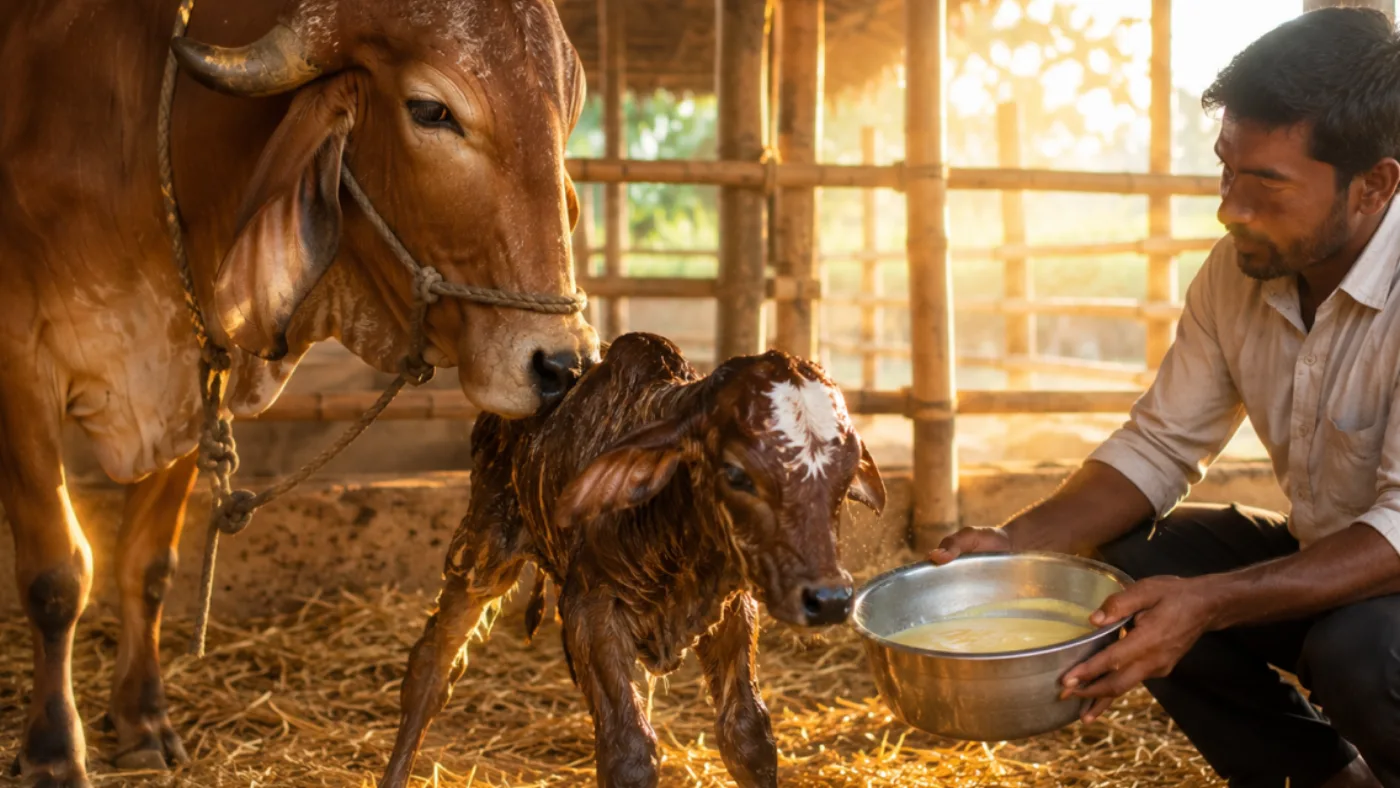
Almost everything a dairy animal will ever be worth is decided in two places most farmers are not watching closely: the first few hours after she is born, and the few months after each calving when she has to be got in calf again. A calf that misses colostrum starts life with no immune protection at all. A heifer that grows badly calves late and milks poorly for the rest of her life. An animal whose heat goes unnoticed adds months to her calving interval — months of feed with no milk against them. This guide covers calf rearing from the first hour through weaning, growing a heifer to breeding condition, why artificial insemination replaced the village bull, and how the nine-month gestation of cattle and buffalo shapes a breeding calendar you can keep in a notebook.
The first few hours: colostrum is the calf's whole immunity
A calf is born almost completely defenceless. Unlike a human baby, it receives no antibodies from its mother across the placenta during pregnancy, so it arrives with essentially no protection in its bloodstream against the bacteria already living in the shed it has just been born into. Everything that will keep it alive through its first weeks has to come in through its mouth, in the first milk. That first milk is colostrum: thick, sticky and deep yellow, nothing like the milk of a day or two later, and loaded with the dam's own antibodies built up over her lifetime of exposure to exactly the germs on your farm.
The urgency is anatomical, not traditional. For a short period after birth, the lining of the calf's small intestine can take whole, intact antibody molecules straight through into the bloodstream — large proteins that a normal gut would simply break into fragments. That ability starts shutting down almost at once and closes progressively over the first day, so every hour of delay means a smaller share of the antibodies actually reaching the blood. Once the gut has closed, colostrum fed later still does some good inside the intestine, but it can no longer put protection into the calf's circulation. This is why 'we will feed it in the morning' is one of the most expensive sentences on a dairy farm.
In practice: as soon as the calf can hold its head up and stand, let it suckle the dam. Most calves find the teat on their own within a couple of hours, but a weak or clumsy calf may need to be guided to it, and a first-calf heifer with a tender swollen udder may need to be held quietly while the calf latches on. If the calf cannot suckle at all, or the dam has rejected it, is ill, has died, or has an udder the calf cannot reach, milk her out and hand-feed the colostrum from a clean, scalded bottle or jug. Colostrum from the very first milking is the richest and thickest; it thins with each milking after that, so the first milking is what the newborn should get.
It is worth keeping an insurance supply. Surplus colostrum from another healthy animal in the herd that has just calved can be held in a clean covered container in the refrigerator for a short while, or frozen in small single-feed portions and thawed gently in warm — never boiling — water, because heat destroys the very antibodies you are trying to feed. Mark each portion with its date. And avoid the commonest and costliest mistake in the calf shed: throwing colostrum away because the dairy will not take it as sellable milk. It is not spoiled milk. It is the cheapest effective medicine you will ever have on the farm, and it is only on offer for a few hours.
The newborn: the jobs of the first day
If the calf is slow to breathe, clear the mucus from its nostrils and mouth with clean fingers or a clean cloth and rub the chest and back briskly; brisk rubbing, and a little cold water flicked on the head, will often start a calf breathing. Then let the dam lick the calf. This is not sentiment — her licking dries the coat, stimulates circulation and breathing, gets the calf moving, and builds the bond that makes her stand quietly and let it suckle. A calf wiped down and moved away from its dam in the first minutes often has more trouble getting its first feed than one that was licked.
The navel cord is an open route into the body until it dries and seals, and navel infection in a newborn is both common and serious. Disinfect the cord with the antiseptic your veterinarian recommends and keep the calf off wet, dung-soaked ground. Clean dry bedding — straw, dry fodder waste, anything absorbent — in a corner sheltered from wind and rain does more for calf survival than almost any input you can buy. Get the calf up and standing rather than leaving it lying in a damp patch.
One thing needs saying plainly. A calving that is not progressing — a long stretch of straining with nothing appearing, only a head showing, only one leg showing, the calf coming backwards, or an animal that has given up straining — is a veterinarian's job, not something to persist with by pulling harder or calling more neighbours. Sending for help early costs a phone call to the veterinary dispensary; sending late can cost both the calf and the dam. Vaccination timing and the common diseases of cattle and buffalo are a subject of their own and we cover them separately; this guide stays with rearing and breeding.
Building the rumen: milk, starter feed and water
A newborn calf is not a working ruminant. The rumen — the big first stomach that lets an adult animal live on fodder — is small, smooth-walled and barely functional at birth, and milk does not even pass through it: a groove closes off and sends suckled milk straight past the rumen into the true stomach. That is fine for the first weeks, but the animal you actually want is one that can turn cheap green and dry fodder into milk, and the rumen does not develop on a timetable. It develops in response to solid feed being fermented inside it.
That is why solid feed matters long before the calf looks as though it needs any. Offer a small handful of clean, dry, palatable calf starter or cattle feed and a little soft green fodder from a young age, keep it fresh, and throw out whatever is left uneaten rather than letting it sour in the trough — a calf that has once tasted stale feed is slow to come back to it. Quantity follows appetite: as intake rises, offer more. Fermenting that solid feed is what thickens the rumen wall and grows the papillae that absorb nutrients, and a calf whose rumen has been built this way keeps growing instead of stalling the moment milk is reduced.
Clean drinking water must be within reach at all times, from the first weeks. Calves are routinely denied water on the reasoning that they are already getting milk, and it is one of the most damaging small mistakes in Indian calf rearing. Milk bypasses the rumen; the fermentation that builds the rumen happens in water, and a calf without free water eats far less dry starter feed. Denying water saves nothing at all — it slows rumen development and stunts growth.
Weaning: a step-down, not a switch
Weaning is not a day on which milk stops. It is a gradual step-down: as the calf's solid feed intake rises, milk is reduced in stages, so that by the time milk feeding ends the rumen is already doing the work of feeding the animal. Done that way, the calf barely notices. Done abruptly — milk withdrawn from a calf still eating very little solid feed — the calf loses condition, scours, stops growing for a period, and becomes far more vulnerable to whatever is going around the shed, and that growth check is never fully made up later.
So judge weaning by the calf, not by the calendar. The questions are how much dry feed it is actually eating each day, whether it eats that feed eagerly or picks at it, and whether it holds its condition, coat and liveliness as the milk comes down. Because breeds, feeds and management differ so widely, this guide deliberately gives no fixed weaning day and no milk quantity — get those from your local veterinarian, the veterinary dispensary or your animal-husbandry adviser, who can actually see the animal. If the calf starts losing condition as milk is reduced, slow the step-down instead of pushing through it.
Calf-shed jobs that belong with the veterinary service
- Disbudding — stopping the horn buds growing while the calf is still very young — is a quick job in trained hands and a cruel, infection-prone injury when attempted at home with a heated rod or with caustic paste bought loose; ask the veterinary dispensary, and ask early, because dehorning a grown animal later is a surgical job with real bleeding and infection risk.
- Ear tagging and identification should be done through the animal-husbandry service, because the tag number is what ties an animal to its breeding, treatment and insurance records — an unidentified animal has no history, and a herd of unidentified animals cannot be managed by records at all.
- Deworming genuinely matters in young stock, whose growth is quietly eaten by internal parasites, but the choice of product and how often it is repeated is a veterinary decision for your area and season — ask at the dispensary rather than buying and dosing on your own.
- Any swelling at the navel, a calf that is dull and off suck, persistent scouring, or laboured breathing means a call to the veterinarian the same day, because young stock go downhill fast.
- Housing the calf in a clean, dry, well-ventilated pen of its own rather than a corner of the adult shed keeps it out of dung and out of the way of larger animals, and lets you see exactly how much it is eating and drinking.
Rearing the heifer: the long wait before she earns anything
A heifer is the one animal on the farm that eats every single day for a long stretch of her life while earning nothing at all. She is pure cost from birth until her first calving, and her whole economics comes down to how long that stretch lasts. Every extra month before she calves for the first time is another month of fodder, water, labour and shed space with no milk against it — and on a holding with a handful of animals that is real money going out.
The way to shorten it is not to breed her early regardless of her state, but to grow her well so she reaches breeding condition on time. Whether a heifer is ready is judged by body development — her frame, her height, her fill and general condition — rather than by age alone. Two heifers born in the same week can be quite different animals by the time they are yearlings, and the well-grown one comes into clear regular heat, conceives without repeated attempts, and calves without trouble. Because the right target differs by breed and by whether you keep cows or buffaloes, ask your veterinarian or your nearest KVK what body development to aim for in your animals rather than working to a number out of an article.
The cost of getting this wrong is permanent, which is what makes it worth the attention. A heifer whose growth was checked — by poor feeding, by a heavy worm burden, by an illness left untreated — calves late, is more likely to have a difficult first calving because her frame stayed small, gives less in that first lactation, and in many cases never milks as well as she would have in any lactation after it either. Feed saved on a growing heifer is the most expensive saving on a dairy farm.
Artificial insemination: why it replaced keeping a bull
Artificial insemination is now the normal way most Indian dairy farmers get their animals in calf, and the reasons are worth understanding rather than just accepting. The first is genetics. Semen is collected from a small number of bulls whose performance is recorded — bulls chosen because their daughters actually milk well — and distributed as frozen doses. That gives a farmer with two or three animals access to breeding quality he could never buy, keep or feed himself, and it works within one generation: the heifer calf born of a well-chosen mating is a better animal than her dam for her whole life.
The second reason is that a bull is an expensive and dangerous animal to keep. He eats every day of the year for a handful of services, needs strong housing and separate handling, and mature bulls injure people — not a rare event on Indian farms. Very few smallholdings can justify one, which is why villages historically shared a single bull, with all the consequences that follow from that.
The third reason is disease control, and it is the one farmers underestimate. Natural service passes reproductive and venereal infections directly from animal to animal, and a shared village bull can move an infection through a whole village herd in one season, leaving a string of animals that repeat-breed, abort, or simply never conceive again. Insemination done hygienically by a trained technician with clean equipment breaks that chain of transmission. That cuts both ways, which is exactly why the technician's hygiene matters and why a hurried job with dirty equipment is not worth accepting.
Catching heat: the part where farmers actually lose money
You can have the best semen in the state and it is worth nothing if the animal is not inseminated at the right moment relative to her heat. This is where most reproductive loss on Indian farms happens, and it is not an equipment problem — it is an observation problem. An animal whose heat passes unnoticed is an animal that will not be in calf this month, and every missed heat pushes her next calving further away while she goes on eating.
The signs of heat in a cow are worth knowing by heart: restlessness and a general change in behaviour; frequent bellowing, often at night; a fall in feed intake and a noticeable dip in yield at that milking; standing still to be mounted by other animals, and mounting or riding others herself; a clear, stringy mucus discharge hanging from the vulva; a swollen, slightly reddened vulva; frequent small urinations; and repeated sniffing and licking of other animals. Not every animal shows all of them, and a quiet animal in a tied shed may show very few — which is why the time to look is when the shed is calm, early morning, late evening and at night, and not only during milking.
Buffaloes are the harder problem, and every buffalo owner knows it. Buffaloes show heat far less obviously than cows, and silent heat — an animal genuinely in heat with almost no outward sign — is a well-recognised problem in buffalo, worse in the hot months. There may be nothing more than slight restlessness, a little mucus, or a small unexplained drop in milk. So buffalo owners have to rely on very close daily observation of each animal, watching for a change from that animal's own normal rather than for a textbook display, and on the judgement of the technician and the veterinary dispensary, who see hundreds of animals.
Timing relative to the observed heat is what decides whether she conceives, and it is not something to work out from a formula in an article. Tell the AI technician exactly when you first noticed the signs and what you saw, and let him decide when to inseminate your animal; the answer is not the same for a cow and a buffalo, and he knows what works in your area. Then write the date down.
Finally, know when to stop repeating. An animal inseminated over several heats that is still not in calf, one that has not been seen in heat for a long stretch after calving, or one that keeps coming into heat again at short irregular intervals, has a reason — an infection of the reproductive tract, a mineral or energy deficiency, a hormonal problem, sometimes a physical defect. Repeating inseminations blindly wastes doses and months. That animal needs a veterinary examination.
Nine months, one year: gestation, calving interval and a calendar you keep
Gestation in cattle and buffalo runs roughly nine months. That single biological fact is what the whole breeding calendar is built on, and it has a consequence that is easy to state and easy to ignore: if the next calving is to arrive about a year after the last one, she has to be got in calf again while she is still in milk. Waiting until she is dry and quiet before thinking about breeding her guarantees a long gap. She should be watched for heat, and considered for insemination, during her lactation — not after it.
The calving interval is simply the gap between one calving and the next, and it is the single number that quietly decides whether a dairy animal pays for herself. She eats every day whether she is milking or not. A short, regular interval means she spends most of her life in milk, gives more lactations over a lifetime, and produces more calves. A stretched interval — caused almost always by heats missed, insemination delayed, or a conception problem left uninvestigated — means months of feeding a dry animal with nothing coming in at the other end. Nobody notices that loss on any single day, which is exactly why it goes on for years.
None of this means milking her to the last moment. The dry period before calving is deliberate and necessary: she needs it to rebuild body condition after a lactation, to let the udder tissue renew before the next one, and to grow the calf, which puts on most of its birth weight in the last stretch of pregnancy. An animal milked right up to calving calves weak, gives less in the next lactation, and takes longer to conceive again. How long that dry rest should be for your animals is worth confirming with the veterinary dispensary or your dairy society; the point here is that it should be a planned dry period, not a long unplanned one caused by a heat nobody saw.
All of this rests on writing things down, and that is genuinely the cheapest improvement available to a small dairy farmer. For each animal, record the date she calved, every heat you observe with its date, every insemination with its date and whatever bull or dose detail the technician gives you, the expected calving date he works out, and the date she was dried off. A notebook hanging in the shed or a note on the phone is enough — there is nothing to buy. The value is not the record itself but what it makes you notice: that an animal who calved months ago has not been seen in heat, that another has been inseminated three times, that a third is due to be dried off next month. The farmer who keeps the notebook is the farmer who catches the missed heat.
Terms explained in this guide
Frequently asked
How soon after birth should a calf get colostrum?+
As soon as possible after birth, within the first few hours, and without waiting for a convenient time. The calf's gut can absorb whole antibody molecules into the bloodstream only for a short period, and that ability closes progressively over the first day — colostrum fed later still helps inside the intestine but can no longer put protection into the blood.
Can I feed a calf colostrum from another animal?+
Yes, and it is a sensible insurance stock. Surplus colostrum from another healthy animal in the herd that has just calved can be kept covered in the refrigerator for a short while or frozen in small single-feed portions, dated, and thawed gently in warm water. Never boil or heat it hard, because heat destroys the antibodies. The first milking's colostrum is the richest and is what a newborn should get.
Why is artificial insemination preferred over natural service?+
Three reasons. It gives a small farmer access to semen from bulls whose daughters have recorded milk performance, which he could never obtain by keeping his own bull. It removes the cost, feeding and real physical danger of maintaining a bull for a handful of services. And it breaks the transmission of venereal and other reproductive diseases that natural service — especially a shared village bull — spreads through a whole herd.
Why do buffaloes seem never to come into heat?+
They do come into heat, but they show it far less obviously than cows. Silent heat, where the animal is genuinely in heat with almost no visible sign, is a well-known problem in buffalo and is worse in the hot months. Signs may amount to slight restlessness, a little clear mucus, or an unexplained dip in milk. Buffalo owners have to watch each animal closely at quiet times — early morning and night — and take the AI technician's advice on timing.
What is the calving interval and why does it matter so much?+
It is the gap between one calving and the next. Because gestation runs roughly nine months, an animal has to be got in calf again while she is still in milk if the next calving is to come about a year after the last. Every month the interval stretches is a month of feeding an animal with no milk coming in, and fewer lactations and fewer calves over her lifetime — which is why it is the number that decides whether she pays.
Where to go next
- AI farming chatbotAsk any farming question in Gujarati, Hindi or English and get an answer in seconds.
- Kheti app for Indian farmersCrop plans, disease diagnosis, weather and mandi rates in one app.
- Agri Bazar marketplaceBuy and sell animals, crops, equipment and dairy near you — and see what buyers want today.
Want this as daily tasks for your farm?
Khetiyaar turns guides like this into a day-by-day plan — in your language, free to start.

Related guides
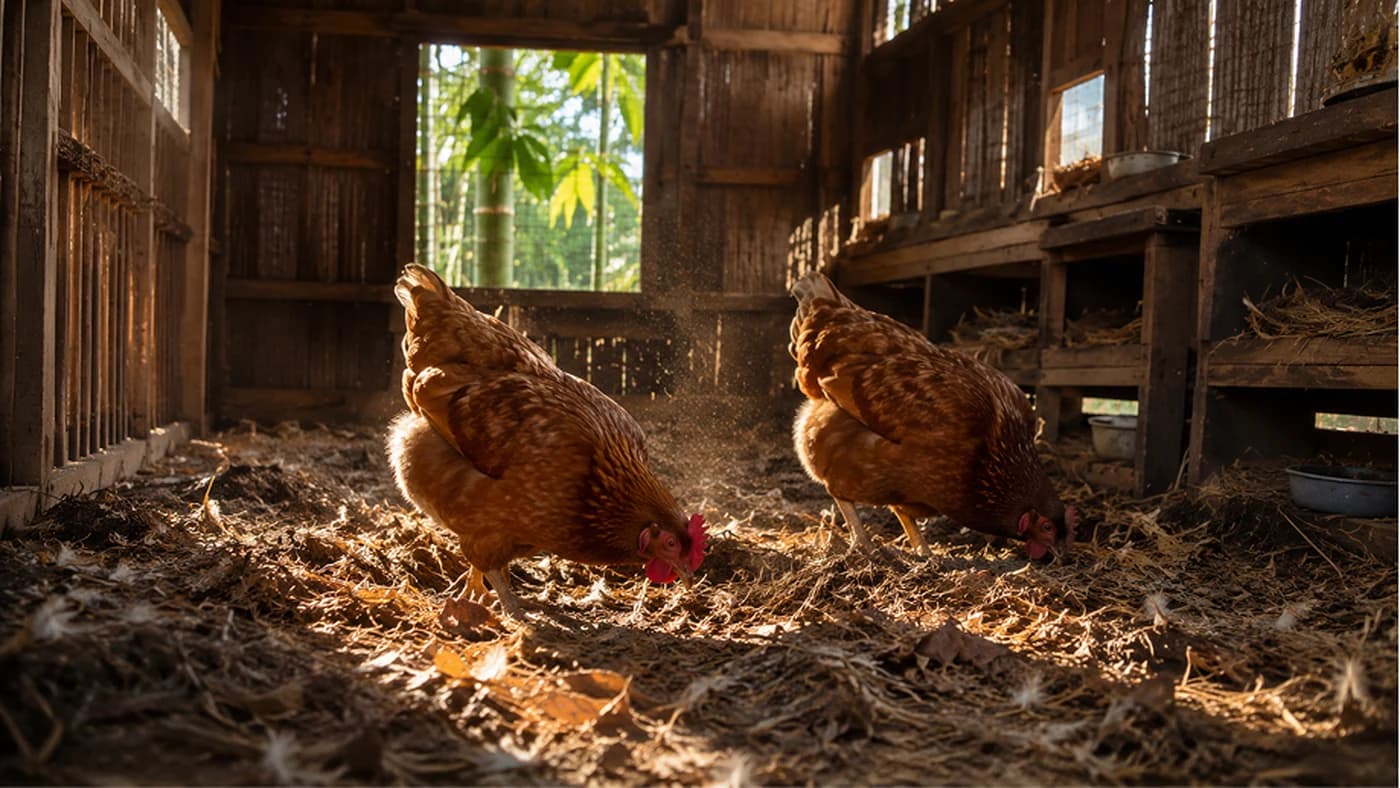
Deep Litter Method: Turn Your Chicken Coop Into a Living Compost System
A scrubbed, bare coop floor is a wasted opportunity. Let a thick carbon bed and billions of microbes do the composting for you — less labour, healthier birds, and free fertiliser for the field.
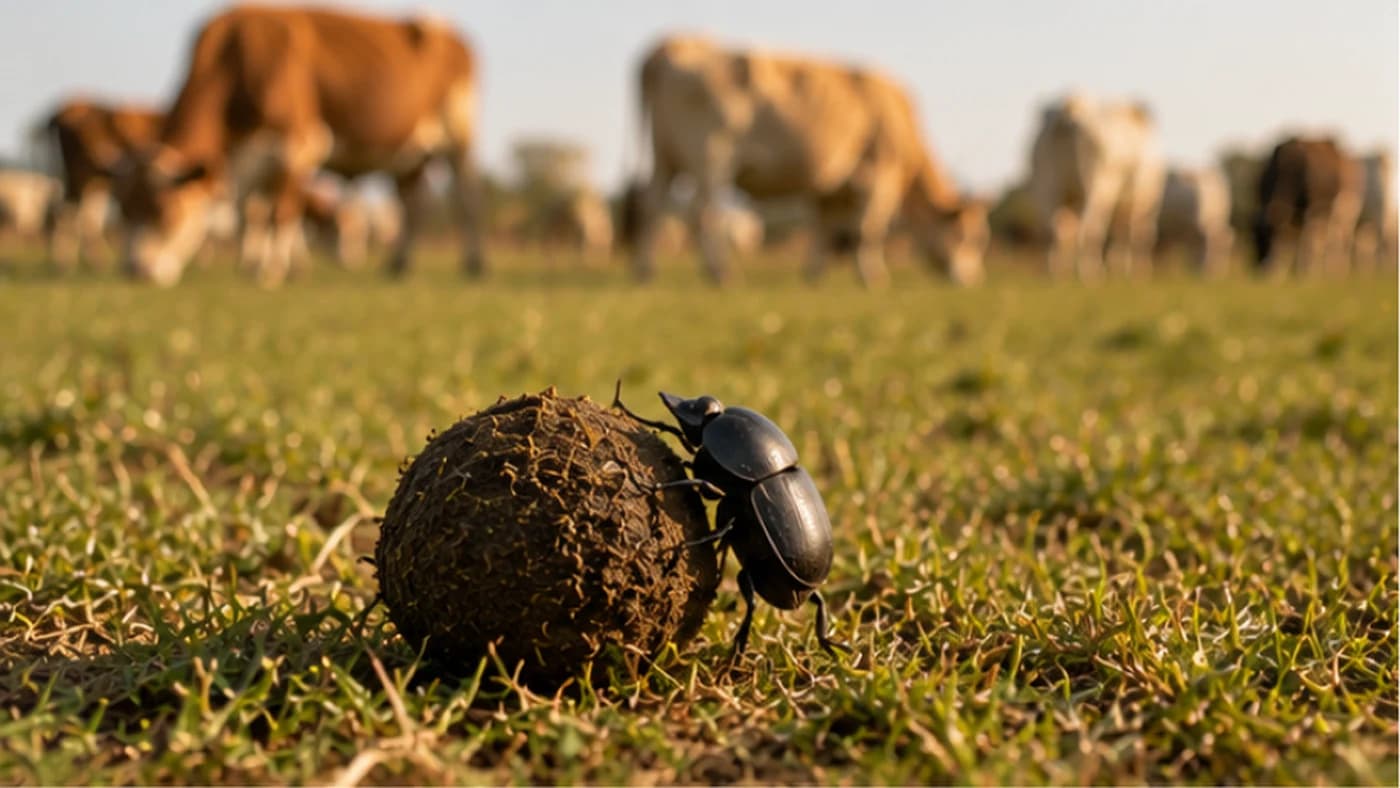
How to Attract Dung Beetles to Your Pasture (and Why Your Dewormer Might Be Killing Them)
Most farmers see a manure pat as a chore. The smart ones see a biological engine — dung beetles that bury parasites, aerate the soil, and cut fly populations, for free, if you stop poisoning them with routine deworming.
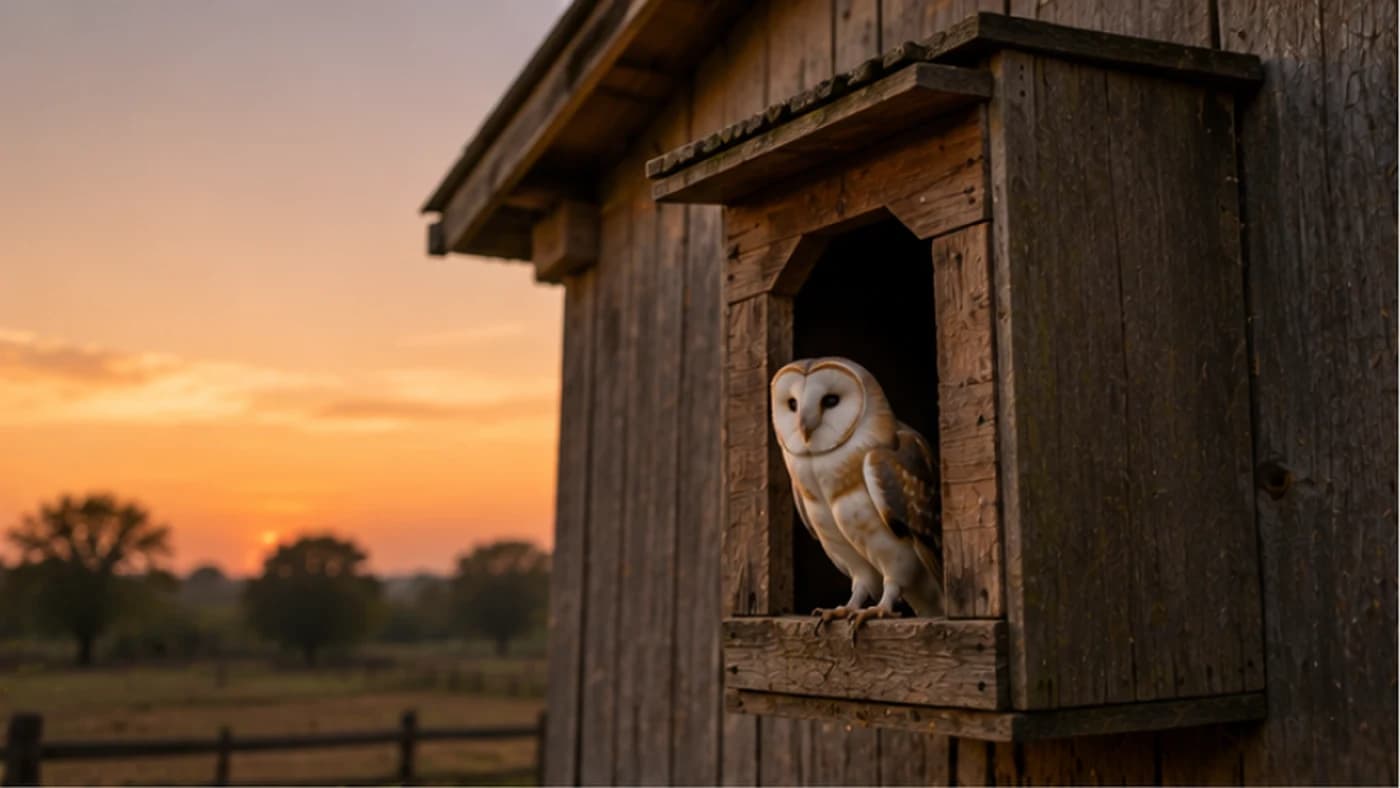
How to Attract Barn Owls to Your Farm for Free Rodent Control
One pair of barn owls can hunt over a thousand rodents in a single season — but only if you give them a properly designed, dark, predator-proof box. Barn owls (Tyto alba) already live across most of India; here's how to bring them onto your farm.