

Banana Cultivation with Tissue Culture Planting Material: A Complete Guide
Tissue-culture banana plants cost more upfront than suckers — but disease-free starts, uniform bunches and a real yield jump usually make the difference back many times over.
Quick answer
Tissue-culture banana costs more to start, but it buys you the one thing a sucker can never guarantee: a genuinely clean, disease-free plant with predictable, uniform growth. Combine that clean start with correct spacing, disciplined drip irrigation and fertigation, real vigilance against Panama wilt, sensible bunch management, and harvesting at the right stage of finger fullness rather than by the calendar — and a banana plot moves from a gamble on what the mother plant might have been carrying to a genuinely manageable, plannable crop.
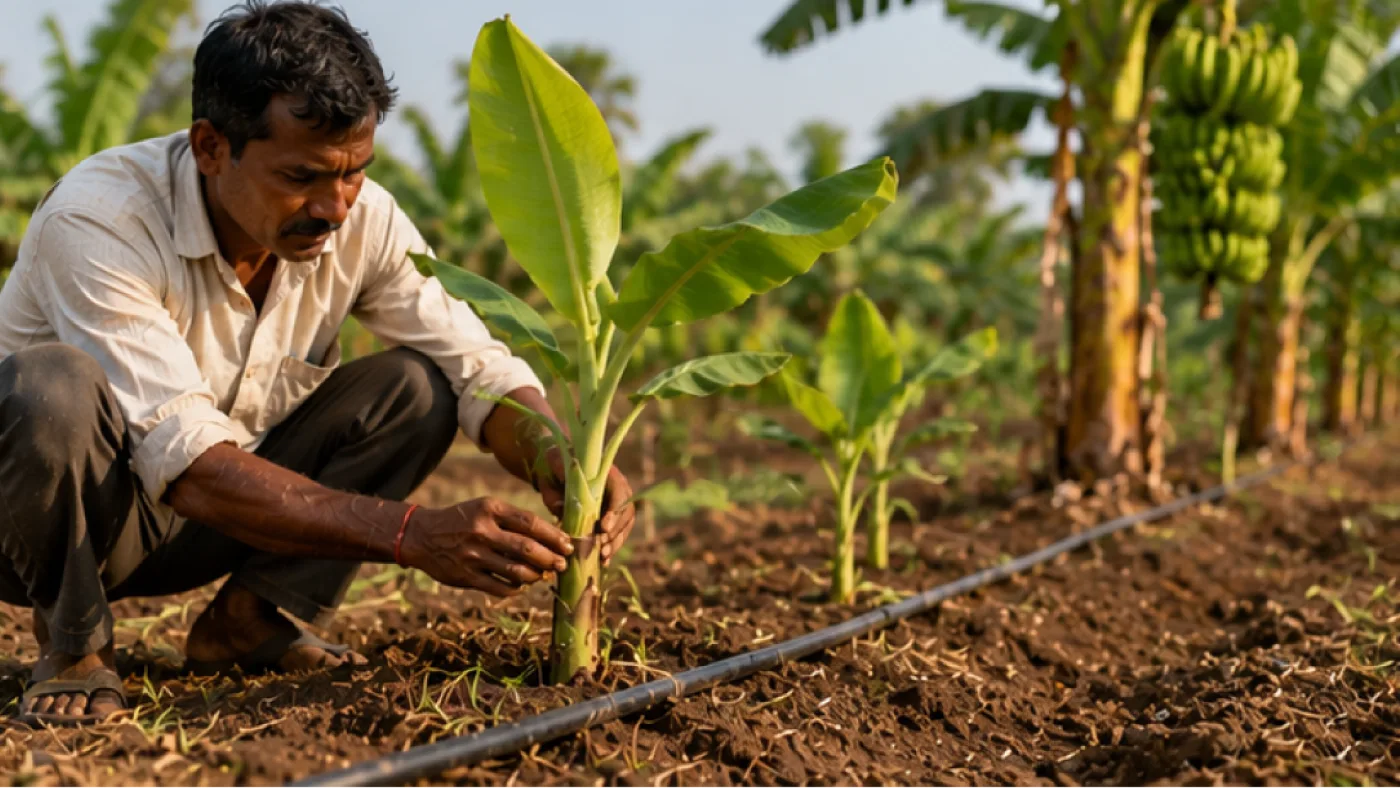
Banana has always been grown from suckers cut off the mother plant, and that habit is exactly why disease and uneven growth have followed the crop from field to field for generations. Tissue-culture planting material — young plants grown in a lab from disease-screened mother stock — breaks that cycle. It costs more per plant than a free sucker from your own field, but a uniform, disease-free start changes almost everything downstream: harvest timing, bunch size, and how much of your crop actually survives to be sold.
Why tissue culture beats a sucker, plant for plant
A sucker carries whatever the mother plant was carrying — including soil-borne diseases like Panama wilt and viruses that show no obvious symptom until the plant is already established in your field. Tissue-culture plants are propagated from screened, disease-indexed mother stock in sterile lab conditions, so you start with a genuinely clean plant rather than an unknown one.
The practical payoff shows up as uniformity: tissue-culture plants flower and mature together far more tightly than a field of sucker-grown plants of mixed vigour and age, which means your whole plot comes ready for harvest in a narrower window — easier to manage, easier to sell as one coordinated lot, and it lets you plan labour and transport around a predictable date rather than a long, staggered harvest. Yield potential is also generally higher because the plants aren't carrying a hidden disease load from day one.
The tradeoff is cost: tissue-culture plantlets cost meaningfully more per plant than a sucker dug from your own field, and there's a nursery-hardening period before they're ready to plant out. For most commercial banana growers, the combination of disease freedom, uniform harvest and higher yield more than pays back that upfront cost over a single crop cycle.
Spacing that gives the plant room to fill a big bunch
Banana is planted at roughly 1.5-1.8 metres between plants depending on the variety and the density system you're following — closer spacing within that range for smaller-statured varieties and high-density systems, wider for tall, vigorous varieties that need more room to avoid crowding and competition for light and nutrients. Whatever spacing you choose, keep it consistent across the plot; uneven spacing is one of the easiest ways to end up with a mix of overcrowded and under-utilised patches in the same field.
Irrigation: banana is thirsty, and fertigation pays off
Banana has a large leaf area and a shallow root system, and it draws heavily on soil moisture throughout its growth cycle — water stress at the wrong stage directly shrinks bunch size and finger fill. Drip irrigation with fertigation (feeding dissolved fertiliser through the same drip system) is widely used in commercial banana cultivation because it delivers both water and nutrients directly to the root zone in small, frequent doses, matching the crop's actual daily demand far more closely than periodic flood irrigation and heavy fertiliser dumps.
Fertigation also lets you adjust the nutrient mix as the crop moves through its growth stages, rather than applying the same blanket dose throughout — a real efficiency gain on both water and fertiliser cost for a crop that needs a lot of both.
Panama wilt: the disease that can end a banana plot
Panama wilt is caused by a soil-borne Fusarium fungus — the same fungal genus behind Fusarium wilt in cotton and tomato, which our full disease identification guide already covers in detail. In banana, it blocks the plant's water-conducting tissue, causing older leaves to yellow and wilt progressively upward, and eventually collapse of the whole plant, often with a visible split at the base of the pseudostem.
There is no cure once soil is infected, and the fungus can persist in field soil for years, which is exactly why prevention matters so much more than treatment here: plant only disease-indexed, clean tissue-culture material (this is one of the strongest arguments for tissue culture over suckers, since a sucker from an infected mother plant can carry the fungus straight into a new field), choose resistant or tolerant varieties where they're available for your growing region, and avoid moving soil, irrigation water, or tools from a suspected-infected plot into a clean one. If you spot the disease, remove and destroy affected plants rather than leaving them as a source of ongoing infection.
Bunch management: getting more out of the bunch you already have
Removing excess suckers around the base of a fruiting plant — keeping only one or two well-timed followers for the next cycle — focuses the plant's energy into the current bunch rather than splitting it across competing growth, and it's one of the simplest, lowest-cost ways to lift bunch size.
Propping mature, heavily-loaded bunches with a bamboo or wooden support is standard practice once the bunch reaches real weight, since a top-heavy plant can lodge (fall over) in wind or simply under its own weight, losing the entire bunch. Bagging the developing bunch (commonly with a perforated polythene sleeve) protects the fruit from sunscald, wind-scarring, birds, and some insect damage, and can visibly improve the finish quality of the fruit that reaches market.
Reading harvest maturity correctly
Banana is harvested green — full but not ripe — since ripening happens after cutting, during transport and storage, not on the plant. The key sign to look for is fullness and angularity of the individual fingers: as the fruit matures, the sharp angular edges of an unripe finger start to round out and fill in, and the fingers themselves plump up. Harvesting too early gives thin, poorly-filled fruit that ripens with poor quality and flavour; harvesting too late risks the fruit starting to ripen on the plant itself, which shortens its shelf life and transport window badly.
Terms explained in this guide
Frequently asked
Why is tissue culture better than suckers for banana planting?+
Tissue-culture plants come from disease-screened mother stock grown in sterile lab conditions, so they start genuinely disease-free, while a sucker can silently carry soil-borne disease or viruses from its mother plant. Tissue-culture plots also flower and mature more uniformly, making harvest easier to plan.
What spacing should I use for banana?+
Roughly 1.5-1.8 metres between plants, with the exact figure depending on your variety and density system — closer for smaller varieties and high-density planting, wider for tall, vigorous ones.
What is Panama wilt and can it be cured?+
Panama wilt is a soil-borne Fusarium fungal disease (the same fungal genus behind Fusarium wilt in cotton and tomato) that blocks the plant's water-conducting tissue and eventually kills it. There is no cure once soil is infected — prevention through clean tissue-culture planting material, resistant varieties, and avoiding moving soil or water from infected plots is the only real defence.
Why should I bag banana bunches?+
Bagging protects the developing bunch from sunscald, wind damage, birds and some insects, and generally improves the finish quality of fruit reaching market — it's a low-cost step with a real payoff in fruit appearance.
How do I know when to harvest bananas?+
Look at the fingers rather than the calendar: as fruit matures, the sharp angular edges of unripe fingers round out and fill in. Banana is always harvested green, since ripening happens after cutting during transport and storage, not on the plant.
Where to go next
Want this as daily tasks for your farm?
Khetiyaar turns guides like this into a day-by-day plan — in your language, free to start.

Related guides
Drip Irrigation: Save Water and Increase Yield
Drip delivers water directly to the roots, drop by drop — saving a large share of your water while lifting yield and cutting weeds.
How to Build a Banana Circle: Turn Kitchen Greywater into a Banana Harvest
A banana circle captures your kitchen and bathroom greywater, composts organic waste, and grows a steady harvest of bananas — all in one self-managing pit-and-mound system that suits most of India's climate.
Cumin Farming: Growing Jeera When the Weather Decides Everything
Cumin is among the highest-value crops a Gujarat farmer can grow and among the easiest to lose. Two cloudy weeks at flowering can take the whole field. Here is how to give it the best odds.