

Why Soil Testing Is Important: The Smartest Decision a Farmer Can Make
Soil quietly sets the ceiling on your yield every season. Testing it is one of the cheapest decisions on the farm — and one of the highest-returning.
Quick answer
Soil testing is not an extra cost — it is the decision that makes every other input work harder. It stops you wasting money on the wrong fertiliser, uncovers hidden problems like wrong pH and micronutrient shortages, lifts and steadies your yield, protects your soil and your water for the future, and helps you choose the right crop. For a small amount of time and money, no other single habit gives an Indian farmer a bigger, more reliable return. Test your soil, farm with facts, and let your land tell you exactly what it needs.
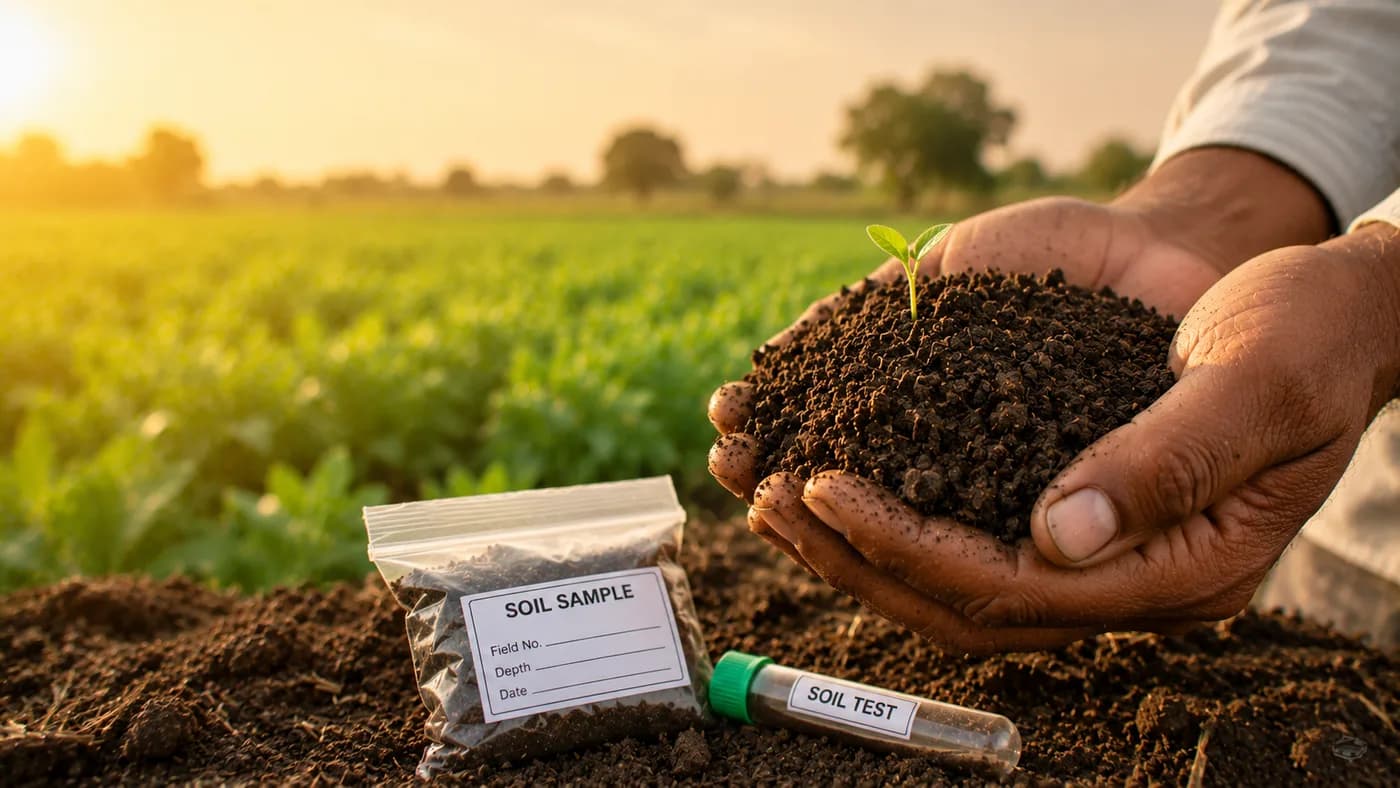
Ask most farmers what their crop needs and they will talk about seed, water and fertiliser. Very few will mention the one thing that decides how well all of those work — the soil beneath their feet. Soil is not just something to hold the plant up. It is a living store of nutrients, water and microbes, and its condition quietly sets the ceiling on your yield every single season. Soil testing is simply the act of finding out what your soil actually contains, so you can farm with facts instead of guesswork. It is one of the cheapest decisions on the farm, and one of the highest-returning.
1. It stops you wasting money on the wrong fertiliser
Fertiliser is one of the biggest expenses a farmer faces, and much of that money is often wasted. When you apply fertiliser without testing, you are guessing. You might be adding a nutrient your soil already has plenty of, while the one that is actually holding back your crop stays missing. That is money spent for no benefit — and sometimes for harm.
A soil test tells you exactly which nutrients are short and which are already sufficient. Instead of buying a standard mix every year out of habit, you buy only what your field needs. Many farmers discover they have been over-applying one nutrient for years while their real limiting factor was something else entirely. Correcting this single mistake often pays for the test many times over in the very first season.
2. It reveals hidden problems that silently cap your yield
Some soil problems are invisible until you test for them. The most important is pH — whether your soil is too acidic or too alkaline. pH controls how well plants can absorb nutrients from the soil. If your pH is wrong, your crop cannot take up nutrients properly even when they are present. You can pour on fertiliser and still see a weak crop, because the plant simply cannot reach the food.
A soil test also uncovers micronutrient deficiencies — small amounts of nutrients like zinc, iron or sulphur that, when missing, cause big drops in yield and quality. These shortages rarely show obvious symptoms early on; the crop just quietly underperforms. Testing brings these hidden problems into the open so you can fix them before they cost you a harvest.
3. It raises your yield — and makes it more consistent
When you feed your soil exactly what it needs and correct its hidden problems, the crop responds. Roots grow stronger, nutrients are absorbed efficiently, and the plant reaches its full potential. The result is not just a higher yield in a good year, but a more consistent yield year after year, because you are managing the soil deliberately rather than hoping for the best.
Consistency matters as much as the peak. A farmer who knows and manages their soil suffers fewer surprise failures and can plan their income with more confidence.
4. It protects your soil for the future
Over-fertilising does not just waste money — it slowly damages the soil itself. Excess chemical fertiliser, applied year after year without balance, can harden the soil, disturb its natural chemistry, and harm the earthworms and microbes that keep it alive and fertile. A degraded soil needs more and more inputs to produce less and less. This is a trap many farms fall into without realising it.
Soil testing breaks this cycle. By showing you what to apply and, just as importantly, what not to apply, it helps you keep your soil balanced and alive. Testing every few years lets you track whether your soil's organic matter and fertility are improving or declining, so you can act before small problems become permanent damage. Your soil is an asset you pass to the next crop and the next generation — testing helps you protect its value.
5. It protects water and the environment
Fertiliser that a crop cannot use does not simply disappear. It washes away with rain and irrigation into ponds, rivers and groundwater, polluting the very water your family and village depend on. Excess nitrogen in particular is a well-known cause of water pollution.
By applying only what the soil and crop need, soil testing dramatically reduces this runoff. You spend less, the crop gets what it needs, and the surrounding water and land stay cleaner. Responsible input use is good for your pocket and good for your community.
6. It helps you choose the right crop for your land
Not every soil suits every crop. Some crops thrive in light sandy soils, others in heavy clays; some tolerate salinity or a particular pH, others do not. When you know your soil's type, pH and nutrient status, you can choose crops that are naturally suited to your land — crops that will grow well with less struggle and lower input cost.
This turns your soil from an unknown into a guide. Instead of forcing a crop that fights your soil all season, you grow what your land wants to grow, and everything becomes easier.
7. It lets you make the most of government support
In India, the government's Soil Health Card scheme offers farmers free or low-cost soil testing along with tailored fertiliser recommendations. Many farmers never claim this benefit simply because they do not act on it. By getting your soil tested and using the recommendations, you turn a free government service into real savings and better yields — support that is already there for the taking.
The real cost of skipping the test
Consider two farmers with the same land and the same crop. One guesses at fertiliser and applies the usual dose. The other spends a small amount and a little time to test the soil, then applies exactly what is needed. Over a single season, the second farmer often spends less on fertiliser, harvests more, and keeps his soil healthier for next year. Over five or ten years, that gap compounds into a very large difference in income and in the value of the land itself.
Skipping the test feels like saving money and time. In reality, it is one of the most expensive habits in farming — you simply never see the bill, because it comes as wasted inputs and lost yield rather than a receipt.
How to get started
Getting a soil test is simple. Walk a zig-zag path across your field and collect small samples of soil to root depth from eight to ten spots. Mix them together, remove stones and roots, take about half a kilogram, label it, and send it to a soil-testing lab or use the government Soil Health Card service. In return you get a report of your soil's pH, nutrient levels and organic carbon, along with recommendations. Test every two to three years, or sooner if your yields fall or you change crops, and always test before a major fertiliser decision.
Terms explained in this guide
Frequently asked
Why is soil testing important for farmers?+
Because it tells you exactly what your soil has and lacks, so you stop wasting money on unnecessary fertiliser, fix hidden problems like wrong pH, grow a higher and more consistent yield, and protect your soil's long-term health.
How often should I test my soil?+
Every two to three years is a good rule, or sooner if your yields start dropping, you notice unusual crop problems, or you plan to switch to a very different crop. Always test before making a big fertiliser decision.
What does a soil test measure?+
Typically the soil's pH, its levels of the main nutrients (nitrogen, phosphorus and potassium), its organic carbon, and often key micronutrients such as zinc and sulphur.
Does soil testing really save money?+
Yes. By showing you exactly what to apply — and what to skip — it prevents you from buying fertiliser your soil does not need, which often saves more than the test costs in the very first season.
Can I get my soil tested for free in India?+
The government's Soil Health Card scheme provides free or low-cost soil testing and fertiliser recommendations for farmers. Ask at your local agriculture office about the current process in your area.
Where to go next
- Agri Bazar marketplaceBuy and sell animals, crops, equipment and dairy near you — and see what buyers want today.
- Farming cost & profit calculatorWork out cost per acre, break-even yield and expected profit before you sow.
- Kheti app for Indian farmersCrop plans, disease diagnosis, weather and mandi rates in one app.
Want this as daily tasks for your farm?
Khetiyaar turns guides like this into a day-by-day plan — in your language, free to start.

Related guides
Soil Testing for Farmers: Why It Matters and How to Do It
Guessing fertiliser doses wastes a large part of one of your biggest costs. A soil test tells you exactly what your land has and what it lacks.
Nano Urea: What It Is, What the Evidence Says, and How to Test It Yourself
Nano urea is promoted hard and criticised hard, and both sides quote studies. Here is what it actually is, why a bottle cannot replace a bag, and how to run a fair test on your own field instead of trusting either camp.
How to Read Your Soil Health Card: All 12 Parameters Explained in Plain Language
Most farmers receive a soil health card, glance at it, and file it away. It is the cheapest agronomic advice you will ever get — twelve numbers that tell you exactly what your land is short of and what you are wasting money on. Here is how to read every one.