

Onion Storage and Price Volatility: A Farmer's Guide to Selling Smarter
Onion prices swing harder than almost any other crop in Indian markets — good curing and storage is often worth more to your final income than the harvest itself.
Quick answer
Onion doesn't reward hurried selling. A crop cured properly in the field with a fully dried, closed neck, then stored in a well-ventilated structure that keeps air moving and bulbs off damp ground, can often be held past the harvest-glut crash into a materially better price window later in the season. Understand the seasonal pattern, get the curing and storage basics right, and check current official sources rather than old numbers when government market-intervention news comes up — and the same harvest can be worth noticeably more in your pocket.
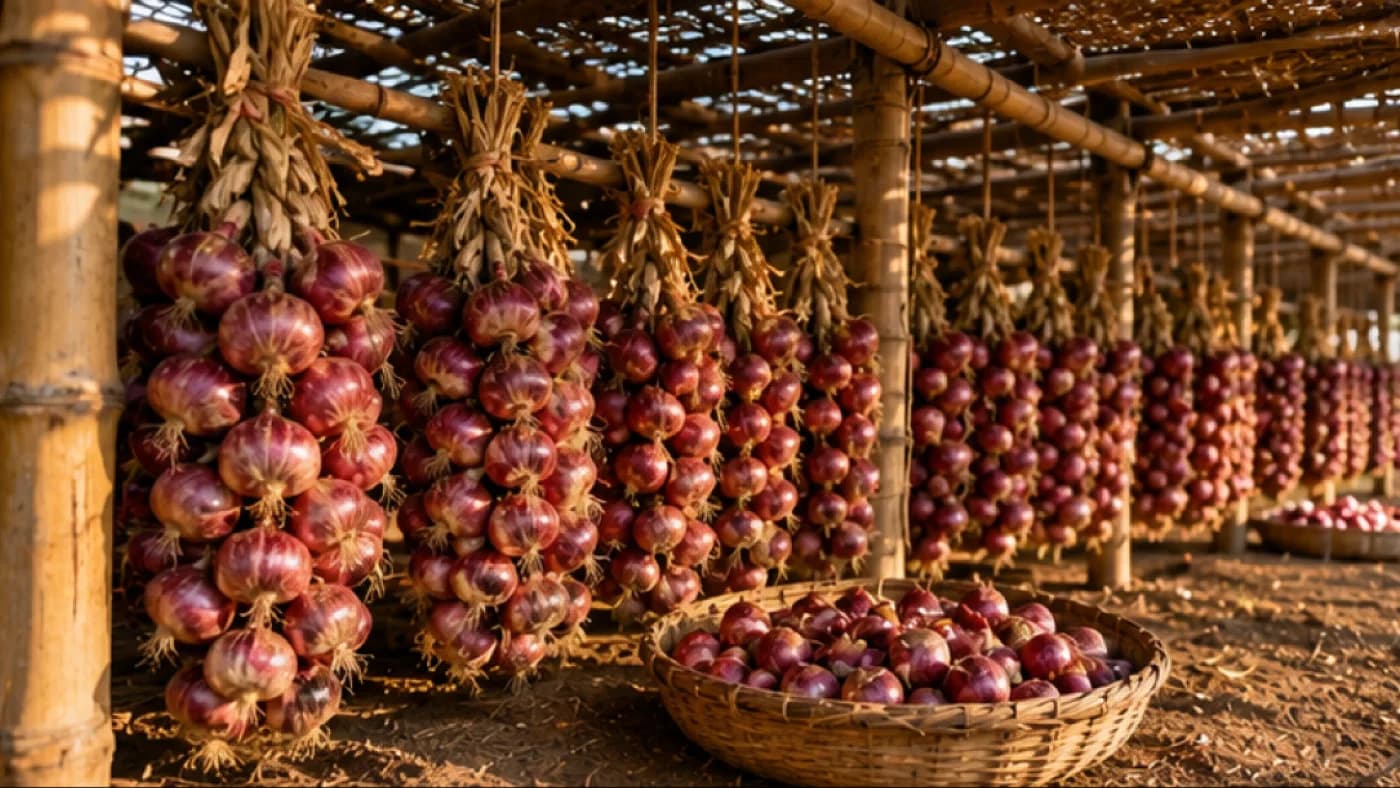
Few crops swing in price the way onion does — a glut at harvest can crash the mandi rate to almost nothing within weeks, while the same crop held a few months later can sell for several times more. This isn't random: it follows a fairly predictable seasonal pattern tied to harvest timing across regions. A farmer who understands that pattern, and who cures and stores the crop well enough to actually wait for a better window, often earns far more from the same harvest than one who sells everything at the peak-glut price right out of the field.
Why onion prices spike and crash the way they do
India harvests onion in overlapping seasonal waves across different regions, and when a major growing region's harvest hits the market all at once, supply floods in faster than demand can absorb it, pushing the price down sharply — sometimes below the cost of cultivation. As that glut clears and stored supply from earlier harvests runs down, prices recover and often climb well above the harvest-time low, especially in the months before the next season's crop arrives.
This pattern repeats every year with variations in timing and severity depending on weather, area sown, and how well earlier-season stored stock holds up. The core lesson for a grower is that the price you're offered on harvest day is very often the worst price of the year, not a fair reflection of the crop's value — and storage is the tool that lets you sell into a later, better window instead of being forced to sell at the worst one.
Field curing and neck-drying: the step that determines whether storage will even work
Storage life is decided in the field, before the bulb ever reaches a storage structure. After the tops naturally fall over (a sign of maturity), onions need a curing period in the field or in a shaded, ventilated area — several days to a couple of weeks depending on weather — during which the outer skin dries and toughens and the neck (the point where the leaves meet the bulb) dries down and closes.
A properly dried, closed neck is the bulb's natural seal against moisture loss and rot-causing organisms entering through that opening; a bulb cured and stored with a wet, open neck is one of the most common and avoidable causes of storage rot. Curing in dry weather with good airflow, and avoiding curing during or right after rain, meaningfully improves storage outcomes.
Ventilated storage: keeping air moving matters more than keeping it cool
Unlike potato, onion generally stores best in a cool, dry, well-ventilated environment rather than a sealed cold room — trapped humidity and stagnant air are the enemy, since they encourage sprouting, rot, and mould far more than moderate temperature alone. Good airflow through and around the stored bulbs, achieved through structural design rather than any mechanical cooling, is the single biggest factor in successful onion storage for most farmers.
Traditional raised-platform storage (bulbs stored above ground level on a slatted bamboo or wooden platform, keeping them off damp soil and allowing air to circulate from below) and simple ventilated storage sheds (with slatted or mesh walls that let air pass through while keeping out rain and direct sun) are widely used, low-cost structures that achieve this without any mechanical equipment. Whatever structure you use, avoid storing onion in tightly sealed sacks or airtight containers, and avoid direct contact with the ground.
Government buffer stock and market intervention: what to know, hedged
Because onion price swings can become severe enough to hurt both farmers and consumers in different years, government agencies have at various times maintained buffer stocks and used market interventions (like export restrictions or releasing buffer stock to cool consumer prices) to try to moderate the swings. Exactly which measures are active, their scale, and their timing change from year to year and season to season based on the specific market conditions of that year — this is genuinely not something that stays fixed, so treat any specific figure or policy you've heard about as needing a fresh check against current official announcements before you rely on it for a selling decision, rather than as a permanent fact about how the onion market works.
What is reliably true across years is the underlying pattern this article describes: seasonal glut-and-recovery pricing, and the real value of curing and storing well enough to have the choice of when to sell, rather than being forced to sell at harvest.
Terms explained in this guide
Frequently asked
Why do onion prices crash right after harvest?+
When a major growing region's harvest hits the market all at once, supply floods in faster than demand can absorb it, pushing prices down sharply — often below the cost of cultivation. Prices typically recover as the glut clears and earlier stored stock runs down.
What is neck-drying and why does it matter for onion storage?+
After the tops fall over, the neck (where leaves meet the bulb) needs to dry down and close during curing. A properly closed neck seals out moisture and rot-causing organisms; a wet, open neck is one of the most common causes of storage rot.
Should onion be stored in a cold room like potato?+
No — onion generally stores best in a cool, dry, well-ventilated space rather than a sealed cold room. Trapped humidity and stagnant air cause sprouting, rot and mould far more than moderate temperature alone, so good airflow matters more than cooling.
What is traditional raised-platform onion storage?+
Bulbs are stored above ground level on a slatted bamboo or wooden platform, keeping them off damp soil and letting air circulate from below — a low-cost, widely used method that doesn't need any mechanical equipment.
Are government onion buffer stocks and export rules something I can rely on for selling decisions?+
Treat these as changing year to year and season to season based on current market conditions — check current official announcements before relying on any specific figure or rule you've heard about, rather than assuming past policy still applies.
Where to go next
- Today's mandi bhavOfficial AGMARKNET rates for your crop, nearby mandis compared, and the net price after travel.
- Farming cost & profit calculatorWork out cost per acre, break-even yield and expected profit before you sow.
- Agri Bazar marketplaceBuy and sell animals, crops, equipment and dairy near you — and see what buyers want today.
Want this as daily tasks for your farm?
Khetiyaar turns guides like this into a day-by-day plan — in your language, free to start.

Related guides

How to Sell Your Farm Produce and Get a Better Price
The difference between a good year and a poor one is often not how much you grow, but the price you get. Selling smarter adds more than any input.

How to Check Mandi Bhav Online: The AGMARKNET Guide (and How to Read the Numbers)
Official mandi prices are free and public, published daily from APMC markets across India. Most farmers either never look, or look at the wrong number. Here is where the data comes from, how to read min, max and modal price, and why the highest figure is usually a trap.

Monsoon Farming Tips: Protect Your Crops in the Rainy Season
The same rain that grows the Kharif crop also brings waterlogging, disease and losses. A little preparation protects your season and your income.