

Keyline Design: Turn Every Monsoon Flood into Stored Water
Keyline design reshapes how water moves across sloped land — pulling it out of waterlogged valleys and spreading it onto thirsty ridges. It builds topsoil, drought-proofs pasture, and softens flash floods.
Quick answer
Keyline design is really a mindset: stop treating your slope as an obstacle and start reading it as a map for where water wants to go. Find your Keypoint, cultivate along a gentle line running from valley to ridge, deep-rip a little further each year, and over a few seasons you'll have thirstier ridges turning green, a wetter valley turning firm, and topsoil building faster than conventional farming alone ever manages.
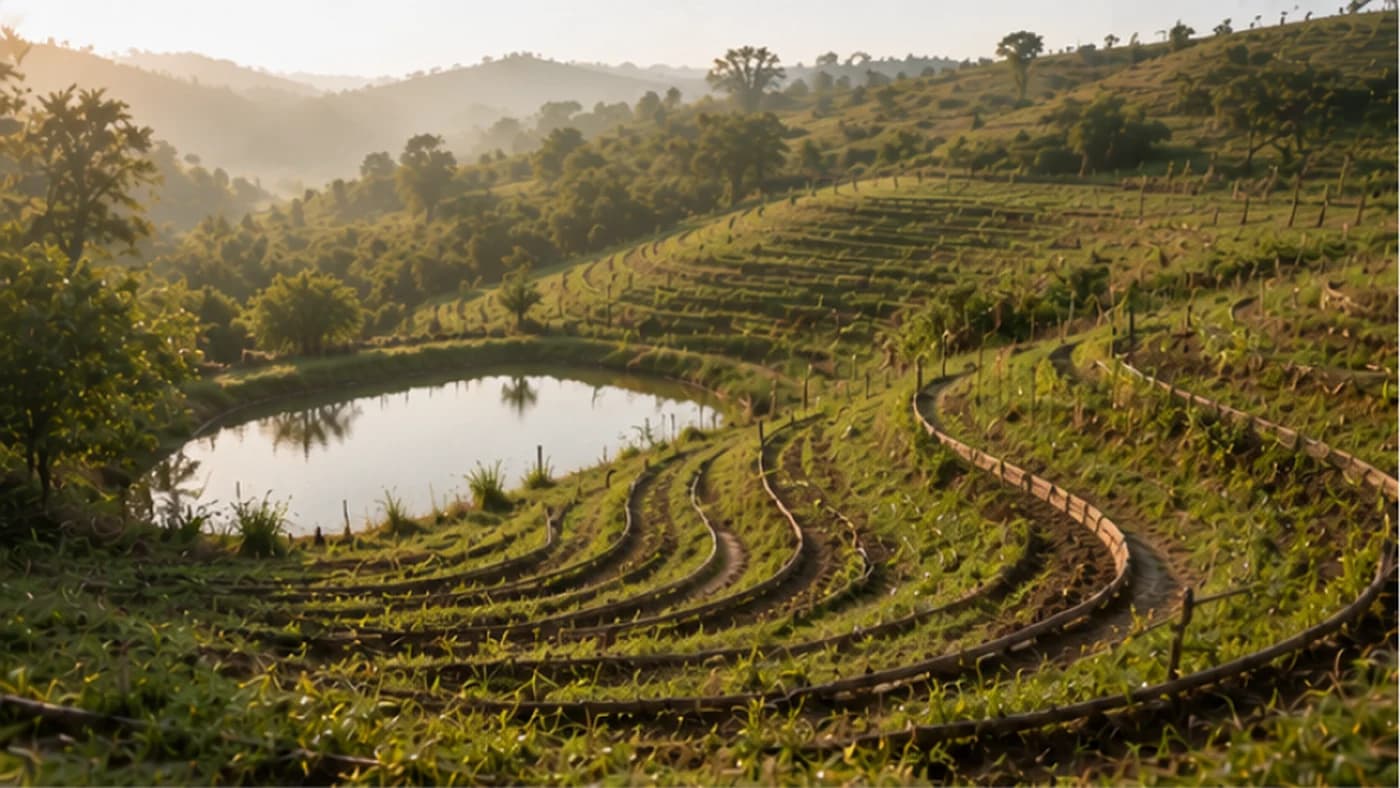
On sloped land, rain almost always does the same thing: it rushes down the fastest path, waterlogging the valley bottom while the ridges stay bone-dry, taking topsoil with it the whole way down. Keyline design, developed in the 1950s by Australian farmer and mining engineer P.A. Yeomans, is a way of reading that slope and working with it — moving water gently from where it naturally pools to where it's naturally scarce, instead of letting it either flood or vanish. It's essentially a more precise, whole-farm version of the contour bunding many Indian farmers already know, aimed at building topsoil and drought resistance rather than just stopping erosion after the fact.
Finding your Keypoint
Every valley on a slope has a point where the land changes from steep and narrow (higher up) to flatter and wider (lower down) — this is the Keypoint, and it's often easy to spot right after rain, because it's where water stops rushing and starts to pool or soak in. A Keyline is a line drawn through this Keypoint, but unlike a normal contour line (which stays perfectly level), a Keyline has a very slight fall — around 1% — as it moves away from the valley centre toward the ridges. That tiny slope is what lets it act like a slow, gentle channel, nudging water sideways out of the wet valley and spreading it across the drier ridge shoulders instead of letting it run straight downhill.
How the water actually gets moved
Homesteaders implement this with a subsoiler or a specialised deep ripper (the original Yeomans plow), which doesn't flip the soil over like a normal plough — it rips narrow channels deep into the subsoil, opening a path for water and air to get through compacted, hardpan layers. You deep-rip gradually deeper over several years, letting roots follow the new moisture down and slowly turning dead subsoil into living, carbon-rich topsoil. The practical steps: map your land's contours (a laser level, dumpy level, or even a simple A-frame level will do); walk your primary valleys after a rain and find where the slope changes — your Keypoint; peg a line running from that Keypoint out toward the ridges; then cultivate parallel to that Keyline (in the valley, work parallel to the line below it; on the ridge, parallel to the line above it) with your subsoiler, breaking the hardpan without inverting the soil.
What you actually gain
The most immediate benefit is drought-proofing: soil managed this way holds far more water, and for every 1% increase in soil organic matter, land can hold roughly 75,000-95,000 extra litres of water per acre. Topsoil builds far faster than through conventional farming alone — Yeomans demonstrated several centimetres of new fertile soil within a few seasons when Keyline water management was combined with planned grazing or cover cropping, because deep-ripping lets oxygen reach the microbes that turn organic matter into humus. It also softens flash floods: the ripped channels slow water down and force it along a longer, gentler path across the ridges rather than tearing straight through the bottomland, protecting downstream fields and infrastructure.
Mistakes to avoid
The single biggest beginner mistake is misreading the Keypoint — get it wrong and you can concentrate water into a sensitive spot and cause more erosion than you started with, so spend at least one full monsoon watching how water actually moves across your land before committing to permanent earthworks. Equipment is a real constraint: a genuine Yeomans-style deep ripper needs a tractor with real horsepower, and a light garden tiller simply won't break a hardpan. And in areas of very high rainfall with heavy clay, pushing too much water onto the ridges can destabilise the slope, so always design in a safe overflow point where excess water can escape into a stable, vegetated drain once the soil is saturated.
Where it works — and where contour bunding or a pond is simpler
Keyline design needs real slope and defined valleys and ridges to work with; on flat land, there's no geometry to exploit, and swales, raised beds or laser-levelled irrigation will serve you better. In very sandy soil, water may drain straight down before it has a chance to move sideways at all, so building organic matter first (via mulching and cover crops) matters more than plowing patterns. And while the principle scales down to a 2-hectare farm, Yeomans designed it for broadacre stations of hundreds of hectares — on a very small plot, the machinery, turning radius and mapping effort can feel like overkill compared to simple contour bunds or a farm pond. Compared to a standard contour swale (visible mounds and ditches, best for orchards and food forests, needs occasional desilting), Keyline ripping is invisible underground work best suited to pasture, fodder and larger orchard blocks, and needs re-ripping every few years rather than being a one-time structure.
Practical tips
Start with one valley rather than mapping the whole farm at once — pick the spot where erosion is most visible and mark your Keypoint and first lines with simple stakes. Time your ripping carefully: the soil should be moist but not wet, since ripping when too dry won't shatter the hardpan, and ripping when too wet smears the clay into a seal that blocks water instead of opening it — a rough test is that if you can roll the soil into a ribbon that doesn't crack, it's still too wet. Bring livestock onto freshly ripped ground soon after, since their manure and hoof action helps drive organic matter down into the new fissures. And watch for naturally wet-loving plants (like reeds or water-loving grasses) growing in odd spots on a slope — they often mark a hidden seep or the true location of a Keypoint.
The order that decisions should follow
Yeomans laid out a 'Scale of Permanence' — a list of eight things to plan in order from hardest-to-change to easiest, so your most expensive, most permanent decisions never end up fighting the water. In order: climate, landform, water, roads, trees, buildings, fences, and finally soil — soil sits at the bottom because it is the most dynamic and the easiest to fix once water and roads are correctly placed. In practice this means: work out how water naturally wants to move across your land before you decide where to put a road, a shed, or an orchard, so that everything downstream of that decision cooperates with the water instead of blocking it.
A realistic example
Picture a 4-hectare sloped farm with a central valley that stays waterlogged well past the monsoon, and two ridges that turn bone-dry by mid-summer. The farmer finds the Keypoint halfway down the valley, pegs a line on that slight fall, and rips parallel to it — 15 cm deep the first year, 25 cm the second, 35 cm by the third. By year three, the once-muddy valley centre is firm enough to walk on days after heavy rain, and the ridges stay green noticeably longer into the dry season than a neighbour's untouched land — without a single extra millimetre of rainfall. That newly hydrated ridge becomes the spot for a fruit orchard, with deep, well-aerated roots that shrug off the worst of the pre-monsoon heat.
Terms explained in this guide
Frequently asked
What is a Keypoint in Keyline design?+
The spot in a valley where the slope changes from steep and narrow above to flatter and wider below — usually visible right after rain as the point where water stops rushing and starts to pool or soak in.
Do I need a tractor for Keyline design?+
For genuine deep-ripping through a hardpan, yes — a proper subsoiler needs real horsepower. Lighter tillers can't break through compacted subsoil effectively.
Does Keyline design work on flat land?+
No — it depends on having real valleys and ridges to move water between. On flat land, swales, raised beds or laser-levelled irrigation are more appropriate.
How is Keyline design different from contour bunding?+
Contour bunding is usually visible earthwork focused on stopping runoff on one field. Keyline design is a whole-farm system that intentionally moves water sideways from valley to ridge using slightly off-level cultivation lines and deep subsoil ripping.
How long does it take to see results?+
Many farmers see the valley firming up and ridges holding moisture longer within 2-3 seasons of deep-ripping, with topsoil continuing to build over several years.
Where to go next
Want this as daily tasks for your farm?
Khetiyaar turns guides like this into a day-by-day plan — in your language, free to start.

Related guides
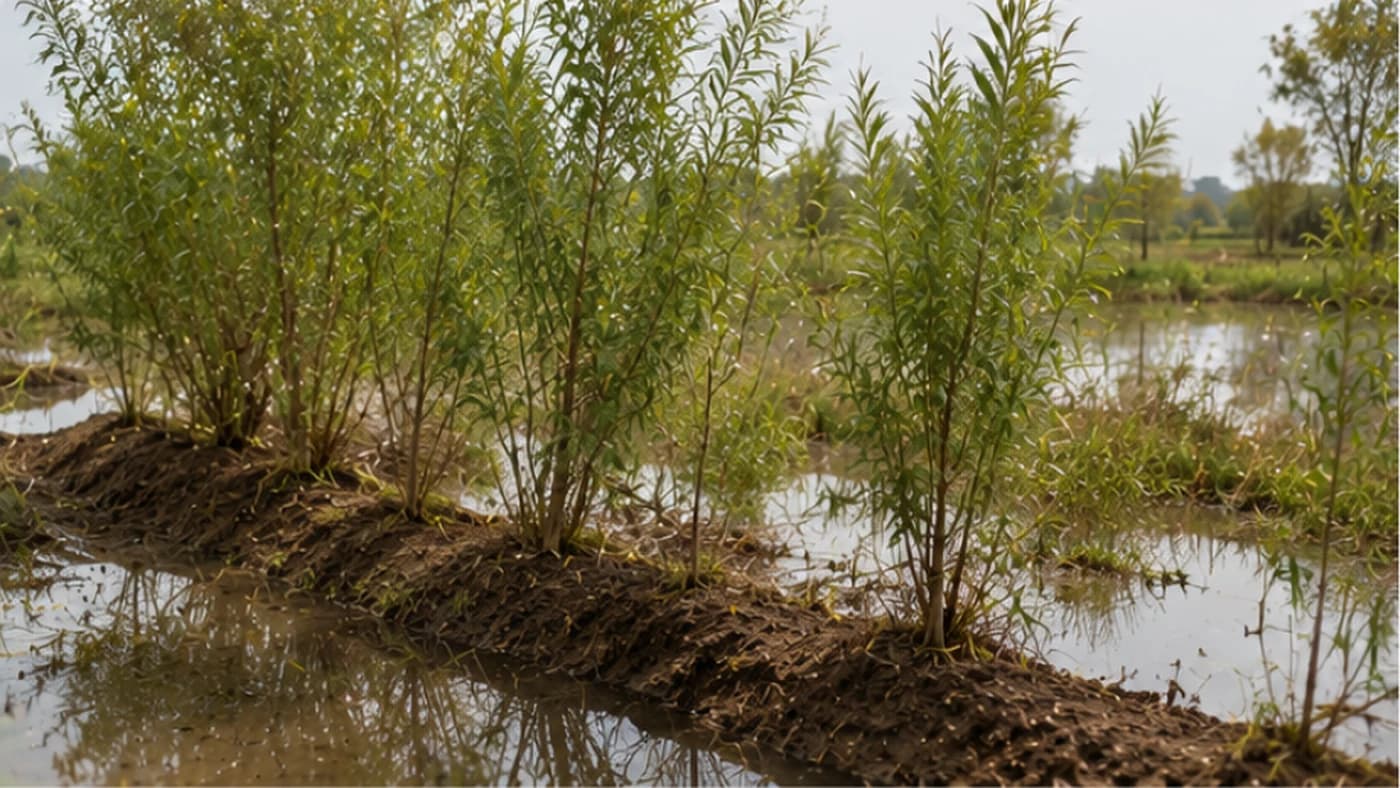
Biodrainage: Using Trees Instead of Pipes to Dry Out Waterlogged Land
Waterlogging quietly ruins more fields than most farmers realise — in canal command areas of Punjab and Haryana alone it affects lakhs of hectares. Trees that pump water out through their leaves can do the job of an expensive drainage system, for a fraction of the cost.
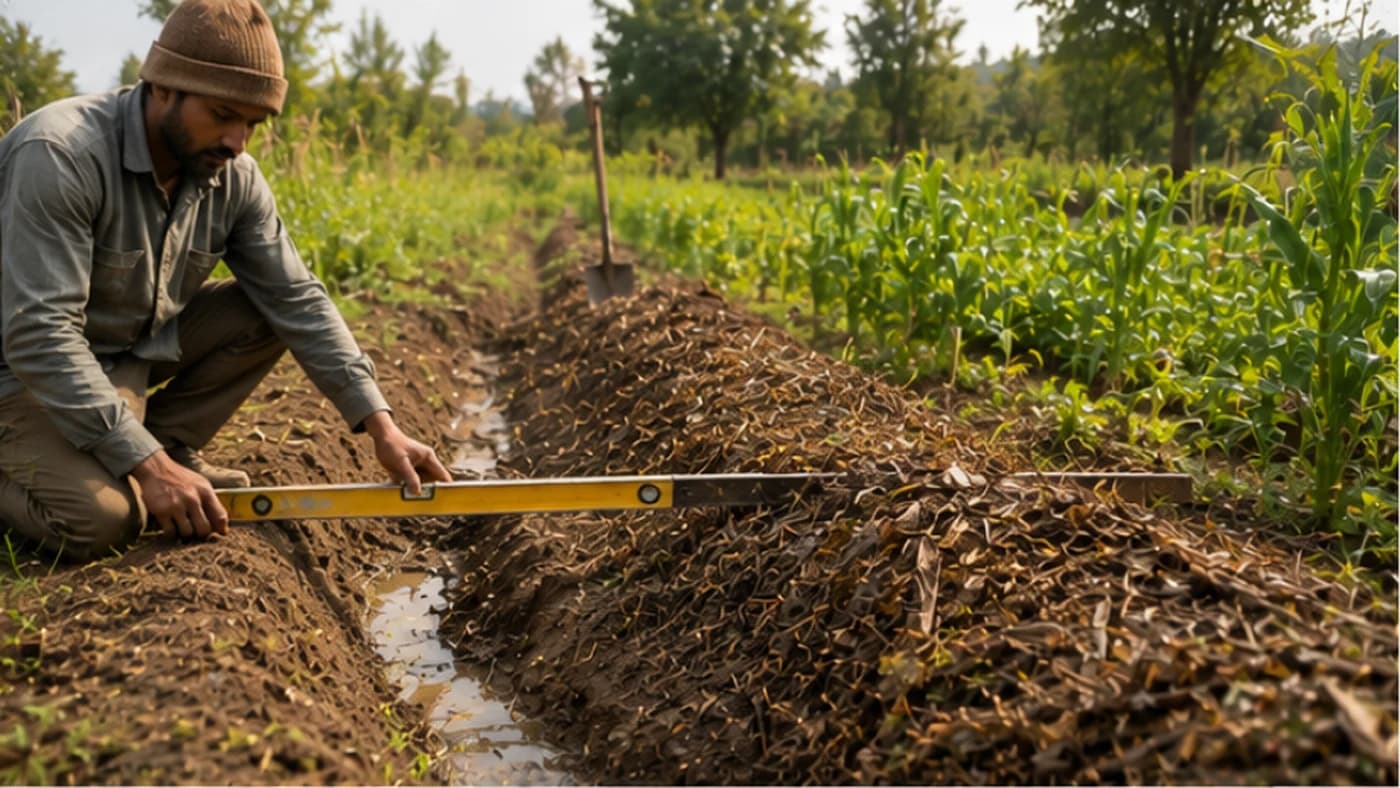
Permaculture Swale Design for Beginners: A Step-by-Step Build Guide
You don't need machinery or an engineering degree to build your first swale — just an A-frame level, a shovel, and patience. Here is the beginner's hands-on guide to laying out, digging and planting one correctly.
Gravity-Fed Water Systems: Reliable Water Supply Without a Pump
If your farm or hill homestead has any real slope, gravity can deliver pressurised water to your home, livestock trough, or field — with no electricity bill, no pump to fail, and no water stoppage the moment the power goes out.